 10kh Realomni Open
Free
10kh Realomni Open
Free
Dreamina is an AI visual creation platform launched by ByteDance. It supports multiple creative modes such as Vincent pictures, Vincent videos, and Picture videos, and is equipped with Agent mode to realize automated creation processes.
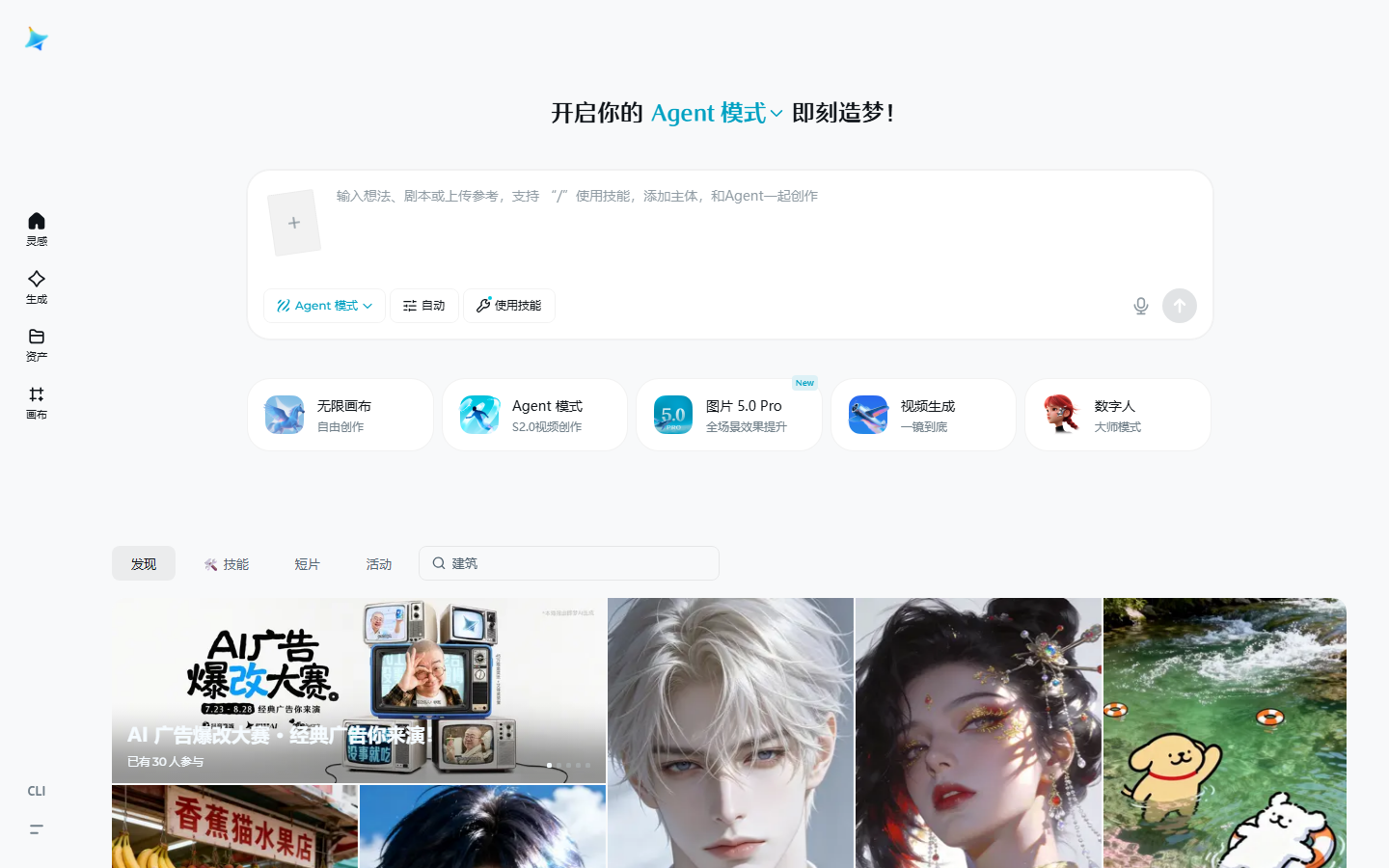
Realomni Open (10kh Realomni Open): In-depth evaluation of ByteDance AI visual creation platform
Core parameters and statistics
| Project | Specifications |
|---|---|
| Product Name | 10kh Realomni Open (Dream AI/Dreamina) |
| Category | AI Image and Design |
| Delivery form | Web / Android / iOS |
| Supported Platforms | Web, Android, iOS |
| Supported languages | Chinese, English |
| Target users | Individual creators, short video operations, e-commerce marketing |
| User scale | The first echelon of the same category in China (calculated based on community activity participation and ecological traffic) |
| Pricing model | Freemium (point consumption system, billing based on resolution and model grade tiers) |
In terms of platform coverage, Jimeng AI uses the Web as the main entrance, and the mobile terminal (Jimeng App) covers mobile creation scenarios. The user scale data is a reasonable deduction based on Douyin/Jiangying ecological traffic distribution capabilities and the popularity of community activities. There is no official public DAU/MAU data.
User and market recognition
- User base and customer acquisition advantages: Relying on the traffic distribution system of Douyin and Jianying, Jimeng AI’s customer acquisition cost is far lower than that of similar independent tools. The community section shows that the number of participants in popular creative activities ranges from hundreds to thousands, and the number of daily active users ranks first in the domestic AI visual creation category. This traffic advantage is a typical strategy of the ByteDance ecosystem - using a billion-level user pool to divert traffic to new products, and then converting free users into paying users through product power.
- B-side cooperation endorsement: Established AIGC technical cooperation with leading cultural events such as the 38th Popular Film Hundred Flowers Awards. Being able to pass the scene acceptance of professional film and television institutions shows that the quality of the pictures is not just "looks OK", but also can withstand the inspection of delivery standards. The value of this case is that it can be verified through public channels (official report of Hundred Flowers Awards) and can be used as a third-party qualification reference for corporate procurement.
- Niche Difference: Compared with domestic competing products such as Tongyi Wanxiang, Wenxin Yige, and Keling AI, the core difference of Dream AI is not in the model parameters themselves—but in the closed loop of "generate → edit → publish". The generated visual materials can be directly connected to the clip editing link, without the need to download and import them across applications. For creators within the Douyin ecosystem, this eliminates the hidden time loss caused by file format conversion, image quality compression, and waiting for transmission.
- Media Attention: The rapid iteration in the field of AI-generated videos and digital humans (Seedance, DreamActor series) has made it a frequently mentioned product in the domestic AI video track. However, compared with Midjourney’s international influence, Jimeng AI’s popularity in overseas markets is still limited.
Cost advantage (including quantitative deduction of cost reduction and efficiency improvement)
| Cost Dimension | Traditional Method | Use Jimeng AI |
|---|---|---|
| Single commercial picture production | ¥200-500 (shooting + post-production) | ¥0.3-8 (consumption based on points) |
| Single short video (30 seconds) production | ¥800-2,000 (shooting + editing + dubbing) | ¥4-20 (automatically generated in Agent mode) |
| Single task production cycle | 2-3 days | 10-30 minutes |
| Tool/license fee | Total monthly fee for multiple tools is ¥500-2,000 | Free daily allowance + pay as you go |
| Learning cost | High (requires mastering PS/AE/PR and other software) | Medium-low (Chinese interface + Agent automation) |
The above efficiency data are reasonable deductions based on product positioning and public pricing. The actual improvement rate varies depending on the industry, team proficiency and business process complexity. It is recommended to evaluate ROI after small-scale verification in your own scenario.
C-side (individual creator) quantitative deduction: A short video operator who produces an average of 30 pictures per day will spend about ¥270-720 per month using Jimeng AI. If you use Midjourney to achieve the same output, you need at least 2 accounts ($60≈¥430/month), and it does not have video generation capabilities. Jimeng AI covers both graphics and video lines within the same budget.
Enterprise Level Cost Considerations:
- API/batch access path is unknown - currently services are mainly provided through Web and App, and there is no public API package. Enterprise-level batch integration requires business docking. Three terms need to be confirmed before purchasing: (1) data isolation (whether the generated content will be used for model training); (2) content audit (whether the audit log can be exported); (3) SLA (service availability commitment).
- Budget trap for high-frequency scenarios: The point consumption of video generation is much higher than that of image generation (about 10-50 times). When planning budget, you need to first measure the single consumption with free quota and then enlarge the estimate.
Main functions
- Visun Picture (Picture 5.0 Pro): Enter a text description to generate an image, supporting three resolutions of 1K/2K/4K. The improvements of the 5.0 Pro model focus on commercial design texture, film and television-level light and shadow performance, and high-density graphics and text mixed scenes. It comes with post-editing capabilities such as smart scaling and local redrawing, allowing fine-tuning of local areas after generation. Applicable tasks: Product main image, social media cover, marketing poster. Use value: Reduce the visual solution generation cycle from "outsource and wait for 2 days" to "run by yourself in 10 minutes".
- Wensheng Video (Seedance 2.0 Series): Convert text or reference images into short videos. The flagship version of Seedance 2.0 outputs up to 720p; the lightweight version 2.0 mini has an inference speed about 30% faster and is suitable for rapid solution verification. Supports first frame/last frame control and lens movement direction adjustment. Applicable tasks: short video cover animation, information flow advertising video, concept demonstration clips.
- Tusheng Video and Digital People (DreamActor M1.5): Upload a picture of a person or character to generate a digital spoken video with movements and expressions. The M1.5 "Master" mode has more refined effects, while the "Vivid" mode has no frame limit and has richer motion effects. Applicable tasks: product explanation videos, virtual anchors, oral short videos. Critical Boundary: Body consistency and natural expression of digital humans decrease significantly in long clips (>30 seconds).
- Agent automatic creation mode: The user sets a creative goal (such as "make a 30-second spring travel short film"), and the system automatically breaks it down into a multi-step process - storyboard design → key frame generation → transition animation → soundtrack synthesis - executed one by one. The user's work is downgraded from "operating frame by frame" to "clicking confirm or hitting back to redo at key nodes". Functional linkage value: Agent mode + asset management + clipping ecology form a three-layer efficiency link, compressing the traditional 12-step operation into less than 3 steps (setting → review → export).
- Asset Management and Community Ecology: Health
The finished products are uniformly stored in the cloud asset module, supporting classification by project tags and version backtracking. The community section displays popular works and creative activities, which can be used as a source of inspiration or a benchmark for prompt testing.
Model and version evolution
| Version | Date | Key Changes |
|---|---|---|
| web-v7.5.0 (latest) | 2026-07 | Picture 5.0 Pro + Seedance 2.0/2.0 mini + DreamActor M1.5 + Agent mode |
| web-v6.0 | 2026-01 | Initial public version, picture 4.0 model, basic Vincent pictures and Vincent videos |
Jimeng AI adopts a continuous online update strategy, and core capabilities are gradually pushed to users through background grayscale release. For production-level users, what should be more concerned about is the actual change in drawing quality after each model upgrade—i.e. Meng AI’s model updates are directly reflected in the generation effect and response speed, and the version number itself does not constitute a basis for selection.
Acceptance Suggestions: If you plan to incorporate Jimeng AI into a fixed production process, it is recommended to establish a standard evaluation set - fixed 10-20 prompts covering different styles and content types. After each model upgrade, run a comparison on the evaluation set to quantitatively record the changes in resolution, style consistency, rejection rate and drawing speed, and then make a decision on link switching.
Technical advantages
- Multi-model unified routing: The system automatically routes requests to the most matching model according to the task type - 5.0 Pro for pictures, Seedance series for videos, and DreamActor for digital people. Users do not need to care about underlying model selection, reducing the cognitive load in multi-model scenarios. The engineering challenge of this design lies in the routing accuracy and the reliability of the Fallback strategy - if the routing judgment is wrong, the user may get output that is inconsistent with expectations without knowing it.
- Bytedance Inference Optimization: Seedance 2.0 mini shortens the inference time by about 30% with image quality close to that of the flagship version. Behind the scenes is ByteDance's self-developed inference acceleration framework that optimizes deep operator fusion and memory reuse for its own model. In a batch trial-and-error scenario, this advantage translates directly into shorter single iteration cycles.
- End-to-end creation link: Most AI drawing tools only complete a single generation, and subsequent editing must be exported to other software. Jimeng AI integrates "creation→editing→synthesis→publishing" into one platform, and the Agent mode further encapsulates multi-step operations into automated creation tasks. The role of the model changes from "one-time generator" to "process collaborator".
- Closed Ecological Loop: The generated content can be opened and edited directly in the clip. For content producers in the Douyin ecosystem, this closed loop eliminates the hidden man-hour losses caused by file format conversion, image quality compression, and waiting for transmission. But this is also an ecological lock-in risk - once content assets are deeply bound to the DreamAI+ editing format, the cost of migrating to other editing tools will increase significantly.
Human-machine collaboration boundary
| Links | Degree of automation | Manual confirmation points |
|---|---|---|
| Prompt generation and storyboard design (Agent mode) | Fully automatic | Confirm whether the narrative goals and style direction are in line with expectations |
| Key frame screen generation | Fully automatic | Picture quality, subject consistency, brand element compliance |
| Video clip synthesis | Fully automatic | Fragment connection smoothness and rhythm |
| Final film output | Fully automatic | Copyright compliance review (portrait/IP/trademark) |
| Content involving brand trademarks/character portraits | Requires manual review | Confirm authorization boundaries item by item and cannot be used directly for commercial release |
Core Principle: Prompt generation and storyboard design in Agent mode can be completed 100% automatically, but the quality acceptance of keyframe images and the final film must be manually confirmed. It is recommended that the brand-level main visual (involving strict VI specifications) be used as a first draft proposal only, and the final version needs to be manually adjusted by the designer.
How to use
Entrance method:
- Web side: Directly visit https://jimeng.jianying.com/ai-tool/home/, and the browser will open and use it.
- Mobile terminal: Search "Jimeng" in the App Store to download the App, supporting iOS and Android.
- Login: Supports quick login with Douyin/Toutiao account or registration with mobile phone number.
Typical usage steps (image generation):
- Enter the "Generate" panel and select the "Picture" creation type.
- Select the model level (Picture 5.0 Pro), set the resolution (1K/2K/4K) and the number of generations.
- Enter Prompt (supports Chinese), and you can upload reference images for image generation or style migration.
- Click Generate and wait 10-30 seconds (depending on resolution and server load) for the results.
- View and download in the asset module, or send directly to the clip for subsequent editing.
Agent mode (automatically create short films):
- Enter Agent mode and set the creative theme and goal (such as "generate a 30-second spring travel short film").
- The system automatically splits it into multiple subtasks: writing storyboard → generating key frames → generating transition video → compositing → soundtrack.
- Review the intermediate products at key nodes. Unsatisfactory parts can be manually adjusted or regenerated.
- Export with one click after confirming the final film.
Product Pricing
| Package | Price | Quota | Applicable objects |
|---|---|---|---|
| Free version | ¥0 | Daily bonus points, about 10-20 basic image generation | Light trial, function verification |
| Pay-as-you-go | ¥0.3-0.8/time (pictures, floating according to resolution) | No fixed amount, pay as you use | Personal high-frequency creation, small team |
| Enterprise business | Customized quotation | Batch generation + exclusive resource scheduling + data isolation | Content factory, advertising agency, film and television post-production |
Jimeng AI adopts a visual point system, and the interface directly displays the points consumption and balance before each generation. Paid points are usually valid for 30-90 days, subject to instructions at the time of purchase. Important Tip: The point consumption of video generation is much higher than that of pictures (about 10-50 times). It is recommended to use the free quota to measure the actual points deduction for a single video generation before making budget planning.
Application scenarios
- Scenario 1: Mass production of social media content - Batch production of short video covers, grassroots graphics and text, and information flow advertising materials. With the Agent mode, multiple sets of variations of different styles can be output for A/B testing in one setting. The amount of materials that a traditional design team takes 2-3 days can be compressed into 30-60 minutes. Verification method: Select 3 target content types, use free credits to generate 5 sets of versions each, and manually evaluate style consistency and availability in batches.
- Scenario 2: Visual display of e-commerce products - Generate multi-scene display images (white background image → scene image → model upper body image) or short video of the product from the original image of the product. Under the traditional model, the cost of single product photography + post-production is ¥200-500/group, and the cycle is 2-3 days; Jimeng AI reduces it to ¥0.3-8/group, and the picture production cycle is reduced to 10-30 minutes. Hidden Cost Warning: The style consistency of the product images generated by AI depends on Prompt control. There may be deviations between batches and manual screening is required for unification.
- Scenario 3: Rapid production of event and marketing materials - festival posters, brand creative short films, and offline event visual materials. The cooperation case with Hundred Flowers Award has verified the availability of materials for professional activities. For brand-level key visuals (strict VI specifications), it is recommended that only the first draft proposal be made, and the final version requires the intervention of the designer.
- Scenario 4: Personal Creator Vlog/Short Film Assistance - Agent mode automatically generates travel short films, Vlog background videos or transition materials. Daily updating creators estimate that they can save 1-2 hours of post-production time every day.
Applicable people
- Short video creators and social media operations: Daily updates are stressful and high-frequency batch production of visual content is required. Agent mode can compress "Conception→Storyboarding→Generation→Finishing" from 2-3 hours/piece to 20-30 minutes/piece (affected by Prompt quality and review speed).
- E-commerce and marketing practitioners: Need to customize multiple versions of product images and video materials for different channels (Taobao/Douyin/Xiaohongshu). It is recommended to use the free quota to test the category style adaptability first, and then transfer to the paid tier after confirmation.
- Designers and Creative Practitioners: Quickly produce inspiration visual drafts and concept maps as materials for the proposal stage. Refined-level commercial delivery still requires manual intervention - detailed defects such as abnormal number of fingers and spelling errors in the AI output need to be repaired manually.
- AI Technology Enthusiasts: People who want to experience the latest AI photo/video technology, the free quota is enough for daily exploration.
Does not fit boundaries:
- Commercial illustration or brand VI design with pixel-level precision control.
- Scenarios involving strict copyright compliance (the copyright ownership of AI-generated content is still a legal gray area).
- Extra long narrative video (>5 minutes short story).
- Live broadcast scenarios with high real-time requirements (the generation delay of 10-30 seconds does not meet the second-level response).
- Not applicable to the group: Content factories that have extremely high requirements for style consistency and do not accept any manual screening; confidential projects that require complete offline intranet deployment.
Comparison of competing products
| Contrast Dimensions | Jimeng AI | Midjourney | Keling AI | DALL·E 3 (via ChatGPT) |
|---|---|---|---|---|
| Core positioning | AI visual creation full-link workbench | High-quality AI image generation | Mainly video generation | Image generation (OpenAI ecosystem) |
| Pricing model | Freemium + pay-as-you-go (starting at ¥0.3) | $10-60/month subscription system | Points system (starting at ¥0.5) | $20/month (ChatGPT Plus) |
| Function coverage | Picture + video + digital human + Agent + editing | Pure image generation | Picture + video | Pure image generation |
| Video generation | Yes (Seedance 2.0) | No | Yes (Kling) | No (Sora is not fully open) |
| Post-editing | Built-in (local redraw/scaling) | Via 3rd party | Basic editing | None |
| Ecological integration | Clipping ecological closed loop | Independent use | Independent use | ChatGPT ecology |
| Learning cost | Medium-low (Chinese interface) | Medium (English + Dicord) | Medium-low (Chinese interface) | Low (conversational) |
Summary and Outlook
Jimeng AI has upgraded "AI photo generation/video generation" from an independent function point to a complete creation workbench - Agent mode + asset management system + editing ecological collaboration, allowing the creation process to change from the breakpoint chain of "click → wait → download → import → edit" to a continuous closed loop of "set goals → review → release". In the domestic market, it is currently one of the most complete AI visual creation tools for C-end users with a comprehensive experience. It is especially suitable for high-frequency and batch visual production scenarios such as short video content, e-commerce materials, and social media planting.
Current Advantages: (1) ByteDance’s ecosystem’s traffic advantages and customer acquisition efficiency; (2) Full form coverage of pictures + videos + digital people, a single tool meets diverse creation needs; (3) Agent mode significantly reduces the complexity of the steps in the creation process.
Known limitations and risks: (1) The degree of API openness is unclear, enterprise-level batch integration needs to rely on business channels, and the cost and cycle of technology docking are opaque; (2) The commercial copyright terms of the generated content need to be confirmed item by item - especially scenarios involving third-party IP and portraits; (3) Queue waiting time and generation consistency in high-frequency production scenarios have not been publicly verified on a large scale; (4) The closed loop of the editing ecosystem has created certain migration costs and platform lock-in risks.
Purchasing/Adoption Suggestions: First use the free quota to conduct a small-scale pilot for 1-2 weeks, focusing on three indicators - the consistency of the rendering style, the Prompt rejection rate (how much content is blocked by security filtering), and the fully automatic completion rate of the Agent mode. After passing the evaluation, it will be expanded to the paid tier. It is not recommended to use Jimeng AI as the only source of visual materials. Traditional tools or open source solutions (such as local Stable Diffusion) should be retained as backup links to deal with the risk of production interruptions caused by service interruptions of a single tool or policy changes.
Related tools:  Midjourney, stable-diffusion
Version Info
- Online version July 2026 :Integrated Picture 5.0 Pro model Seedance 2.0 series video model DreamActor M1.5 digital human model and Agent automatic creation mode.
- Early 2026 version :The initial public version supports basic Vincent picture and Vincent video functions, and is equipped with the Picture 4.0 model.
User Reviews