 32CD
Free
32CD
Free
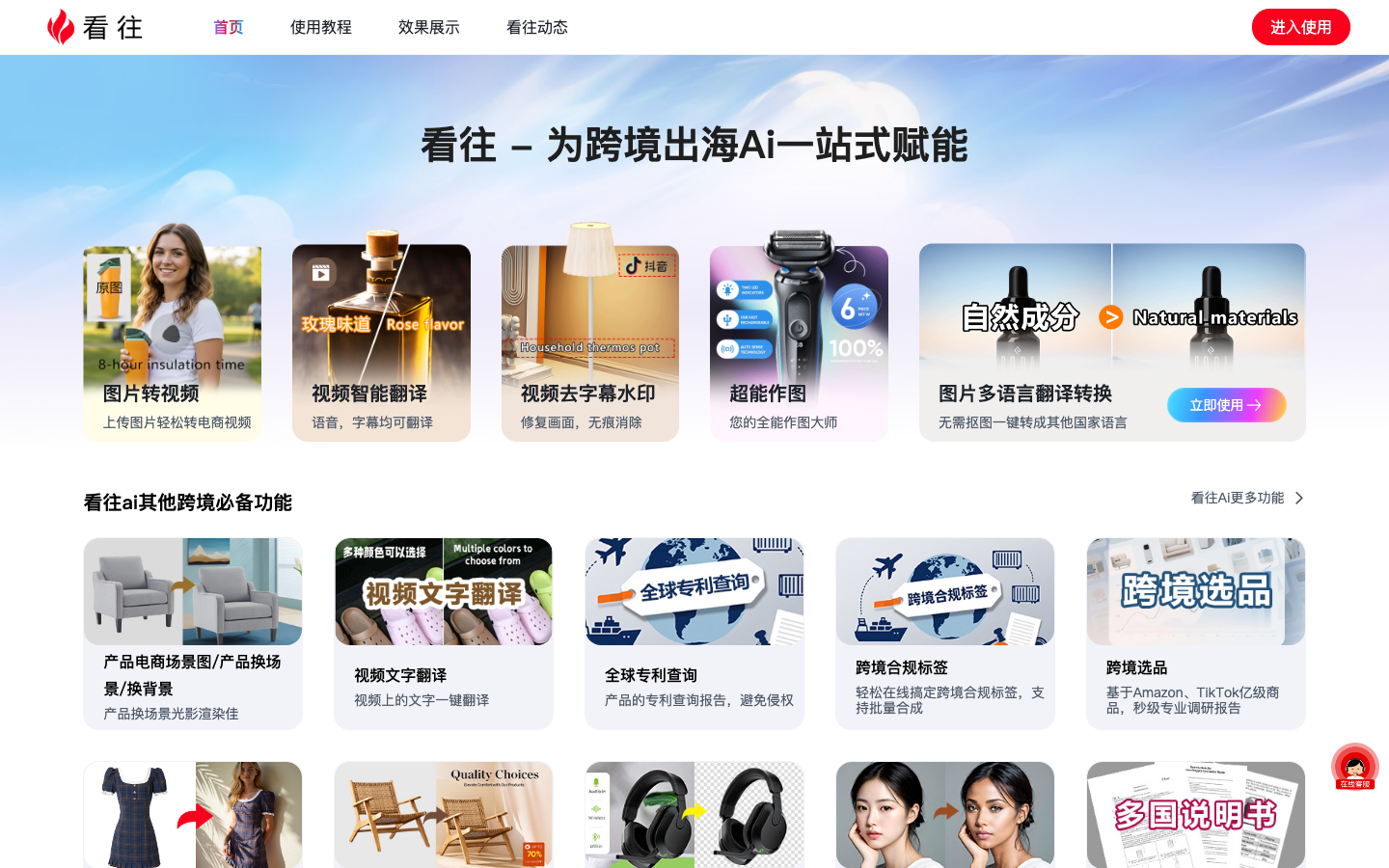
32CD is an online 3D design and AI visual creation platform that provides 3D model editing and AI image generation capabilities.
32CD
Core parameters and statistics of 32CD
32CD is a 3D design and AI visual creation platform that runs in the browser. It integrates 3D model editing and AI image generation into an online service, allowing users to complete the visual content production process from model adjustment to final rendering without installing any professional software. The product is aimed at non-designer users without professional 3D software operating experience, focusing on e-commerce visual and social media content creation scenarios.
| Projects | Public Information |
|---|---|
| Product positioning | Online 3D design and AI visual creation platform |
| Core Competencies | 3D Model Editing AI Image Generation |
| Platform | Web (browser) |
| Place of Belonging | CN |
| Supported languages | Chinese |
| First online | ~2025-09 |
| Current version | 1.0 (~2026-07) |
| Access Portal | 32cd.com |
| Service model | Free trial + subscription |
A brief review in one sentence: 32CD is not a replacement for Blender, but a lightweight online 3D creation tool for non-professional users, allowing people without 3D design experience to create three-dimensional visual content. The core value is to lower the threshold of 3D design from "install software + learn operation" to "open browser + drag and drop adjustment", so that e-commerce operators and social media editors can produce sufficient 3D visual materials without learning professional 3D software.
Users and market recognition of 32CD
Market positioning and competitive landscape: 32CD is at the intersection of "online 3D design" and "AI visual generation". There are many international competitors on this track, but each has different capabilities and focus.
| Dimensions | 32CD | Vectary | Canva 3D | Tinkercad |
|---|---|---|---|---|
| Chinese interface | ✅ Native Chinese | ❌ Mainly in English | ❌ Mainly in English | ❌ Mainly in English |
| Online 3D editing | ✅ Browser direct editing | ✅ Professional online editing | ❌ Only 3D material library | ✅ Basic modeling |
| AI image generation | ✅ Built-in integration | ❌ None | ✅ Built-in | ❌ None |
| Professional modeling ability | ⭐⭐ Basic-Intermediate | ⭐⭐⭐⭐ Professional level | ⭐ Material level | ⭐⭐⭐ Educational level |
| Learning cost | Low (drag-and-drop operation) | Medium-high (3D basics required) | Low | Medium |
| Domestic access experience | Fast (domestic server deployment) | Slow (overseas server) | Average | Slow (overseas server) |
| Pricing threshold | Low-medium | Medium | Medium | Free |
| 3D + AI linkage | ✅ Native access | ❌ Separation | ❌ Separation | ❌ No AI |
Target user group deduction: The number of small and medium-sized merchants on domestic e-commerce platforms (Taobao, JD.com, Pinduoduo, Douyin e-commerce) exceeds tens of millions. A large number of them need to regularly produce product display pictures and social media content, but lack professional design teams or are unwilling to bear outsourcing costs. This group of users constitutes 32CD’s core potential population. In addition, content creators on Xiaohongshu and WeChat public accounts are also an important incremental market - they need visually appealing cover images and accompanying images to increase click-through rates, but their design capabilities are generally limited.
Market Recognition: The specific number of registered users, activity, payment conversion rate and other data are subject to official public information. It is recommended to pay attention to the frequency of exposure and user discussion heat of 32CD on domestic e-commerce design communities (such as Taobao Art Forum, Xiaohongshu Operation Group) and design navigation sites (such as Youshe.com, Zokuu), as a reference signal for market acceptance.
The cost advantage of 32CD: three-layer structure disassembly
The cost structure varies depending on the usage method: C-side users can usually experience core functions through the free version, and high-frequency usage requires subscribing to paid packages; developers/API users are billed based on the number of calls; enterprise-level users need to contact the business to obtain customized quotations. The specific price is subject to the official real-time pricing page.
Main functions of 32CD
-
Online 3D model editing: Complete the import, combination adjustment, material editing and real-time rendering output of 3D models in the browser. Supports combination editing of basic geometry (cube, sphere, cylinder, etc.), color and texture material adjustment, multi-view switching and lighting context settings. All operations are done in the browser, no desktop software required to install or download.
- [Expert Viewpoint - Hidden Linkage]: There is a close collaboration between online 3D editing and AI image generation - after users adjust the model angle and material in the 3D editor, they can switch to the AI generation module with one click, allowing AI to generate matching background or decorative elements based on the composition and lighting information of the current 3D scene. This saves 10-20 minutes of cross-tool connection time compared to the traditional process (Blender export → import Midjourney → manual alignment of composition) and reduces rework caused by composition inconsistencies. For e-commerce operations that need to frequently produce "product display pictures in different scenarios", this ability is the core efficiency increase.
-
AI image generation: Generate 2D visual material through Chinese text description (Prompt) and link it with the 3D editing scene. Unlike independent AI image tools, 32CD's AI generation can perceive the composition and main object information of the current 3D scene, and generate matching background, light and shadow, and decorative elements, rather than independently generating pictures that are unrelated to the scene.
- [Expert Viewpoint]: The real efficiency improvement comes from the combination of "3D composition → AI supplement → combined output". First use the 3D editor to determine the main angle, composition, and basic lighting and shadow of the product, then let AI supplement the background and atmosphere elements based on the scene information, and finally output the image in a unified canvas. This method is more controllable than repeatedly drawing cards to adjust the composition in Midjourney - the 3D effect of the product is certain, and the AI only needs to process the background part, reducing the scope of uncertainty.
-
Preset templates and scene library: Provides classified 3D scene templates (the specific categories and number of templates covered are subject to the official page), covering common e-commerce display scenarios (such as electronic products, beauty, food, etc.), helping users skip the initial stage of modeling from scratch. The template supports secondary editing, and users can adjust the model, color and layout based on the presets.
- Acceptance focus: Whether the category coverage of the template meets your own business needs; the customizable depth of the template (whether the material can be replaced, the composition adjusted, and the lighting modified).
-
Material export and multi-platform adaptation: Supports exporting completed 3D scenes to common image formats. Users can choose the corresponding output ratio and resolution according to the target platform (Taobao main image, Xiaohongshu cover, official account banner, etc.).
- Acceptance concerns: Whether the maximum exported resolution meets the quality requirements of the e-commerce platform; whether a transparent channel (PNG) is supported for subsequent synthesis; whether batch export is supported.
-
Basic Asset Management: Users can manage created 3D scenes and AI generation records in the workbench, which supports copy, edit and delete operations to facilitate unified visual style management of series products.
32CD model and version evolution
Version context:
| Version | Time | Description |
|---|---|---|
| 0.1 (launch) | ~2025-09 | The product is launched for the first time, providing basic 3D online editing functions, supporting model import, material adjustment and rendering output |
| 1.0 (current) | ~2026-07 | The current version integrates AI image generation capabilities based on 3D editing to improve the editor's interactive fluency and template coverage |
Version Analysis: From the launch in ~2025-09 to the release of version 1.0 in ~2026-07, the transition from a pure 3D editing tool to a "3D + AI" integration platform was completed in a span of about 10 months. This rhythm shows that 32CD’s product strategy is to first use the 3D editor to establish a basic user base and tool reputation, and then form differentiated competitive barriers through the superposition of AI capabilities. The launch of AI image generation coincides with the preliminary completion of user education for domestic AI image tools (such as Keling and Tongyi Wanxiang). The market's acceptance of AI generation is on the rise, and the timing is reasonable.
Speculation on the direction of subsequent versions (subject to the official release plan):
- Possible functional directions include: video animation output (3D scene rotation animation), team collaboration and asset management 3D model trading market, and higher resolution AI generation support.
- Technical iteration directions may include: upgrading the WebGPU rendering pipeline to improve performance, optimizing the AI model's understanding of Chinese prompts, and adding more 3D template categories.
Historical version details: In addition to the above two public version nodes, there may be several minor version iterations (bug fixes, performance optimization UI improvements, template expansion). The specific release log is subject to official channels, and no unfounded supplements will be made here.
Technical advantages of 32CD
Browser-side 3D rendering engine: 32CD’s 3D editing capabilities are based on the WebGL/WebGPU technology stack to achieve real-time 3D rendering in the browser. The core of the technology lies in "providing an interactive experience close to desktop 3D software under the constraints of browser memory and GPU computing power."
- Mechanism: Complete geometry vertex processing, lighting calculation and texture mapping through the GPU-accelerated graphics pipeline, achieving 60fps level real-time preview in the browser canvas. WebGL provides cross-browser compatibility, and WebGPU provides more efficient GPU scheduling on browsers that support the new standard.
- Effect: When the user drags and rotates the model, adjusts the color of the material, or moves the position of the light source, the screen can respond to refresh within hundreds of milliseconds. The interaction is smooth enough to support a "what you see is what you get" design experience. There is no need for offline rendering cycles of "adjusting parameters → waiting for rendering → viewing results".
- Applicable scenarios: Suitable for visual content production scenarios that have medium requirements for rendering accuracy (e-commerce level, social media level) but high requirements for operational efficiency and convenience.
- Project Boundary Description: Specific technical specifications such as the upper limit of model faces, upper limit of texture resolution, and concurrent rendering performance are subject to official technical documents. When the online solution handles high-polygon models (more than hundreds of thousands of polygons) or ultra-high-resolution textures (above 4K), lags or crashes may occur due to browser memory limitations. Whether 32CD has made optimizations such as model simplification (LOD) or progressive loading at the engine level needs to be verified through actual testing.
3D + AI fusion architecture: The real technical difference of 32CD does not lie in the individual capabilities of 3D editing or AI generation, but in the connection between the two at the data level - the AI generation module can understand the composition, main object position and lighting information of the current 3D scene, thereby generating complementary content that matches it.
- Compared with traditional solutions: Although the solution using Blender (modeling rendering) + Midjourney/Stable Diffusion (background generation) independently has stronger capabilities, there are significant process breaks - it is necessary to manually transfer files, align sizes, and match styles between the two tools, and each iteration consumes about 5-15 minutes of context switching time. 32CD's converged architecture compresses this step down to a click-to-switch level.
- Technical Implementation Speculation: The AI generation module may use the depth map or normal map of the 3D scene as a conditional input to keep the diffusion model consistent with the perspective of the 3D scene during generation. This solution has been verified in academia (such as ControlNet’s depth condition control), but the effect of engineering implementation depends on the quality and coverage of model training data.
Architectural advantages of online services:
- No local computing power required: All 3D rendering and AI inference are completed in the cloud (or partially on the browser side). Users do not need to configure a high-performance graphics card and can use an ordinary computer or tablet.
- Continuous Updates: As a SaaS product, feature updates and model upgrades are completed by the server, and users do not need to manually download installation packages or update packages.
- Data Cloud Storage: Created content is stored in the cloud, supporting switching access across multiple devices, reducing the burden of local file management.
32CD usage path
Entrance and initial preparation:
- Visit 32cd.com and register an account (registration via email or mobile phone number is supported).
- After logging in, enter the workbench homepage and select "New 3D Scene" or "AI Image Generation" as the starting point for creation.
- When using it for the first time, it is recommended to browse the template library first and select a template that is close to the target category as a starting point to reduce the cost of learning from scratch.
3D Edit Full Path:
- Select a preset scene from the template library, or import a 3D model file locally (the supported import formats are subject to the official product documentation, usually including OBJ, FBX, GLTF and other common formats).
- Use the toolbar in the editor to adjust the position, rotation, and scaling of the model.
- Edit material properties: Modify basic color, metallicity, roughness, texture map and other parameters, and view the effect changes in real time.
- Set scene lighting: select a preset lighting scheme or manually add/adjust the position, intensity, and color of the light source.
- Adjust the camera angle of view: select a preset angle of view (front, 45°, etc.) or drag it freely to the target angle.
- After you are satisfied with the preview, enter the rendering output section, select the target resolution and format, and generate the final image.
AI image generation path:
- Enter the description text (supports Chinese Prompt) in the AI generation module to describe the desired image content and style.
- Select whether to "Generate based on the current 3D scene" - if enabled, the AI will refer to the composition and main object information of the current 3D scene.
- Adjust the generation parameters (style selection, screen ratio, detail richness, etc. The specific adjustable parameters are subject to product functions).
- Click Generate and wait for a few seconds to tens of seconds (depending on the cloud inference load) to obtain the preview image.
- If you are satisfied with the result, you can export it; if you are not satisfied, you can modify the Prompt or adjust the parameters to regenerate it, or you can use the result as a basis for partial modification.
Human-machine collaboration boundary (Rule D mandatory):
- 100% automated and organized: batch rendering output under standardized templates (such as a series of product images with unified shooting angles and unified background styles); batch AI background generation based on fixed Prompt templates; export and archiving of fixed resolutions and formats. Once these procedures are verified, they can be executed repeatedly without manual intervention.
- Some sections that require manual confirmation points:
- Verification of the details of the final output image (whether the text generated by AI is correct, whether the edges of the product are deformed, whether the material texture is authentic) - it is recommended to set up a sampling review process after batch generation.
- Finalization of visual materials involving the brand VI (whether the color matches the brand color, whether the composition matches the brand tone) - it is recommended to be confirmed by the operation or brand person in charge before release.
- Materials used for paid advertising (through-train, information flow advertising) - A/B testing and performance monitoring of advertising materials require manual participation and cannot rely solely on tool generation.
- Synthetic content involving portraits or well-known IP - it is necessary to confirm the compliance of AI-generated content to avoid the risk of infringement.
Efficiency improvement deduction (calculation based on typical workflow scenarios, unofficial commitment):
| Job roles | Typical tasks | Time-consuming traditional process | Time-consuming use of 32CD deductions | The key to savings |
|---|---|---|---|---|
| E-commerce operation | Create a product Tmall main image | 30-60 minutes (outsourced communication or self-study PS production) | 5-15 minutes | Eliminate software installation, cross-tool switching, repeated communication and modification |
| Social media editor | Create a cover image for a Little Red Book article | 20-40 minutes (finding materials + PS synthesis + color correction) | 3-10 minutes | Template output + AI one-click background matching + multi-size adaptation |
| Small business owner | Create a promotion picture | 60-120 minutes (outsourced design + back-and-forth revision and confirmation) | 10-25 minutes | Independently complete the complete process from conception to drawing |
| Product Manager | Create product concept display | 45-90 minutes (hand-drawn sketch + find reference images for stitching) | 8-20 minutes | 3D rapid prototyping + AI to add contextual atmosphere |
Product Pricing for 32CD
Overview of charging model: Please refer to the real-time pricing page of the official website. Current public information shows that the product adopts a "free trial + subscription" charging model. The free version is for experience and evaluation, and the paid version unlocks full functionality.
Pricing structure elements (please check the official page to verify the specific values):
- Free version: Provides limited 3D editing times or AI generation quota, lower export resolution, limited templates, and output may have watermarks.
- Individual paid version: Subscribe monthly or annually to unlock all templates, higher AI generation resolution, watermark-free export, and more export times.
- Enterprise/Team Edition: Specific business terms are not disclosed, and may include enterprise-level functions such as batch account management, data isolation, and customized templates.
Pricing comparison reference (the following data is subject to the real-time pricing on the official website of each product, and the 32CD part is subject to the official price):
| Products | Free Credit | Starting Price (Individual Monthly Payment) | API Pricing | Enterprise Plan |
|---|---|---|---|---|
| 32CD | ✅ Yes | Undisclosed | Undisclosed | Undisclosed |
| Canva Pro | ✅ Yes | ~$12.99/month (~¥90) | No | ✅ Team version available |
| Vectary | ✅ Yes | ~$12/month (~¥85) | No | ✅ Yes |
| Tinkercad | ✅ All Free | $0 | ❌ | ❌ Personal/Educational Only |
| Final design | ✅ Yes | ~¥30/month | No | ✅ Enterprise version available |
Purchase Suggestions:
- Individual users: Start with the free version and use 1-2 weeks of actual work tasks to verify whether the output quality meets the core requirements. If the monthly production volume of 3D visual content exceeds 30 pieces, it is recommended to directly subscribe to the paid version to unlock higher resolution and non-watermark export, to avoid the limitations of the free version affecting production efficiency.
- Small Team: Try the paid version on one account first, and then decide whether to purchase it for team members after evaluating the effect. Pay attention to confirm whether the official supports multiple device logins with the same account.
- Enterprise Users: Large-scale purchases are not recommended before the official enterprise plan is disclosed. First conduct a small-scale pilot (3-5 people) to verify whether 32CD’s capabilities in data isolation, brand consistency management, and batch output meet enterprise-level requirements, and then contact the official business customization plan.
Application scenarios of 32CD
-
E-commerce main image and detail page production: Build a 3D display scene of the product in the 3D editor, adjust the best display angle and material texture, use AI to generate a background and context that matches the product style, and output the main image (usually 800x800 or 1000x1000) and detail page long images suitable for e-commerce platforms such as Taobao, Tmall, JD.com, Pinduoduo, and Douyin.
- Key points for verification: Whether the resolution and file size of the output image meet the platform's image specifications; whether the product details of the 3D rendering are authentic and credible (especially chamfering, light and shadow transition, and material texture); whether the AI-generated background will overwhelm the focus or conflict with the product style; whether the styles of multiple main images produced in batches are consistent.
- Deduction efficiency improvement: Under traditional methods, it takes 2-4 hours for e-commerce operations to produce a set of (5-8) product main images (including communication and modifications with designers). After using 32CD, the time can be compressed to 30-60 minutes, and it can be completed independently on the operation side, reducing communication delays.
-
Match production of pictures for social media content: Produce social media visual materials such as Xiaohongshu note covers, Douyin short video covers, WeChat public account tweet pictures, Weibo event posters, etc. Use the template reuse mechanism to maintain a unified visual style (consistency in tone, font, layout style) for the same series of content.
- Key points to verify: Whether the cover size specifications of each social platform (Xiaohongshu 1:1/3:4, Douyin 9:16, Official Account 2.35:1) are all covered; whether the output file size is within the platform upload limit (usually no more than 20MB); whether the 3D style meets the aesthetic preferences of the target audience.
- Deduction efficiency improvement: Social media editors need to produce 20-40 pictures per month, and the traditional method takes 20-40 minutes for each picture. After using the template process, batch output can reduce the time required for a single image to 3-10 minutes, and the monthly image production time is reduced from 13-26 hours to 2-7 hours.
-
Quick production of visual materials for promotional activities: Produce temporary visual materials such as event posters, coupon display pictures, hot sale list pictures, etc. required for major promotions such as 618, Double Eleven, and New Year's Day. This type of material is characterized by strong timeliness, large quantity, and does not require extreme visual creativity, but it requires high speed.
- Key points for verification: Whether the generated materials can meet the basic requirements of brand tone while maintaining speed; whether the promotional copy generated by AI is accurate (key information such as numbers, dates, discount intensity, etc. must be manually checked).
- Deduction Efficiency Improvement: During major promotions, the operations team usually needs to produce 50-100 event materials within a week. The traditional outsourcing model requires scheduling 2-3 weeks in advance and the process is rigid. After using 32CD, operations can independently generate on-demand, compressing the schedule to 2-3 days without incurring additional communication costs caused by "last-minute modification requirements".
-
Product Concept and Proposal Display: During the internal proposal stage, product managers or marketing personnel need to quickly produce visual materials such as product concept drawings, usage scenario diagrams, exhibition board renderings, etc. for team alignment or upward reporting. The core appeal of this type of demand is "fast visual communication tool" rather than the final deliverable.
- Key points for verification: Whether the flexibility of 3D editing is enough to express the core features of the product concept; whether the scene map generated by AI can help the audience understand the usage context of the product.
- Deduction efficiency improvement: In the traditional way, product managers need to hand-draw sketches or commission designers to make renderings, with a turnaround of at least 1-2 days. 32CD can shorten this process to 15-30 minutes, allowing the discussion to focus more on the product definition itself rather than the visuals.
-
Introduction to 3D Design Teaching: For enthusiasts who want to learn 3D creation but lack software foundation, 32CD provides a low-threshold online practice environment. Users do not need to configure the hardware and complex operating interface required by Blender. They can open the browser to understand the core concepts of 3D creation - modeling, materials, lighting, and rendering.
- Key points of verification: Whether the 3D editing function covers the core operations required for teaching; whether the response speed of the online editor is sufficient to support the smoothness of the teaching demonstration; whether it supports basic interactions such as undo/redo. As a teaching tool, the design logic of 32CD is similar to that of mainstream 3D software to facilitate smooth migration to professional tools.
Applicable people for 32CD
-
E-commerce operators: need to produce product display pictures and event page banners at high frequency (10-50 pictures per week), but usually do not have the professional ability to operate 3D design software and Photoshop. 32CD’s templated process and AI assistance can significantly shorten the image production cycle, allowing operators to independently complete the production of visual materials that used to require outsourced communication.
- Prerequisites: Clear product photos or basic 3D model files are required as input; basic aesthetic judgment skills are required for the output results generated by AI - the ability to identify common problems such as unrealistic material texture and unnatural light and shadow.
- Incompatibility: If an e-commerce brand has extremely high visual requirements for product display images (such as beauty, jewelry, and other categories that require extreme details), the online rendering accuracy of 32CD may not be enough, and professional 3D designers still need to use C4D or Blender to produce them.
-
Social media content creators: including Xiaohongshu bloggers, public account operators, Douyin content operators, etc., need to regularly output visually attractive cover images and accompanying images to increase the click-through rate and completion rate of the content. 32CD's template reuse and AI background generation capabilities are suitable for content production models that pursue "high-yield continuity" rather than "single ultimate creativity."
- Prerequisites: AI generated results require manual screening and fine-tuning, and are not suitable for one-time generation and direct release; basic layout and color matching aesthetics are required, and the ability to judge whether the output images match the content theme is required.
- Inapplicable situation: Creative content that pursues "each original hand-painted style" and "unique artistic sense" is not applicable - the output style of 32CD is biased towards standardized templates, lacking the randomness and uniqueness of hand-painted and artistic creation.
-
Small and micro business owners/individual entrepreneurs: do not have full-time designers, but need basic 3D visual materials for store operations, offline publicity and social media promotion. 32CD's online and low-threshold features allow entrepreneurs with non-design backgrounds to independently complete the production of basic visual materials, eliminating the communication costs and time costs of outsourcing design.
- Prerequisites: Limited creative quality requirements for visual materials, able to accept templated style output; willing to invest 2-5 hours to become familiar with the basic operations of the editor.
- Unsuitable situation: Not suitable for companies whose brands are in high-end positioning and require highly customized visual output - the upper limit of 32CD's capabilities cannot replace the work of a professional brand design team.
-
Product Manager and Marketing Personnel: During the internal proposal and demand communication stage, it is necessary to quickly produce product concept display diagrams, usage scenario diagrams or exhibition effect diagrams. 32CD can be used as a "quick visualization tool" to help people in non-visual professional positions convert ideas into viewable images and reduce information loss in internal communication.
- Precondition: The output accuracy requirement is low, and it mainly serves the purpose of "visualizing ideas to assist communication".
-
3D Design Beginners: Want to get into 3D design but are unwilling to invest high time costs in learning professional software such as Blender and 3ds Max. 32CD provides a progressive learning path from "online template operation" to "understanding 3D design principles".
- Prerequisite: You need to cooperate with other tutorial resources (such as Bilibili 3D design introductory videos, Zhihu tutorials, etc.) to complete systematic learning. 32CD itself does not provide structured courses or teaching systems.
- Incompatibility: Users with 3D design as their career goal are not suitable to rely on 32CD for a long time - it is good to experience the concept as an entry-level tool, but career development requires migration to professional tools such as Blender, C4D, Maya, etc.
Unsuitable Boundary Summary: 32CD is not suitable for the following scenarios - requiring high-precision industrial-grade 3D modeling (BIM building information model for automotive parts), complex character animation (skeletal rigging, skinning, character performance), solid 3D print output (requiring closed manifold model, precise dimensional tolerance), commercial print output with resolutions above 4K, and high-end brand visual design that requires a highly customized artistic style. These requirements still need to be completed by professional tools such as Maya, Blender, 3ds Max, SolidWorks, ZBrush or brand design teams.
Summary and Outlook
Core Competencies: The core value of 32CD is to compress "3D design" from a skill that requires professional software and long-term training to an online service that is readily available in the browser. For millions of small and medium-sized e-commerce sellers and content creators in China, this is a real efficiency gap - they need 3D visual content to improve product attractiveness and content click-through rates, but lack the corresponding tool foundation and learning time. 32CD uses the combination of "online 3D editing + AI image generation" to provide a "good enough" and "immediately usable" solution. It is not positioned to replace professional 3D software, but to provide an intermediate option between professional tools and complete outsourcing - allowing non-designers to independently complete basic to medium-complexity 3D visual content production.
Current Limitations and Uncertainties:
- Performance ceiling is not quantified: The upper limit of model complexity of the online 3D editor (number of faces processed simultaneously, texture resolution, number of material layers) is constrained by the computing power of the browser and cloud, but the specific upper limit value is not disclosed. Before purchasing, users should conduct stress testing using high-complexity models in their actual business to confirm whether the performance is within the red line.
- Stability of AI generation quality: There are probabilistic fluctuations in the results of AI image generation - the results generated by the same Prompt at different times may have significantly different quality. This uncertainty in the production environment means that time budgets for "multiple rounds of generation + manual selection" need to be reserved, and production capacity cannot be planned based on "one generation and qualification".
- Insufficient ecology and openness: Currently there is a lack of third-party plug-in/extension mechanisms, a lack of 3D model trading market, and a lack of data interoperability with other design tools (Figma, Photoshop, Canva). This means that users can only complete creation within the confines of 32CD and cannot take advantage of wider ecological resources.
- Lack of team collaboration functions: It is mainly personal tools and does not have collaboration functions such as team space, shared template library, comment review, etc., which limits its penetration into enterprise-level scenarios.
- Insufficient market verification data: Publicly available information such as number of users, payment conversion rate, customer cases, performance benchmarks, etc. is limited, making it difficult for outsiders to independently assess the maturity and market position of its products.
Follow-up observation points:
- Whether to launch a mobile app (supporting mobile viewing and light editing), which will expand its reach among content creators.
- Whether to open the 3D model market (supporting users to upload, share and trade 3D models) will be a key step in building ecological barriers.
- Whether to add team collaboration and brand asset management functions (shared templates, brand color palettes, material libraries) will determine whether it can enter the enterprise market.
- Whether the underlying model of AI image generation continues to iterate (Chinese Prompt understands accuracy, style diversity, and generation speed). This is a core technical variable to maintain product competitiveness.
- Whether there is an overseas version or English interface support will determine whether its market ceiling is limited to the domestic market.
Procurement/Adoption Risk Assessment:
- Individual users: Start with the free quota, select 1-2 real business needs (such as making 3 main product images and 5 Xiaohongshu accompanying images) for complete process verification - the key is to see "whether it can be used in your own business scenario" rather than "how long the function list is." If the free version can meet the needs, the purchase risk is extremely low; if a paid version is required, it is recommended to subscribe monthly instead of paying annually to allow enough exit flexibility.
- Enterprise users: Before placing an order or purchasing in bulk, you need to confirm the following terms in writing with the official - (1) The storage location and security compliance of the data (in scenarios involving product design manuscripts and brand visual assets, it is necessary to confirm that the data is not externally transmitted and not used for model training); (2) The copyright ownership and authorization scope of the output for commercial use (whether there are commercial restrictions on the images generated by AI, and whether they can be used for paid advertising and printed materials); (3) The data export format and migration plan after cancellation of the subscription (ensure that the data has been created 3D scenes and materials can be exported in a common format and are not locked by the platform); (4) Service Level Agreement (SLA) and availability guarantee of the Enterprise Edition. Since 32CD is a domestic tool and the server is deployed domestically, data compliance risks are relatively controllable. However, in material output scenarios involving overseas e-commerce (Amazon, Shopify, independent websites, etc.), additional confirmation is required to see whether the intellectual property terms of the AI-generated content cover overseas markets, and whether the AI model uses technology or data subject to export controls.
Related tools:  Midjourney, stable-diffusion
How to use 32CD
- Web client: You can use it by visiting the official website and registering an account. Most functions do not require installation.
- API Access: Provides RESTful API, developers can obtain the API Key and integrate it into their own applications.
Version Info
- current :Current version.
- launch :Product goes online.
User Reviews