 ACE-Ego
Free
ACE-Ego
Free
ACE-Ego is an open source research project for embodied intelligence and robot operation pre-training. It proposes a method for adapting the same VLA model to different robot ontologies through morphological condition coding, and performs well in dual-arm collaborative operation scenarios.
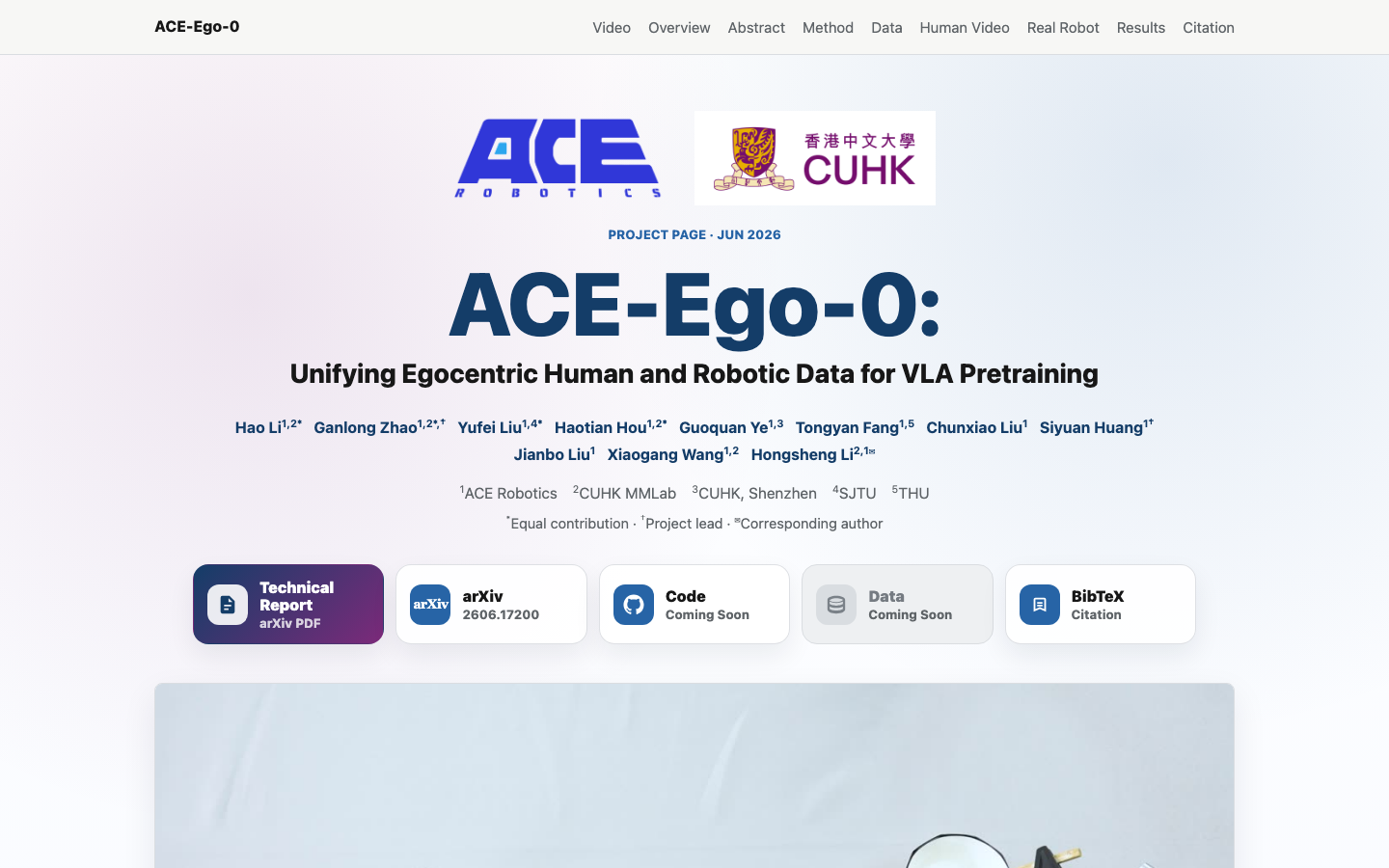
Full review of #ACE-Ego
Core parameters and statistics
| Project | Specifications |
|---|---|
| Product Positioning | Cross-ontology embodied operation VLA research project |
| Development Agency | ACE Robotics Research Team |
| Core Technology | Unified camera space action + morphological condition coding |
| Training data | 6.0K+ hours of human first-person video + robot/simulation data |
| Evaluation Benchmark | RoboTwin 2.0 Easy/Hard |
| Evaluation Score | 91.12% / 90.62% |
| Code Status | Coming Soon |
ACE-Ego answers a practical question: Different robots have different joint numbers, arm lengths, and gripper types. The traditional approach is to train a separate model for each robot. The idea of ACE-Ego is to use one model to adapt to all robots, relying on feeding "what the robot looks like" as conditional information to the model.
Publicity verification: "91.12%/90.62% accuracy" - these numbers are achieved on specific benchmark tasks, including plastic bag packaging, shoe boxing and other retail operation scenarios. The actual performance of different scenarios and robots will fluctuate, and there is a gap between the benchmark test environment and the real production line environment.
User and market recognition
ACE-Ego is still in the academic research stage and is publicly available through papers and project pages. Its technical value lies in proposing a scalable cross-ontology VLA pre-training framework, which achieves 90%+ results on the RoboTwin 2.0 benchmark. The project code has not yet been open sourced, but the solution described in the paper provides a new technical route for multi-robot operation learning.
Publicity verification: "91.12%/90.62% accuracy" - these numbers are achieved on specific benchmark tasks, including plastic bag packaging, shoe boxing and other retail operation scenarios. The actual performance of different scenarios and robots will fluctuate, and there is a gap between the benchmark test environment and the real production line environment.
Cost advantage
| Dimensions | Description |
|---|---|
| Paper and Project Page | Free to the public |
| Code | Coming Soon (expected to be open source) |
| API Service | Not provided |
| Commercial License | Undisclosed |
Free truth: Research papers and project pages are free, but reproducing the results requires your own robot hardware and training computing power. The cost of a dual-arm robot platform is $50K-200K, and training the VLA model requires a multi-card GPU cluster. For research teams without hardware conditions, the cost of verification is much higher than the zero cost of reading papers.
Main functions
- Unified VLA across ontology: The same model adapts to the kinematic structures (URDF information) of different robots through morphological condition encoding, without the need for separate training for each type of robot. From "one robot, one model" to "multiple robots sharing one model", model maintenance costs are greatly reduced.
- Complex operations with both arms cooperation: Supports retail operation scenarios that require the cooperation of both arms, such as plastic bag packaging and shoe boxing. Coordination of both arms is a difficult point in robot operation - the left hand fixes the object and the right hand performs the operation. The two sets of kinematic chains need to be accurately aligned in time and space.
- Mixed data pre-training: Fusion of human first-person perspective video (6.0K+ hours), robot teleoperation data and simulation rollout data for joint pre-training. Human videos provide rich operational diversity, robot data provide precise action annotations, and simulation data supplement exploratory operation trajectories.
Model and version evolution
Mainline release
- ~2026-06: ACE-Ego paper and project page are published for the first time, code Coming Soon.
Technical advantages
The core technological breakthrough of ACE-Ego is "how to make a model understand what it looks like." The traditional VLA method assumes that the robot body is fixed. ACE-Ego breaks this assumption through two key designs:
-
Uniform camera space actions: Different robots have different mechanical arm lengths and different joint angle ranges. The same "grab forward" action has completely different representations in joint space. ACE-Ego represents actions uniformly in the camera coordinate system - no matter what the robot looks like, the goal of "move the hand 10 centimeters to the front right of the screen" is consistently represented in the camera space.
-
Morphological condition coding: Add the robot's URDF (Unified Robot Description Format) structure and kinematic constraint information to the model input, so that the model knows "which robot I am using now and how its joints rotate." The effect is that the same set of network parameters activates different sub-network paths on different robots.
How to use
ACE-Ego is currently publicly available as a research paper, and the code has not yet been released. Estimated usage process:
- Visit the project page to learn about technical solutions
- Wait for the GitHub code to be open source and download it
- Configure the training environment and robot hardware according to the documentation
- Prepare or download pre-training data
- Fine-tune or deploy directly on the target robot
Product Pricing
There is currently no commercial form and it is entirely for the research community. It is expected that the code will be open sourced under an academic open source license (such as MIT/Apache 2.0), and commercial use requires confirmation of specific licensing terms.
Human-machine collaboration boundary: 100% automation: model inference and robotic operation execution. Manual intervention is necessary: quality inspection and random inspection of operation results, manual intervention for abnormal situations, and adjustment of training data and scene design. When migrating across ontologies, you need to manually confirm whether the migration effect is as expected.
Application scenarios
- Automation of retail warehousing operations: collaborative operation of both arms such as plastic bag packing, shoe boxing, product sorting, etc. ACE-Ego's cross-ontology capability means that the same set of models can be deployed on different types of robots, which is suitable for scenarios where multiple robots are running simultaneously in warehouses.
- Unified deployment of multiple robots: Different brands and models of robots are mixed in factories or warehouses. ACE-Ego allows the operation and maintenance team to use the same set of models to manage all robots, reducing the maintenance burden of "an AI model for each robot".
- Robot skill transfer research: Skills trained on one robot are transferred to another robot through the cross-ontology capability of the model. Suitable for R&D teams that need to migrate operational skills between different hardware platforms.
Dissuade scenario: If your robot only has a single model and will not be replaced in the short term, a specially trained single VLA model will usually perform better than a cross-ontology model - the improvement in generalization capabilities comes at the expense of accuracy on a specific robot. The value of ACE-Ego is fully reflected in scenarios where "unified management of multiple models" is required.
Current limitations: The code is not yet open source (Coming Soon), and technical solutions can only be evaluated through papers. The test scenario of RoboTwin 2.0 is retail operations, and the generalization ability in other scenarios (such as precision assembly, medical surgery) has not been verified.
Applicable people
- Embodied Intelligence Researchers: Academic researchers focusing on VLA, cross-ontology generalization, and multi-task robot learning.
- Robot Algorithm Team: Algorithm engineers who need to manage multiple robot ontologies at the same time and evaluate the cost performance of cross-ontology models and single-body models.
- Retail and Warehousing Automation Team: The actual operation scenario involves an engineering team cooperating with multiple types of robots.
Summary and Outlook
It provides competitive solutions in its field, and its core value lies in lowering the threshold for AI use in this field.
Current limitations: Some advanced features require paid subscription, and the free version has function or usage restrictions; specific technical details and performance benchmarks have not yet been fully disclosed.
Related tools:  Hugging Face, replicate
Version Info
- ACE-Ego :First public paper and project page, GitHub code Coming Soon, no official precise date yet.
- ACE-Ego :First public release, no official precise date yet.
User Reviews