 ACE-Step
Free
ACE-Step
Free
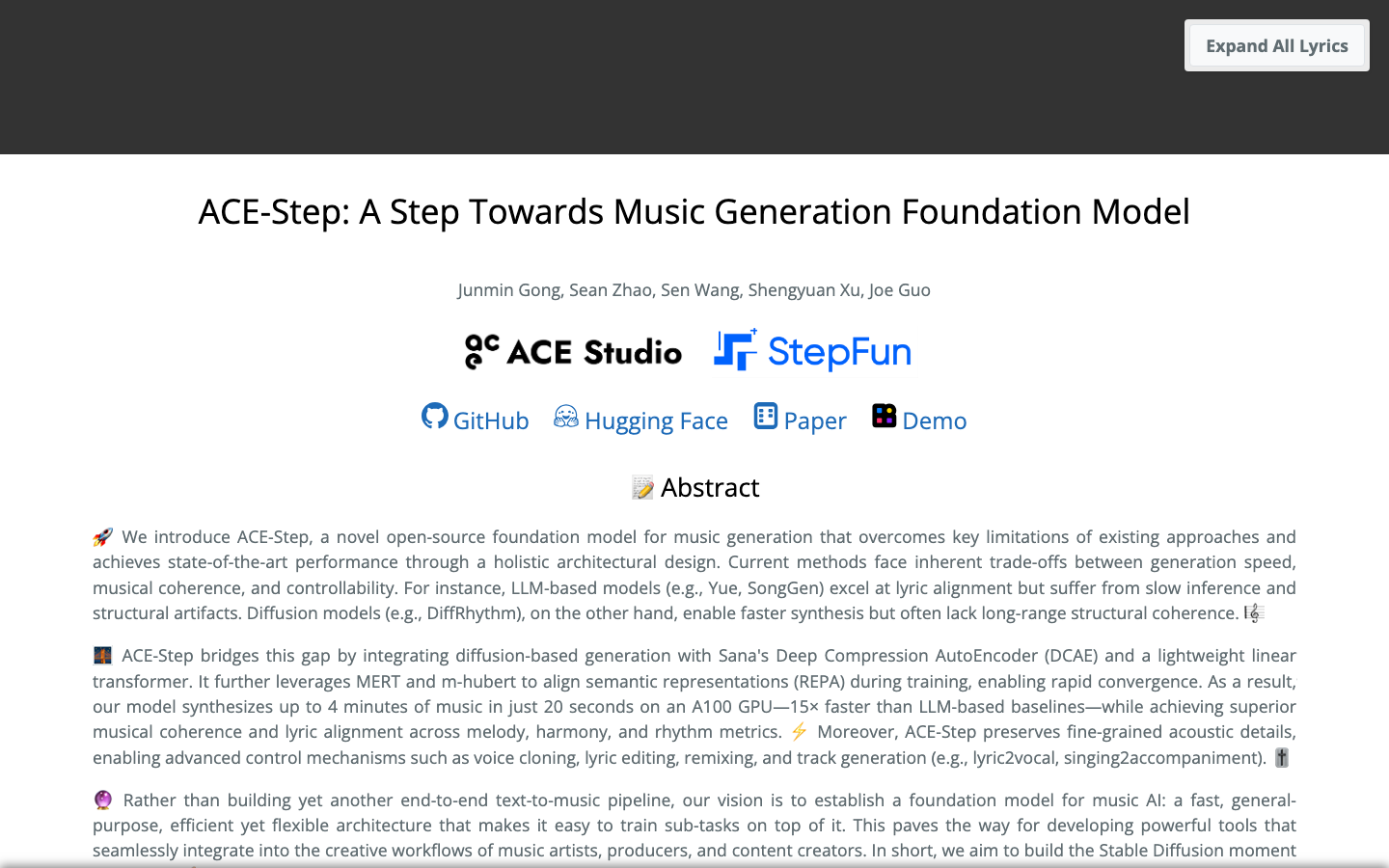
ACE-Step is an open source AI audio tool jointly developed by ACE Studio and StepFun. It is oriented to tasks such as text to music, lyrics to vocals and partial redrawing, emphasizing efficient, coherent and controllable music generation.
ACE-Step
Core parameters and statistics
ACE-Step is an open source basic model for music generation. The official public page defines it as an "efficient, coherent, and controllable" music creation engine. It is not an arrangement software in the traditional sense, but a generation pipeline from text, lyrics to music clips.
| Projects | Public Information |
|---|---|
| Product positioning | Basic model of music generation |
| Open Source License | Apache-2.0 |
| Code repository | GitHub public repository |
| Public form | Home page, warehouse PyPI package HuggingFace model page |
| Community popularity | About 4,558 stars, 581 forks |
| Latest version | 0.1.0 (2025-05-07) |
| Main capabilities | Text2Music, Lyric2Vocal, Text2Samples, partial redrawing |
| Multi-language coverage | 19 languages |
| Main platforms | Web, API |
| Version context | Public project page → PyPI 0.1.0 |
Clear efficiency indicators: The official page gives an example of 4 minutes of music generated on the A100 in about 20 seconds. This type of indicator shows that it is more biased towards engineering efficiency and creative iteration, rather than a long-latency general audio model.
Community base: 4,558 stars and 581 forks indicate that it has become visible in the field of open source music generation and has the foundation to continue to be reproduced and re-developed.
Capability Boundary: The official describes Text2Music, Lyric2Vocal and Text2Samples separately, indicating that its goal is controllable music creation rather than a one-stop commercial music platform.
User and market recognition
ACE-Step's market recognition comes primarily from the open source music generation community. The home page, repository, and HuggingFace model page together form a complete path from browsing examples to downloading reproductions, which is more friendly to both creators and researchers.
Open source and reproducible: The public warehouse and model page allow users to directly verify the main line capabilities such as text to music, lyrics to vocals, partial redrawing, etc., instead of just looking at the promotional page.
Clear mission orientation: The official list of "music creation, music production, music education, and multi-language generation" is a clear direction, indicating that its implementation scenario is not an abstract audio classification, but a specific creative link.
Clear boundaries: Officially, enterprise customers, subscription packages and licensing terms have not been disclosed. Therefore, market recognition should give priority to warehouse activity, model availability and actual generation quality, rather than commercial revenue indicators.
Cost advantage
The cost advantage of ACE-Step is the typical open source model route: the model ontology is free, and the inference cost is determined by computing power and deployment method.
| Cost layer | Public information | Description |
|---|---|---|
| C-side/Personal | Free trial | Official page and model page are publicly accessible |
| Developer/API | Undisclosed | No unified public pricing page, more reliance on self-built or third-party hosting |
| Enterprise/Private | Undisclosed | Commercial delivery and deployment terms undisclosed |
Controllable budget: If it is only a small-scale creation or demonstration, the cost is mainly a one-time trial and a small amount of inference; if it is to be produced in batches, the computing power cost will quickly become the main expenditure.
The balance between cost and quality: The example of generating 4 minutes of music in 20 seconds shows that it is more suitable for creative creations that require quick trial and error, and can keep the time cost of the "generating a draft" step to a low level.
Main functions
- Text2Music: Generate music directly based on text prompts, suitable for quick drafting.
- Lyric2Vocal: Generate audio with vocals directly based on lyrics.
- Text2Samples: Generate loops, sound effects and clips, suitable for producers to quickly experiment.
- Partial redrawing/re-editing: Make partial modifications to existing fragments, leaving other parts unchanged.
- Multi-language lyrics support: For cross-language music creation and localized content production.
- Controllable variant generation: Different versions can be generated through noise and redrawing to facilitate manuscript selection.
These functions together form a creative logic: first generate, then change, and then partially correct. For music production, this is closer to a real workflow than a single one-click generation.
Model and version evolution
Mainline version
- preview (~2025-04): The official homepage and warehouse are the first to be made public, showing model capabilities and examples.
- 0.1.0 (2025-05-07): The first installable version released by PyPI, entering the distributable stage.
Version relationship
The public rhythm of ACE-Step is closer to the path of "disclosure of research projects → release of installable packages → continued optimization of capabilities". For users, this means looking at examples and model cards first, then checking whether the package version is stable, and finally deciding whether to include it in the workflow.
Technical advantages
Diffusion + DCAE + Linear Transformer: The diffusion model is responsible for generation, DCAE is responsible for compression and decompression, and the lightweight linear transformer is responsible for modeling sequence relationships. The effect is to retain musical details while reducing the cost of modeling long sequences.
Semantic Alignment: Aligning semantic representations through MERT and m-hubert makes the model converge faster and makes it easier to align lyrics, melody and style into the same context.
Controllable generation: The ability to redraw, morph and edit lyrics allows it to not only "write a piece of music", but also to continuously revise around existing drafts, which is of greater practical value to producers and creators.
How to use
| Entrance | Description |
|---|---|
| Official homepage | View model introduction, examples and interaction methods |
| GitHub repository | Get code, training and inference details |
| HuggingFace model page | Download model weights and view model cards |
| HuggingFace Space | Online experience demo |
Typical steps: First select the Text2Music, Lyric2Vocal or Text2Samples route on the home page or model page, then enter prompt words, lyrics or reference fragments, then adjust the length and variation parameters, and finally partially redraw or modify the lyrics of the generated results. For high-performance environments such as A100, it is suitable to conduct short sample verification first and then expand to complete songs.
Product Pricing
The pricing model is subject to the official real-time page. Usually a freemium or subscription system is adopted, basic functions can be used for free, and advanced functions or high-frequency use require payment.
Application scenarios
- Music Creation: Quickly generate melodies and drafts based on themes.
- Vocal Generation: Turn lyrics directly into vocal demo clips.
- Production Materials: Generate musical instrument loops and sound effects to supplement the production material library.
- Cross-language creation: For multi-language lyrics and localized content.
- Music Education: Serves as a teaching and demonstration tool to aid in learning compositional structures.
Applicable people
- Music Producer: People who need to quickly produce drafts, test lyrics and test styles.
- Content Creators: People who need soundtracks for short videos, commercials or presentations.
- Research and Engineering Team: People who need to reproduce and retrain music generation models.
- Not suitable for the boundary: If you only want mature commercial music library or finished music with strict copyright and clear copyright, ACE-Step is not currently a ready-made finished product supply platform.
Summary and Outlook
The core value of ACE-Step is to make high-efficiency music generation into a basic model that is open, reproducible, and can be continuously rewritten. For creators, it is suitable for inspiration drafts, quick demonstrations of lyrics to vocals, and experiments with controllable variations; for researchers, it provides a clear route from diffusion and compression representation to semantic alignment.
Current limitations are mainly due to undisclosed commercial pricing, undisclosed enterprise delivery, and no standardized specification of SLAs for large-scale production. Points worth observing in the future include: more mature APIs or hosting portals, more stability in languages and styles, and coherent performance in longer audio and more complex lyric scenarios.
Related tools:  ElevenLabs, udio
Version Info
- ACE-Step v0.1.0 :The latest version released by PyPI continues to iterate around efficient music generation, lyrics editing, multi-language support and a redrawn creative experience.
- ACE-Step public project page :The official homepage and open source repository were released before the PyPI package, showing that 4 minutes of music can be generated on the A100 in about 20 seconds to support 19 languages and the main interaction modes. There is no official precise date yet.
User Reviews