 ACE-Step 1.5
Free
ACE-Step 1.5
Free
ACE-Step 1.5 is an open source music basic model jointly launched by ACE Studio and StepFun. It focuses on local deployment, high-speed generation and multi-language lyrics singing. It supports text-generated songs, covers, redraws, audio track separation and other editing capabilities, and can be run with 4GB of video memory.
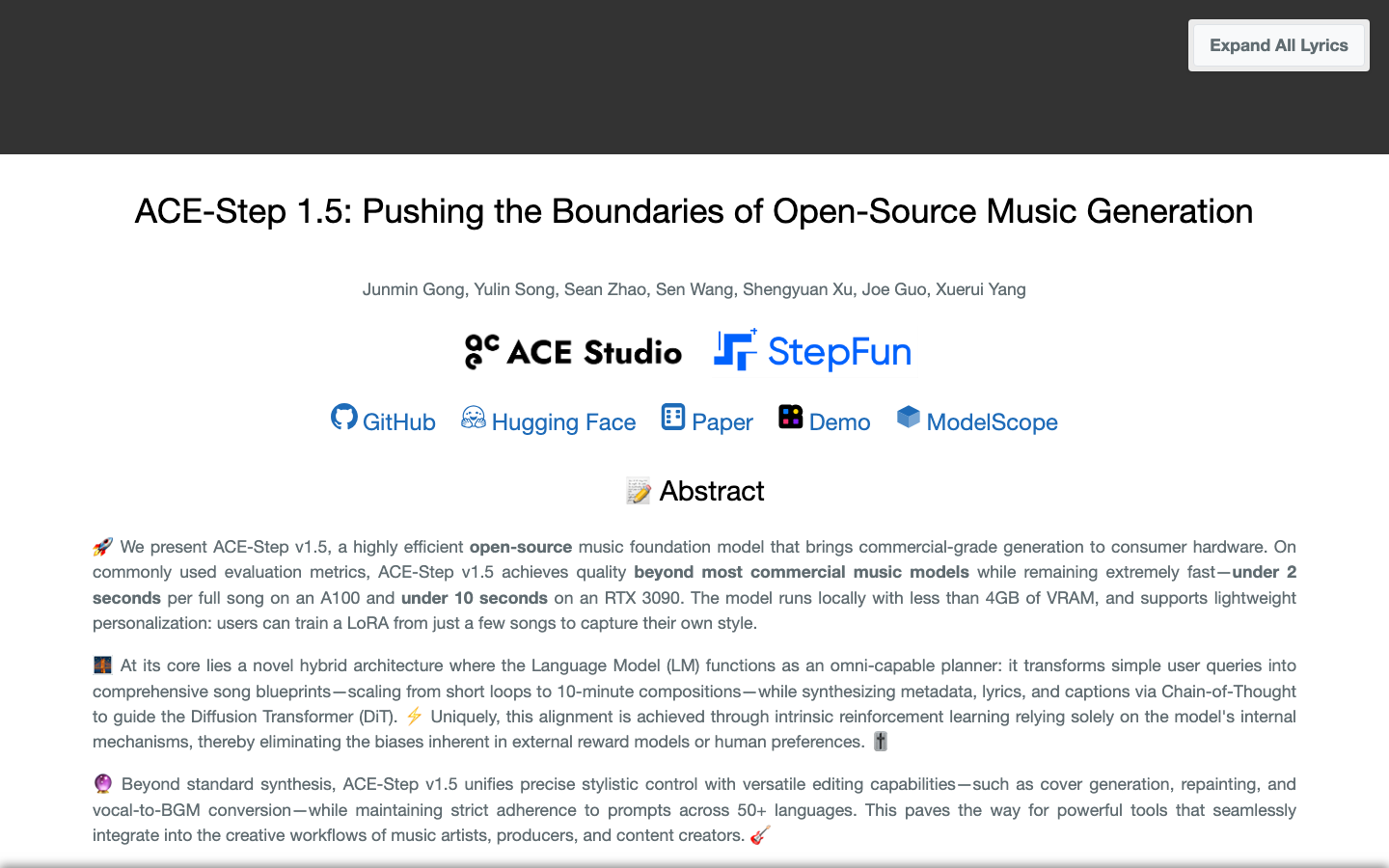
Full review of #ACE-Step 1.5
Core parameters and statistics
| Project | Specifications |
|---|---|
| Product Positioning | Open source music basic model |
| Developer | ACE Studio + StepFun |
| Architecture | LM (Song Planning) + DiT (Acoustic Rendering) Mix |
| Generation speed | A100 ≈ 2 seconds/song, RTX 3090 ≈ 10 seconds/single |
| Minimum Video Memory | 4GB (some configurations) |
| Supported Platforms | CUDA, Apple Silicon, ROCm, Intel XPU |
| Open Source License | MIT |
| Lyric Language | 50+ languages |
ACE-Step 1.5 is probably the most hardware-friendly open source music generation model currently available. The threshold of 4GB of video memory means that consumer-grade graphics cards within the past five years can run, which is a breath of fresh air in the music generation track that often requires A100.
User and market recognition
ACE-Step 1.5 is quickly gaining traction in the open source music generation community. Compared with closed source products such as Suno, its differences are: ① MIT license, free for commercial use and secondary development; ② Support local deployment, data does not leave the device; ③ Provide a complete editing pipeline (generate → cover → redraw → split tracks), which is not just as simple as "generating a song". Compared with SongGeneration, the outstanding advantage of ACE-Step is the lower inference speed and lower memory requirements.
Publicity verification: "4-8 steps of distilled inference, A100 generates the entire song in about 2 seconds" - This speed is achievable with short clips (10-30 seconds), but the inference time increases significantly when generating a complete song of 3-5 minutes. Distillation inference has obvious acceleration effects while maintaining sound quality, but the sound quality may suffer from detail loss at very low step counts.
Cost advantage
| Dimensions | Description |
|---|---|
| Code | Free under MIT license |
| Model Weights | Public Download |
| Online Demo | Free trial |
| Self-deployment | RTX 3090/4090 can run smoothly |
FREE TRUTH: MIT License, code and model weights free to download. The lowest cost of self-deployed hardware is reflected in the existing graphics card - if you have an RTX 3090 or higher model on hand, the incremental cost is almost zero; if you need to purchase new hardware, an RTX 4060 (4GB video memory) for about 2,000-3,000 yuan can meet the minimum requirements. For users who just want to try it out, the online demo is the lowest-cost option.
Main functions
- Text-generated song: Enter lyrics and style description, and AI will generate a complete song. Any duration from 10 seconds to 10 minutes is supported.
- 50+ language lyrics and singing: Supports mainstream languages such as Chinese, English, Japanese and Korean, and multiple minor languages. This is a core differentiating feature for creators who require multilingual music content (for example, game soundtracks that require sung versions in different languages).
- Cover and Redraw: Input a piece of audio, and AI will re-interpret it with a different style or voice. Suitable for adapting existing songs.
- Track Separation and Completion: Separate songs into vocal and backing tracks, or complete segments. From "generating a song" to "editing a song", it covers more aspects of music production.
- LoRA Personalized Training: Train personal style LoRA with a small number of songs. For creators with a fixed style, the consistency after fine-tuning will be much better than a general model.
Model and version evolution
| Stage | Time | Key changes | Current significance |
|---|---|---|---|
| ACE-Step 1.0 | ~2026-03 | Establish a main text-to-song link to form basic acoustic generation capabilities | Prove that the open source music model can generate complete songs |
| ACE-Step 1.5 | ~2026-06 | Expanded to 50+ language lyrics, covers, redraws, track splits and LoRA training | Upgraded from "can generate" to "can edit and customize" |
ACE-Step's versioning path is very clear: first complete the process of generating songs from text, and then complete the editing steps that creators will actually use. 1.0 is more like an open source baseline, while 1.5 is starting to get closer to a complete music workflow, especially the cover, redraw and track splitting capabilities, advancing the model from a one-time generator to a production tool that can be modified repeatedly.
The positioning of the current version is not to compete with closed-source platforms for the strongest finished product sound quality, but to use lower hardware thresholds and looser licenses to make the "locally runnable music basic model" an implementable choice in engineering. For researchers and developers, 1.5 is already a more complete milestone than a pure Demo.
Technical advantages
| Technical points | Mechanism of action | Actual effects |
|---|---|---|
| LM + DiT hybrid architecture | Plan the song structure first, then render the acoustic details | A more stable sense of control over melody, rhythm and timbre |
| Distilled Inference | Complete sampling in fewer steps | Dramatically reduce wait time when deployed locally |
| Multi-language lyrics modeling | Bind lyrics understanding and singing generation | Make cross-language songs and localized content more smoothly |
| LoRA personalized training | Use a small number of samples to inject style preferences | More suitable for reuse by creators with fixed styles |
The advantage of ACE-Step 1.5 is not only that it is "open source", but that it combines speed, memory threshold and editing capabilities. Many similar open source models can produce sounds, but it is difficult to take into account the generation speed, post-editing and commercial licensing at the same time; the differentiation of ACE-Step 1.5 is to package these details into a relatively complete creative base.
Publicity Verification: The official emphasizes that 4GB of video memory can be run and 4-8 steps of distillation acceleration are basically established. This selling point is basically true for "running", but there is an additional condition for "stable output of high-quality entire songs". Short-term snippets, draft generation, and partial editing are closer to its comfort zone; if you pursue long-term high-fidelity finished products, hardware, inference time, and post-processing costs will still increase.
How to use
| Entrance | Minimum Requirements | How to Get Started |
|---|---|---|
| Online Demo | Browser accessible | Directly enter lyrics and style description, first verify the timbre and rhythm direction |
| Local Inference | 4GB+ video memory, CUDA or Apple Silicon is recommended | After downloading the weights, configure the context according to the official warehouse and execute the basic inference script |
| Personalized training | Additional video memory and a small number of training samples | Solidify your personal style or brand tone through LoRA fine-tuning |
The fastest way to get started is to first use the online demo to confirm the prompt word structure, and then decide whether to deploy it locally. For most teams, it is more cost-effective to first test "whether the lyric style description can be stabilized to produce a usable draft" than to fiddle with the graphics card from the beginning.
When used locally, the minimum configuration addresses "can run", not "high throughput". If you want to generate, cover and track long songs at the same time, the 3090/4090 device will be obviously more convenient. For enterprises or studios, it is recommended to put it into the "draft generation + manual refinement" process, rather than directly replacing the complete production link.
Product Pricing
The pricing model is subject to the official real-time page. Usually a freemium or subscription system is used, and basic functions can be used for free. Advanced functions or high-frequency use require paid subscriptions, and users are advised to evaluate the optimal solution based on actual usage.
Application scenarios
- Quick soundtrack generation: Generate customized background music for videos, podcasts, and games. Enter "Chinese style, melodious 2 minutes" and get a usable soundtrack draft within 30 seconds.
- Cover and Adaptation: Cover a song in different styles - change a pop song into a jazz version, or translate an English song into a Chinese version. Suitable for content creators to do secondary creation.
- Music Teaching and Experimentation: Use AI to generate different styles of musical passages as teaching examples, or conduct acoustic experiments.
Dissuade scenario: If you need publishing-level professional mixing quality, the songs generated by AI are still inferior to professional recording studios in terms of sound quality layering and mixing details. ACE-Step is suitable for draft and demo stages, not for final release.
Applicable people
- Indie Musicians: Quickly verify melodies and arrangement direction during the creative process, MIT license allows commercial use. There is no need to worry about copyright disputes or platform sharing issues.
- Content Creator: Quickly generate soundtracks and background music for videos and podcasts to reduce copyright risks. Compared with purchasing commercial licenses on music platforms, the cost of self-generating is much lower.
- Audio AI Developer: Build music generation applications based on ACE-Step, with fewer restrictions under the MIT license. It is necessary to pay attention to whether the sound quality of the model output can meet user expectations, and whether the inference cost is economical after scale-up.
- Game Audio Team: Generate customized background music and theme songs for the game. The MIT license can be embedded in commercial products, but the sound quality and sound effect consistency require additional processing.
Current Limitations: ACE-Step 1.5 has limited support for some minor languages in terms of pronunciation accuracy of lyrics. Lyrics in non-Latin alphabet languages (such as Chinese and Japanese) sometimes have pronunciation deviations, which require manual correction or post-recording.
Summary and Outlook
It provides competitive solutions in its field, and its core value lies in lowering the threshold for AI use in this field.
Current limitations: Some advanced features require paid subscription, and the free version has function or usage restrictions; specific technical details and performance benchmarks have not yet been fully disclosed.
Related tools:  ElevenLabs, udio
Version Info
- ACE-Step 1.5 :Supports text generation of song lyrics in 50+ languages, cover repainting, audio track separation and LoRA personalized training.
- ACE-Step 1.0 :Basic music generation model, supporting text-to-song conversion.
User Reviews