 Actionable AI
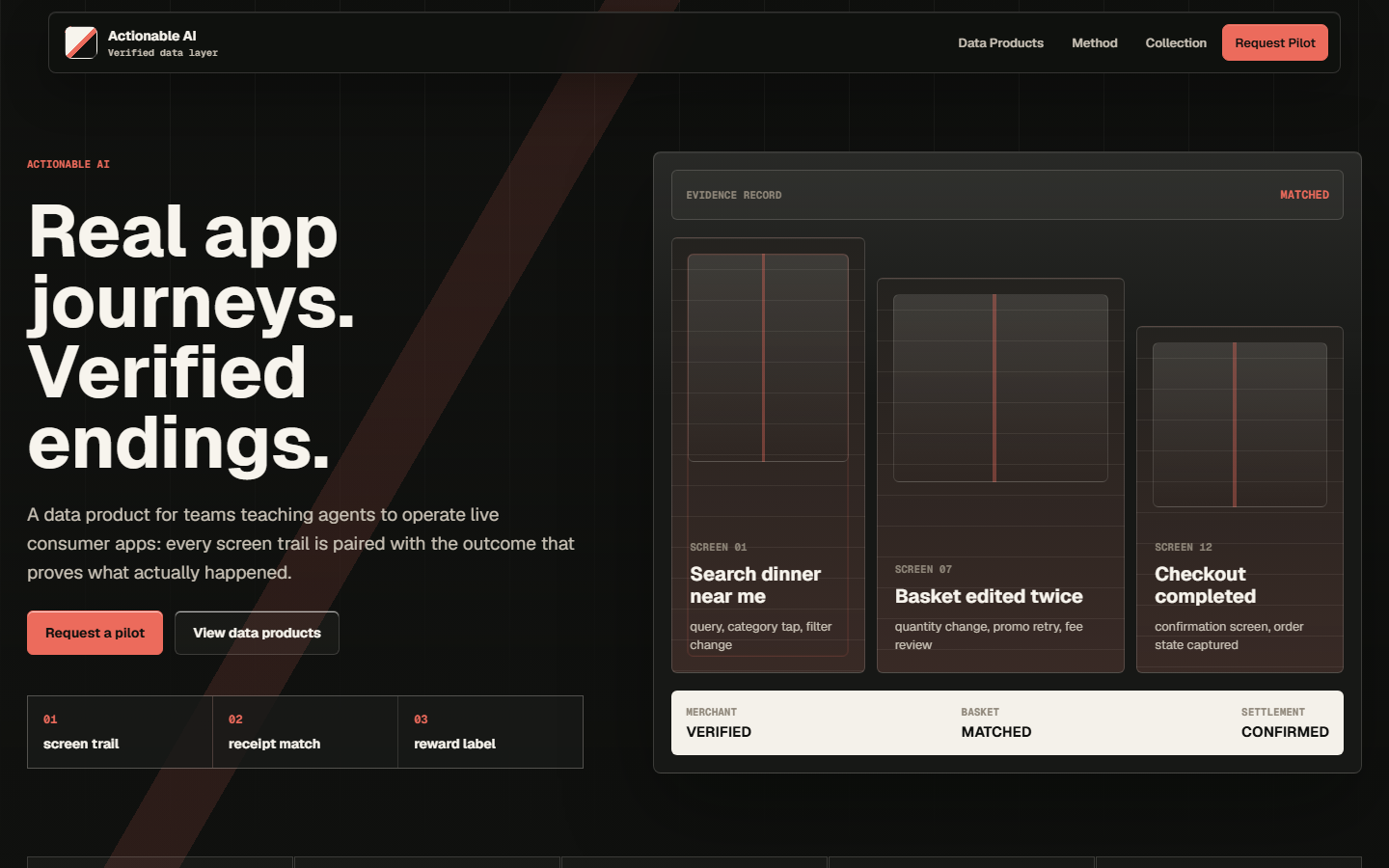
Actionable AI is a data product company for AI Agent training teams. It collects user-authorized Android screen operation trajectories through reward.app, pairs them with voucher verification results (receipts, orders, settlements), and outputs structured data sets that can be used for model training, evaluation, and reward modeling. It covers the three major consumption scenarios of takeout, e-commerce and travel, and covers emerging markets such as Brazil.
ActionableAI
Core parameters and statistics
Actionable AI is not a SaaS tool or API service in the traditional sense, but a data product company focusing on AI Agent training data infrastructure. Its core deliverable is a structured paired data set of real Android App operation trajectories and credential verification results (receipts, order status, settlement signals) authorized by the user.
| Projects | Public Information |
|---|---|
| Official positioning | Real-user app journeys linked to verified receipt outcomes |
| Data Collection Method | reward.app Android Accessibility Service (User Authorization) |
| Data verification method | Intelligent matching of third-party vouchers (receipts, orders, settlement) |
| Core Output | Operation Track + Voucher Verification Result + Reward Label |
| First market | Brazil (takeaway, e-commerce, travel) |
| Expansion of candidate markets | Hong Kong, Singapore, India, Indonesia, United Arab Emirates, United States |
| Applicable workflow | Takeout ordering, e-commerce search and purchase, travel and taxi hailing |
| Target buyer | AI Agent training team, evaluation team, reliability team, data procurement team |
| Contact channel | [email protected] (direct email to the data team) |
| Public pricing | Undisclosed, launches in Pilot mode |
Data product positioning: Actionable AI provides not raw logs or pure receipt data, but a carefully paired three-in-one structured record of "operation intent → screen trace → verification result". Each record contains the user intent command in-app operation event sequence (search, browse, add purchase, coupon code attempt, settlement), and the final result verified by the voucher (merchant, shopping cart, price, fee, promotion, settlement total). This kind of pairing data is scarce in the current market.
Acquisition + Verification Close: The acquisition end uses Android accessibility service to capture the screen status and interaction path through reward.app, and the verification end confirms the transaction result through smart matching of receipts. Both ends enter the delivery pipeline after privacy processing (masking, field deletion reporting, quality marking). The official clearly regards "credential link coverage" as the core quality indicator, distinguishing two quality levels: "observed trajectories only" and "reward mark trajectories verified by credentials".
Market Strategy: Actionable AI adopts the pragmatic route of "pilot first and then expand" - starting from the takeout scenario in the Brazilian market, because the receipt matching link is the most mature and the verification clarity is the highest. Customers first see link coverage and quality in one market and one workflow, and then expand to more markets and app categories as needed.
User and market recognition
Actionable AI is currently in the early commercial verification stage, and public channels have not disclosed user numbers, corporate customer lists or revenue data. Its market recognition is mainly reflected in the scarcity of product positioning and the precise matching of target customer groups.
Clear Target Buyer: The official buyer portrait refers directly to four types of teams - AI Agent training and post-training data teams, teams that evaluate and measure the completion of real App tasks, reliability teams that study failure and recovery behaviors, and data procurement teams that require informed consent, data Schema and quality review. The demand for these four types of roles is growing rapidly in the current Agent implementation boom.
Competing Alternatives Comparison:
| Comparative dimensions | Actionable AI | Alternatives (self-built collection/synthetic data) |
|---|---|---|
| Data authenticity | Real user operations + credential verification results | Synthetic data lacks real noise; self-built requires large-scale real-person testing |
| Privacy compliance | reward.app user authorization collection + desensitization processing | You need to build your own consent framework and privacy pipeline |
| Covering workflow | Three high-frequency consumption scenarios: takeout/e-commerce/travel | Self-developed collection scripts are required to adapt to each App |
| Failure mode coverage | Includes edge cases such as promotion failures, payment retries, cancellations, etc. | Synthetic data often misses real-world long-tail anomalies |
| Delivery format | Structured JSON, including quality mark and desensitization report | Need to define Schema and quality standards by yourself |
| Procurement threshold | Pilot launch, on-demand pricing | High initial investment (engineering + compliance + operations) |
Prerequisites for Adoption: The value of Actionable AI is highly dependent on the buyer’s requirements for data link auditability. If the team only cares about the model's score on a static benchmark, rather than the actual task completion rate of the app scenario, then the marginal benefit of this paired data will be significantly reduced.
Cost advantage
The cost advantage of Actionable AI is not reflected in "how much cheaper than competing products" - because its product form (operation track + voucher verification pairing) has almost no direct benchmark in the open market - but is reflected in the implicit cost comparison of "self-built vs. purchased".
C-side/direct users: Actionable AI is not for individual users, and there is no free plan or subscription system.
Developer/Agent Team: The procurement cost is Pilot pricing (not publicly disclosed) and needs to be communicated via email at [email protected]. Hidden costs include:
- Time cost: Build a self-built pipeline from data collection, user authorization, privacy desensitization to credential verification. It is estimated that the development and compliance cycle will be about 3-6 months with a medium-sized engineering team (4-6 people).
- Quality Cost: Synthetic data or simulator data cannot reproduce real users' behavior patterns such as hesitation, retries, and coupon overlay failures, leading to unexpected behavioral decline in the model in real contexts.
- Compliance Cost: Building a user authorization collection framework by yourself requires handling the compliance review of privacy regulations in GDPR, LGPD (Brazil), CCPA and other regions.
Enterprise/Scale Team: Actionable AI's Pilot model itself is a cost control method - starting from one market, one workflow, and the minimum link sample size, first verify the data quality before committing to a larger purchase volume. The team only needs to keep the Pilot budget within an acceptable range (usually equivalent to the monthly salary of 1-2 engineers) to complete the data availability assessment.
Hidden benefits: Another value of paired data is the improvement of evaluation efficiency. Traditionally, evaluating the Agent's performance on App tasks requires manually checking the operation results one by one; with the voucher verification results, "whether the task was successfully completed" can be automatically determined, saving the labor consumption of systematic evaluation.
Main functions
Actionable AI provides four types of data products, covering different sections of the Agent training life cycle:
-
App Journey Demonstrations: Human navigation trajectory data set collected from reward.app, including screen status, visible text, click/swipe operations, timing, number of retries, and workflow advancement progress. It is suitable for training models to learn real consumer app operation behaviors. The first batch supports the three major categories of takeaway, e-commerce, and travel.
-
Receipt-Verified Reward Labels: Result labels built based on smart receipt matching, including final order status, merchant, shopping cart, price, fee, promotion and settlement signals. Ideal for reward modeling, assessment scoring and post-training reviews. Key value: Verify whether the Agent's operation path actually reaches a verifiable result state.
-
Failure And Recovery Flows: Operation data of real users in "chaotic moments" such as promotion failure, product sold out, payment retry, empty shopping cart, order modification, cancellation, etc. Suitable for reliability testing and recovery behavior training. These edge cases are almost non-existent in static benchmarks, but are exactly the key scenarios that the Agent must face when moving from demonstration to production.
-
Custom Market Collection: A customizable data collection project executed around the buyer's target market App list, workflow, privacy requirements and delivery schema. Ideal for teams that need real-time behavioral data for a specific app or market. Starting point: Complete Pilot collection first, then commit to a larger scale.
Synergy: Four products form a complete data value chain - "Demonstration Track" provides training materials, "Reward Tags" provide automatic evaluation methods, "Failure Recovery" covers long-tail robustness, and "Customized Collection" solves specific market gaps. The buyer can first verify the "link coverage" (that is, what proportion of operation tracks can find the corresponding voucher verification results) from a small-scale Pilot, and then decide which product line to expand to formal procurement.
Model and version evolution
As a data product company, Actionable AI's version evolution reflects the expansion of data collection capabilities and coverage, rather than the version iteration of traditional software.
Current core product line (~2025-Q3 first release):
- App Journey Demonstrations: The first batch of core trajectory data sets released, starting from the takeout, e-commerce, and travel scenarios in the Brazilian market.
- Receipt-Verified Reward Labels: The verification result label layer is launched simultaneously with the trajectory data set, so that the training data has both "process" and "result" information.
- Failure And Recovery Flows: A subset of edge cases filtered and annotated based on trajectory data, covering scenarios such as promotion failure, payment retry, cancellation, etc.
- Custom Market Collection: Customized data collection solutions for buyers with specific needs.
Early Pilot Phase (~2024-Q4):
- Launched Android user authorization data collection pilot in the Brazilian market through reward.app.
- Completed the construction of the data matching pipeline with the receipt verification service.
- Verify the complete feasibility of "operation track → voucher verification → reward label".
Subsequent evolution direction (there is no official commitment, the following is a deduction based on public information):
- Expand market coverage (candidate markets such as Hong Kong, Singapore, India, etc.).
- Add more consumer app categories (travel booking, insurance purchase, financial products, etc.).
- Improve voucher link coverage and reduce empty reward rate.
- Possible introduction of a standardized API delivery interface to replace the current manual Pilot process.
Relationship with model training: Actionable AI is not a basic model provider and does not release model versions; the update rhythm of its data products is driven by collection scale, market expansion and credential verification coverage. Buyers should pay attention to the "link coverage" and "quality mark" changes of each data package, not the version number.
Technical advantages
The technical value of Actionable AI does not lie in the model architecture or inference engine, but in the uniqueness of the data pipeline design and quality verification mechanism.
Collection end: reward.app accessibility service. Capture a serialized representation of the screen state on an Android device via the Accessibility Service - including visible text, interactable elements, scroll position, click coordinates and timestamps. Compared with traditional tracking or log collection, this capture method does not require the cooperation of app developers and covers any third-party applications. User participation is managed through reward.app’s informed consent process, and the collection content, purpose, and participation methods are all explained to users.
Verification end: smart receipt matching. After the trajectory data is delivered, merchant, shopping cart, price, fee, promotion, order status and settlement signals are obtained through the receipt verification pipeline. The matching logic is divided into two layers: first confirm "whether the receipt appears in the track" (with/without reward), and then conduct field-level verification (merchant matching, amount matching, promotion applicability, etc.) of the track containing the receipt. The official reports "link coverage" as a core quality indicator.
Privacy & Quality Control. Each record is desensitized (sensitive fields are deleted or replaced) before delivery, and comes with a masked field report and quality mark. What the buyer receives is not tiled data with "all trajectories are equally important", but layered data - verified reward label trajectories, observation-only unverified trajectories, empty reward trajectories - with each layer having different credibility and applicable scenarios.
Architecture Link:
Android users → reward.app (user authorization + barrier-free collection)
    ↓
Screen track data (event sequence + screen status + timeline)
    ↓
Desensitization + field deletion report
    ↓
Receipt verification engine (Merchant/Price/Fees/Promotions/Billing Match)
    ↓
Structured records (track + verification results + reward labels + quality marks)
    ↓
Customer Delivery (JSON format, including empty reward samples and quality reports)
Core difference from competing products: Most AI Agent training data comes from synthetic generation (real noise is easily missing) or simulator playback (cannot cover the retry and recovery behavior of real users). Actionable AI simultaneously captures "process" (the complete sequence of screen operations) and "result" (the final state of the credential verification), a pairing that is relatively rare in the public market. The trade-off is that coverage is limited by reward.app’s user install base and the availability of the receipt verification pipeline, with meaningful pairing scale currently only achieved in the Brazilian market.
How to use
Actionable AI adopts a Pilot priority procurement model and does not provide self-service registration or API Key issuance.
| How to use | Suitable for the crowd | Process | Remarks |
|---|---|---|---|
| Pilot | Agent team for first evaluation | Email [email protected] to submit a Pilot Brief | Select workflow, marketplace, dataset shape |
| Customized collection | Teams with specific App/market needs | Started with Pilot and expanded to Custom Program after verification | Involving privacy review and delivery Schema negotiation |
| Data delivery | Procurement team that has completed Pilot | Receive desensitized JSON structured records in the agreed format | Contains tracks, verification results, and quality marks |
Standard Pilot startup steps:
- Select workflow: Choose one of the three categories: takeout (order + voucher verification), e-commerce (search → purchase), and travel (hailing a taxi + fee verification). The official recommendation is to start with takeaways because the receipt matching link is the most mature.
- Select the data set form: Checkout journey + receipt labels (settlement track + voucher labels), Purchase journey + receipt labels (purchase track + voucher labels), Failure and recovery flows (failure recovery flows), etc.
- Select a market: Brazil is the recommended first market; Hong Kong, Singapore, India, Indonesia, the United Arab Emirates, and the United States need to be negotiated as customized collections.
- Set Pilot Goals: Clarify the minimum number of link samples, acceptable empty reward rate, delivery format and timeline.
- Send Pilot Brief: Email the above options to [email protected] to get availability and preliminary pricing.
Typical Pilot Brief Template (from the official request page):
Workflow: Food delivery
Dataset: Checkout journey + receipt labels
Market: Brazil
Use case: Agent training
Target: Pilot sample with linked examples
Data format example (from the JSON structure disclosed on the official product page):
{
  "instruction": "Order dinner under the user's usual budget",
  "source": "reward.app Android accessibility session",
  "journey": {
    "app": "food_delivery_app",
    "market": "pilot_market",
    "events": ["open", "search", "view_item", "add_to_cart", "apply_promo", "checkout"]
  },
  "receipt_match": {
    "merchant": "verified",
    "basket": "verified",
    "fees_and_promos": "verified",
    "settlement_total": "verified"
  },
  "reward_label": {
    "task_success": true,
    "price_match": true,
    "outcome_source": "verified receipt intelligence"
  }
}
Product Pricing
Actionable AI's pricing model is completely based on Pilot + customized negotiation, with no public price list, no free quota, and no self-service subscription.
- Pilot stage: The customer selects a workflow, a market, a minimum number of link samples, and completes an end-to-end data quality assessment. Pricing is negotiated by Pilot range and sample size, with no official price range disclosed. It is recommended that the procurement team control the Pilot budget to a range equivalent to the monthly salary of 1-2 engineers (specifically based on the official quotation).
- Formal Bulk Purchase: After Pilot verification is passed, the formal price will be negotiated based on the expanded market App category, sample size and delivery frequency. Contract terms may include link coverage SLAs, empty reward rate caps, desensitization standards, and delivery timelines.
- Customized collection: Collection projects involving specific apps or new markets require additional negotiation of collection costs (user incentives, compliance reviews, pipeline construction, etc.).
Subject to the official real-time page: All pricing information must be obtained through email inquiry at [email protected]. This article does not provide any speculative figures.
Application scenarios
Actionable AI's data products directly serve multiple key aspects of AI Agent from research and development to production deployment:
-
AI Agent Behavior Training: Use real App operation trajectories to train the Agent to learn the human decision-making process in consumer applications - search, browse, compare, add purchases, discount code operations, and settlement. The benefit is reflected in the fact that the Agent's behavior pattern is closer to that of real users, reducing the gap between agents that perform well in the test environment but behave abnormally after going online. Agents no longer learn the "perfect path" in the simulator, but are exposed to exploration, hesitation and recovery in the real world.
-
Agent Evaluation and Reward Modeling: The credential verification results change the evaluation problem of "whether the task is successfully completed" from manual inspection to automated judgment. The Agent training team can use Receipt-Verified Reward Labels to build a reward model so that the Agent learns to pursue "real success" (merchant matching, price matching, settlement completion), not just "completed a series of operations." The evaluation team can also use these labels to quickly determine the performance differences between different Agent versions on real app tasks.
-
Reliability Testing and Failure Recovery: Failure And Recovery Flows provides operational data of real users in scenarios such as invalid promotional codes, product out of stock, payment rejection, order cancellation, etc. The Agent Reliability Team can use this data to test how the Agent behaves under abnormal circumstances—will the Agent retry different coupon codes like a human would? Will I choose an alternative payment method after payment failure? Can order cancellations be recognized and the process interrupted correctly?
-
Competition and Market Behavior Analysis (deduction scenario): Desensitized operation trajectory data can indirectly reflect consumers’ behavioral preferences in different apps—search word changes, price sensitivity, and promotion participation. However, this scenario involves more complex privacy boundaries, and whether Actionable AI supports such uses needs to be clearly defined in the procurement contract.
Applicable people
Actionable AI's target customers are highly concentrated on enterprise-level AI Agent R&D teams and is not suitable for individual developers or non-technical purchasers.
-
AI Agent training and post-training team: direct beneficiaries. A large amount of real app operation data is needed to train or fine-tune the agent model so that it can perform multi-step tasks in consumer applications. The value of paired data is to provide "process demonstration" and "result verification" at the same time, reducing false signals in training data.
-
Agent Evaluation and Quality Assurance Team: Repeatable, auditable evaluation data sets are needed to measure Agent performance on real-world tasks. The voucher verification results can automate the evaluation process and no longer rely on manual inspection of operation results one by one. Suitable for teams that need to systematically compare different model versions and different Prompt strategies.
-
Data Procurement and Compliance Team: Responsible for finding compliant, high-quality data sources for enterprise AI projects. Actionable AI's privacy processing process (user authorization + desensitization + field deletion report) can meet a certain degree of compliance review requirements, but whether it can pass the company's internal privacy and security review still needs to be evaluated by the purchaser.
-
Not suitable for the crowd: It is not recommended to purchase Actionable AI in the following scenarios - teams that require text/code/multi-modal pre-training data (their data focuses on App operation behavior, not applicable); teams that only require static benchmark evaluation (the core value of paired data is in the evaluation of real task completion rates, not ranking scores); individual developers or student projects (the procurement threshold is high and there is no self-service solution); teams that require real-time API access (currently only batch data delivery is supported, no API interface).
Summary and Outlook
The core competitiveness of Actionable AI lies in the paired data structure of "operation trajectory + credential verification results", which has a differentiated positioning in the current AI Agent training data market. It's not the largest data provider, but it fills a critical gap - taking Agent training data from "simulator demonstration" to "real world operation + verifiable results" stage. Its Pilot-first sourcing strategy also reduces buyer evaluation risk, allowing teams to validate data availability before committing large budgets.
Current Limitations:
- Limited coverage: The launch market is only Brazil, other regions are still in the candidate stage, and it is not yet available for teams that need data from mature markets in North America, Europe or Asia.
- No public pricing and self-service entrance: The overall procurement process relies on email communication, which is inefficient and not suitable for data teams that need rapid iteration.
- No standardized API: Currently only batch data delivery is supported and cannot be integrated into real-time training or evaluation pipelines.
- The scale has not yet been verified: there are no customer cases, revenue data or financing information in public channels, and the product is still in the early commercial verification stage.
Follow-up observation points:
- Market expansion speed: whether it has entered candidate markets such as Hong Kong, Singapore, and India as expected, and the link coverage performance of each market.
- Workflow diversity: In addition to food delivery, e-commerce, and travel, whether it will cover higher value categories such as tourism, finance, and insurance.
- API progress: whether to move from email pilot to self-service platform to reduce procurement friction.
- Changes in the competitive landscape: As the demand for Agent training increases, more similar data suppliers may emerge, and Actionable AI’s first-mover advantage window is limited.
Procurement/Adoption Risk Assessment:
- It is recommended that the team first launch a minimal Pilot with a workflow (recommending takeaways) and the Brazilian market, focusing on verifying three indicators: link coverage (how many tracks can be matched to valid credentials), empty reward rate, and quality mark transparency. Pilot’s budget is controlled within the monthly salary of 1-2 engineers. Confirm data availability before considering expanding markets and workflows.
- Terms that enterprises need to verify before purchasing: whether the data can be used for model retraining, whether the desensitization standards meet internal compliance requirements, whether the accuracy of voucher verification is guaranteed by SLA, and whether custom quality screening is supported after data delivery.
Version Info
- Core Data Product Suite :Actionable AI's first public data product line includes four major products: App Journey Demonstrations, Receipt-Verified Reward Labels, Failure And Recovery Flows, and Custom Market Collection. There is no official precise date yet.
- Pilot Data Collection :In the early pilot data collection stage, reward.app started pairing verification of Android user App operation track collection and voucher verification in the Brazilian market. There is no official precise date yet.
User Reviews