 Adam AI
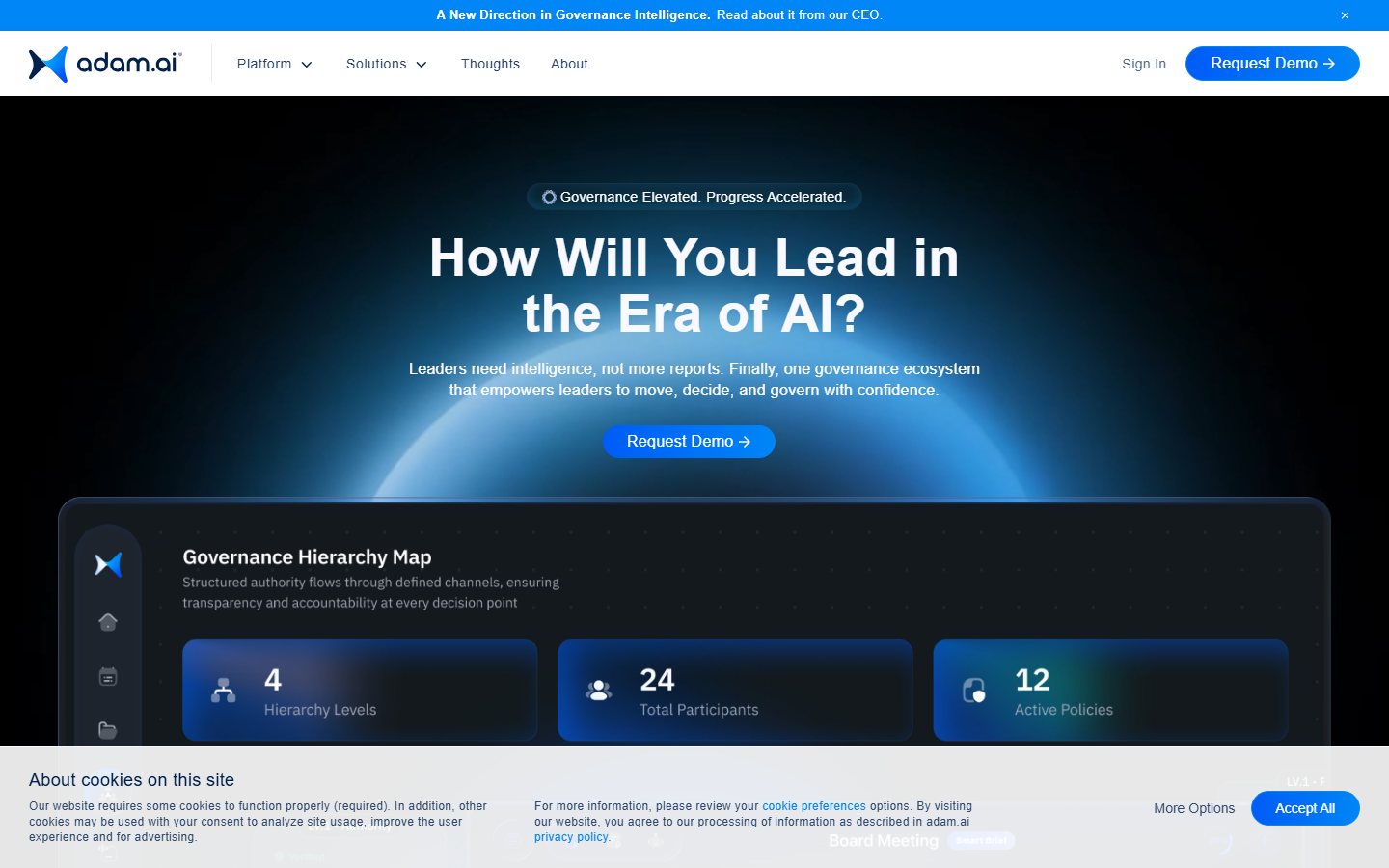
Adam AI is a AI Office and Efficiency governance platform for board of directors and C-level executives and government leaders. It focuses on the three pillars of Executive Intelligence, Governance Foundations and Meeting Operations to upgrade meeting management into an intelligent governance ecosystem.
AdamAI
Core parameters and statistics
Adam AI was formerly a meeting management collaboration tool. In January 2026, it was officially upgraded to an AI governance ecosystem for senior leaders. Officially positioned as an "intelligent governance ecosystem", it no longer stops at the agenda arrangement in the conference room, but extends to the complete relationship between strategic decision-making, compliance framework and execution tracking.
| Projects | Public Information |
|---|---|
| Official positioning | Intelligent Governance Ecosystem |
| Product Architecture | Executive Intelligence / Governance Foundations / Meeting Operations |
| Deployment method | Cloud SaaS |
| Security Certification | SOC 2 Type 1 & Type 2, ISO 27001, GDPR |
| Target customer groups | Board of Directors C-level executives, government leaders, committee members |
| Typical customers | MoMAH, ADNOC, ZTCA, Johns Hopkins Medicine, abpi |
| Founder | Abdullah Kamel (CEO & Co-Founder) |
| Support Platform | Web |
| Home | US |
Product form: Adam AI is not a general AI chat or content generation tool, but a highly vertical governance scenario SaaS. Its value is not reflected in model parameters or API throughput, but in the digital reconstruction of high-level management activities such as board operations, committee processes, and decision tracking.
Security Compliance Threshold: Holds four certifications: SOC 2 Type 1/Type 2, ISO 27001 and GDPR. This is the baseline configuration for entering the enterprise market in governance SaaS, which directly determines whether it can enter the whitelist of financial, medical and government customers.
User and market recognition
The user structure of Adam AI shows the characteristics of "dense high-end customer groups, but the magnitude is not disclosed". The official website displays customer logos such as MoMAH (Museum of Modern Art), ADNOC (Abu Dhabi National Oil Company), ZTCA, and Johns Hopkins Medicine, covering government, energy, medical and cultural institutions, indicating that it has established benchmark cases in the fields of global governance and public sector.
Evolution of market positioning: Upgrading from a meeting management tool to a governance platform means that it no longer directly competes with calendar tools such as Calendly and Doodle, but enters the segmented track of board management software such as Diligent Boards and BoardEffect. The brand upgrade announcement in January 2026 marks the transformation of product strategy from "efficiency tool" to "strategic system".
Publicly verifiable information: The customer logo and security certification disclosed on the official website are the main market signals, but the number of active users, number of paying customers, annual revenue and other indicators are not disclosed. For procurement evaluations, it is recommended to request case references and ROI data directly from the sales team.
Cost advantage
The cost structure of Adam AI is a typical enterprise-level SaaS model. There is no public self-service pricing and everything is reached through business negotiation (Request Demo). This means that its purchasing decisions are naturally on the track of "high customer unit price + long cycle".
C-side/Personal: No personal version or free plan is provided. Products are designed for organizations rather than individuals, and individual users cannot purchase them independently.
Developers/API: No public API or developer program available. Adam AI is a closed end-to-end governance platform and is not designed to integrate the developer ecosystem.
Enterprise/Private: Pricing is based on annual subscriptions, with specific pricing based on number of user seats, number of committees, module combination (Executive Intelligence may be billed separately), and compliance customization needs. SOC 2 and ISO 27001 certification means that companies can incorporate them into existing supplier risk control processes and reduce independent audit costs.
Hidden Costs: The real cost to the purchaser is not just the subscription fee. The launch of the governance platform requires preliminary configuration (charter introduction, committee structure construction, historical meeting minutes migration), and this part of the implementation manpower investment is often underestimated. Additionally, if the organization is also using Diligent or other governance tools, the cost of running both tracks during the parallel migration period will also need to be factored into the budget.
Main functions
Adam AI's capabilities are organized according to three product pillars, covering the entire "rules → execution → insights" link of the governance workflow:
- Executive Intelligence: Transforms data into decision-ready dashboards, providing AI summaries and briefings, decision and risk analysis, and role-based personalized guidance. The core delivery is not "more reports", but to help leaders quickly grasp the key points before the meeting, understand trade-offs during the meeting, and track implementation after the meeting.
- Governance Foundations: Intelligent frameworks interpret and maintain governance rules, charters, and protocols to ensure that the system operates according to the system. Supports multi-space management (managing multiple boards and committees at the same time), agenda modeling, authoritative recording of meeting minutes, and integration with existing corporate systems.
- Meeting Operations: Intelligent orchestration covering the entire life cycle of the meeting - from agenda construction (including time allocation, responsible persons and decision points), board material distribution, decision recording and voting, action item tracking, to context transfer between committees.
Synergy: The three modules are not independent tools, but share the same governance data model. For example, the charter rules defined by Governance Foundations will automatically constrain the agenda structure in Meeting Operations; the decision analysis generated by Executive Intelligence will be written back to the knowledge base of Governance Foundations to form comprehensive feedback on system implementation. This linkage mechanism of "rules drive execution and execution feeds back insights" is the core difference between it and traditional conference management software.
Model and version evolution
From conferencing tool to governance platform
- ~2025 (initial version): Enter the market with a meeting management collaboration tool, with functions focused on schedule coordination, meeting minutes, and action tracking. The accumulation at this stage provides a user base and scenario understanding for subsequent governance upgrades.
- 2026-01-14 (Governance Intelligence Platform): Officially released the Governance Intelligence Platform, and the product expanded from a single module of Meeting Operations to three pillars. CEO Abdullah Kamel defined the upgrade in the announcement as a strategic leap "from management meetings to governance decisions."
Since the product operated in a private SaaS form in the early stages, the official has not disclosed detailed historical version logs and precise release dates. It is recommended to refer to the official real-time page. The version context is only sorted out based on the current public information.
Technical advantages
The technical barrier of Adam AI is not in the underlying model, but in the industry depth of "governance knowledge engineering".
Interaction design driven by cognitive science: The official clearly mentioned that the design of its Executive Intelligence module incorporates executive cognition research, that is, the system does not generally "summarize everything", but organizes the information hierarchy according to the leader's decision-making habits - first look at risks, then weigh options, and finally confirm execution. This "role-aware AI" is more suitable for high-level management scenarios than a general summary engine.
Formal engine for governance rules: The Governance Foundations module is essentially a lightweight rules engine that converts institutional texts such as charters, committee terms of reference, and voting rules into executable structured constraints. This enables meeting agendas to automatically verify compliance and avoid procedural flaws caused by human negligence.
End-to-end closed architecture: The three modules share a unified data model and authority system. From rule setting → meeting execution → decision recording → tracking and implementation, the information flow is uninterrupted and does not cross systems. Compared with the fragmented "meeting tool + document system + project tracking" combination solution, Adam AI reduces context loss and manual transcription errors.
How to use
Adam AI is a pure enterprise-level SaaS. All usage paths require business confirmation. There is no public self-service registration process.
| How to use | Suitable stage | Features |
|---|---|---|
| Submit Demo request on the official website | Evaluation period | After filling in the company information, the sales team will contact you. It is suitable to first understand the functional matching and quotation |
| Enterprise Pilot | Pre-purchase verification | Select 1-2 committees or boards of directors as the pilot scope to verify the actual effects of agenda arrangement, decision recording and action tracking |
| Full deployment | After formal purchase | Complete charter import, user permission configuration, historical data migration, and enter production |
Typical implementation path: First, the company secretary or the person in charge of governance submits a Demo request. During the sales demonstration stage, the focus is on the adaptability of Governance Foundations to existing charters and the depth of integration of Meeting Operations with existing calendar and email systems. In the pilot phase, it is recommended that one committee run through the complete governance cycle (agenda→meeting→decision→tracking) in a three-month cycle, and then the evaluation is extended to other committees or board levels.
Product Pricing
Adam AI adopts a pure enterprise sales model. There is no public pricing page on the official website (the pricing route returns 404), and everything is determined through business negotiations.
Purchasing model: Annual subscription system, seat system or committee number system for billing. The specific structure needs to be confirmed by sales in the Demo section.
Price range reference: Since the entry-level pricing of similar governance platforms (such as Diligent Boards, BoardEffect) usually ranges from thousands to tens of thousands of dollars per year, Adam AI, as a new generation platform with AI capabilities, is likely to be priced in the mid-to-high range of its category. The actual quotation is affected by factors such as customer size, module combination, deployment requirements, etc., and is subject to the official written quotation.
Enterprise Procurement Notes: The contract should focus on the user number expansion clause, data export rights, service availability SLA, and data migration plan when the cooperation is terminated. Since the platform involves highly sensitive information such as board minutes, data sovereignty and deletion protection clauses need to be confirmed separately.
Application scenarios
The applicable scenarios for Adam AI focus on "high-level management activities that require formal governance structures" rather than daily team collaboration or personal efficiency improvement.
- Board of Directors and Management Meeting Governance: Full-link management from annual meeting calendar planning, pre-reading and distribution of board materials, to resolution voting and minutes archiving. The benefits are reflected in shortened pre-meeting preparation cycles and increased resolution implementation rates, but attention needs to be paid to whether the system covers the special requirements of local board governance regulations.
- Committee and cross-departmental governance: For organizations with multiple standing committees (audit committee, compensation committee, strategy committee), Adam AI’s multi-space management capabilities allow each committee to operate independently under a unified framework while maintaining compliant flow of information to the board of directors.
- Government and Public Sector Governance: SOC 2 and ISO 27001 certification gives it a compliance baseline to enter government scenarios. It is suitable for scenarios such as coordination of cabinet meetings, tracking policy issues, and follow-up on the implementation of cross-department resolutions. However, additional confirmation is required to ensure that local data residency requirements are met.
Not suitable for scenarios: For teams that only need basic video conferencing and schedule coordination, Adam AI’s governance capabilities are over-configured. Similarly, for small and medium-sized enterprises without a formal board of directors structure, or organizations whose governance processes have not been standardized, it is difficult to fully unleash the value of products.
Applicable people
Adam AI serves four role groups surrounding high-level governance:
- Senior Leaders (Board Chair CEO, Minister, Committee Chair): Direct beneficiaries of the Executive Intelligence module, reducing information overload through decision-ready dashboards and AI briefings, focusing attention on key issues that require human judgment.
- Strategic Executive (Chief of Staff, Company Secretary, General Counsel): The core operator of Governance Foundations and Meeting Operations, responsible for charter maintenance, meeting preparation, resolution recording and compliance review. For it, the system means an upgrade from "manual coordination" to "rule-driven" working methods.
- Operations Team (Secretariat, Governance Specialist, Administrative Assistant): Daily use of Meeting Operations for agenda arrangement, material distribution and action item tracking is a basic role for the smooth operation of the governance process.
- AI/Digital Expert (Consultant, Digital Transformation Leader): Evaluate and promote the implementation of digital governance within the organization, paying attention to the configurability, integration capabilities and security compliance of the system.
Not suitable for the crowd: Small and medium-sized team managers without a formal governance structure, individual contributors who only need lightweight conferencing tools, and individual users pursuing a general AI chat experience are not the target audience of Adam AI.
Summary and Outlook
The core value of Adam AI is to redefine governance from "compliance burden" to "strategic empowerment" - through the collaboration of the three modules of Executive Intelligence, Governance Foundations and Meeting Operations, a complete system from rule setting to decision execution to tracking and implementation is built. It targets traditional board management software such as Diligent Boards, but uses AI capabilities as a differentiation lever to enter the narrow but high-value market segment of governance digital upgrade.
Current limitations: Product pricing is opaque, there is no self-service trial path, there are few public cases, and the cost of obtaining information for purchasing decisions is high. In addition, whether the platform's AI capabilities are truly embedded into daily governance workflows or remain at the demonstration level of "summaries and summaries" still needs to be verified in actual testing.
Procurement and Adoption Risk Assessment: It is recommended to first obtain a complete functional demonstration and quotation through the official website Demo, select a single committee for a 3-month pilot, and focus on verifying the adaptability of Governance Foundations to the existing charter, the correlation between the output quality of Executive Intelligence and actual decision-making, and whether Meeting Operations can be taken over by the operations team on a daily basis. Before purchasing, enterprises need to focus on confirming the SLA terms of data export permissions and the data migration plan when the cooperation is terminated. If the organization already has a mature digital governance system and the replacement cost is high, it is recommended to use incremental modules (such as Executive Intelligence) instead of full replacement as the entry point.
Related tools:  Notion AI, google-workspace
Version Info
- Governance Intelligence Platform :Comprehensively upgraded from a meeting management platform to an AI-driven governance ecosystem, launching three major product pillars: Executive Intelligence, Governance Foundations, and Meeting Operations.
- Meeting Management Platform :A basic version with meeting management and collaboration tools as the core, laying the user base and scenario data for subsequent governance upgrades. There is no official precise date yet.
User Reviews