 Adyen AI
Adyen is a global payments platform for large enterprises, processing €1.4 trillion in annual transaction volume, supporting 150+ currencies and 200+ local payment methods. AI-driven revenue optimization, fraud management, and data insights embedded in a single platform, customers include global brands like Meta, Adobe, Prada, eBay, and more.
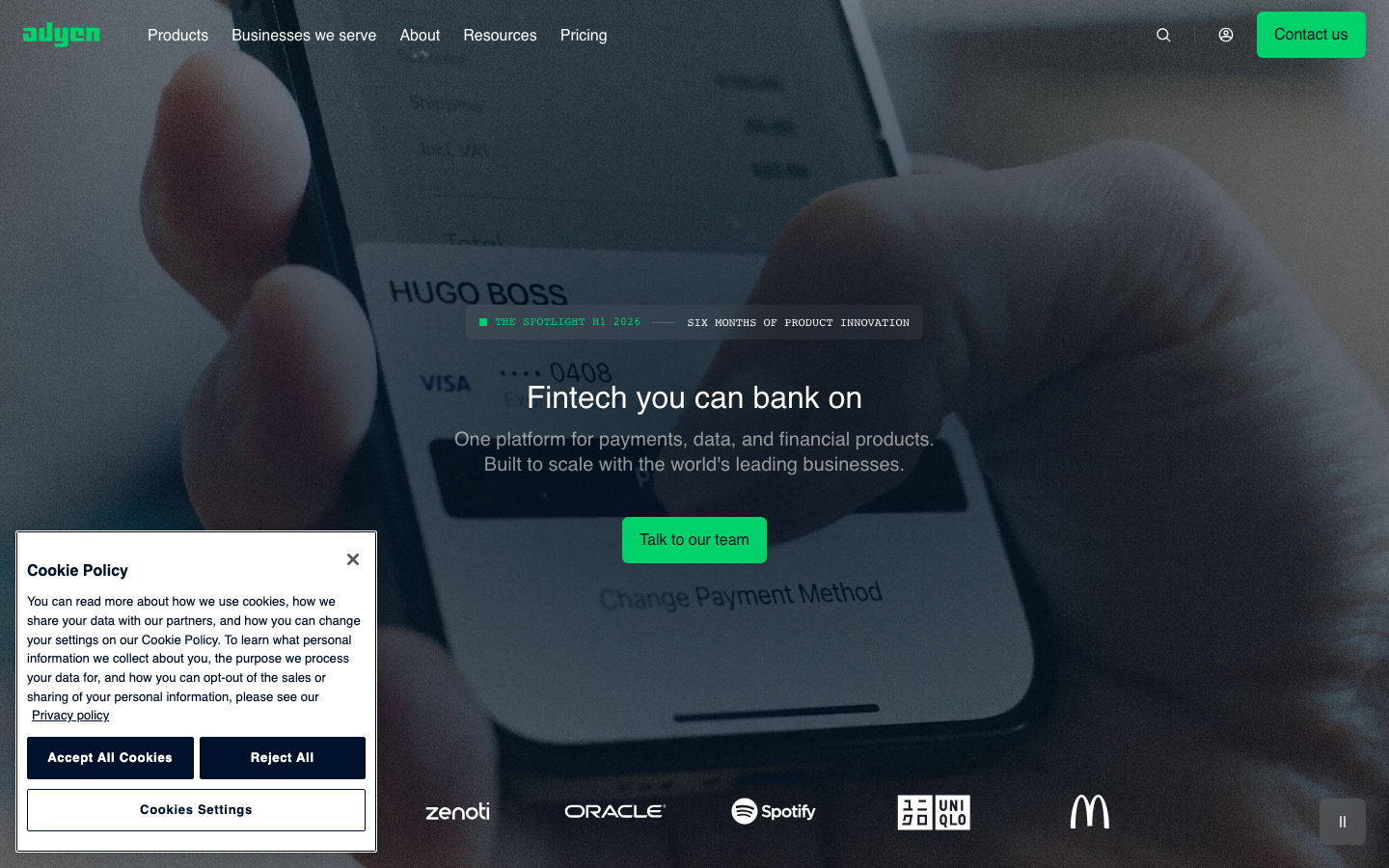
AdyenAI
Core parameters and statistics
| Parameter items | Public data |
|---|---|
| Product positioning | AI-empowered enterprise-level global payment platform |
| Core form | Single platform (payment + data + financial products) |
| Annual transaction volume | €1.4 trillion |
| System Availability | 99.999% Historical Uptime |
| Supported currencies | 150+ |
| Local payment methods | 200+ |
| Global Offices | 29 |
| Banking license | United States, United Kingdom, European Union |
| Industry coverage | Retail, tourism, digital media SaaS, catering, financial services |
| Key Accounts | Meta, Adobe, Prada, eBay, Nord Security, L'Occitane |
| Listing Information | Euronext (ADYEN) |
The core difference between Adyen and Stripe is the target market: Stripe targets all sizes (from startups to enterprises), while Adyen has a clear focus on large enterprises. Its "single platform" concept - payment processing, data analysis, risk control, financial products all delivered through the same API and Dashboard - is a core attraction for enterprise-level customers. AI capabilities are delivered embedded in revenue optimization and risk control modules.
User and market recognition
- Enterprise Customer Base: Global brands such as Meta, Adobe, Prada, eBay, Nord Security, L'Occitane, Vagaro, Rectangle Health and more use Adyen. Customer cases cover technology, luxury goods, retail, tourism and other industries.
- Scale Verification: With an annual processing capacity of €1.4 trillion, it is one of the largest payment processors in the world. 99.999% uptime is among the top levels of enterprise-grade SLAs.
- Bank License Advantage: Holds US, UK and EU banking licenses - this means that Adyen, as a licensed bank, can process transactions directly without going through a third-party bank intermediary. This has a material impact on the compliance and capital flow efficiency of large enterprises.
- Customer Results: Adobe maximizes subscription revenue with Adyen; Nord Security improves payment conversion rates by 10%; L'Occitane consolidates 40 systems into one and reduces reconciliation workload by 20%; Vagaro enables instant payments for 80,000+ merchants.
Cost advantage
C-side/individual users: Adyen does not directly target individual consumers. Users complete payments through Adyen when using platforms such as Meta and eBay, with no personal fees.
Developers/API Users: Adyen provides a REST API and SDK for integration. Unlike Stripe, Adyen does not provide free self-registration API access - all integrations require contacting the sales team and have business thresholds. API call charges are included in the overall payment processing rate.
Enterprise Customers: Adyen’s pricing model is a customized quotation based on transaction rates:
- Payment processing rate: Pricing based on transaction volume tiers, no public standard rate. Typically lower than Stripe’s standard rate (2.9% + $0.30), depending on transaction volume, industry, and payment method mix.
- Platform Fee: One-time integration fee and annual platform fee (if any) are subject to business negotiation.
- Financial product fees: Value-added services such as embedded finance, card issuance, and fund management are priced separately.
- Hidden Costs: Adyen's enterprise-grade integrations require more initial engineering investment (typically 2-6 months); custom rates and features require long-term contract commitments (typically 1-3 years); compliance reviews and multi-region banking license utilization require the cooperation of legal and compliance teams.
Main functions
- AI Revenue Optimization: Payment conversion rate optimization engine based on real-time transaction data. AI analyzes the characteristics of each transaction (amount, payment method, country, device, time, etc.), dynamically selects the optimal payment route and acquiring bank, and maximizes the transaction authorization rate. The effect is to increase the overall payment conversion rate by 1-5%.
- AI Fraud Management (RevenueProtect): Adyen's AI risk control system is trained on €1.4 trillion transaction data and evaluates the fraud probability of each transaction in real time. Supports custom rules engine to reduce fraud losses while minimizing false positive rate (False Positive).
- Single platform omni-channel integration: Online payment, offline POS, in-app payment, subscription billing Marketplace accounting, etc. are all managed through a unified API. Data is connected across channels, and AI analysis can cover cross-channel consumption behaviors such as "online browsing -> offline purchasing".
- Intelligent Money Movement: Unified management of payment collection, currency exchange, cross-border settlement and batch payments. AI optimizes the capital flow path (when to exchange currency, which channel to use for settlement) and reduces cross-border capital costs.
- Embedded Finance: Platform companies can provide payment, account and card issuance services to their sub-merchants or users through Adyen's banking license. AI is used to assess the creditworthiness and risk of sub-merchants.
Model and version evolution
Mainline release
- 2026 H1 (The Spotlight): Intelligent Money Movement enhances AI payment optimization and upgrades, embedded financial expansion, and platform capability enhancement.
- 2025: Revenue optimization AI tool launched; Adyen for Platforms enhancements (Marketplace splitting, sub-merchant management); banking license coverage expanded to major economies.
- 2023-2024: Adyen continues to strengthen its single platform capabilities and launches RevenueProtect risk control upgrades and embedded financial product lines. Global office footprint expanded to 29.
- 2019-2022: Adyen becomes a listed company (Euronext), expanding from payment processing to financial products and services. Combine acquisition and self-construction capabilities to strengthen enterprise-level services.
- 2006-2018: Adyen was founded with the vision of a "global single payments platform" to enable businesses to access global payment methods with one integration. In the early days, it mainly focused on cross-border e-commerce customers, and gradually expanded to omni-channel retail and platform customers.
Technical advantages
- Single platform vs patchwork system: Most large enterprises use a patchwork solution of "payment gateway + independent risk control + independent acquiring bank", and data and funds are separated between different systems. Adyen's single platform allows AI models to access full-link data from transaction initiation, risk control assessment to settlement reconciliation, and the accuracy of the trained optimization models is significantly higher than that of single-point AI in patchwork solutions.
- Direct connection advantage of bank license: As a licensed bank, Adyen can directly access card organizations and local clearing systems without going through a third-party bank. This architecture reduces the number of fund flow nodes and reduces transaction delays and loss risks.
- AI-driven dynamic payment routing: Traditional payment routing is static (a certain acquiring channel is fixedly used). Adyen's AI engine evaluates the authorization rate and cost of multiple available routes in real time for each transaction and selects the optimal path. The effect is to increase the overall authorization rate by 1-5%, and a single number corresponds to tens of millions of dollars in additional revenue.
- Global Data Training Risk Control Model: €1.4 trillion of cross-industry, multinational transaction data enables Adyen’s fraud detection models to identify geographic, industry-specific and seasonal fraud patterns, a breadth of data that cannot be achieved by single-country or single-industry payment processors.
How to use
- Web client: You can use it by visiting the official website and registering an account. Most functions do not require installation.
- API Access: Provides RESTful API, developers can obtain the API Key and integrate it into their own applications.
Product Pricing
Adyen's pricing model is "billing by transaction + customized platform fee", and there is no public standard price:
- Payment Processing Fee: Billed as a percentage of each transaction + a flat fee. Specific rates depend on transaction volume, industry, region and payment method combination. Typically includes routing costs for multiple acquirers.
- Platform Fee: One-time integration fee and/or annual platform maintenance fee.
- Value-added Services: Additional functions such as RevenueProtect (risk control), Revenue optimization, and embedded finance are priced separately.
- Currency conversion fee: exchange rate difference for cross-border transactions and multi-currency settlements.
- MINIMUM COMMITMENT: Enterprise clients are typically required to sign a 1-3 year contract and meet minimum monthly transaction volume requirements.
- Free Quota: No free quota. All usage is billed based on actual transaction volume.
Application scenarios
- Global Omni-channel Payments for Large Retailers: Brands such as Nord Security, L'Occitane, Prada and more use Adyen's unified platform to manage payments online, in-store and in-app. AI analyzes customer consumption behavior across channels and optimizes payment conversion rate. Implementation Tips: Omni-channel integration requires high initial investment, and requires coordination of online and offline technical teams to participate.
- Marketplace split account for platform enterprises: Platforms such as Uber and eBay need to process the "split payment" process of buyer payment, deducting platform commission and then settling the payment to the seller. Adyen for Platforms supports automatic accounting and batch settlement, and AI is used to assess the risk level of sub-merchants.
- Global collection optimization for subscription-based SaaS: Subscription-based SaaS such as Adobe uses Adyen to manage cross-regional and cross-currency subscription charges. AI dynamic payment routing ensures that users from different countries can obtain the highest authorization rate for their first payment and renewal.
- Cross-border payments in the travel and hotel industry: Travel platforms such as Booking.com need to handle a large number of cross-border transactions - consumers in different countries use different payment methods (such as iDEAL, Sofort, Alipay) to book hotels around the world. Adyen’s coverage of 200+ local payment methods is a core matching point.
Applicable people
- Payments Engineering Team at Large Enterprises: Adyen’s core users. For engineering teams that need to integrate and maintain global payment systems, Adyen's single API solution saves a lot of maintenance costs compared to connecting multiple local payment gateways. However, the enterprise needs to have sufficient engineering resources to support the integration cycle of 2-6 months.
- Corporate Finance and Fund Management Team: Intelligent Money Movement helps the financial team optimize global fund flows - when to exchange currency, which settlement channel to use, and the allocation strategy of funds among accounts in various countries.
- Platform product growth team: Platform products that need to provide payment capabilities for platform sub-merchants. Adyen’s embedded finance enables platforms to rapidly roll out payments, card issuance and treasury management services.
- Risk Control and Compliance Team: RevenueProtect’s AI risk control system and Adyen’s bank license compliance framework reduce the burden on enterprises to build their own risk control systems and compliance processes.
- Not suitable for the group: Small and medium-sized enterprises with an annual transaction volume of less than €10 million (Adyen's customized quotation model is not friendly to small and medium-sized merchants); Enterprises that do not want to sign long-term contracts (Adyen usually requires a 1-3 year commitment); Small merchants who only need a single payment method in a single market (self-service registration solutions such as Stripe are more suitable).
Summary and Outlook
Adyen's core competitiveness lies in the trinity of "licensed bank + single platform + global coverage" - holding a US/UK/EU bank license allows it to directly connect to the clearing system as a bank, a single platform architecture enables AI models to access full-link payment data, and €1.4 trillion transaction volume and 200+ payment method coverage constitute a scale barrier. AI Revenue Optimization and RevenueProtect are the main delivery forms of its AI capabilities.
Current limitations: Adyen does not provide self-service registration and public pricing. All purchases need to contact the sales team and go through business negotiations. The entry threshold for small and medium-sized enterprises is high; the integration cycle is long (2-6 months), which is not suitable for small projects that need to be launched quickly; the AI function is mainly for payment optimization and risk control, and has limited coverage in areas such as financial forecasting and customer analysis; it cannot provide Agent-oriented interfaces such as MCP Server like Stripe.
Procurement/Adoption Risk Assessment: Adyen is suitable for medium to large enterprises with an annual transaction volume of €10 million or more. Before purchasing decisions, it is necessary to evaluate: 1) The complexity of the existing payment system (multiple acquirers, multiple regions, multiple channels) - Adyen's unified value is the greatest in this scenario; 2) Contract terms (minimum committed transaction volume, contract years, early termination clauses); 3) The expected ROI of AI Revenue Optimization (the sales team can be asked to provide conversion rate improvement data of customers in similar industries as a reference benchmark). It is recommended to clarify the SLA terms (compensation mechanism for 99.999% uptime) and the AI risk control system’s commitment indicators on the false rejection rate in contract negotiations. Adyen is a listed company, and its products and pricing are relatively transparent and predictable.
How to use Adyen AI
Adyen's integration paths are geared toward enterprise-level engineering teams:
- Contact Sales: Go to adyen.com/contact/sales to submit your requirements, and the sales team will provide a quotation and integration solution after evaluation. Self-service registration is not available.
- API Integration: Complete payment integration using Adyen REST API or SDK (supports Python, Java, PHP, Node.js, .NET and other languages). Typical integration scope includes: Checkout (checkout page), Webhook (asynchronous notification), Reports (reconciliation report).
- Dashboard Configuration: Configure payment methods, risk control rules, routing policies and reporting settings in the Adyen Customer Area. Parameter configurations of AI functions (such as RevenueProtect risk control thresholds) are also managed in the Dashboard.
- Online Test: Use Adyen Test API to simulate the transaction process, verify the correctness of the end-to-end integration and then switch to production.
- Typical integration cycle: 4-8 weeks for basic payment integration; 2-6 months for complete integration including risk control, subscription management and multiple payment methods, depending on the complexity of the enterprise system.
Version Info
- The Spotlight H1 2026 :H1 2026 product updates, including Intelligent Money Movement, enhanced AI payment optimization and upgrade, and embedded financial expansion. There is no official precise date yet.
- Adyen 2025 Platform :Launched Adyen for Platforms enhanced revenue optimization AI tool and bank license extension (US/UK/EU). There is no official precise date yet.
User Reviews