 Adzooma
Adzooma is an integrated PPC and SEO optimization platform for AI office collaboration. Through AI-driven audits and recommendations, it helps small and medium-sized teams reduce management costs and increase investment returns on Google, Meta and Microsoft Ads.
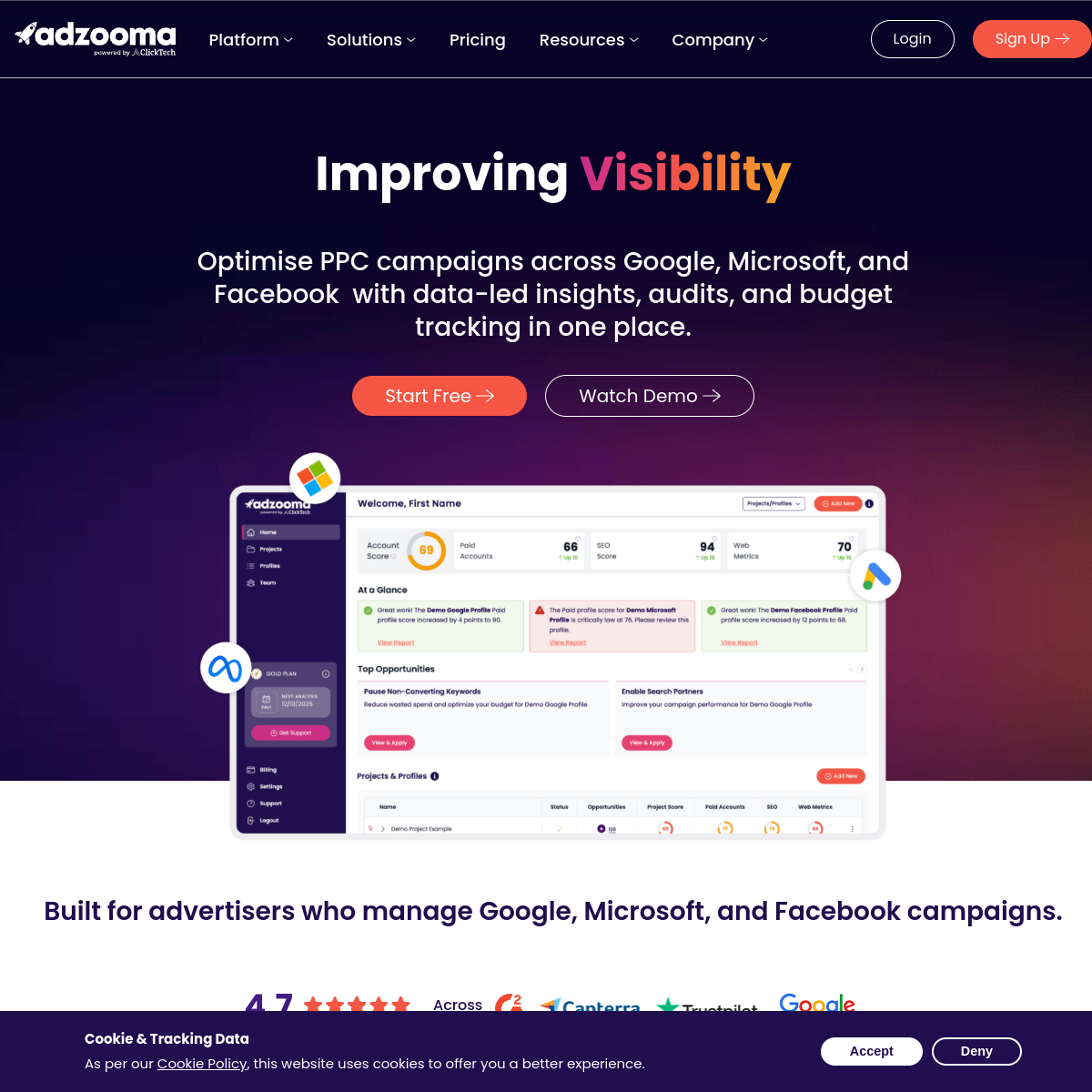
Adzooma
Core parameters and statistics
Adzooma's core positioning is to provide a "one-stop diagnostic cabin for advertising accounts" for small and medium-sized enterprises and marketing teams, rather than another independent advertising management backend. It does not perform the execution of advertising (creating and modifying campaigns still requires returning to the Google/Meta/Microsoft native platform), but builds an AI analysis layer on top of each campaign to be responsible for cross-platform data aggregation, opportunity discovery and prioritization.
| Projects | Public Information |
|---|---|
| Official positioning | PPC and SEO health diagnosis and optimization platform |
| Target users | PPC marketers, freelancers, digital agencies, e-commerce brands |
| Delivery form | Web SaaS |
| Coverage platforms | Google Ads, Meta Ads (Facebook), Microsoft Ads |
| Auxiliary capabilities | SEO audit Web indicator monitoring, budget tracking |
| Reports Generated | 48M+ Free Performance Reports |
| Ad Spend Analyzed | $17 Billion+ |
| Improvement suggestions made | 23 million+ |
| User rating | 4.7/5 (aggregated rating platform) |
| Parent company | ClickTech Solutions Ltd. (UK) |
Data scale: The official website’s public display platform has generated more than 48 million free performance reports, analyzed more than 17 billion US dollars in advertising spending, and put forward more than 23 million account improvement suggestions. These numbers show that it is not an experimental product, but a practical tool that has been verified by large-scale real delivery data.
Significance of the score: The aggregate score of 4.7 plus multiple user reviews (including PPC practitioners and agencies) indicate that Adzooma’s delivery quality has been recognized by the market segment in the two urgently needed scenarios of “account audit operability” and “cross-platform unified view”.
Boundary Note: Adzooma does not directly perform advertising operations, nor does it provide its own advertising channels; its value lies in allowing advertisers to use the least manual work and discover the "low-hanging fruit" in the account in the shortest time - wasted budget, ignored keyword opportunities, and space that can be optimized in the bidding strategy.
User and market recognition
Adzooma’s market recognition comes more from vertical word-of-mouth diffusion than from large-scale brand exposure. Its user base is concentrated among PPC practitioners - those small and medium-sized teams who need to switch repeatedly between Google Ads, Meta Ads and Microsoft Ads every day and manually pull reports.
User Feedback: The user reviews published on the official website mentioned that "Adzooma can find problems that I can't find myself", "The report clearly shows the current performance and areas for improvement", and "The suggestions are very clear and can be implemented quickly." Many users position it as a "must-have tool for daily management" rather than an "icing on the cake".
Customer Cases: After using Adzooma, agencies such as Phonetic Digital have expanded more customers and new channels without hiring additional staff, indicating that the tool's scalability capabilities have been verified in actual business scenarios.
Industry Certification: Adzooma has obtained the Google Partner badge, Microsoft Advertising Partner and Meta Business Partner triple certification, which is not common among independent third-party advertising optimization tools, indicating that its technical docking and data compliance capabilities have passed the review of the three major platforms.
Geographical Distribution: Although Adzooma is based in the UK (ClickTech Solutions Ltd.), its services are oriented to the global English-speaking market, mainly covering mature PPC markets such as the United States, the United Kingdom, Canada, and Australia.
Cost advantage
Adzooma's cost structure does not only differentiate between "free/paid" like general SaaS, but differentiates around reporting frequency and depth, which has very practical significance for advertisers at different stages.
C client/individual user: Free plan ($0/month) can get monthly PPC report, monthly opportunity analysis, 3 PPC warnings, unlimited ad account connection and budget tracking, suitable for solo freelancers or small e-commerce just starting to verify the value, no explicit costs are incurred, and the implicit cost is that the frequency of analysis is low (monthly) and only a limited number of optimization opportunities can be seen.
Team & Agency: The Silver plan ($69/month, approximately $55/month annually) increases the frequency to weekly, unlocking 10 alerts for all available opportunities (including customization), 5 SEO profiles, 5 web metric profiles, and unlimited seats and brand reports. This is the most commonly chosen level by agencies and in-house teams. The core leverage is "unlimited seats" - the cost per person for a team of 3-5 people can be as low as $14-23/month**.
Scaled Team: The Gold plan ($179/month, approximately $143/month annually) upgrades the frequency to daily, with unlimited early warnings for SEO and Web indicator files, and comes with priority support. For agencies that manage multiple large accounts or serve several clients simultaneously, a daily scan cadence can mean hours of manual inspection time lost.
Enterprise/Privatization: The official website clearly states "Need something bespoke, We can build that". Enterprise pricing needs to be confirmed by contacting the business. Compliance Tip: Enterprises need to focus on confirming the data storage location, audit log SSO and contract SLA before purchasing - these are not disclosed in detail on the public pricing page.
Hidden benefits: The real cost advantage of Adzooma is not low in absolute terms, but in compressing the repetitive work of "manual inspection + pulling reports + analysis opportunities", which may take 2-4 hours a week, into a 5-10 minute review after logging in. For a PPC specialist making $50-100 an hour, the savings of 6-12 hours per month can cover the annual fee for the Silver plan.
Main functions
Adzooma's functional matrix is not a simple "report generator", but is designed around the four stages of "audit → early warning → suggestion → execution tracking":
-
Cross-platform PPC account audit: After connecting Google Ads, Meta Ads and Microsoft Ads, a complete health score report is generated within 5-10 minutes, covering account structure, keyword quality score, bidding efficiency, wasteful expenditure and other dimensions, and sorted by urgency and impact. This is the core entry function of Adzooma and a key touch point for users’ first experience.
-
30+ pre-built automated warnings: Covering highly sensitive scenarios such as abnormal CPA spikes, budget overruns, and sudden drop in conversion rates. Supports custom thresholds and rules, and early warnings can be pushed in real time via Email or Slack, reducing the time-consuming manual monitoring of disks. The customizability of early warning determines whether it can adapt to the delivery rhythm of different industries.
-
Intelligent Optimization Suggestion Engine: Based on historical account data and industry benchmarks, it provides executable suggestions such as "budget adjustment, keyword expansion/pause, and bid strategy changes". The key differentiator is that the recommendations not only mark the problem, but also come with an expected impact estimate (such as "ROAS is expected to increase by X% after repair") to help users filter by ROI priority.
-
Performance Max Toolkit: A diagnostic module specifically for Google PMax campaigns that reveals product group performance, search term consumption and audience signal quality that are hidden in Google native reporting, which is rare in third-party tools.
-
Shopping Ads Enhancer: For e-commerce scenarios, automatically audits product feed quality, identifies disapproved, incomplete information or low-potential products, and gives optimization priorities to directly benchmark the GMV protection needs of e-commerce peak seasons.
-
Budget tracking and cross-platform comparison: Summarize expenditures across channels in real time, display budget consumption speed and expected deviations through a visual dashboard, and discover overspending risks in advance instead of reviewing them afterwards.
-
SEO & Web Metrics Audit: Provides technical SEO checks (page speed, indexability, structured data) and website performance scoring as a supporting capability. This part is not as deep as professional SEO tools, but it is enough to cover 80% of basic problem detection needs for small and medium-sized teams.
Model and version evolution
Adzooma's function iteration rhythm is highly coupled with the API changes of the advertising platform, rather than the multi-version linear evolution of traditional software:
Early Phase (2020-2022)
- Public Launch (~2020-01): The first available version supports basic connection and report generation of Google Ads and Facebook Ads. The core value lies in "automatic pulling + preliminary diagnosis", replacing the old process of manually exporting CSV and then making a pivot table in Excel.
- Automated Alerts Launch (~2022-03): Launches 30+ pre-built alert templates, upgrades from passive reporting to active monitoring, marking the product's transformation from an audit tool to an operational monitoring platform.
Cross-platform phase (2022-2024)
- Cross-Platform Dashboard (~2024-06): Unify Google, Meta and Microsoft Ads into a comparison dashboard, solving the most troublesome "data island" problem for multi-platform advertisers. New budget tracking and cross-platform comparison reports were added during the same period.
Intelligent optimization stage (current)
- Smart Recommendations Update (~2026-02): The core recommendation engine is upgraded, Introducing expected impact estimation and ROI prioritization, adding PMax toolkit and Shopping Ads Enhancer. This version marks the evolution of Adzooma from "telling you there is a problem" to "telling you the most cost-effective way to change it."
Version Rhythm: Adzooma does not have a strict semantic version number, but uses the function module name and the year mark. The driving force for iteration mainly comes from two major external factors: one is the API changes of the three major advertising platforms (especially the abandonment and update of the Google Ads API), and the other is the functional sprint before the e-commerce peak season (Black Friday/Christmas).
Technical advantages
The technical barrier of Adzooma is not in the complexity of the underlying model, but in the "consistency of multi-platform data pipelines" and "industry adaptability of analysis rules":
Cross-platform data pipeline: Connect to Google Ads API, Meta Marketing API and Microsoft Advertising API at the same time, ensuring the unified definition of account structure mapping, attribution model alignment and key indicators (impressions/clicks/spends/conversions) of the three. The real difficulty is that each platform has different definitions of "conversion" (Google's Floodlight vs Meta's Pixel vs Microsoft's UET). Adzooma needs to perform normalization at the bottom level to support cross-platform comparison.
Suggestion rules engine: Different from the question-and-answer suggestions of general large models, Adzooma's analysis layer is a rule system based on the experience accumulated in the PPC industry, covering dozens of diagnostic nodes such as keyword quality score optimization, match type adjustment, bidding strategy verification, audience overlap detection, and budget reallocation**. The advantage of this rule system is that it is highly interpretable (each suggestion can be traced back to specific account data), but the disadvantage is that it needs to be maintained as the platform is updated - this is the heaviest part of the continuous investment in vertical tool products.
AI's classification role: The "AI" in Adzooma is more reflected in the level of rule automation - automatically identifying abnormal patterns, automatically sorting opportunity lists, and automatically generating reports, rather than generative AI (such as using LLM to write advertising copy). This means that its output is predictable and auditable, and is more in line with advertisers’ demands for budget security.
Early Warning Architecture: A two-layer structure with 30+ pre-built early warnings and custom thresholds, enables early warnings to cover 80% of common risk scenarios under the default configuration, while retaining flexible space for advanced users. The triggering frequency of early warnings (month/week/day) is directly linked to the paid plan, forming the main feature upgrade path from free to premium.
How to use
The entrance and landing path of Adzooma are designed differently for different roles:
| How to use | Suitable for people | How to start | Cost |
|---|---|---|---|
| Web console | All users | Visit app.adzooma.com to register, connect your ad account to generate your first report | Free plan $0/month |
| Free performance report | Unregistered visitors | Generate Google/Meta/Microsoft single-platform free reports separately on the official website, no registration required | Free |
| Silver/Gold Subscription | Agencies and in-house teams | Upgrade your plan within the console to increase scan frequency and feature breadth | $69/month or $179/month |
| Enterprise plan | Customized demand organization | Contact the sales team to confirm the deployment method | Business confirmation required |
Typical implementation steps:
- Connect account: Authorize read permissions for Google Ads, Meta Ads or Microsoft Ads (Adzooma is read-only access and does not involve modification, reduce security concerns).
- Get Baseline Report: The first report is typically generated within 5-10 minutes and includes an account health score, a list of opportunities, and improvements sorted by urgency.
- Configure early warning rules: Set CPA/CPC/expenditure thresholds based on budget size and key indicators, and select Slack or Email notification channels.
- Regular review of suggestions: Log in to view new suggestions according to the plan frequency (month/week/day), mark "executed" or "ignore", gradually accumulate account optimization history, and form traceable effect attribution.
- Team collaboration: Silver and above plans support unlimited seats and can be assigned read-only/administrator rights, which is suitable for division of labor within the agency.
Quick Verification Suggestion: New users are advised to first run through their existing main accounts with the free report, compare the list of problems automatically discovered by Adzooma with the results of their own manual inspections, and evaluate the "missing rate" and "recommendation accuracy rate" - this is the most direct way to judge whether the tool is worth paying for.
Product Pricing
Adzooma’s pricing structure is clear and concise, with three public plans plus a custom enterprise plan:
| Plan | Price (monthly payment) | Price (annual payment, equivalent to monthly payment) | Core differences |
|---|---|---|---|
| Free | $0 | $0 | Monthly Reports and Opportunity Analysis 3 Alerts 1 SEO/Web Profile |
| Silver | $69 | ~$55 (20% savings) | Weekly reports and opportunity analysis, 10 warnings (including customization), unlimited seats, brand report |
| Gold | $179 | ~$143 (20% savings) | Daily reports and opportunity analysis, unlimited alerts, unlimited files, priority support |
| Enterprise | Business confirmation required | — | Custom reporting frequency, private deployment or integration requirements |
Free quota boundary: The "limited opportunities" of the Free plan means that only some optimization suggestions can be seen, and the complete list of opportunities requires upgrading to Silver or above. In addition, the free version only has 3 PPC alerts and cannot use custom alert templates, so the alert coverage scenarios are relatively limited.
Annual discount: You can save 20% by paying annually. The Silver plan has an annual payment of about $660/year (equivalent to a monthly average of $55), and the Gold plan has an annual payment of about $1,716/year (equivalent to a monthly average of $143). For long-term agencies, annual payment is a more economical option.
Hidden Costs: The warnings and reports of all solutions depend on the stability and frequency control quota of the API. In extreme cases (such as encountering Google Ads API frequency control or outage), the data refresh timeliness may be affected. It is recommended that users reserve a manual backup solution.
Application scenarios
Adzooma's implementation scenarios focus on "cross-platform, standardization, and high-frequency duplication" account management:
-
Agency batch account inspection: For an agency team that manages 5-50 client accounts, the manual audit time of switching between platforms is often more than 2-4 hours per day. Adzooma's daily audit + early warning push can compress inspections to 15-30 minutes, and the freed man-hours can be used for strategic analysis and customer communication. The focus of the verification is whether the agency's account structure is compatible with Adzooma's rules engine (if there are a large number of custom tags or unconventional bid strategies, false positives may occur).
-
PPC stop loss for small and medium-sized e-commerce: For e-commerce sellers with a single-store advertising budget of $5,000-50,000/month, the most common problem is that the budget is spread over inefficient keywords and not discovered in time. Shopping Ads Enhancer and PMax toolkit can quickly identify inefficient SKUs in product feeds and provide suggestions for pausing or adjusting prices. The key point of verification is whether the tool's parsing granularity of the product feed matches the complexity of its product catalog.
-
Freelancer client delivery efficiency: Independent PPC consultants usually serve 3-10 clients, and the preparation time of each client's weekly report is 1-2 hours. Adzooma’s automated reporting plus branding feature compresses report generation to 5 minutes, and the Silver plan is unlimited seats with no additional charges for the number of customers. The focus of the verification is whether the degree of customization of the brand report meets the customer's visual style requirements.
-
Account health check before major e-commerce sales: 2-4 weeks before major sales such as Black Friday Prime Day, full account scanning and problem repair are standard operations. Adzooma's PMax toolkit and budget monitoring work together during this window to help operations teams plug budget holes before traffic surges.
Applicable people
Adzooma’s three-tier solution design itself has mapped the hierarchical adaptation of the target population:
-
Freelance PPC Consultant: The Free plan offers monthly baseline reporting, and the Silver plan's weekly frequency with unlimited seats for brand reporting directly matches their client lead times. Prerequisites: You need to manage at least 1 advertising account and have a basic understanding of the basic concepts of PPC (CPA, ROAS, quality score).
-
In-house marketing team (3-10 people): The daily scanning frequency and unlimited number of files of the Gold plan are suitable for the internal operation teams of small and medium-sized enterprises. Real-time push of daily main value in early warning-avoiding the expansion of single-day losses due to budget overruns or abnormal conversions. Prerequisites: The team has established a basic advertising account permission classification and approval process.
-
Digital agency (more than 10 people): The unlimited seats of the Silver/Gold plan means that the agency does not need to pay per head, the cost structure is relatively fixed, and the growth of the number of clients does not increase tool expenses linearly. Prerequisite: It is necessary to confirm whether Adzooma's read-only access to customer accounts complies with the agency's own compliance and privacy terms.
-
E-commerce Operations and Category Manager: Shopping Ads Enhancer and PMax toolkit directly serve the e-commerce scenario. The core value lies in discovering inefficient delivery from the granularity of the product SKU level. Prerequisite: The e-commerce platform has been connected to Google Merchant Center or Facebook Catalog.
Does not fit boundaries:
- Heavy customization requirements: If you need to deeply customize report dimensions, privatize deployment, or deeply integrate with internal CRM/BI systems, Adzooma's public solution may not be flexible enough, and the enterprise customization threshold and waiting period need to be confirmed by business.
- Non-English Market: Adzooma currently mainly covers the English-speaking market. The degree of support for Chinese, Japanese, Arabic and other non-English advertising accounts has not been disclosed. Non-English users need to verify by themselves.
- Pure SEO needs: SEO audit is only an auxiliary function and is not as in-depth as professional tools such as Ahrefs and Semrush. SEO-focused teams should not use it as the main tool.
Summary and Outlook
The core value of Adzooma is not to create some kind of "AI new paradigm", but to deeply engineer and encapsulate the most tedious and repetitive "data pulling → problem discovery → prioritization" section in PPC management. It does not replace advertising decisions, but it significantly shortens the perceived distance "from data to action".
Current limitations: The suggestion engine still mainly relies on deterministic rules rather than generative AI, which means that edge scenarios not covered by the rules (such as emerging ad formats, non-conventional attribution models) may be missed; API dependencies may cause data delays during platform upgrades (such as before and after the Google Ads API version is deprecated); the difference in reporting frequency (month/week/day) of paid plans directly limits the depth of use for free users.
Follow-up observation points: First, whether the suggestion engine will introduce LLM for more flexible policy interpretation and natural language interaction; second, whether it can be expanded to emerging channels such as TikTok Ads and Amazon Ads, which will directly affect the moat depth of its "cross-platform" positioning; third, whether the collaborative direction within the ClickTech product matrix (Omni, Hub, etc.) will generate data interoperability value.
Procurement/Adoption Risk Assessment: Small and medium-sized teams are recommended to start with the Free plan, use 2-4 weeks to verify the accuracy of the recommendations and early warning coverage, and confirm that the "missing rate" for existing account management is within an acceptable range before upgrading to the Silver annual payment plan; agencies need to focus on verifying the data isolation mechanism (whether multiple customer accounts are strictly isolated), custom space for brand reports, and data retention clauses in the contract; before purchasing, enterprises need to clarify the data storage location, audit log availability, and SSO to the sales team The support status of the integration, these details are still not fully disclosed on the public page.
Related tools:  Notion AI, google-workspace
Version Info
- Smart Recommendations Update :Enhance the cross-channel suggestion engine, optimize keyword and budget recommendation logic, and add the Performance Max toolkit and Shopping Ads Enhancer module to improve the executability and ROI traceability of suggestions.
- Cross-Platform Dashboard :Unify Google, Meta and Microsoft Ads dashboards to support cross-platform comparison reporting and unified budget tracking. There is no official precise date yet.
- Automated Alerts Launch :Launched 30+ pre-built PPC alert templates, supporting custom rule thresholds and Slack/Email notifications. There is no official precise date yet.
- Public Launch :The first available version supports Google Ads and Facebook Ads account connection and basic optimization suggestions. There is no official precise date yet.
User Reviews