 Aether
Free
Aether
Free
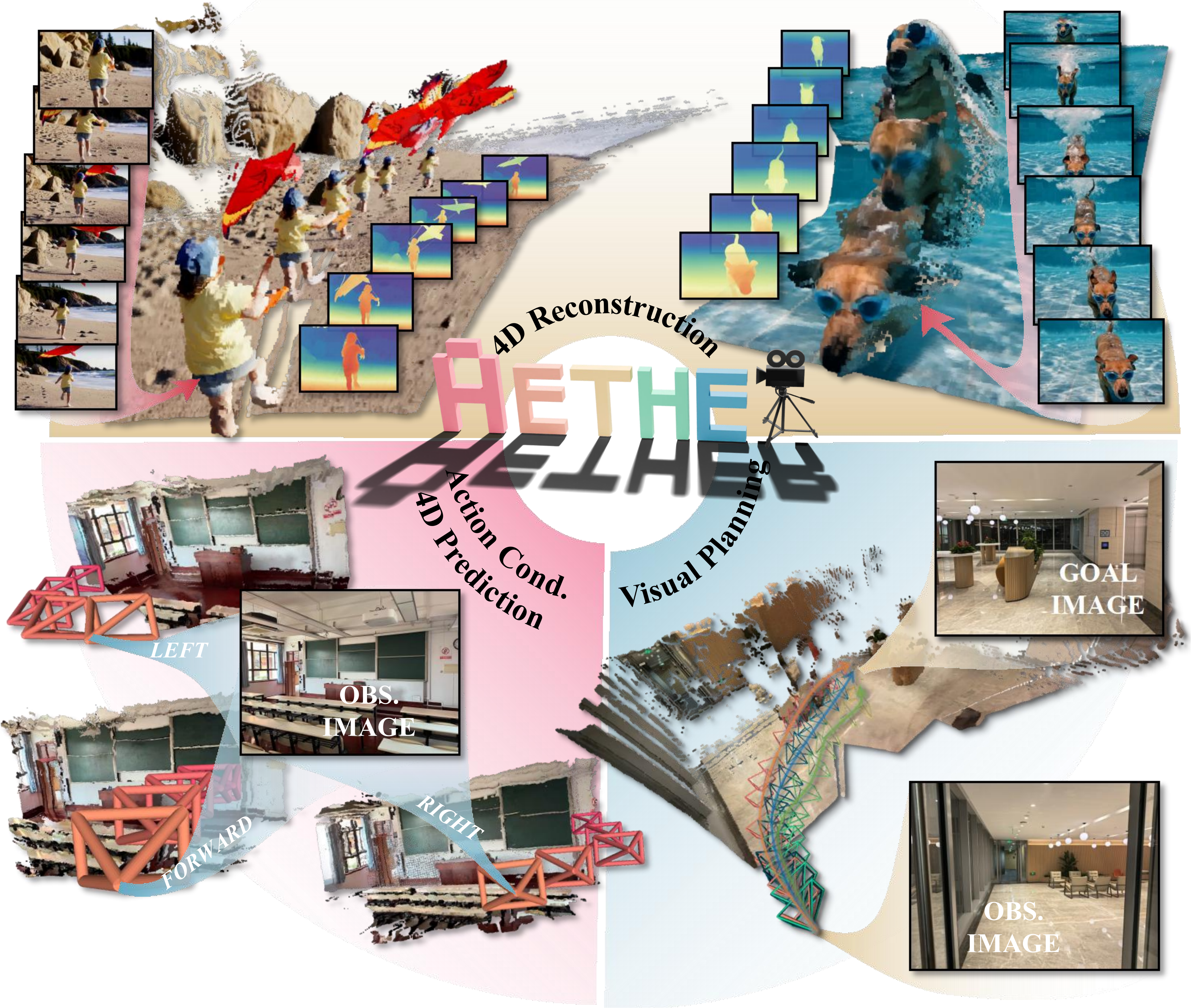
Aether is a geometrically aware world model framework that unifies dynamic reconstruction, action condition video prediction, and goal-oriented visual planning into the same architecture. It is suitable for research teams to conduct basic verification of world models.
Aether tool text
Core parameters and statistics
| Parameters | Current public information | Description |
|---|---|---|
| Product positioning | Open source world model research framework | Not commercial SaaS, but research infrastructure |
| Core tasks | 4D reconstruction, video prediction, visual planning | Three-task unified architecture |
| License Agreement | MIT License | Available for Research and Commercial Use |
| Model weights | Public (Hugging Face) | AetherV1 can be downloaded directly |
| Contextual requirements for inference | Linux + CUDA + ≥24GB VRAM | GPU resources required |
The starting point of Aether's design: the value of the world model is not only in "generating good-looking videos", but also in its ability to simultaneously understand geometric space, predict action results, and support goal planning.
User and market recognition
- InternRobotics is a team with a certain academic background. The project is open sourced under the MIT License, indicating that it remains open to both research and commercial applications.
- The tight pace from paper submission to AetherV1 public release in 2025 shows that the project is in an active advancement stage.
- The number of public citations and enterprise users is not disclosed; it is better to think of it as a research community tool rather than a mature commercial product.
Cost advantage
- C-side/Individual: Not for ordinary individual users, more suitable for researchers with GPU resources.
- Developer/Researcher: The MIT license is public and the download weight is free; the main cost is GPU computing resources.
- Enterprise/Private: There is no commercial purchase page; if enterprises want to use it, they need to evaluate the cost of GPU resources and engineering access by themselves.
Its real hidden benefit is to reduce the time to build world model experiment context from scratch; the hidden cost is high VRAM requirements and dependence on Linux/CUDA context.
Main functions
- 4D Dynamic Reconstruction: Reconstruct three-dimensional geometric structures in dynamic scenes to distinguish static backgrounds from moving objects.
- Action-conditioned Video Prediction: Using the camera trajectory as the action condition, predict the corresponding future video frame sequence.
- Goal-conditioned Visual Planning: Given a goal state, infer the sequence of visual paths required to reach the goal.
- Local Gradio Demo: Officially provides an interactive demo that can be run directly to facilitate quick verification.
- Public model weights and inference code: AetherV1 weights are hosted on Hugging Face, and the inference scripts are public in the GitHub repository.
Model and version evolution
- 2025-03-24/arXiv v1: The first version of the paper is submitted, and the method description and quantitative evaluation are disclosed.
- 2025-03-28 / AetherV1 full release: GitHub README confirms that the model weight, project website, and inference code are released simultaneously.
- 2025-07-28/arXiv v3: A revised version of the paper is released, with updated comments and instructions.
Aether's iterations focus on research completeness: making methods reproducible first, and then expanding task coverage with subsequent work.
Technical advantages
-
Mechanism: Joint optimization of geometric reconstruction and generative modeling, shared spatial representation.
Effect: Different tasks share geometric priors, reducing the consistency drift of multi-task independent modeling. Applicable scenarios: World model research that requires spatial awareness, autonomous driving scene simulation.
-
Mechanism: Camera trajectory as geometry-informed action space.
Effect: Prediction and planning use more stable geometric conditions instead of abstract tokens. Applicable scenarios: Research on visual planning and action condition video prediction.
-
Mechanism: Three-task unified architecture (reconstruction + prediction + planning) shared backbone network.
Effectiveness: No need to maintain models independently for each task, reducing research iteration costs. Applicable scenarios: Basic research on world models, embodied intelligence multi-task verification.
How to use
- Getting Started: Clone the GitHub repository → Install dependencies (CUDA, torch, gradient, etc.) → Download AetherV1 weights → Run the local demo.
- Research path: Design experiments based on AetherV1 → Modify task conditions → Evaluate the performance of three tasks.
- Project access path: Modify and integrate into your own research or application scenarios according to the terms of the MIT license.
Product Pricing
| Level | Current public status | Description |
|---|---|---|
| Research use | Free (MIT License) | Weights, codes, and documents are all open source |
| Commercial Use | Permitted (MIT License) | Subject to MIT Terms |
| Hosting Services | Undisclosed | No commercial API or hosting solutions yet |
For most research teams, the main cost is not the license, but GPU resources and engineering adaptation time.
Application scenarios
- Basic Research on World Model: Verify the unified modeling method under geometry awareness.
- Autonomous driving scene simulation: Action condition video prediction can be used for driving scene testing.
- Embodied Intelligent Planning Verification: Target condition visual planning is suitable for prototype verification of robot grasping and navigation tasks.
Applicable people
- World Model Researchers: A research team that verifies the geometry-aware unified modeling method.
- Robotics/Embodied Intelligence Engineers: Teams that require joint validation of 4D reconstruction and vision planning.
- Autonomous Driving Algorithm Team: A technical team that conducts scene dynamic prediction and visual planning research.
Doesn’t fit the boundaries: It’s not a commercial video generation SaaS out of the box; it can’t be used directly by teams without GPU resources and Linux engineering capabilities.
Summary and Outlook
It provides competitive solutions in its field, and its core value lies in lowering the threshold for AI use in this field.
Current limitations: Some advanced features require paid subscription, and the free version has function or usage restrictions; specific technical details and performance benchmarks have not yet been fully disclosed.
Related tools:  Hugging Face, replicate
Reference sources
- https://aether-world.github.io/
- https://github.com/InternRobotics/Aether
- https://arxiv.org/abs/2503.18945
- https://huggingface.co/AetherWorldModel/AetherV1
Version Info
- AetherV1 :The GitHub README clearly annotates the AetherV1 model weights, the paper, the project website, and the inference code have been released.
- arXiv v1 Submission :The first version of the paper was submitted to arXiv, and the Aether method and evaluation results were disclosed for the first time.
User Reviews