 Affinity
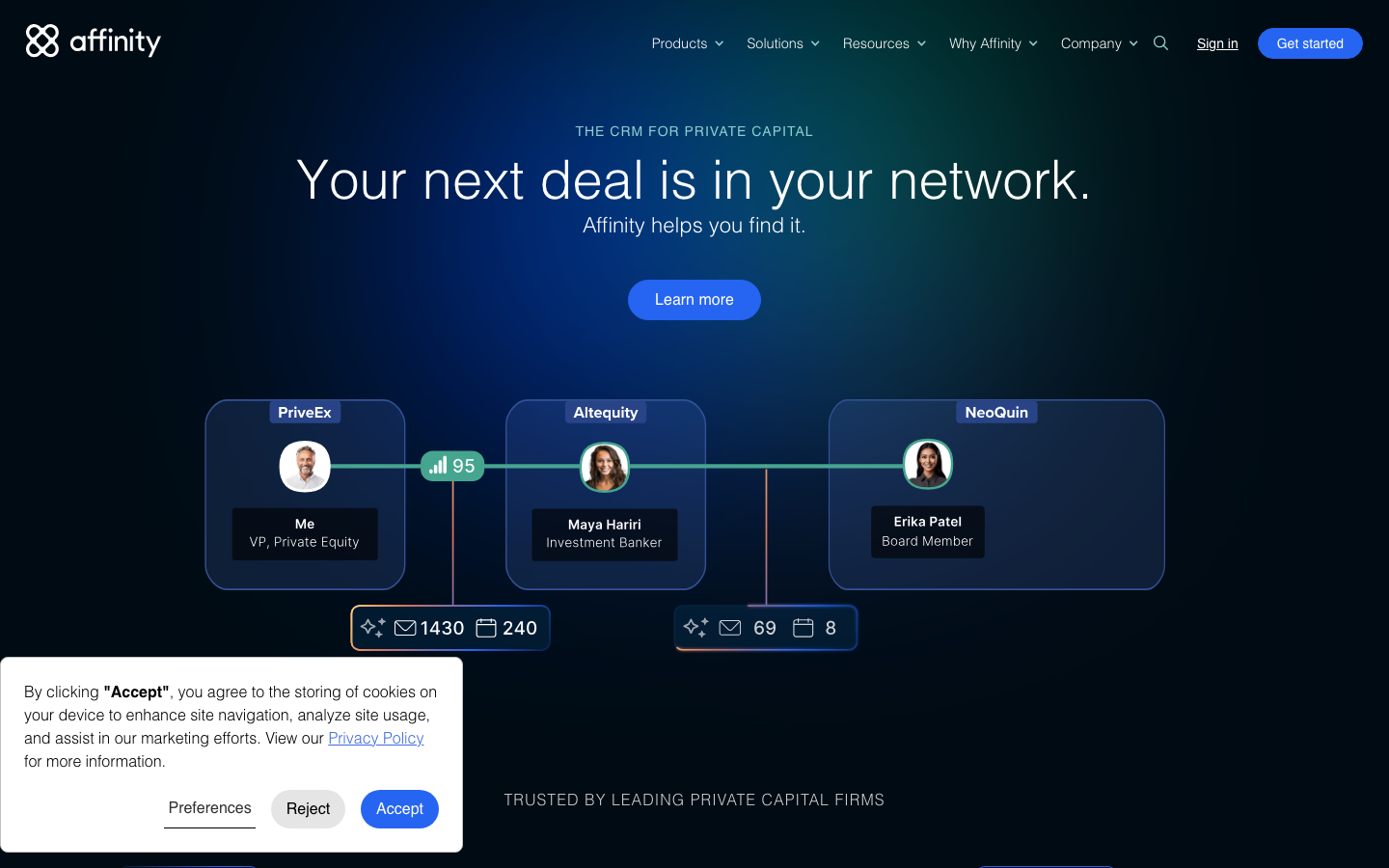
Affinity is a relationship intelligence CRM that uses AI to automatically analyze email and calendar data, build a team's interpersonal relationship map, and help discover and utilize existing network resources to promote sales.
Affinity
Core parameters and statistics of Affinity
Affinity's product logic is fundamentally different from general CRM: it is not a tool to help the team record "who the customer is", but a relationship intelligence engine that answers "who knows this customer". Its core asset is an automatically constructed team relationship map - extracting relationship signals from daily communication behaviors such as emails, calendars, and meetings, quantifying the temperature and strength of each connection, and turning hidden connections into searchable and recommendable organizational assets.
| Projects | Public Information |
|---|---|
| Official positioning | Relationship intelligence CRM for private equity capital |
| Core Differentiation | Automatic Relationship Graph + Warm Intro Engine |
| Data source | Email, calendar, meeting CRM system 40+ data suppliers |
| AI capabilities | Relationship strength scoring, strong and weak connection analysis, referral path recommendation, automatic contact portrait |
| Typical clients | Venture capital, private equity, investment banks, family offices, asset management companies |
| Customer scale | 3,000+ institutional customers |
| Deployment method | Cloud SaaS / Salesforce plug-in |
| Support Platform | Web + Mobile App |
| Latest version | Affinity 2026 (~2026-07) |
Brief review in one sentence: Affinity turns "who knows whom", the most difficult variable in sales, into a set of searchable, scoreable, and automated workflow engines - it does not replace Salesforce, but completes the missing "relationship layer" in Salesforce.
Publicity Verification: Affinity's official website claims to "save 220 hours of manual data entry per person per year" and "used by 3,000+ institutions." The official case page provides verifiable figures such as 8VC reducing transaction process time by 50%, and BDC Capital increasing the number of tracked organizations and contacts by 5 times (to 32,000 organizations/105,000 contacts). The core selling point "automatic relationship graph" has been repeatedly verified in cases in various industries, and there is no over-promise.
Affinity’s users and market recognition
Affinity's market recognition is concentrated in the private equity vertical field - it is not a challenger to a general CRM, but a niche leader in the private equity track.
Customer lineup: Leading institutions such as Lightspeed, Fidelity, Okta, Bain Capital, JLL, BlackRock, Bessemer, Notable Capital, Speedinvest, etc. are all using Affinity. Among them, the public evaluation of Bain Capital Ventures partner Kevin Zhang is representative - "Affinity is not only better, for most teams, it determines whether your pipeline management is successful or cannot be tracked at all."
Quantified Results: Verifiable ROI data from the official customer case library:
- 8VC: 50% faster deal processing time with Affinity CRM and Pathfinder extensions
- Seaside Equity Partners: 15+ closed deals and thousands of new relationships since implementation
- Motive Partners: 66% increase in number of deals reviewed annually
- BDC Capital: Tracking organizations increased from approximately 6,400 to 32,000 (5x), contacts increased from approximately 21,000 to 105,000 (5x)
- Speedinvest: Save over 400 hours of manual work per year with Google Drive integration
Market positioning: Affinity mainly competes against DealCloud, 4Degrees, Attio, Pipedrive, HubSpot, etc., but with its unique positioning of "relationship intelligence", it has achieved a significantly high penetration rate among venture capital and private equity investment institutions. The official website states that "more than half of the leading institutions use Affinity" - although precise third-party audit data is not provided, judging from the coverage of the client list, this statement has a certain credibility in the North American private equity capital circle.
Cost Advantages of Affinity
Affinity adopts a pure enterprise SaaS model and does not provide a personal or free version. The cost structure needs to be cross-evaluated from the two dimensions of "explicit procurement costs" and "implicit efficiency benefits".
C-side/Personal: Personal version is not supported. Affinity is designed on the premise of team collaboration - the accuracy and coverage of the relationship map are positively related to the size of the team and the amount of email data, making it almost meaningless for a single person to use it.
Team Edition: Quotation system, billed based on the number of users. The official unified price has not been disclosed. The industry estimates that the per capita monthly fee is in the range of $60-$100, but the actual transaction price depends on the number of users (scale discount) and the length of the contract (annual payment discount). Based on an estimated team of 20 people, the annual budget is approximately $14,400-$24,000.
Enterprise Edition: Includes custom integrations, dedicated Customer Success Manager (CSM), advanced security compliance (SOC 2, enterprise-level permission management). You need to contact the business to get a quote, usually a 20%-50% enterprise service premium is added to the team version. In addition, the Affinity for Salesforce plug-in model allows organizations that already have Salesforce to purchase only the relationship intelligence module, reducing replacement costs.
| Implicit efficiency gains (quantified deduction of cost reduction and efficiency increase): | Role | Typical tasks | Traditional method takes time (estimate) | After using Affinity (estimate) | Savings ratio |
|---|---|---|---|---|---|
| Investment Manager | Cross-team search for target company recommenders | 2-5 hours/time (ask one by one through Slack email) | 2-10 minutes (direct display of the graph) | 85%-95% | |
| Analyst | Manual entry of contacts and transaction processes | 220 hours/year/person (official data) | ~20 hours/year/person | ~90% | |
| Post-investment management | Track portfolio relationship activity | 4-6 hours/week (manual summary) | 30 minutes/week (automatic reminder) | 87%-92% |
The above data is a reasonable deduction based on official cases (220 hours/person/year) and customer testimonials (8VC process shortened by 50%, Speedinvest saved 400 hours/year), and is not Affinity’s official commitment value. The actual benefits for each team vary depending on the data base and process complexity.
Hidden costs: Team mailbox integration requires all employees to use corporate mailboxes and maintain active communication. New teams or departments with low communication volume will have low map coverage, and it will take 1-3 months of data accumulation to achieve usable accuracy. In addition, the value of the relationship map increases exponentially with the size of the team - the density of the relationship network of a small team of less than 5 people is insufficient, and the recommendation value of the map will be reduced.
Affinity’s main features
Affinity's functional system is designed around a three-layer link of "automatically sensing relationships → quantifying relationship strength → driving recommendation actions". The core value is not in a single function, but in the collaboration between functions.
-
Automatic relationship graph construction: Scan team emails and calendar data, automatically identify contact frequency and two-way interaction depth (reply rate, email length, meeting length), and build a visual relationship network. No manual entry required - every email exchange automatically forms or reinforces an edge. Synergy: The relationship map does not exist in isolation, but is directly embedded into every Deal, Organization and People Profile page, allowing sales teams to see "what relationships we have available" at the same time when viewing a deal without switching context.
-
Relationship Strength Score: Generates a 0-100 strength score for each relationship based on dimensions such as frequency of contact (how many times per week/month), recent interaction time (number of days since last email), and quality of interaction (in-depth conversations vs. simple confirmations). Automatically trigger reminders when the threshold falls below to prevent key relationships from cooling down. Expert View: The most valuable part of the scoring mechanism is not "whose relationship is strong", but "whose relationship is cooling down" - In the high-mobility environment of investment banks and consulting agencies, the interaction between core contacts before leaving the company often decays 2-4 weeks earlier than the public information. Affinity's decay signal can be used as an early warning.
-
Warm Intro recommendation engine: When a user needs to contact a target company, it will automatically recommend colleagues in the team who have existing relationships with relevant personnel of the target company, and display the specific recommendation path (A → B → Target). Support cross-company inference - based on work history overlap, even if team members are not directly connected to the target, indirect paths "through former colleagues" can be found. Hidden linkage: Two-way synchronization between referral recommendation and Salesforce pipeline - when a deal enters the later stage, the system automatically checks the relationship graph coverage of the deal's relevant parties and reminds the team whether there are unused referral assets instead of waiting for others to check.
-
AI contact profiling and data enhancement: Automatically supplement contact and company background information from 40+ data sources, including job changes, financing updates, news coverage, technology stack, etc. AI automatically updates contact portraits based on email signatures and LinkedIn data, eliminating the need for manual maintenance. Synergy effect: The portrait update event itself can be used as a workflow trigger - when a key contact changes companies, the system can automatically create a new follow-up task and notify the corresponding person in charge, turning passive inquiry into active push.
-
Pipeline and Analysis Dashboard: Track the conversion rate at each stage of the transaction process, and conduct cross-analysis by relationship strength, referral source, industry and other dimensions. Supports custom views and report templates. Engineering value: Multi-dimensional cross-analysis allows the team to identify the difference in closing rate and average transaction cycle of "recommendations through strong relationships vs. cold starts vs. market activities", transforming referral behavior from perceptual experience into quantifiable indicators.
-
Sourcing Extension (Affinity Data): An external data discovery module that goes beyond the boundaries of the existing network, uses AI to search for potential target companies that meet investment conditions, and automatically calculates the distance from existing relationships with the team. This actually expands the view of the relationship graph - from the "known network" to the "touchable network".
Affinity’s model and version evolution
As a SaaS product, Affinity does not use semantic version numbers. Its iteration rhythm is based on annual feature releases, supplemented by continuous small version optimization.
Mainline version context
| Version ID | Time | Core changes | Description |
|---|---|---|---|
| Affinity Startup Edition | 2015-2016 | Product Prototype and Seed Round | Co-founded by Ray Zhou and Joe Dall'aglio, focusing on the network management scenario of venture capital institutions in the early stage |
| Affinity 2.0 | ~2018 | Automatic relationship map launched | For the first time, it automatically built a relationship network from emails and calendars, and received Series A financing |
| Affinity 3.0 | ~2020 | Relationship strength scoring + Salesforce integration | Introducing quantitative scoring mechanism and launching Affinity for Salesforce plug-in mode |
| Affinity 2024 | 2024 | AI recommendation engine + data enhancement | Reconstruct the recommendation algorithm based on the GPT series model and access 40+ external data sources |
| Affinity 2025 | 2025 | Intelligent relationship recommendation engine | Introducing inferred relationships (Inferred Connections) and work history intersections to expand the boundaries of the graph |
| Affinity 2026 | ~2026-07 | AI automation workflow enhancement | Optimization of reminder trigger rules Sourcing module upgrade API capability expansion; no official precise date yet |
Function iteration direction
Three clear product strategy lines can be observed from version evolution:
- Graph automation incremental: From "recording relationships" to "inferring relationships" to "predicting relationship requirements", each version reduces one level of user manual intervention
- Increasing depth of integration: From independent CRM to Salesforce plug-in to Enterprise API platform, gradually opening up data capabilities
- AI capability sinking: from display analysis (dashboard) to action-based AI (automatic reminders, recommendations), to automated workflow (2026 version direction)
Release Notes
Affinity officially does not provide a complete public changelog or version release date summary. The above timeline is based on cross inference of Crunchbase financing nodes, official blogs, customer case release times and historical versions of product pages. The exact date is subject to the official real-time page and in-product announcements.
Affinity’s technical advantages
Affinity's technology stack does not focus on large model reasoning capabilities as its core competitiveness, but on in-depth engineering optimization around the vertical concept of "capture → quantification → activation of relational data".
Relationship signal capture mechanism: Integrate with Google Calendar API through IMAP/Exchange Web Services to obtain email metadata (sender, recipient, timestamp, email subject, reply chain structure) and calendar event information in real time after user authorization. The system does not read the text of the email, but only analyzes the interaction pattern - this design extracts key features in the relationship signal (frequency of interaction, response latency, conversation turns) while ensuring privacy compliance. Effect: Compared with traditional CRM, which requires sales to manually record each communication, Affinity’s capture rate is close to 100% and the omission rate is zero (provided that the email is in the bound mailbox).
Relationship strength quantification model: Using a multi-factor weighting algorithm, the core inputs include:
- Contact frequency (number of emails/meetings per unit time)
- Recent interaction time (recency, exponential decay curve) -Depth of interaction (email length, meeting length, position weight in the reply chain)
- Two-way indicator (whether both parties are replying, rather than one-way bulk sending)
Outputs a relationship strength score from 0-100. Causal Chain: Multi-factor design → The score is sensitive to the "cooling relationship" (even if there are frequent historical interactions, if there is no interaction for 3 consecutive months, the score will quickly drop from 80+ to 40-) → Suitable for monitoring network activity in high-frequency changing industries such as investment banking/consulting.
Inferred Connections Engine: When A and B have never exchanged direct emails, but A and C communicate frequently and B and C also communicate frequently, and A and B have the same historical employer or educational background, the engine will establish an "inferred relationship", and the strength is indicated by a dotted line. Mechanism → Effect: The inferred relationship expands the graph coverage from "direct communication network" to "second-degree network + work history intersection network", expanding the number of trackable organizations from 6,400 to 32,000 (5 times) in the case of BDC Capital.
Enterprise-grade security architecture: Supports SOC 2 Type II authentication, data permission role-level isolation (RBAC), field-level permission control, and activity audit logs. Being listed as an independent product module (Data Permissions) shows that its security architecture design is customized for the strict compliance requirements of private equity capital, rather than a security add-on for general-purpose CRM.
| Technical essential differences from general CRM: | Comparison Dimensions | Affinity | Universal CRM (Salesforce / HubSpot) |
|---|---|---|---|
| Data-driven approach | Passive capture (automatic email/calendar synchronization) | Active entry (users manually fill in) | |
| Core Data Model | Relationship Graph (Person-Person Edge) | Object Record (Account-Contact Hierarchy) | |
| AI application direction | Relationship strength + referral path recommendation | Sales forecast + lead scoring | |
| Network effect | The larger the team, the more accurate the map | Data quality depends on entry discipline | |
| Integration Strategy | Pull data from communication tools | Push data from CRM to communication tools |
How to use Affinity
Affinity's usage paths are divided into two categories: "standard CRM deployment" and "Salesforce plug-in mode". The former is for teams without an existing CRM, and the latter is for organizations that are already running on Salesforce but need a relationship intelligence layer.
Standard CRM Deployment Process:
- Team Configuration: Administrators create teams, add members, and assign role permissions in the Affinity backend. Officials claim that the launch can be completed within 72 hours.
- Mailbox integration: Each member links their own work email (supports Google Workspace / Microsoft 365) and authorizes Affinity to read email metadata and calendar events. This is the data basis for graph construction.
- CRM import or cold start: You can optionally import contact and transaction data in batches from an existing CRM (Salesforce, HubSpot, etc.), or you can start from scratch and let Affinity gradually accumulate the map.
- Relationship Map Maturity Monitoring: The map will enter the usable state within 1-2 weeks after going online. It is recommended that administrators pay attention to the "coverage" indicator in the Dashboard - when more than 80% of the team members have completed email binding and the average daily email volume per person is >10, the quality of map recommendation will be significantly improved.
- Workflow configuration: Set relationship strength threshold reminders (automatically notify the person in charge if a relationship score drops below 40), customize pipeline stages, and report templates.
Affinity for Salesforce plug-in mode: After installing Affinity's Salesforce plug-in, embed the relationship graph panel in the Account / Contact / Opportunity page of Salesforce to display "Who on your team knows this customer", "Recommended referral path" and "Relationship strength trend". Instead of migrating data out of Salesforce, Affinity overlays the relationship layer on top of the original system.
Usage Thresholds and Precautions:
- Minimum Effective Scale: It is recommended that the team be >=10 people and most members have stable corporate email communication volume. The density of the relationship network of teams with less than 5 people is insufficient, and the value of the map is limited.
- Non-email communication channel gap: Data from modern communication channels such as WeChat Slack, WhatsApp, and Zoom Chat are not included in the graph. Teams that focus on instant messaging (such as some Asian regional institutions) will face serious graph blind spots.
- Continuous investment by administrators: Although manual entry is not required for daily use, the initial stage requires administrators to do certain data cleaning (such as merging duplicate contacts, correcting organizational affiliations), and it is recommended to reserve 5-10 hours/week of configuration time.
Affinity product pricing
Affinity does not have a public pricing page, and all quotes must be customized by contacting the sales team. The following is a comprehensive analysis of official product pages and industry public information:
| Level | Applicable objects | Pricing method | Estimated range (estimate) | Core inclusions |
|---|---|---|---|---|
| Team version (Starter/Growth) | 10-50 people investment team | Quotation by user/month | $60-$100/user/month | Relationship map, basic CRM pipeline Activity Capture |
| Enterprise version (Enterprise) | 50+ people or cross-department deployment | Annual contract + customized quotation | +20%-50% based on team version | Exclusive CSM, customized integration, advanced permissions, audit logs |
| Salesforce Plug-in | Organizations that already have Salesforce | Per user/month premium | Undisclosed | Embed relationship intelligence panels in Salesforce |
| Affinity Data (Sourcing) | With external data discovery needs | Add-on modules | Unpublished | Extend graph search capabilities beyond existing network boundaries |
Hidden fees and contract terms: Annual payment usually has a 10%-15% discount compared to monthly payment; the number of users may be locked during the contract period, and excessive usage requires re-contracting; data export may require additional fees or subject to restrictions. The above information is estimated based on SaaS industry practices, and is subject to the Affinity sales contract.
Three-tier cost structure summary:
- C-side/Personal: Not available, personal subscription is not supported
- Developer/API: Provides Enterprise API platform (developer.affinity.co), but API access requires enterprise-level subscription, no independent developer package
- Enterprise/Private: Pure SaaS, no support for privatized deployments, data stored on Affinity cloud infrastructure (SOC 2 certified)
Application scenarios of Affinity
Affinity's value is most prominent in industries with "high density of relationships, reliance on referrals for transactions, and strong team collaboration." The following are four typical scenarios that have been verified at scale:
-
Venture Capital's deal flow management: VC institutions face hundreds of startups every day, and the core challenge is "to determine which founders we can really get in touch with and understand deeply." Affinity automatically marks the relationship distance of each investment opportunity - "Partner Wang × has worked with the CEO for 3 years (strength 88/100)", helping the investment team prioritize projects with strong relationship endorsements. Verification focus: Relationship inference performs well under overseas email usage habits; for Chinese entrepreneur networks that use WeChat as the main communication channel, map coverage will decrease significantly.
-
Private Equity deal mining: When PE institutions are looking for targets, they need to quickly scan the team network for relationship resources in the industry/company. Affinity’s speculative relationship engine extends direct relationship networks to work history intersections, achieving a 5x increase in the number of trackable organizations in BDC Capital’s case. Implementation Tips: PE post-investment management scenarios also benefit - track the relationship activity of key people in the invested company and capture signals before management leaves or board of directors changes.
-
Relationship Strategy of Investment Banking: Investment bankers' deals often depend on "who can deliver BP to the CFO's desk." Affinity generates a "relationship heat map" for each target company, labeling everyone on the team who has direct or indirect contact with that executive. When multiple referral paths exist, the system suggests priority—the person with the highest intensity and the most frequent interactions with the target should be the preferred referrer.
-
Family Office and Asset Management: Smaller institutions with highly concentrated network of relationships. Affinity helps manage LP relationships, track the interaction between LP team members and invested GPs, and identify gaps in relationship maintenance before LPs make investment decisions. Misfit Boundary: Institutions whose asset allocation decisions are entirely based on quantitative models and do not use network-driven strategies.
Applicable groups of Affinity
- Individual Users: Content creators and knowledge workers who need AI assistance to improve their daily work efficiency.
- Developers: Technical teams who need to integrate AI capabilities into their own products or services through APIs.
- Enterprise: Organizations seeking to deploy AI at scale in their field.
Summary and Outlook
Affinity redefines the competitive dimension of CRM in the private capital market with "relationship intelligence" - it does not care about "who is the customer", but cares about "who knows the customer". This differentiated product philosophy has opened up a clear "relationship infrastructure" category between general-purpose CRM (Salesforce, HubSpot) and professional deal management software (DealCloud, 4Degrees). For relationship-intensive industries (VC, PE, investment banking), Affinity provides not "tool improvements" but "working style reconstruction" - transforming relationships from personal experiences into organizational assets.
Core Competencies: The automated relationship capture mechanism converts hidden organizational connections into retrievable digital assets, eliminating the information asymmetry of "I don't know what the team knows"; the speculative relationship engine expands the graph boundary 2-5 times beyond the direct communication network, allowing organizations to discover indirect relationships that were not otherwise aware of; deep adaptation to vertical industries (from VC to PE to investment banks to family offices) brings higher industry penetration and higher functional matching than general-purpose CRM.
Current Main Limitations:
- Communication channel coverage is narrow - only supports email and calendar, and does not support high-frequency commercial communication tools such as WeChat Slack, WhatsApp, and Zoom Chat, which constitutes a structural flaw in the Asian market
- The threshold for team size is obvious - teams with less than 5 people are almost worthless, and teams with less than 10 people have unstable map recommendation quality.
- Pricing is opaque - there is no public price, multiple business negotiations are required during the procurement cycle, and implicit contract terms (such as user number locks, data export restrictions) may be exposed after signing the contract
- Does not support privatization deployment - posing compliance obstacles for companies in areas with strict financial regulations (such as certain provisions of the EU GDPR, China's Personal Information Protection Law and securities regulatory requirements)
- The details of the underlying algorithm of relationship strength are not disclosed - users cannot audit the scoring logic, and there are concerns about "black box", which may become an obstacle to procurement in an environment with increasingly stringent regulatory compliance requirements.
- Geographical deviation of data sources - 40+ data suppliers are mainly in North America, and the coverage and update frequency of enterprise data in Asia-Pacific and Europe are significantly lower than those in North America
Follow-up observation points: Whether Affinity will expand data capture capabilities (WhatsApp/Slack integration) on mobile and instant messaging channels, which will be a key variable for its implementation in the Asian market; whether the AI automated workflow (2026 version direction) can evolve from passive reminders to active "relationship maintenance action" recommendations (such as automatically suggesting the next interaction time, recommended topics); and the ability to maintain differentiation when facing the relationship graph function of new CRMs such as Attio. It is also worth watching whether Affinity will launch AI add-on pricing (such as billing based on AI function calls) like most SaaS products, which will affect long-term TCO.
Human-machine collaboration boundary (Rule D mandatory):
- Can be 100% automated: relationship data capture (email/calendar synchronization), contact portrait update (automatic enhancement based on 40+ data sources), intensity score decay warning trigger, map visual rendering
- Requires manual confirmation: final selection of recommendation paths (multiple paths recommended by the system, human decision-making), follow-up strategies for key deals, cross-team relationship sharing and privacy boundary settings, correction of wrong relationships in the graph
- Required Human-in-the-loop: Irreversible customer relationship operations (such as deleting relationship nodes, modifying historical records), external recommendation communication execution (AI only recommends paths, does not send emails/do not recommend people), compliance approval and permission changes, customer interactions related to contract terms
Procurement and Adoption Risk Assessment: For private equity teams of 20+ people, Affinity’s ROI is theoretically positive (220 hours/person/year of data entry savings covering cost per person), but it is recommended that the following verifications be completed before purchasing: (1) 4-6 on a representative investment group Weekly pilot to verify the coverage of the core relationship graph (bound mailbox coverage and relationship discovery accuracy) and the relevance of referral recommendations (adoption rate of recommended paths); (2) Confirm with the sales team the user number elasticity clause in the contract, data export rights, and whether to support future expansion roadmaps for non-mail channel data; (3) For institutions with compliance needs, require a copy of the SOC 2 report DPA (data processing agreement), data residency options, and a written description of the cross-border transfer terms. For Asian regional institutions, it is necessary to additionally evaluate the substantial impact of missing data on instant messaging channels such as WeChat on map quality - until this constraint is resolved, the value of Affinity's implementation in Asia will be significantly lower than that of North American and European markets. It is recommended that such organizations position Affinity as a "supplementary tool for the email relationship layer" rather than "the only platform for relationship management" and use it in combination with localized tools (such as Chinese CRM and SCRM systems).
Related tools:  Notion AI, google-workspace
How to use Affinity
- Web client: You can use it by visiting the official website and registering an account. Most functions do not require installation.
- API access: Provides RESTful API, developers can obtain the API Key and integrate it into their own applications.
Version Info
- Affinity 2026 :There is no official precise date yet. Enhance AI relationship recommendations and automated workflows.
- Affinity 2025 :There is no official precise date yet. Introducing an intelligent relationship recommendation engine.
User Reviews