 Afforai
Free
Afforai
Free
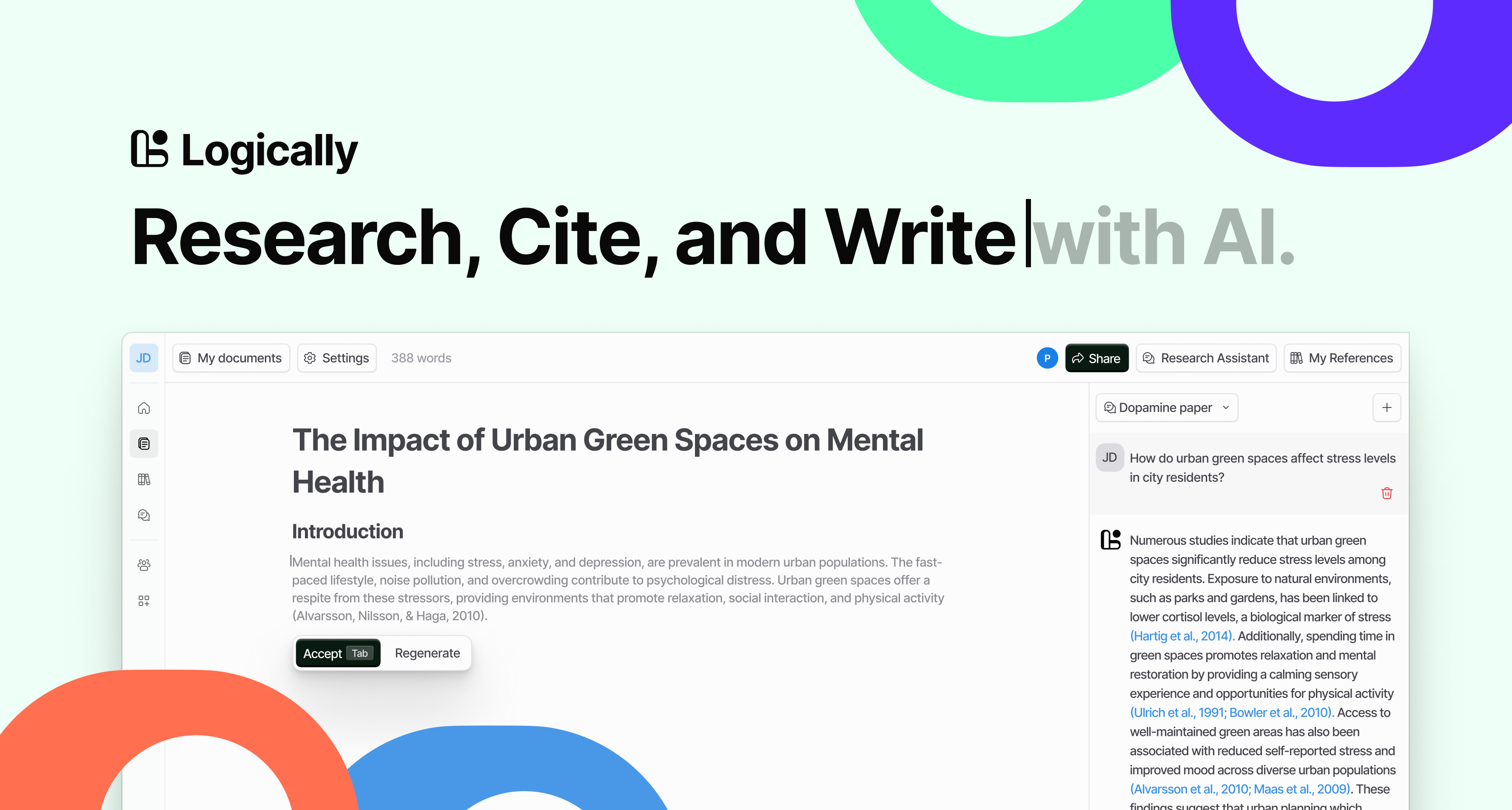
Afforai (currently known as Logically on the brand page) is an AI office tool for academics and knowledge workers. It integrates AI Research Assistant, Document Writer, Reference Manager and PDF annotation capabilities to help users complete data collection, citation management and paper writing faster.
Afforai
Core parameters and statistics
Afforai (currently branded as Logically) is positioned as an AI-driven research and writing workbench, oriented towards paper writing, literature sorting and citation management scenarios, emphasizing "complete research, citation and writing in the same space".
| Projects | Public Information |
|---|---|
| Official positioning | AI-powered workspace for citation-backed research and writing |
| Core Competencies | AI Research Assistant, Document Writer, Reference Manager, File Annotator |
| Typical users | Students, researchers, teachers, content-intensive knowledge workers |
| Platform form | Web application |
| Covered scenarios | Literature retrieval, paper writing, citation and reference management PDF annotation |
| Public user signals | Official website shows 100,000+ user scale |
Afforai's product boundaries are biased toward academic and knowledge-based writing, not general chatbots. It emphasizes more that "research with references" is related to "deliverable document output".
User and market recognition
The user groups of this tool are concentrated in universities and research scenarios. The official website displays the institutional logos and user reviews from many universities, emphasizing its value in improving research efficiency.
From the perspective of market positioning, Afforai targets the combination of "research retrieval + document management + writing assistant" rather than a single question and answer model. Its differentiation lies in its deep integration of reference management and writing process.
The disclosed growth signals mainly come from official website statements and community reputation; financial information such as revenue and financing has not been fully disclosed.
Cost advantage
- C-side/Individual: Usually a free version is provided to experience the core functions, and high-frequency use requires a paid package subscription.
- API/Developer: Billed by call volume, suitable for development teams that can be flexibly integrated into their own systems.
- Enterprise/Privatized: Contact the business owner for customized quotation and deployment plan. The specific price is subject to the official real-time pricing page.
Main functions
- AI Research Assistant: Conduct Q&A and research combing in the context of existing literature and data.
- Document Writer: Provides AI continuation and writing assistance to reduce the cost of drafting and rewriting papers.
- Reference Manager: uniformly import, organize and manage references, supporting common academic formats.
- File Annotator: supports document annotation such as PDF and combines AI to explain complex content.
- Citation/Bibliography: supports a large number of citation styles and automatic reference generation.
Overall, Afforai takes "research evidence chain" as a core design point and is suitable for writing tasks that require traceable citations.
Model and version evolution
Continuous iterative updates, the latest version introduces performance optimization and new features. Historical version information can be viewed through the official release page. There is currently no complete public version evolution timeline. It is recommended to pay attention to the official announcement to understand the rhythm of feature updates.
Technical advantages
Afforai’s technical advantage lies in integrating “model capabilities + document context + citation specifications” into the same interaction flow:
- The research phase emphasizes citation-backed output to reduce the risk of unfounded answers.
- Link content generation and citation management during the writing phase to reduce errors in manual reference insertion.
- The document stage combines annotation and question and answer to improve the efficiency of long document reading and knowledge recovery.
This integrated architecture is more friendly to academic and report writing scenarios, and is especially suitable for users who frequently process PDFs and references.
How to use
- Register an account: Visit the official website to create an account and enter the workbench.
- Import data: Upload PDF, DOI, URL or local documents to build a research material library.
- Manage citations: Organize documents, tags and groups in Reference Manager.
- AI research and writing: Use Research Assistant to search for evidence, and Document Writer to organize documents.
- Export and submit: Generate citations and references according to the target journal or school specifications, and export the document.
It is recommended to verify the citation accuracy and writing style on a small-scale project before expanding to formal papers or team workflows.
Product Pricing
Afforai offers a free entry plan, and paid plans are usually tiered by available credits and advanced capabilities. The official website displays free trial signals such as “Jump in for free / No card details required”.
Since prices and benefits will be dynamically adjusted, the exact rates should be determined from the official Pricing page. When organizing purchases, it is recommended to pay attention to collaboration permissions, team management, and data security terms.
Application scenarios
- Academic paper writing: used for literature search, citation generation, text drafting and structure optimization.
- Coursework and review: quickly complete data archiving, annotation and evidence chain organization.
- Research team collaboration: unified management of references and writing versions to reduce collaboration fragmentation.
- Knowledge-intensive reporting: Improve output speed in scenarios such as policy research and consulting analysis.
Afforai's value will be even more obvious if the task requires strongly compliant citation formats and traceable information sources.
Applicable people
- College students and graduate students: need to frequently process documents, write papers, and do citation management.
- Teachers and researchers: It is necessary to improve the efficiency of research sorting and drafting.
- Knowledge-based content creators: require a high-frequency output process from materials to articles. -Small research team: need to share data and unified citation rules.
It is not suitable for users who only need light chat Q&A and do not have document management needs.
Summary and Outlook
The core advantage of Afforai (Logically) is to integrate research retrieval, citation management, document annotation and paper writing into the same product, helping users reduce the need to switch between multiple tools and improve the quality of academic writing.
In terms of follow-up observation dimensions, we will focus on its citation accuracy, team collaboration capabilities, data security compliance, and interoperability with the mainstream academic ecosystem. For target users, this type of "researched-to-documented" proprietary tools can usually generate stable efficiency compound interest over long-term use.
Related tools:  Notion AI, google-workspace
Version evolution of Afforai
Early stages
In the early days, it provided AI research assistants and paper assistance capabilities under the Afforai brand, focusing on solving the problems of scattered literature retrieval and citation management.
Current stage
Currently, the Logically branded site hosts core products, with functions extended to integrate research, annotation, writing, and citation, and provides a variety of academic gadgets. The official standardized version log has not been published, and the timeline is subject to changes in the capabilities of the public page.
Business process integration and ROI analysis
As a productivity tool for enterprises or professional positions, Afforai's true value depends on the depth of integration with existing workflows and the quantifiable efficiency improvement effect. The following is a systematic analysis from three core dimensions.
System integration and data interoperability The ability to interoperate with existing business systems is a key prerequisite for productivity tools to be integrated into workflows. It is recommended to focus on evaluating the following integration dimensions: the openness and documentation quality of the RESTful/GraphQL API (whether a complete API reference and SDK examples are provided), the support scope of Webhook event notifications (which business event types are supported for automatic push), the number and depth of pre-built integrations with common collaboration SaaS tools (WeChat Enterprise, DingTalk, Feishu, Slack, Notion, Jira, etc.), and enterprise-level identity authentication support (SSO/SAML/OAuth and LDAP/AD directory integration). Products that lack integration capabilities are easily isolated into information islands, which in turn increases the cognitive cost and operational friction for teams to switch between different tools.
Efficiency Quantification and ROI Estimation Methodology Before purchasing decisions, it is recommended to quantify the input-output ratio through a structured method: Step 1, choose 3-5 Standardized tasks that are frequently repeated and time-consuming in each team are used as test samples; in the second step, the average time consumption of a single task before and after tool intervention, first-time pass rate or error rate, and the number of links requiring manual intervention are recorded under controlled conditions; in the third step, the saved manpower time is converted according to the comprehensive cost of the position (salary, benefits, management sharing), and soft benefits (increased employee satisfaction, standardization of work quality, and improvement in response speed to core business) are superimposed to obtain a comprehensive ROI estimate. It is recommended to continue tracking ROI trends on a monthly basis, as the value of a tool usually increases over time as team proficiency increases and workflows are optimized.
Phase-based implementation strategy and risk control It is recommended to adopt a three-stage implementation path of "pilot verification-gradual promotion-continuous optimization". In the pilot stage (1-2 weeks), a single team or a single business scenario is selected for small-scale verification. The core goal is to verify technical feasibility and user acceptance, and establish preliminary usage specifications and success standards; in the promotion stage (2-4 weeks), after the pilot verification is passed, the coverage is gradually expanded, and standardized activation processes and training materials are developed; in the optimization stage (continuous), the workflow configuration is continuously adjusted based on actual usage data and user feedback, and more high-value application scenarios are explored. Clear quantitative key result indicators should be set at each stage to avoid blindly expanding the scope of use without data support.
Version Info
- Logically Web App :Currently, AI Document Writer, AI Research Assistant, Reference Manager, File Annotator and various academic gadgets are provided to the public under the Logically brand. The official unified semantic version number has not been disclosed.
- Afforai earlier versions :In the early days, it provided AI-assisted research and writing capabilities under the name Afforai, and later gradually migrated to the Logically branded site. The exact date of the version change has not been officially disclosed.
User Reviews