 AG-UI Protocol
Free
AG-UI Protocol
Free
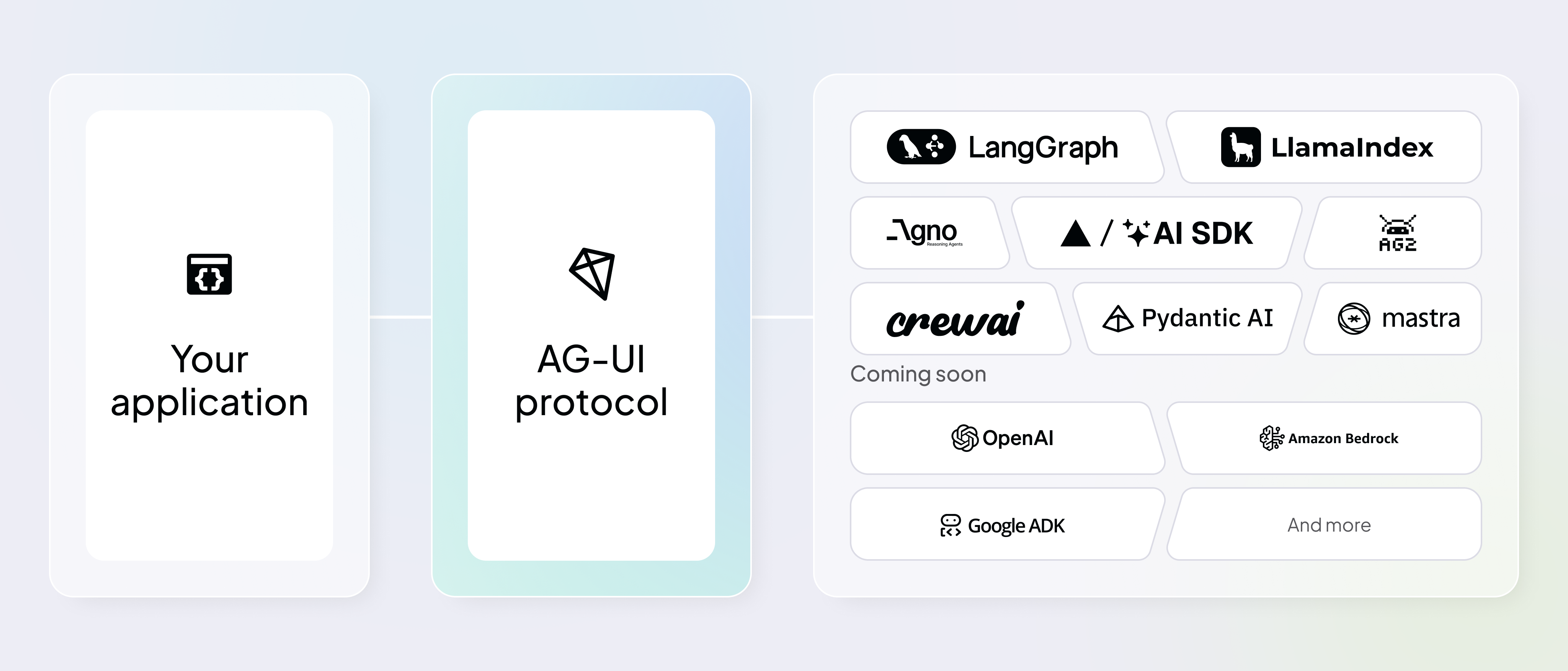
AG-UI is an open protocol that connects AI Agents and front-end interfaces. It realizes real-time synchronization of Agent running status, tool invocation and streaming output at the UI layer through standardized event streams.
AG-UI Protocol tool text
Core parameters and statistics
| Parameters | Current public information | Description |
|---|---|---|
| Product positioning | Agent-UI communication protocol | Not a UI component library, but a protocol standard |
| Core mechanism | Event flow + status synchronization | Define how Agent running status is transmitted to the front end |
| License Agreement | Open Source (MIT) | GitHub Public Repository |
| Compatible with the ecosystem | MCP, A2A, LangChain, CrewAI, etc. | Official documents list the cooperation framework |
| Official SDK | Documentation for TypeScript/Python | Covering mainstream front-end and back-end languages |
The problem AG-UI solves: In what standard format should the "thinking process, tool calls, intermediate results, and streaming text" generated by the Agent at runtime be passed to the front-end rendering, instead of inventing a set of protocols for each product.
User and market recognition
- The GitHub repository has public displays by partners such as LangChain, CrewAI, CopilotKit, and Mastra, indicating that it has been adopted in the mainstream Agent framework ecosystem.
- As a protocol standard rather than a commercial product, its "market recognition" is more reflected in how many frameworks it is integrated into, rather than the number of paying users.
- The official documents are hosted on Mintlify, and the maintenance quality is relatively complete, indicating that the project is not just an academic experiment.
Cost advantage
- C client/individual: The protocol itself is free and the SDK is open source; the main cost is the project access time.
- Developer/API: There is no API call fee; the protocol is a data format definition, and the access cost mainly lies in the adaptation implementation.
- Enterprise/Privatization: There is no commercial purchase page; the cost introduced by the enterprise is the engineering workload of "internal unified front-end Agent communication format".
The value of AG-UI is not in saving money, but in "if you already have multiple Agent backends that need to be connected to multiple frontends, the unified protocol layer can save a lot of adaptation code."
Main functions
- Standardized Agent event stream: Defines a standard format for events such as running status, tool invocation, and streaming output. The front end does not need to guess the Agent output structure.
- Two-way communication support: Not only Agent → front-end one-way push, but also supports front-end to transfer status and user interaction to Agent.
- State Management Specification: Define the state machine of the Agent's thinking, execution, completion and other stages to facilitate the front-end to make corresponding UI responses.
- Multi-framework SDK support: TypeScript and Python SDKs are provided, covering mainstream front-end and Agent back-end technology stacks.
- Streaming text and tool call events: Supports real-time delivery of streaming token output and tool_call results.
Model and version evolution
AG-UI is a protocol specification rather than a model, and does not have a version number in the traditional sense; it can be inferred from the history of GitHub:
- The protocol was first proposed for the LangChain scenario and was later extended to CrewAI, CopilotKit, Mastra, etc.
- The content of the documentation site continues to expand, indicating that the ecosystem is still in the growth stage.
Technical advantages
-
Mechanism: Unified event stream format defines Agent running status and tool invocation.
Effect: The front end does not need to write different data parsing logic for each Agent framework. Applicable scenarios: Front-end product teams that connect multiple Agent backends at the same time.
-
Mechanism: two-way communication + state machine specification.
Effect: The front-end can accurately respond to the Agent's various stages of status (loading, thinking, tool-calling, done) to create a more accurate UX. Applicable scenarios: Chat interfaces, task boards, and collaboration tools that require accurate Agent status UI feedback.
-
Mechanism: The protocol layer is decoupled from the specific framework.
Effect: Changing the Agent backend does not require rewriting the front-end adaptation logic. Applicable scenarios: Product engineering teams with multiple Agent backends coexisting or planning to migrate.
How to use
- Understand the path: Read the docs.ag-ui.com documentation to understand the core event types and state machine definitions.
- Front-end access path: Install TypeScript SDK → Subscribe to Agent event stream → Render the corresponding UI according to the event type.
- Backend access path: Agent backend outputs AG-UI compatible event stream → front-end automatic parsing.
- Verification path: First check the access in an Agent scenario (such as chat interface), and then promote after verifying that the event coverage is complete.
Product Pricing
| Level | Current public status | Description |
|---|---|---|
| Agreement and Documentation | Free | Official Documentation Site Open |
| SDK | Free and open source | TypeScript/Python |
| Commercial support | Unpublished | No commercial service page yet |
Application scenarios
- AI Chat Interface Development: Unify the front-end docking method of multiple Agent backends.
- Agent workflow dashboard: Displays Agent task progress, tool calls and intermediate results in real time.
- Multi-Agent collaboration product: Aggregate the status synchronization of different Agent outputs in one interface.
Applicable people
- Front-end engineer: Building the Agent application interface requires standardized communication formats.
- Full stack Agent developer: Maintain the Agent backend and frontend at the same time, hoping to unify the status synchronization interface.
- AI Product Team: Plan to connect to multiple Agent frameworks or plan to migrate the Agent backend in the future.
Not suitable for boundaries: If your product has only one Agent backend and does not plan to expand, handwriting a simple SSE or WebSocket interface may be more straightforward, but introducing the AG-UI protocol will increase learning costs.
Summary and Outlook
It provides competitive solutions in its field, and its core value lies in lowering the threshold for AI use in this field.
Current limitations: Some advanced features require paid subscription, and the free version has function or usage restrictions; specific technical details and performance benchmarks have not yet been fully disclosed.
Related tools:  GitHub Copilot,
  Cursor
Reference sources
Version Info
- Current Protocol Specification :The current public version of the official documentation site and GitHub repository; the protocol defines event types, status management and tool calling processes, and there is no official precise version number yet.
- Initial Public Release :The protocol was made public for the first time on GitHub, defining core event flow and state management specifications; there is no official precise date yet.
User Reviews