 Agent Reach
Free
Agent Reach
Free
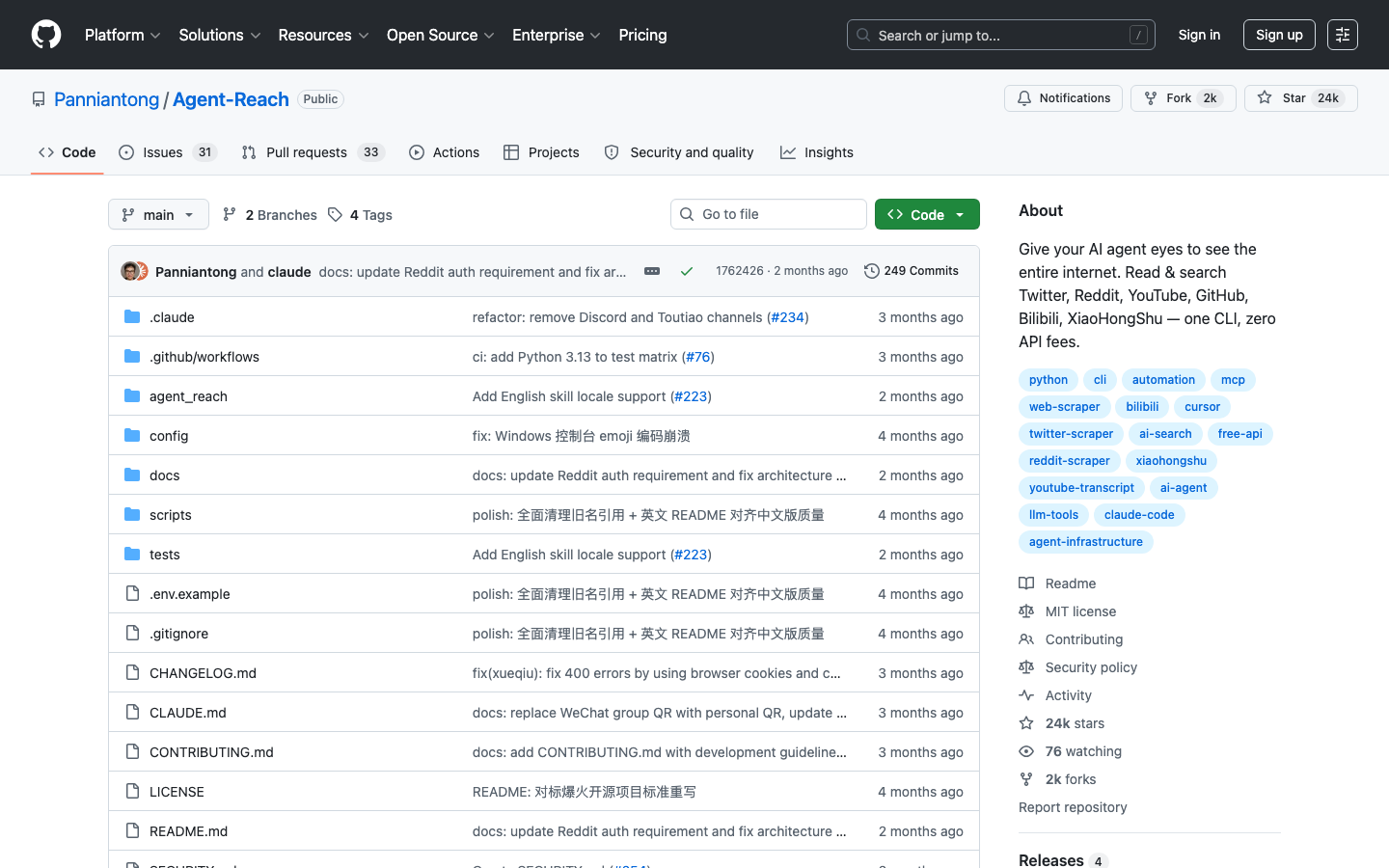
Agent Reach is an open source scaffolding that equips AI Agent with Internet capabilities. It unifies the reading and search of web pages such as YouTube, GitHub, Twitter, Reddit, Bilibili, WeChat, Xiaohongshu and other channels, and provides agent-reach doctor diagnosis, installation and safety mode.
Tool text (please fill in completely)
Core parameters and statistics
The positioning of Agent Reach is not a single web product, but a set of Internet capability scaffolding for AI Agents. It integrates a set of high-frequency upstream tools, authentication methods, installation processes, and health checks into reusable local capabilities, which is suitable for teams that want agents to truly "read web pages, search content, watch videos, and read social platforms."
| Projects | Public Information |
|---|---|
| Product Form | Open Source CLI / Scaffolding / Installer |
| Official entrance | GitHub Repo |
| License | MIT |
| Supported languages | zh-CN, en-US |
| Support Platform | Desktop, API |
| Latest version | v1.4.0 (2026-03-31) |
| Historical versions | v1.3.0, v1.2.0, v1.1.0 |
| Community size | About 23.9k stars, 2k forks, 18 contributors |
| Coding language | Python 94.7%, Shell 5.3% |
| Channel scale | 16 channels tested on real networks |
| test status | 77 tests passing |
| Typical commands | agent-reach install, agent-reach doctor, agent-reach uninstall |
| Price Status | Totally free; server proxies only may be around $1/month |
Product positioning: The core of Agent Reach is not to replace a single point crawling tool, but to package Internet access capabilities into a set of Agent-friendly installation, diagnosis and configuration processes. It's more like a "connectivity layer" and an "upstream tool orchestration layer" than a single search site.
Ecological density: The upstream tools listed in the README cover web pages, videos, social GitHub, RSS, search Bilibili, Xiaohongshu, Douyin and WeChat public accounts, etc., indicating that its value comes from channel coverage, not just the depth of a certain channel.
Release rhythm: The evolution from v1.1.0, v1.2.0, v1.3.0 to v1.4.0 shows that the project will accelerate significantly in early 2026, and the focus of updates will gradually shift from "can it be used" to "more stable, simpler, and more reliable".
User and market recognition
Community Popularity: The GitHub repository currently shows about 23.9k stars, 2k forks, and 18 contributors. For an open source project that is mainly based on CLI and scaffolding, this magnitude shows that it has surpassed the personal toy stage and formed a basis for sustainable maintenance.
Clear target use: The README directly states that "Agents that can run the command line" such as Claude Code, OpenClaw, Cursor, Windsurf, etc. can be used, indicating that it is not targeted at a certain client, but is designed for a type of Agent workflow.
Stability signal: v1.4.0 release notes mentioned that 16 channels completed real network testing and gave 77 tests passing. This is a better indication than a simple slogan that the project has entered a verifiable state at the functional level.
Disclosure boundaries: The number of users, revenue, business contracts and corporate procurement scale are not disclosed. For this type of open source scaffolding, market recognition is more reflected in Star, Fork, number of channels, regression testing and user spontaneous expansion, rather than traditional SaaS financial indicators.
Cost advantage
Completely Free: The README clearly states that all tools are open source and all APIs are free. For individuals and teams, the entry cost can be reduced to almost zero. The only possible paid items are server agents, and the reference value given in the README is about $1/month.
Developer layer: Agent Reach unifies the repetitive work of "finding upstream tools, configuring cookies, writing installation scripts, and maintaining changes". What is saved is integration and maintenance time, not a certain API quota. For agent teams that frequently switch channels, this time cost is often more sensitive than the subscription fee.
Enterprise layer: If an enterprise uses it for servers or machines shared by multiple people, the cost is mainly in agency, permission management, cookie management and compatibility maintenance, rather than protocol authorization fees. In other words, Agent Reach lowers the threshold for Internet capabilities, but it will not automatically eliminate platform restrictions and account management issues for you.
Hidden costs: Platforms that require cookies (Twitter, Xiaohongshu, etc.) will bring account suspension risks and account management costs; README even recommends using a dedicated account. This cost is not the money itself, but the organizational process and account isolation strategy.
Main functions
- One-click installation and upgrade:
agent-reach install,agent-reach uninstallandpip install --upgrade agent-reachallow the local Agent to connect to the upstream tool chain with only a few commands. - Health Diagnosis:
agent-reach doctorcan quickly tell you which channels are available, which are not available, and how to fix them. It is suitable for forwarding contextual problems to the installation stage. - Channels are pluggable: Each channel corresponds to an independent upstream tool, which facilitates replacement, tuning and fault isolation, and does not tie all capabilities into a set of packages.
- Multi-platform reading and search: Covers web pages YouTube, GitHub, Twitter/X, Bilibili Reddit, Xiaohongshu, Douyin, WeChat public account, Weibo V2EX, Snowball RSS, etc.
- Cookie Localization: Platforms that require login use local cookie configuration, emphasizing that credentials are only retained on the local machine and are not uploaded or transmitted.
- Safe Mode and Dry Run: Supports
--safeand--dry-run, suitable for multi-person machines or production environments to see what will happen first.
The common effect of these functions is to turn "getting Agent online" from a scattered script into a standardized installation process. For teams that rely on multi-platform collection, the biggest benefit is usually not that a certain query is faster, but that the entire configuration process is more stable, rollable, and diagnosable.
Model and version evolution
The version evolution of Agent Reach is more like a continuous reconstruction process of channels and upstream tools, rather than a single major upgrade of a large model. Its changes focus on channel expansion, upstream migration to Windows compatibility, and doctor process stabilization.
Public Milestones
| Time | Node | Key points of change |
|---|---|---|
| 2026-02-25 | v1.1.0 | Joining Instagram, LinkedIn, and Boss direct recruitment, channels began to expand significantly |
| 2026-02-26 | v1.2.0 | Join Douyin, remove immature Instagram, improve channel status and installation instructions |
| 2026-03-04 | v1.3.0 | Added WeChat public account channel and fixed Windows related issues |
| 2026-03-31 | v1.4.0 | Large-scale upstream migration, focusing on improving stability, availability and reliability |
Version context
- Early Stage: Mainly solve the problem of "whether the Agent can read the content", and first run through key channels such as Twitter, Reddit, YouTube, and GitHub.
- Expansion Phase: Gradually connect to more localized or higher-threshold platforms such as Xiaohongshu, Douyin, WeChat public accounts, Weibo, and Snowball.
- Stable Phase: v1.4.0 The focus is not on adding new concepts, but on replacing upstream implementations, fixing deprecated dependencies and improving the pass rate of real network tests.
Version meaning
If the team wants to use Agent Reach as a long-term capability, the version judgment should not only look at whether it is the "latest version", but whether the channels it currently relies on have been replaced by upstream, whether there is still real network testing, and whether the platform it relies on has been stable in terms of local cookies or agent policies.
Technical advantages
Mechanism 1: Upstream tool layering. README splits the web pages Twitter, YouTube, GitHub, Bilibili Reddit and other channels into independent upstream tools, and Agent Reach is responsible for the installation and orchestration itself. The effect is that when one channel fails, the entire system will not be brought down. It is suitable for teams that need to collect data from multiple channels but do not want to have a problem in one place and fail completely.
Mechanism 2: Doctor-driven observability. agent-reach doctor is not a decoration, but used to check the upstream status behind each channel. The effect is to turn many things that were originally guessed based on debugging logs into a diagnosable state, which is suitable for multi-person collaboration and server deployment.
Mechanism 3: Cookies and Safe Mode. It manages cookies as local credentials and gives both --safe and --dry-run. The result is that you can enter a high-threshold platform without having to leave credential management entirely to scripts. Suitable for scenarios that are sensitive to account risks.
Mechanism 4: Real network testing and channel migration. The v1.4.0 release notes explicitly mention upstream migration and real network testing of 16 channels. The effect is that the tool will not just stay at the document layer, but will continue to replace unavailable backends. Suitable for collection links that require long-term maintenance.
The essence of these technical choices is to make "Agent Internet access" into a maintainable infrastructure, rather than a bunch of commands scattered in prompt words. It's heavier, but also closer to a form that can be used repeatedly in production.
How to use
The typical entrance of Agent Reach can be summarized as four steps: "installation, diagnosis, configuration, and invocation".
| Entrance | Command/Action | Suitable for the scene |
|---|---|---|
| Default installation | agent-reach install --env=auto |
PC, development context |
| Safe mode | agent-reach install --env=auto --safe |
Production server, machine shared by multiple people |
| Preview only | agent-reach install --env=auto --dry-run |
See what happens first |
| Health check | agent-reach doctor |
Confirm whether the channel is available |
| Upgrade | pip install --upgrade agent-reach |
Follow up on new version channels and fixes |
Basic process: First install the CLI, then run doctor to check the status of the context, then log in to Twitter, Xiaohongshu Reddit and other platforms that require cookies as needed, and finally hand over common operations to the Agent to call upstream tools.
Implementation Focus: If deployed on a server, first verify whether proxy cookies, browser automation, and upstream tools can all pass doctor; if it is only used locally, the focus is on the installation success rate and whether your usual channels can directly read the content.
Product Pricing
Pricing Status: Agent Reach publicly states that it is completely free, with all tools open source and all APIs free. For most users, the real cost comes almost exclusively from local time and necessary server proxies.
- Personal/Local: Free. The main cost is installation and commissioning time.
- Developer/API: Free. Many upstream tools themselves are also open source or freely available, and the focus is on combined use.
- Enterprise/Server: If an overseas server is required to access certain platforms, the README gives a reference agency cost of approximately $1/month; the larger cost usually comes from account management, compliance and maintenance.
There are no subscription tiers to “compare prices” with because it is an open source scaffolding. To judge whether it is worth using, the core depends on whether it reduces your time to maintain multi-platform Agents, not on its selling price.
Application scenarios
- Internet Research Agent: Let the Agent automatically read web pages, search GitHub, watch YouTube, and check Reddit. It is suitable for competitive product research, technology tracking, and data collection.
- Social platform intelligence collection: Connect to Twitter/X, Bilibili, Xiaohongshu, Weibo, WeChat public accounts and other channels, suitable for content insight, public opinion tracking and topic selection collection.
- Development and Documentation Assistant: Through GitHub, web pages and RSS channels, the Agent can read the warehouse, issues, and update logs, which is suitable for the daily information intake of the technical team.
- Multi-platform automation prototype: Unify the collection capabilities of different channels to one Agent, suitable for prototype verification of "one prompt word drives multi-site information capture".
Applicable people
- AI Agent Builder: I want my Agent to have the ability to read the Internet, search the Internet, read social platforms, and read GitHub.
- Research and Content Team: Need stable access to public information on multiple platforms, but don’t want to write a separate script for each platform.
- Open source tool maintainer: Hope to make channel capabilities into pluggable, diagnosable, and replaceable local infrastructure.
- OpenClaw / Cursor / Claude Code users: As long as you can execute shell commands, you can plug it into your existing workflow.
Not suitable for boundaries: If the team does not have a command line execution context, cannot accept local cookies, or only needs lightweight crawling on a single platform, then Agent Reach's scaffolding will appear to be heavy; in this case, it may be simpler to use a single point tool directly.
Summary and Outlook
The core value of Agent Reach is not in a single channel, but in turning the matter of "letting Agents access the Internet" into a scaffolding that is installable, diagnosable, replaceable, and safe to run. It unifies multi-platform access cookie localization, upstream migration and security model, and is suitable for teams that maintain multi-channel Agent capabilities for a long time.
Its current limitations are also clear: the risk of platform cookie blocking, agency costs, and upstream tool changes may affect stability. A more realistic approach is to first use --dry-run and doctor to verify key channels on a local or small-scale server, and then decide whether to extend it to a team standard; if it is to enter production or be shared by multiple people, the agent policy, account isolation, and upstream tool compatibility must be verified in advance.
Related tools:  CrewAI,
  LangChain
Version Info
- Agent Reach 1.4.0 :The upstream large-scale migration version has completed back-end migration and stability improvement around Twitter/X, Reddit, Xiaohongshu, WeChat public accounts, Snowball and Bilibili, and continued to strengthen the doctor and installation processes.
- Agent Reach 1.3.0 :The addition of the WeChat official account channel and the repair of Windows-related issues indicate that the project has shifted from a single-point channel tool to a more complete cross-platform collection scaffolding.
- Agent Reach 1.2.0 :Added Douyin channel and removed immature Instagram support, while further standardizing channel status and installation instructions.
- Agent Reach 1.1.0 :With the addition of capabilities related to Instagram, LinkedIn and Boss direct recruitment, channel coverage has begun to significantly expand.
User Reviews