 Agenta
Free
Agenta
Free
Agenta is an open source engineering platform for AI model training and LLM applications, helping teams standardize the evaluation and release process. It covers four major capability modules: prompt word management, systematic evaluation, online observation and agent orchestration, and supports 50+ LLM model access and self-hosted deployment.
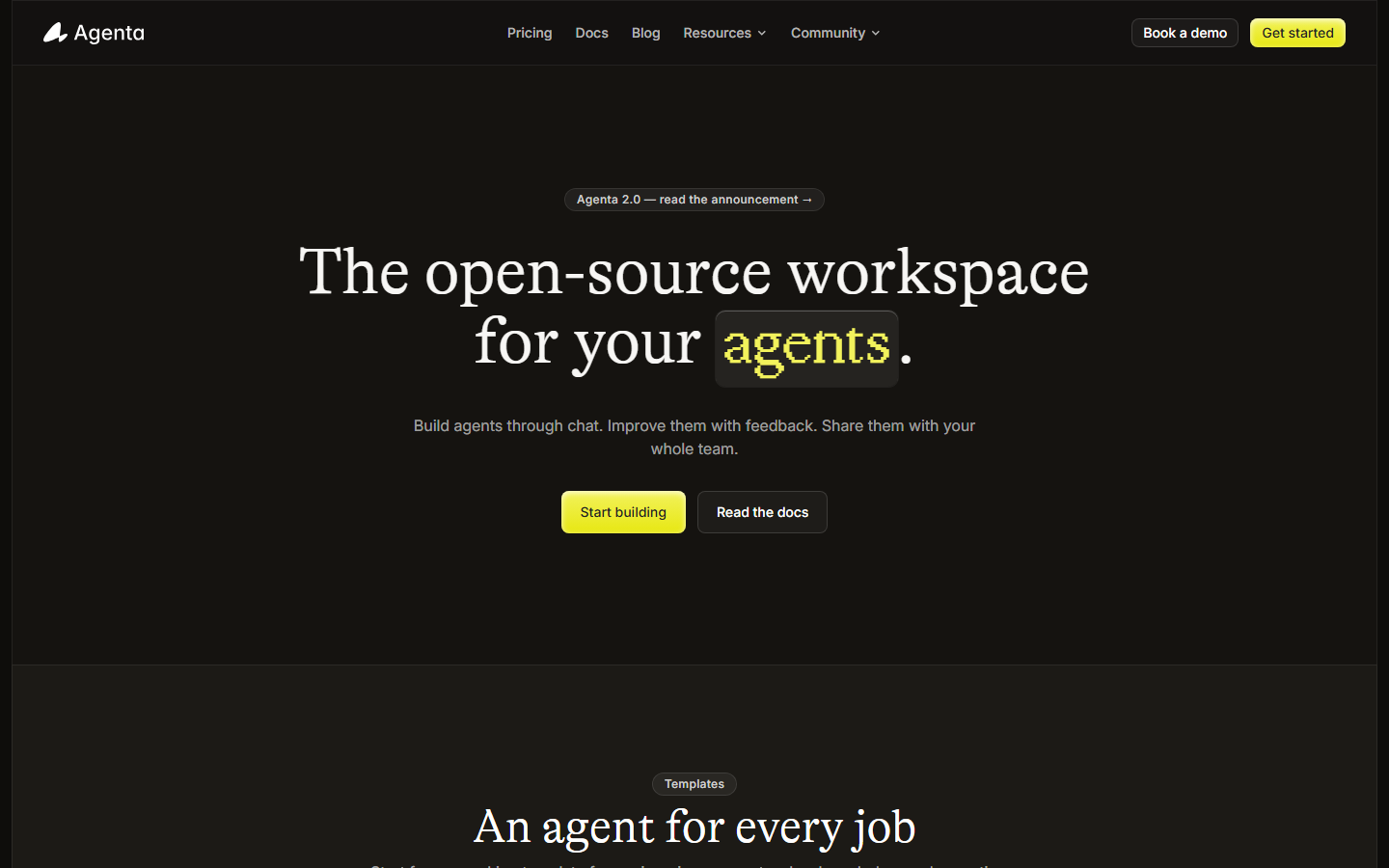
Agenta: Open source LLMOps evaluation and publishing platform
Core parameters and statistics
Agenta is an open source LLMOps platform for LLM application engineering teams. Officially positioned as "The open-source LLMOps platform", Agenta integrates the four capability lines of prompt word engineering, systematic evaluation, online observation and Agent orchestration in a single product. It is not just a "better Prompt editor", but a platform-level tool that upgrades LLM application development from a manual, dispersed, and irreproducible process to a systematic, measurable, and traceable engineering process.
| Project | Specifications |
|---|---|
| Model/API Name | Agenta |
| Product Type | Open Source LLMOps Platform |
| Delivery form | Cloud SaaS + open source self-hosting (Docker Compose) |
| Context length | Depends on the connected LLM model |
| Support modal | Text (prompt word engineering + evaluation + observation + agent arrangement) |
| Open Source License | MIT License |
| GitHub Stars | ~4,300 |
| GitHub Forks | 572 |
| Contributors | 95+ |
| Total Releases | 417+ Release |
| Latest version | v0.105.3 (2026-07-17) |
| Technology stack | TypeScript 57.7% + Python 41.2% |
| Supported platforms | Web, API, Docker |
| Place of Belonging | Germany (Agentatech UG) |
| Pricing Model | Free (Self-Hosted) + Free Tier (SaaS Hobby) / Pro / Business / Enterprise |
Interpretation of Core Parameters: Agenta's "capabilities" do not come from a single model, but from its platform architecture. The ability to support access to 50+ LLM models means teams are not locked into a single vendor. The community activity of 417 Releases and 95 contributors shows that the project has passed the early experimental stage and formed a stable external contribution ecosystem. Four versions (v0.105.0~v0.105.3) have been released continuously in the past week. The core functions have been iterated intensively, and the Agent orchestration and observation panel are the current main lines.
Model-agnostic design: Supports access to any model API through a custom Provider interface, and the team can freely switch and compare the performance of different models during the evaluation process - this is especially important for companies with multi-model strategies.
User and market recognition
Agenta's market recognition comes primarily from actual adoption by the open source community and LLM engineering teams, rather than public revenue or customer numbers (the latter is not officially disclosed).
Open source community popularity: GitHub currently has about 4,300 stars and 572 forks, and 417 Releases indicate that the project is in a high-frequency iteration period. The 95 contributors include the core team and external community contributors, and problem feedback and feature improvements have certain external verification. The official Slack community, GitHub Discussions and public Roadmap are provided, and the community response is relatively active.
Target customer group: Officially, "Product Managers, Developers, and Domain Experts" are listed as target users, indicating that the design goal is not a single developer tool, but a cross-role LLM engineering collaboration platform. The product positioning keyword has been upgraded from "prompt management" to "LLMOps platform", reflecting that its coverage has expanded from prompt word management to full life cycle management.
Prerequisites for implementation: For platform-based LLMOps tools to truly exert their value, the team usually needs to have a clear LLM application development process (prompt word iteration, evaluation regression, online monitoring), and be willing to unify experiments, evaluation and observation data into one platform. For teams still using "prompts scattered everywhere + manual visual inspection", Agenta's standardized process itself will bring normative binding.
Industry competitive positioning: Agenta is positioned as an "open source all-rounder" in the LLMOps tool ecosystem - compared with LangSmith (closed source, LangChain ecological binding), Weights & Biases Prompts (closed source, strong experimental tracking), and Helicone (observation-specific, open source), Agenta is one of the few choices that simultaneously meets the five-in-one requirements of "open source + prompt word management + evaluation + observation + Agent".
Cost advantage
Agenta provides a dual-track cost path of "zero cost for open source hosting + free cloud quota entry". The core value lies in lowering the threshold of the LLMOps platform from "enterprise-level SaaS of thousands of dollars per month" to "zero cost to start."
| Cost hierarchy | Pricing method | Explicit costs | Implicit costs |
|---|---|---|---|
| C-side / Individual Developer | Hobby (Free) | $0, 2 seats, 20 evals/month, 5K traces/month | 30 days data retention, no SLA, community support only |
| Developer/Small Team | Pro ($49/month) | 3 seats ($20/additional seat), 10K traces/month, unlimited evaluation | Extra Trace $5/10K, 90-day reservation |
| Business Team | Business ($399/month) | Unlimited seats, 1M traces/month, RBAC, SOC2, SSO | 365-day retention, private Slack channel |
| Enterprise / Privatization | Enterprise (Business Quote) | BYOC, self-hosted, audit logs, custom SLA | Business confirmation terms and DPA required |
| Self-hosted (open source) | Free (MIT license) | Software $0, infrastructure cost only | Operations manpower (PostgreSQL + Redis + multi-container orchestration) |
The true cost of self-hosting: The self-hosted path is free at the license level (MIT), but the infrastructure costs are borne by the enterprise. Take Docker Compose deployment as an example. The backend relies on PostgreSQL + Redis and can be run on a single machine. However, in high-concurrency scenarios, database connection pool and container resource allocation need to be considered (a cloud instance with at least 4 cores and 8GB RAM is recommended). Self-hosting also means that the team needs to maintain version upgrades (1-2 releases per month), data backups, and security patches themselves. Compared with the $399/month of the Business plan, self-hosting has cost advantages when the scale is large, but only if the team has the corresponding operation and maintenance capabilities.
The free truth: The cloud Hobby plan is completely free, but the free plan does not provide SLA guarantees and advanced security features (RBAC, SSO, SOC2), and the Trace retention period is only 30 days. For serious use in production environments, the Pro plan ($49/month) is a reasonable starting point. Comparison with commercial competitors: LangSmith’s Starter plan starts at $25/month but has limited functions and Trace volume, W&B’s Enterprise version is usually $100+/seat/month, and Agenta’s Pro plan is at a moderately low level among its peers.
Main functions
Agenta's capabilities are designed around "upgrading LLM application development from a manual, dispersed, and non-reproducible process to a systematic, measurable, and traceable engineering process." The core functions can be summarized into five major modules. Each function point follows the causal chain of "mechanism → effect → scene".
-
🧪 Prompt Management and Engineering: Mechanism - Provides an interactive playground that supports side-by-side comparison of the performance of multiple models/prompt word variants on test cases in the same interface. Complete version history, supporting branching and environment management (staging/production). Domain experts can securely edit prompt words through the UI without touching code. Effect——The prompt word iteration is shortened from "engineer manual modification→visual inspection→deployment" to a closed loop of "UI editing→automatic evaluation→one-click release". Scenario - The AI product manager compares the output differences of GPT-4o and Claude on the same test set of three prompt word variants in the playground, and selects the best-performing combination to publish online.
-
📊 Systematic Evaluation (Evaluation): Mechanism - upgraded from "manual visual inspection" to a repeatable evaluation process. Supports creating test sets (Testsets) from production data, playground experiments, or CSV uploads. Built-in 20+ preset evaluators (including LLM-as-judge, accuracy evaluation, correlation evaluation, security check), and also supports custom code evaluators (Python functions). Evaluations can cover every intermediate step of the Agent's reasoning, not just the final output. Effect - Change the evaluation from "subjective judgment" to "reproducible quantitative indicators". Every time the prompt word is modified, the impact on the quality indicators can be immediately seen. Scenario - After the prompt word engineer modified the system prompt of the customer service robot, a batch evaluation pipeline containing 200 test cases was automatically triggered. After 5 minutes, a report was received that the accuracy rate increased from 87.3% to 91.1%.
-
📡 Online Observability: Mechanism - Provides request-level Trace to accurately locate error nodes. Track the cost, latency, and usage patterns of each LLM call. Supports OpenTelemetry native protocol and is compatible with OpenLLMetry and OpenInference standards. User feedback can be marked on the Trace, and the abnormal Trace can be converted into a test case by clicking on it, completing the feedback closed loop. Effect - Once an LLM call exception occurs online, it can be located within 30 seconds whether it is a Prompt problem, a model problem or a context problem, instead of checking the logs step by step. Scenario - The operation and maintenance engineer found in the observation panel that the delay of an API endpoint soared from 2s to 8s. The Trace details showed that the context was too long, causing the Token consumption to surge. With one click, the Trace was converted into a test case and included in the regression set.
-
🤖 Agent Orchestration (Agent Capabilities) : Mechanism - The focus of the 2026 iteration, using the "Harness + Skill + Tool" three-layer architecture. Agent Harness is a running container that manages model connections and sandbox life cycles; Skill is a reusable capability module; Tool is a specific execution unit that calls external systems through MCP or internal gateways. Supports manual confirmation (HITL) approval process and tool call permission control. Effect - Agenta is expanded from an "evaluation platform" to an "Agent development and operation and maintenance platform", and the team can complete the construction, evaluation, online and monitoring of Agent on the same platform. Scenario - The developer creates a "Customer Service Agent" in Agenta, configures Claude Sonnet as the inference engine, connects to the CRM system as a tool, sets up HITL approval (only refund operations require manual confirmation), runs batch evaluation and then publishes it online.
-
👥Team collaboration (Collaboration): Mechanism - Provide differentiated interfaces for different roles - engineers use API/SDK to perform programmatic operations, and product managers and domain experts run reviews and edit prompt words through the UI. All operations are centralized on a unified platform to reduce information fragmentation across tools. Permission control overrides project-level RBAC. Effect - Eliminates the collaboration friction of "the product manager changes the Prompt and then sends it to the engineer for manual deployment". All changes have version records and approval links. Scenario - The product manager optimized the customer service prompt in the UI and saved it as v2.3. The system automatically triggered the evaluation, and the engineer received the approval notice. After confirmation, it was released to the production environment with one click.
Synergy between functions: These five modules form a closed loop of "experiment → evaluation → observation → feedback → optimization". Exceptions in production Trace → One-click conversion to test cases → Playground modification Prompt → Automatic evaluation → Version management → Deployment and online → Continuous monitoring by observation panel. This closed loop compresses the iteration cycle of LLM applications from "days/weeks" to "minutes/hours".
Model and version evolution
Agenta's version iteration follows the rhythm of semantic versioning (SemVer) plus frequent incremental releases. From the early open source core to the current main line of Agent capabilities, four key transitions are covered.
| Version | Date | Key Changes |
|---|---|---|
| v1 (open source foundation) | 2024-01 | Open source core release, Playground interactive comparison and basic evaluation capabilities |
| v0.58.0 | 2025-10 | Enterprise Edition (ee) directory structure, multi-organization support, RBAC basic framework |
| v0.84.0 series | 2025~2026 | Batch evaluation pipeline, regression comparison report, observation panel alarm mechanism and Trace details |
| v0.103.x series | 2026-06 | RBAC moved from ee to OSS, UI optimization (test set management, evaluator navigation, batch archiving) |
| v0.104.0 | 2026-06 | Multi-org capabilities enter OSS, enterprise self-hosting multi-team support |
| v0.105.0 | 2026-07-14 | Agent capability mainline merged, new Agent panel, skill system, MCP tool, sandbox execution, HITL |
| v0.105.3 | 2026-07-17 | [Latest] Agent Playground session management, file upload, and inspector function enhancements |
Version evolution characteristics: Agenta's version rhythm presents a high-frequency pattern of "mainline once every two weeks, hot fixes twice a week". More than 10 versions were released from June to July 2026 alone, with the v0.105.x series completing consecutive iterations from 0.105.0 to 0.105.3 within a week. This rhythm means that if you are considering production deployment, it is recommended to fix a verified official version for closure evaluation, rather than directly following each update.
Roadmap Assessment: It can be seen from the version evolution that Agenta’s product priorities are: Prompt word management (basics) → Evaluation system (core barriers) → Observation panel (differentiation) → Agent orchestration (new growth curve). The introduction of Agent capabilities marks Agenta's positioning upgrade from "LLM evaluation tool" to "LLM application full life cycle platform" - this is a strategic direction worthy of attention.
Technical advantages
Agenta's technical advantage does not come from the performance of a single model, but from the combination of the three dimensions of "architectural openness + full-link closed-loop + model-independent design".
Architecture Unification and Role Adaptation: Agenta covers prompt word engineering, evaluation, observation and agent orchestration through the same API and UI, rather than splicing together multiple independent tools. Engineers can embed the evaluation and deployment process into the CI/CD pipeline through the Python SDK (pip install agenta); product managers and domain experts complete daily experiments and evaluations through the Web UI. Full API and UI parity means that any operation can be completed in two ways - this is a key architectural decision for platform-level tools, which avoids the capability gap of "what the UI can do but the API cannot".
Model-independent evaluation framework: The evaluator (Evaluator) abstraction layer supports three modes - LLM-as-judge (use another large model to judge the quality of results), built-in 20+ preset evaluators (covering dimensions such as accuracy, relevance, security, etc.), and custom code evaluators (Python functions). Evaluation can act on every intermediate step of the Agent's reasoning, rather than just examining the final output. The evaluator in the SDK runs in a sandbox environment (RestrictedPython) to prevent malicious code execution.
Open technology stack: The observation module is based on the OpenTelemetry native protocol and is compatible with the OpenLLMetry and OpenInference standards. This means that applications that are already connected to OpenTelemetry can send Trace data to Agenta with zero modification. Provides out-of-box integration for popular frameworks such as LangChain, LlamaIndex and more. The custom Provider interface allows access to any model API, as long as the standard calling protocol is implemented.
Architectural evolution of Agent capabilities: The Agent subsystem introduced in v0.105.0 in 2026 adopts a three-layer architecture of "Harness + Skill + Tool". Agent Harness is a running container that manages model connections and the sandbox life cycle; Skill is a reusable capability module that describes what the Agent can do; Tool is a specific execution unit that calls external systems through MCP or internal gateways. The HITL approval process is designed with "human delay" in mind - there is a downgrade strategy (automatic denial or rule-based automatic approval) after approval times out.
Adaptation boundaries and restrictions
Agenta provides a complete tool chain in the LLMOps world, but not all LLM development scenarios require its full capabilities.
Recommended usage scenarios:
- The team has multiple LLM application lines that need unified management.
- Measurement metrics have been or are planned to be incorporated into the CI/CD process.
- Systematic comparison and version management between multiple model providers are required.
- Building or maintaining LLM production applications that require continuous monitoring.
- Requirements for data sovereignty require a self-hosted LLMOps platform.
Not recommended scenario:
- The team only has 1~2 simple LLM calls (such as a single translation or summary function) and does not require version management and systematic evaluation.
- There is no evaluation awareness and process at all (that is, "just go ahead if you make changes, and deal with problems later"). Agenta's standardized process requires additional organizational adaptation costs.
- Only basic Prompt management is required, no observation and Agent orchestration required - more lightweight tools (such as PromptHub, HumanLoop) may be more suitable.
- The core requirement is model fine-tuning rather than prompt word engineering - Agenta does not provide training-related capabilities and should be used with fine-tuning platforms (such as Weights & Biases).
Known limitations:
- Agent orchestration capability (v0.105.x) is still in a rapid iteration period, the stability of HITL approval and MCP tool discovery is still being polished, and verification time needs to be reserved for production environment deployment.
- The scoring criteria of evaluators (especially LLM-as-judge) require the team to invest time in calibrating, otherwise automatic scoring may deviate from human judgment.
- The operation and maintenance complexity of the self-hosted version cannot be ignored - PostgreSQL, Redis, and multi-container orchestration require specialized operation and maintenance manpower.
- The number of corporate customers, revenue data and specific user levels have not been officially disclosed. Commercial verification requires more transparent information disclosure.
- There is a risk that the feature gap between the open source version and the enterprise version will widen - enterprise features such as SSO and SOC2 are only available in the enterprise version.
How to use
| How to use | Suitable for the crowd | Getting started | Cost |
|---|---|---|---|
| Cloud SaaS | Teams looking to validate quickly | Visit cloud.agenta.ai to sign up | Hobby Free / Pro $49/mo |
| Self-hosting (Docker Compose) | Organizations with high data compliance requirements | git clone → configuration .env → docker compose up -d | Infrastructure costs |
| Python SDK | Engineers who need CI/CD integration | pip install agenta | API on-demand or self-hosted |
| API access | Programmatic workflow | Obtain API Key → Call REST API | Pay-as-you-go or self-hosted |
Quick Start (Cloud):
- Visit cloud.agenta.ai to register an account (no credit card required).
- Create a project (Application) and select a model provider (OpenAI, Anthropic, etc.).
- Write prompt words in the playground, add test cases, run and compare the output of different variants.
- Systematically evaluate the results using pre-built evaluators or custom evaluators.
- Publish the satisfactory version to the production environment and monitor online performance through the observation panel.
Self-Hosted Deployment (Docker Compose):
git clone https://github.com/Agenta-AI/agenta && cd agenta
cp hosting/docker-compose/oss/env.oss.gh.example hosting/docker-compose/oss/.env.oss.gh
docker compose -f hosting/docker-compose/oss/docker-compose.gh.yml \
  --env-file hosting/docker-compose/oss/.env.oss.gh \
  --profile with-web --profile with-traefik up -d
Access via http://localhost after startup. For more detailed remote deployment guide, please refer to the official documentation.
Python SDK Quick Example:
from agenta import EvaluationFlow

#Initialize the evaluation process
flow = EvaluationFlow(
    app_name="my-chatbot",
    variant_name="v1.2",
    api_key="<YOUR_API_KEY>"
)

# Run the evaluation
results = flow.run(
    testset="production_errors_202607",
    evaluators=["exact_match", "llm_as_judge"]
)

print(results.aggregate_scores())
Implementation Tips: It is recommended to proceed by "Pilot → Comparison → Expansion". First select 1 to 2 high-repetition, low-risk LLM call links (such as customer intent recognition, content summary generation), establish a complete prompt word + evaluation + observation process in Agenta, run in parallel with the existing process for 1 to 2 weeks, and then gradually expand to more scenarios after confirming that the evaluation indicators are consistent with manual judgment.
Product Pricing
Agenta's pricing system has a four-tier structure of "Hobby Free Verification → Pro Team Collaboration → Business Organizational Governance → Enterprise Corporate Compliance", covering teams of different sizes with a gradient combination of seats + trace volume + security functions.
| Package | Price | Core Benefits | Applicable Objects |
|---|---|---|---|
| Hobby | $0 | 2 seats, 20 evals/month, 5K traces/month, 30-day reservation | Individual developers, small teams of less than 2 people |
| Pro | $49/month | 3 seats (+$20/additional seats), unlimited reviews, 10K traces/month, 90-day retention | Small team, early launch of LLM application |
| Business | $399/month | Unlimited seats, 1M traces/month, RBAC, SOC2, SSO, 365 days retention | Formal organization, compliance audit required |
| Enterprise | Business quotation | BYOC, self-hosting, audit logs, customized SLA, DPA | Financial/medical/government affairs and other strong compliance industries |
| Self-hosted (open source) | $0 (MIT) | The software is free, you need to provide your own infrastructure and operation and maintenance | A team that prioritizes data sovereignty |
Free truth: The Hobby solution is relatively limited in the amount of Trace and number of evaluations, and is suitable for verifying core scenarios rather than for production use. The free plan does not provide SLA guarantees and advanced security features (RBAC, SSO, SOC2), and Trace retention period is only 30 days. For serious use in production environments, the Pro plan ($49/month) is a reasonable starting point. The self-hosted version is functionally equivalent to the cloud version, but the security audit provisions of the Enterprise version (SOC2, HIPAA BAA, Infosec auditing) are only available on the Enterprise plan.
Purchase Tip: Hobby and Pro plans are suitable for preliminary verification, but if the team exceeds 10 people or has RBAC/SSO requirements, you need to directly upgrade to Business or Enterprise. The self-hosted version is functionally equivalent to the cloud version, but the security audit provision of the Enterprise version is only available on the Enterprise plan. For specific contract details, please refer to the official real-time page and business communications.
Application scenarios
-
Scenario 1: The quality of the customer service robot returns - Every modification of the prompt word of the customer service robot may affect the accuracy and safety of multiple rounds of dialogue. Mechanism: Create a test set covering common problems, edge cases and security boundaries in Agenta, and automatically run the batch evaluation pipeline every time the prompt words are modified. Effect: Upgrade "Manual Sampling" to "Full Return", and the return cycle is shortened from half a day to 5 minutes. Verification method: Conduct correlation analysis between the evaluation score and the actual customer satisfaction score (CSAT) to verify the consistency between the evaluation indicators and the real experience. Implementation Tip: The test set needs to continue to be supplemented with new failure cases from production conversations, otherwise regression coverage will decay over time.
-
Scenario 2: Version comparison of content generation models - When the team chooses between multiple models (GPT-4o, Claude Sonnet, DeepSeek-V4, etc.) or multiple versions, a systematic comparison basis is needed. Mechanism: Agenta's Playground supports running the output of multiple models/prompt word variants on the same test set side by side in the same interface, with LLM-as-judge automatic scoring and manual annotation. Effect: Provide quantitative basis for model upgrade decisions, rather than based on subjective feelings or supplier propaganda. Verification method: Select 30-50 high-priority test cases, conduct manual double-blind scoring and perform consistency analysis with LLM-as-judge scoring.
-
Scenario 3: Debugging and Evaluation of Agent Applications - The complexity of Agent applications is much higher than that of a single round of question and answer - involving tool invocation, multi-step reasoning, and state management. Mechanism: Agenta's Agent Playground supports viewing the reasoning process and tool call results of each intermediate step, and cooperates with the HITL manual approval mechanism. Effect: Agent planning deviations can be discovered during the development stage (such as choosing the wrong tool, or the reasoning path is too long, causing the token to exceed the limit). Verification method: Agent evaluation requires a special evaluator to check whether the tool call is correct and whether the planned path is reasonable. It cannot just evaluate the final output.
-
Scenario 4: Online acceptance of multi-model routing - In the architecture of "dynamic routing to different models based on task type", each routing branch needs to be independently verified. Mechanism: Agenta's custom workflows support configuring independent evaluator combinations and acceptance thresholds for different routing branches. Effect: Ensure that changes in routing logic will not lead to a decline in the quality of a branch. Verification method: The Trace link in the routing scenario involves multiple LLM calls. It is necessary to confirm that the observation panel can completely trace the end-to-end request link.
Applicable people
-
AI Engineering and Platform Team: Need to establish a standardized development and release process for the company's LLM application. Agenta's API/SDK + UI dual-channel architecture allows engineers to embed evaluation and deployment into the CI/CD pipeline, while providing the product team with a visual experiment interface. Prerequisite: There are already multiple LLM application lines that need unified management.
-
Prompt word engineer and AI product manager: It is necessary to systematically iterate prompt words and quantify the effect difference. Agenta’s Playground + evaluation pipeline allows them to design, run, and compare experiments without writing code. Precondition: Prompt words need to be adjusted frequently to adapt to different model versions.
-
Subject Matter Experts: Although they do not write code, they have the ability to judge the correct answers to business scenarios. Agenta's UI-based evaluation and manual annotation functions allow them to directly participate in quality acceptance. Prerequisite: The organization is willing to inject business knowledge directly into the AI quality governance process.
-
Unsuitable Boundary: If the team only has 1~2 simple LLM calls, version management and systematic evaluation are not required; if the team has no evaluation awareness and process at all, Agenta's standardized process requires additional organizational adaptation costs; if only basic prompt management is required and no observation and Agent orchestration are required, a lighter tool (such as PromptHub) may be more suitable; if the core requirement is model fine-tuning rather than prompt word engineering, Agenta does not provide training-related capabilities.
Comparison of competing products
| Compare Dimensions | Agenta | LangSmith | Weights & Biases Prompts | Helicone | LangFuse |
|---|---|---|---|---|---|
| Open Source/Closed Source | ✅ Open Source (MIT) | ❌ Closed Source | ❌ Closed Source | ✅ Open Source (MIT) | ✅ Open Source (MIT) |
| Prompt word management | ✅ Playground + version management | ✅ Playground | ✅ Experiment tracking | ❌ | ✅ Playground |
| Systematic evaluation | ✅ 20+ evaluators + customization | ✅ Evaluation SDK | ✅ Evaluation panel | ❌ | ✅ Evaluation pipeline |
| Online Observation | ✅ OpenTelemetry Trace | ✅ Trace | ❌ | ✅ Trace + Cost | ✅ Trace |
| Agent Orchestration | ✅ v0.105+ Agent Subsystem | ✅ LangGraph Integration | ❌ | ❌ | ❌ |
| Self-hosted | ✅ Docker Compose | ❌ Cloud only | ❌ Cloud only | ✅ Docker | ✅ Docker |
| Pricing threshold | $0 (Hobby / Self-hosted) | Starting from $25/month | Enterprise offer | Starting from $20/month | $0 (OSS) / Starting from $59/month |
| Model binding | None (50+ models + customization) | LangChain Ecology | None | None | None |
| Enterprise Features | RBAC (OSS)/SSO+SOC2 (Paid) | RBAC+SSO (Paid) | RBAC+SSO | RBAC (Paid) | RBAC+SSO (Paid) |
| Place of Belonging | Germany | United States | United States | United States | Germany |
Decision Suggestion: If your team is deeply bound to the LangChain ecosystem, LangSmith's integration experience is more seamless; if the main requirement is experiment tracking and model training management, W&B Prompts is a mature solution; if you only need production environment Trace and cost monitoring, Helicone is more lightweight; if you need a one-stop open source LLMOps platform and want to retain the self-hosting option, Agenta is currently the most comprehensive choice. It is recommended to use Agenta's Hobby free plan or self-hosted version to run an LLM link first, and then decide whether to adopt it long-term.
Summary and Outlook
The core value of Agenta is to upgrade LLM application development from a state of "prompt words scattered in Slack and spreadsheets + manual visual inspection + luck on the line" to an engineering process of "centrally managed prompt words + systematic evaluation + observable production monitoring". It is currently one of the few open source one-stop platforms that covers prompt word engineering, evaluation, observation, and agent orchestration. The MIT license and Docker Compose self-hosting path give it a natural advantage in enterprise data compliance scenarios.
Core Advantages: (1) Open source full-link coverage - four-in-one prompt word management, evaluation, observation, and Agent orchestration; (2) MIT license + self-hosting, fully controllable data sovereignty; (3) Model-independent design, 50+ models + custom Provider; (4) High-frequency iterations, active community, 417+ Releases verify the sustainability of project maintenance.
Current limitations: (1) Agent orchestration capabilities are still in a rapid iteration period, and verification time needs to be reserved for production environment deployment; (2) The evaluator scoring standards (especially LLM-as-judge) require the team to invest time in calibration; (3) The operation and maintenance complexity of the self-hosted version cannot be ignored; (4) The number of enterprise customers and revenue data have not been officially disclosed, and commercial verification needs more transparent information disclosure.
Procurement/Adoption Risk Assessment: Agenta is suitable for teams that have identified LLMOps needs. First use the Hobby free plan to run through the closed loop on 1~2 high-value LLM links to verify the validity of the evaluation indicators and team acceptance, and then select the Pro/Business plan or self-hosting based on the actual trace volume and seat requirements. For industries with extremely high data sovereignty requirements (finance, medical care, government affairs), the self-hosting path is the baseline choice, but it is necessary to evaluate whether the internal operation and maintenance capabilities match. Before purchasing, enterprises need to confirm: the enterprise-level security function coverage of the self-hosted version, the retention and export strategy of Trace data, the production readiness of the Agent capabilities, and the long-term maintenance commitment of the open source community.
Follow-up observation direction: When will Agent capabilities enter the stable version; whether the functional gap between the open source version and the enterprise version will widen; in the context of the continuous evolution of competing products such as LangSmith, W&B Prompts, Helicone, LangFuse, etc., whether Agenta's open source differentiation can be maintained.
Related tools:  Hugging Face, replicate
Version Info
- Agent Playground enhanced version :Focus on optimizing the Agent Playground session management, file upload and checker functions, and enhancing the visualization capabilities of the intermediate state during Agent running; dependency upgrades and Redis stability fixes.
- Big Agents Main Line :The main lines of Agent capabilities have been merged, and the Agent configuration panel, skill system, MCP tool integration, sandbox execution, and HITL manual approval process have been added.
- Multi-org open source :Multi-org capabilities officially enter OSS, and RBAC is migrated from ee to the open source version.
- Open-source Launch :Release open source core capabilities and support prompt word experiments and basic evaluation.
User Reviews