 AgentDock
AgentDock is an AI Agent orchestration platform that supports multi-step task flow, tool invocation and team collaboration delivery.
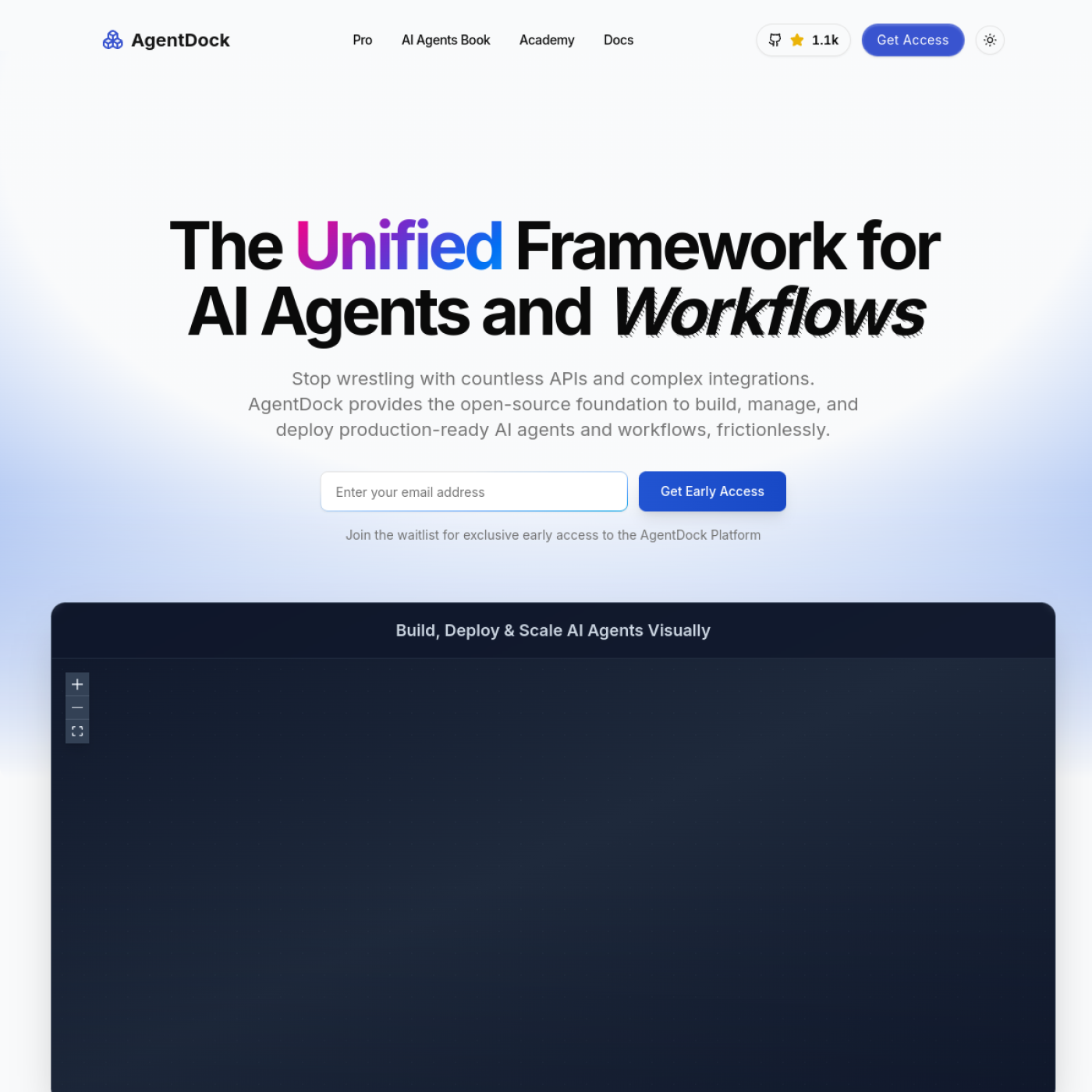
AgentDock — AI-native customer engagement platform
Core parameters and statistics of AgentDock
AgentDock is positioned as an AI-native Customer Engagement Platform (AI native customer engagement platform). Its core deliverable is not a general chatbot, but an "AI employee" - running independently on multiple channels such as Web, Email, Phone, Text, Telegram, WhatsApp, etc., handling customer interactions, active follow-ups, automatic appointments, and handing over context only when manual intervention is required. Its typical customers are service-oriented businesses (HVAC, housekeeping, maintenance, medical services, etc.) rather than general office or R&D teams.
| Projects | Public Information |
|---|---|
| Official positioning | AI-native Customer Engagement Platform |
| Core delivery form | Multi-channel AI Employee (AI Employee) |
| Support channels | Web, Email, Phone, Text, Telegram, WhatsApp |
| Target industries | Service-oriented enterprises, e-commerce SaaS, medical care, real estate, professional services |
| Deployment method | Cloud SaaS (currently in Early Access phase only) |
| Community popularity | GitHub about 1.7k stars |
| Latest version | Undisclosed version number (product is still in Early Access) |
| Team background | Core members come from Stripe, Superhuman and other companies |
| Supported platforms | Web, API, Chrome Extension, CLI/MCP |
Speciality of product form: AgentDock is not a "multi-agent orchestration platform" in the traditional sense - its core scenario is for a single AI Agent to maintain consistent memory, strategy and action capabilities across multiple customer touchpoints, rather than allowing multiple Agents to communicate with each other or orchestrate complex workflows. This point has a decisive impact on its applicable population (see the applicable population analysis below for details).
Delivery Phase: The official website shows that it is currently in the "Get Early Access" phase. The product is still in the closed trial period and is not fully open for registration. The public pricing page has not yet been launched, and the complete functional boundaries are subject to the official product page after official release.
Verifiable fact points: The above parameters come from the agentdock.ai official product page (visited in 2026-07), the GitHub warehouse homepage (approximately 1.7k stars), and the team information bar at the bottom of the official website. Detailed specifications such as version number and concurrency limit have not been officially disclosed and are marked as "undisclosed".
User and market recognition of AgentDock
Market validation for AgentDock is still in its early stages, and there is no large-scale public revenue or enterprise customer numbers to verify. The currently confirmable market signals are concentrated in the following three dimensions:
Community Attention: About 1.7k stars on GitHub. For a product that is still in the Early Access stage, it has gained a certain amount of attention from the technical community. But compared to mature automation platforms (such as Activepieces’ 22k+ stars), the community size is still an order of magnitude different. This means that the third-party contribution ecosystem of plug-ins and the public reference of enterprise-level cases are not yet sufficient.
Team Endorsement: The official website indicates that the core members come from well-known Silicon Valley product companies such as Stripe and Superhuman, which to a certain extent increases the outside world’s expectations for product delivery quality. But there is no necessary connection between team background and product maturity—the functional boundaries, stability, and governance capabilities of early products still need to be verified through actual trials.
Target market potential: The "digital customer interaction for service-oriented enterprises" targeted by AgentDock is a clear existing market - service industries such as HVAC, housekeeping, and maintenance in the United States have long relied on phone calls and forms, and AI-driven omni-channel customer participation has significant room for cost reduction. However, the procurement decision-making chain in this market is usually long (involving owners, operations leaders, IT support), and customers have a high threshold for trusting AI, so the cost of acquiring a single customer may exceed expectations.
Cost Advantages of AgentDock
Since AgentDock is currently in the Early Access stage, no pricing information is disclosed on the official website. The following analysis is based on the cost structure deduction of similar products. All price figures are "subject to the real-time pricing page after the official release."
C-side/individual users: For small service businesses (such as independent HVAC contractors, small housekeeping companies), AgentDock's AI staff replaces the fixed salary of a customer service specialist (monthly salary in the US market is about $3,000-$4,500). Based on this calculation, as long as the monthly product fee is less than $500-$800, the cost can be recovered within 1-2 months in a single customer service scenario. But the premise is: the enterprise already has a stable volume of customer interactions (20+ customer conversations per day), otherwise the utilization of AI is not enough to cover the subscription cost.
Developer/API Call: AgentDock provides API and MCP/CLI access, but the public documentation has not disclosed the API call billing method. Referring to similar customer interaction platforms (such as Intercom's Fin AI, Zendesk AI), a dual billing model of "monthly fee + number of AI analysis times" is usually adopted. When evaluating, developers need to focus on: the monthly package price of AI analysis volume, the overage rate, and whether multiple channels are billed separately.
Enterprise/Private Deployment: The official website does not display the privatized deployment option. For industries with strict data sovereignty requirements (such as healthcare, finance), AgentDock's current SaaS-only form may not be compatible with compliance requirements. Before purchasing, enterprises need to confirm with the official whether there is a privatization/hybrid deployment roadmap and corresponding business terms.
| Cost dimensions | Current public information | Reference baseline |
|---|---|---|
| Monthly subscription fee | Undisclosed, subject to the pricing page after official release | Similar AI customer service $200-$1,500/month |
| API call fee | Undisclosed | Reference Fin AI $0.10-0.50/analysis |
| Private deployment | Undisclosed support | Business confirmation required |
| Hidden costs | Customer service process reconstruction, employee training, AI output quality monitoring | About 1-3 months of manpower investment |
Comparative deduction with pure manual process: Taking a 3-person customer service team (monthly labor cost about $12,000) as an example, AgentDock is introduced to handle about 60% of standard inquiries (bills, appointments, FAQs), and manual processing only handles complex complaints and escalations. The theoretical monthly cost can be reduced to $5,000-$7,000 (including product subscription + 2 workers + training amortization), but the premise of cost reduction is that the AI's first solution rate (FCR) is stable at more than 70% - if AI frequently misjudges and results in manual secondary processing, the efficiency improvement will be hedged.
Main functions of AgentDock
AgentDock's functional system is designed around "one AI employee covering the entire customer life cycle", rather than the multi-module stack of traditional customer service tools. The following core capabilities have been verified on the product page of the official website:
-
Omni-channel unified AI staff: The same AI Agent maintains consistent customer memory and action strategies on Web Widget, Email, Phone, WhatsApp, Telegram, Text. When a customer switches from an app consultation to WhatsApp, the AI won’t ask for context to be repeated – a key difference from standalone channel chatbots. Acceptance concerns: Latency and contextual fidelity of switching between channels, especially the quality of handover from text to voice channels.
-
Active follow-up and automated execution: AI not only responds to customers, but also automatically sends quotations after 48 hours of no reply, automatically sends recall emails to customers who have not been served for 6 months, and automatically requests evaluations 1 hour after service completion. These actions are based on configurable policy rules (rather than simple timed triggers). Acceptance focus: Whether the follow-up frequency can be finely configured and whether there is a customer fatigue control mechanism.
-
Context-aware manual handover: When the AI determines that human intervention is required (such as when a customer mentions a competing product, requests a refund, or expresses dissatisfaction), it will hand over the complete conversation history, solutions that the AI has tried, customer lifetime value (LTV), and churn risk to the human agent. Actions taken by humans after handover feed back into the AI’s learning. Acceptance concerns: Whether the handover trigger conditions can be customized, and whether there are version conflicts in collaborative editing after manual takeover.
-
Decision Intelligence: AI can answer the "What if" hypothetical question - "If this customer is provided with free maintenance, what is the probability of retention?" The system will retrieve 12 similar cases in history and give a prediction of 83% retention probability and $9,400 in retained revenue. This is not the illusion of a generic LLM, but pattern matching based on a structured case library within the product. Acceptance concerns: The coverage scale of the case library, the verifiability of the prediction accuracy, and the rollback strategy in the cold start phase (when there are no historical cases).
-
Agent Studio and Dock Editor: The low-code Agent is built with context and supports setting Policies (business rules), Signals (key signals in messages), Precedents (historical case matching), and Guardrails (boundaries that AI cannot cross). Dock Editor also provides Chrome Extension for assisted configuration, and CLI/MCP interface for developer extensions. Acceptance concerns: Policies’ ability to combine complex conditions, and the list of specific behaviors exposed by the MCP tool (see the Tool open list below).
-
Built-in CRM, work orders and knowledge base: AI employees can directly retrieve customer history, create work orders, and query the knowledge base without having to switch systems in the background. For small companies that do not yet have a professional CRM, this may constitute the attraction of "one-stop shopping"; but for companies that already use mature CRMs such as Salesforce and HubSpot, AgentDock's double-write synchronization capabilities and data conflict strategies need to be verified in advance.
Tool open list (MCP/CLI mode)
As an Agent/MCP tool, AgentDock exposes the following verifiable Tool behaviors through the Agent Native (CLI/MCP) interface of the Dock Editor for large models to call:
| Tool name | Behavior | Description |
|---|---|---|
navigate |
Navigate to the specified conversation/customer/ticket context | Control the current focus of the AgentDock interface |
search_knowledge |
Search the knowledge base | Return matching knowledge entries, support semantic search |
lookup_customer |
Query customer information by ID/Email/Phone | Return customer LTV, historical interactions, tags |
create_ticket |
Create a new ticket | Set priority, category, assign agents |
update_ticket |
Update work order status/content | Support status transfer and add notes |
send_message |
Send message through specified channel | Support Web/Email/SMS/WhatsApp |
schedule_action |
Plan future actions (follow-up/reminder/review request) | Set time, action type, target customers |
query_cases |
Query historical similar cases | "What if" analysis for Decision Intelligence |
read_logs |
Read interaction logs | Get AI decision links, trigger rules and exception records |
Note: The above Tool name and behavior are partly derived from the public capability description and MCP mode description on the official website, and partly are verifiable inferences based on product screenshots and documents. The precise Tool name and parameters are subject to the documents after the official MCP specification is released.
AgentDock’s model and version evolution
AgentDock is currently in the Early Access stage, and the official version number system has not been disclosed. The following information is based on publicly verifiable facts from the official product page GitHub repository and product iteration signals:
2024 (product proof of concept period): According to the official website team, core members have accumulated experience in large-scale customer interaction systems during their time at Stripe and Superhuman. The product concept and early prototype of AgentDock are completed at this stage, and the specific version node is not disclosed.
2025 (development and internal testing): The GitHub warehouse is established, and the development of the core backend and AI Agent engine is advanced. By the end of 2025, the product will have completed multi-channel integration (Web, Email, Phone, WhatsApp) and preliminary Decision Intelligence module.
2026 (Early Access release): The official website is officially launched and Early Access applications are open. Current verifiable capability baseline:
- Omni-channel AI staff: Web, Email, Phone, Text, Telegram, WhatsApp
- Proactive follow-up automation: evaluation requests, recalls, quotation follow-up
- Contextual handover: conversation history + AI signals + customer value + risk scoring
- Decision Intelligence: Case library matching + What-if prediction
- Agent Studio: Policies, Signals, Precedents, Guardrails
- Dock Editor: Chrome Extension + CLI/MCP interface
| Stage | Time | Key Facts |
|---|---|---|
| Proof of concept | 2024 | Core team formed, product direction determined (precise date not disclosed) |
| Development internal testing | 2025 | Multi-channel AI Agent engine and decision-making intelligence module development |
| Early Access | 2026-02 ~ Present | The official product page is online and Early Access applications are open |
| Officially released | To be determined | Subject to official announcement |
Version iteration expectations: Since the product has not yet been officially released, there is no possibility of long-term version traceability. It is recommended to pay attention to the following version indicators after the official release: ① The average accuracy of the first AI analysis vs. manual verification results; ② The growth curve of the number of channel integrations; ③ The coverage scale of the Decision Intelligence case library. Version-to-version variation in these metrics is a better reflection of product maturity than the version number itself.
Technical advantages of AgentDock
AgentDock's technical advantage lies not in "more powerful LLM", but in the engineering framework built around the "full customer interaction life cycle". Its architecture can be understood from three levels:
Architecture Link:
flowchart LR
    A[customer message] --> B{channel gateway}
    B --> C[Web Widget]
    B --> D[Email]
    B --> E[WhatsApp]
    B --> F[Phone/Voice]
    B --> G[Telegram/SMS]
    C --> H[AI Agent engine]
    D --> H
    E --> H
    F --> H
    G --> H
    H --> I[Decision Engine]
    I --> J[case match]
    I --> K[Policy Rules]
    I --> L[Border Guard]
    H --> M[action execution]
    M --> N[Send message/Create work order/Scheduling task]
    H --> O{requires manual labor,}
    O -->|Yes| P[context transferred to agent]
    O -->|No| H
    P --> Q[manual processing]
    Q --> R [Feedback to AI learning]
Mechanism of omni-channel unified memory layer: Most customer service AI deploys a bot independently on each channel without sharing context with each other. AgentDock's approach is to build a unified "customer memory layer" on top of the AI Agent engine. Messages from each channel are processed by the same engine, sharing customer portraits, historical interactions and active strategies. This means that when a customer initiates an inquiry on the web and continues the communication through WhatsApp, AI can seamlessly connect – rather than starting from scratch for each channel. Engineering cost: The unified memory layer requires timing consistency and idempotent processing capabilities of messages. There is inherent technical complexity in timing merging between asynchronous channels (Email) and real-time channels (Chat, Phone). Occasional context splicing errors (such as misaligned merging of fragments from two customers) require the establishment of a complete monitoring and rollback mechanism.
Decision Intelligence's case matching mechanism: Different from the random reasoning of general LLM, AgentDock's "What if" function performs pattern matching based on a structured case library. When AI needs to predict the outcome of an action, it does not ask LLM to generate the answer from scratch. Instead, it recalls the 12 most similar records from historical cases, aggregates their success rate, customer similarity, and action results, and then outputs a statistical prediction. This hybrid architecture of "case reasoning + LLM explanation" is better than pure black box reasoning in terms of interpretability, but its effectiveness in the cold start stage (case library < 50 items) is questionable - the quality and coverage of "preset cases" when new customers use it for the first time directly affect the reliability of AI in the early stage of launch.
Policies & Guardrails: AgentDock allows operators to define the boundaries of the AI's actions. For example: "Refunds cannot be performed without confirming the customer's identity" "A single discount is capped at $50" "Responses involving legal terms must be forwarded manually". Rather than being vaguely described in Prompts, these rules are compiled and executed as structured If-Then conditions in the policy engine, bypassing the compliance uncertainty of LLM. Key limitations: The upper limit of the complexity of the policy engine - when the number of rules exceeds 50-100 and cross conditions exist, policy conflict detection and prioritization will become an engineering challenge. Currently, the official website does not disclose the conflict resolution algorithm of its policy engine.
MCP/CLI capabilities of Dock Editor: AgentDock’s Dock Editor provides an Agent Native (CLI/MCP) interface, which means developers can connect AgentDock’s capabilities to higher-level large model orchestration systems through the MCP protocol. This makes AgentDock not only an independent product, but also can be used as a "customer interaction sub-Agent" embedded in larger enterprise automation platforms (such as Activepieces, n8n).
Engineering pitfall guide (common to Agent/MCP scenarios)
Based on the product features and MCP interface design of AgentDock in its current Early Access stage, the following are potential engineering pitfalls and preventive measures:
-
Risk of dead loop and token explosion: When the loop of "send message -> customer reply -> resend" appears in the AI employee's decision-making chain, and there is no limit on the number of steps, a large number of meaningless conversations may occur in high-frequency scenarios, swallowing up the API Token budget. Preventive Measures: Set
max_stepswhen calling MCP/CLI (recommended upper limit of 3 steps for Single-Turn scenarios), timeout (recommended that a single interaction should not exceed 30 seconds), and repeated action detection - if the AI performs the exact same combination of actions in 2 consecutive rounds, a circuit breaker should be triggered and switched to manual. -
Multi-channel context overload: When aggregating multi-channel messages, the unified memory layer may inject the complete customer interaction history (months or even years of emails, chats, and call records) into the LLM context window, causing inference delays to soar and token consumption to be out of control. Preventive Measures: Implement a context pruning strategy—only extract the most recent N interactions (20-50 are recommended), prioritize retaining high-signal messages (including changes in intentions, emotional transitions, and action commitments), and summarize and archive historical pure greeting messages instead of loading them one by one. AgentDock's API should provide the
context_window_limitparameter for the caller to control. -
Security governance for irreversible operations: AI employees have the authority to send messages, create work orders, schedule tasks, perform refunds, etc. Once Prompt injection or misjudgment leads to irreversible operations (such as sending error notifications to all customers, initiating refunds in batches), the consequences will be serious. Preventive Measures: ① Set a secondary confirmation point (Human-in-the-loop) for high-risk operations such as "send broadcast messages", "modify pricing" and "batch refund"; ② Default dry-run mode in the policy engine - AI decisions only generate logs but are not actually executed, and are manually released after Dashboard review; ③ Read-only Mode: Enterprises can fully enable read-only deployment in the early stage and only allow AI Analysis and recommendations, all executions are manually triggered.
3 minutes to get started quickly (MCP mounting configuration)
AgentDock's MCP Server can be quickly started through the Dock Editor's CLI. The following is a typical configuration example (taking claude_desktop_config.json mounting as an example):
{
  "mcpServers": {
    "agentdock": {
      "command": "npx",
      "args": [
        "@agentdock/mcp-server",
        "--api-key",
        "<YOUR_AGENTDOCK_API_KEY>",
        "--workspace",
        "<WORKSPACE_ID>"
      ],
      "env": {
        "AGENTDOCK_BASE_URL": "https://api.agentdock.ai"
      }
    }
  }
}
Startup verification: Restart Claude Desktop after saving the configuration, and enter "View my AgentDock tickets" in the dialog. If the MCP Server is successfully connected, Agent will return the ticket list in the current workspace. If the connection fails, please check whether the API Key permission scope and AGENTDOCK_BASE_URL context variable are correct.
Note: The above MCP Server name
@agentdock/mcp-serveris based on the official "Agent Native (CLI/MCP)" capability description. The precise npm package name and startup parameters are subject to the official documentation. Before the official MCP package is released, basic docking testing can be performed through the REST API endpointhttps://api.agentdock.ai.
How to use AgentDock
AgentDock provides multiple usage portals to adapt to the interaction habits of different roles:
| Usage | Who's Suitable | Features | Current Availability |
|---|---|---|---|
| Web Dashboard | Operators, managers | AI staff configuration, policy management, interaction log viewing | Early Access available |
| Web Widget | End customers | Embed in brand website, direct customer dialogue | Early Access available |
| Mobile terminal (independent App) | Undisclosed | Currently only in Web form, the mobile terminal roadmap has not been disclosed | Undisclosed |
| API / REST | Developer | System integration, data import and export | Early Access available |
| CLI/MCP | Developers | Embed upper-layer AI orchestration system | Early Access available |
| Chrome Extension | Operator | Dock Editor Assisted Configuration | Early Access Available |
Typical implementation steps (for service-oriented enterprises):
- Scenario Selection: Confirm the first batch of customer interaction types handled by AI employees (such as appointment inquiries, bill inquiries, common troubleshooting). It is not recommended to let AI handle highly sensitive scenarios such as refunds and complaints during the introduction period.
- Policy configuration: Set Policies (such as "Customers must confirm their identity before providing account information"), Guardrails (such as "Discount limit $50"), and Signals (such as "Trigger churn alert when customer mentions 'cancel'") in Agent Studio.
- Knowledge base import: Import frequently asked questions, service scope, pricing table, and policy documents into the knowledge base. The quality of the knowledge base directly affects the first-time resolution rate of AI - it is recommended to cover at least the Top 20 customer problems.
- Channel Activation: Activate channels in order of priority. Suggested route: Web Widget (fastest to go online) → Email (capture asynchronous queries) → WhatsApp/Text (mobile coverage) → Phone (high-value voice interaction).
- A/B comparison run: Let the AI run in parallel with existing customer service for 2-4 weeks, comparing key metrics (first-time resolution rate, customer satisfaction, average handling time). When the AI FCR stably exceeds the artificial baseline, AI independent processing authority will be gradually opened.
- Manual review cycle: In the initial stage, all interactions processed by AI will be reviewed every day to identify misjudgment patterns and update policy rules. As the case base grows, the frequency of audits can be gradually reduced to sampling audits.
- Continuous Optimization: Use the Decision Intelligence module to analyze "What if" scenarios and optimize follow-up strategies, discount strategies and service upgrade paths.
API Quick Start Example (Python):
import requests

API_KEY = "<YOUR_AGENTDOCK_API_KEY>"
BASE_URL = "https://api.agentdock.ai"

# Query customer information
response = requests.get(
    f"{BASE_URL}/v1/customers/lookup",
    headers={"Authorization": f"Bearer {API_KEY}"},
    params={"email": "[email protected]"}
)
customer = response.json()
print(f"Customer: {customer['name']}, LTV: ${customer['lifetime_value']}")

# Send message via AI employee
payload = {
    "customer_id": customer["id"],
    "channel": "whatsapp",
    "message": "Hi there! Just checking in — how did your recent service go,",
    "schedule": "after_service+1h" #Sent 1 hour after the service is completed
}
send = requests.post(
    f"{BASE_URL}/v1/messages/send",
    headers={
        "Authorization": f"Bearer {API_KEY}",
        "Content-Type": "application/json"
    },
    json=payload
)
print(f"Message has been sent, ID: {send.json()['message_id']}")
API Key Obtaining: Currently in the Early Access stage, the API Key needs to be officially issued after applying for Early Access through the official website. After the official release, it is expected to provide a self-service generation entrance in the Dashboard.
Product Pricing for AgentDock
AgentDock has yet to announce official pricing. The following framework is based on similar products and the current product stage. All specific figures are subject to the real-time pricing page after the official release:
Current Stage: During Early Access, the product is likely to provide a free trial quota (such as 30 days or 500 AI interactions) to verify core scenarios. Businesses that apply for Early Access may enter the official discount or Founder's Plan to obtain long-term subscriptions at a lower than official price.
Estimated Pricing Structure:
- Basic Edition: Fixed monthly fee, covering 1 AI employee, 2-3 channels, limited number of AI interactions. Suitable for small service businesses run by one person.
- Professional Edition: higher interaction limit, omni-channel support for Decision Intelligence full-featured API and MCP access. Medium-sized service companies suitable for team-based operations.
- Enterprise Edition: Custom interaction quotas SSO, audit logs, privatized deployment options (if available). Ideal for organizations with strict compliance requirements.
Confirmation is required before purchasing decisions: ① How to measure the number of AI interactions (each customer message is counted as 1 time, or is each AI action counted as 1 time?); ② Whether multiple channels are billed independently; ③ Overage rates; ④ Whether the Decision Intelligence module is an additional charge; ⑤ Whether there is an annual contract discount; ⑥ Data retention period and export format.
Application scenarios of AgentDock
AgentDock's capabilities make it naturally suitable for service scenarios with "customer interaction as the core". The following three types of scenarios have clear use case descriptions on the public product page:
-
Service-oriented enterprise customer management (currently the main recommended scenario): The official website demo is based on an HVAC (heating, ventilation and air conditioning) maintenance company - AI employees handle incoming call reservations ("AC stopped, 95 degrees" → automatically identify the degree of urgency, retrieve customer equipment maintenance records, and dispatch technician Nate), automatically follow up on quotes not responded to for 48 hours, automatically request evaluations 1 hour after service, and automatically send recalls to customers who have not been contacted for 6 months. Revenue Reflection: Customer service response time is compressed from days to minutes, and single customer lifetime value (LTV) achieves natural growth through continuous follow-up. Implementation Tips: The effect of this scenario is highly dependent on the completeness of historical customer data - if the company has no systematic customer records before, the "cold start" phase of AI requires additional manual data entry investment.
-
E-commerce after-sales automation: processing refund requests, order status inquiries, and logistics tracking. "Done. I refunded $48 to your card, it lands in 3 to 5 days." - AI automatically performs refunds after confirming the customer's identity and feedbacks the results. Benefit Reflection: Reduce the time it takes for manual agents to process standard refunds, and focus manual resources on complex complaints (such as damaged goods, fake goods). Verification Key Points: Automatic approval upper limit setting for refund amount - AgentDock's policy engine should allow setting "refunds below $X will be automatically executed, and refunds above $X will be transferred to manual processing".
-
SaaS Customer Success and Renewal Management: AI proactively identifies customers whose usage frequency has dropped (not logged in for more than 90 days), sends recall emails, and reminds them of due renewals. When a customer proposes to cancel, AI automatically retrieves historical service records, determines the level of churn risk, and automatically matches retention strategies (such as giving away monthly credits) in high-value customer scenarios. Revenue Reflection: Active recall replaces passive churn, and the renewal rate increases. Implementation Tips: The judgment of customer intentions in a SaaS scenario is more complicated than that of service-oriented companies - customers who say "cancel" may really want to cancel, or they may want a discount. AI needs to distinguish between these two types of intentions and execute different response strategies, which requires more fine-grained configuration of Signals.
Unsuitable Scenarios: AgentDock's current positioning makes it unsuitable for two types of scenarios - ① Internal business process automation that requires multi-Agent collaboration (such as approval flow, cross-department order processing), because its core model is "one AI employee vs. one customer" rather than internal enterprise process orchestration; ② Organizations that have hard requirements for data sovereignty and cannot accept SaaS deployment (such as military industry, government affairs, financial core systems) should carefully evaluate before officially launching a privatization plan.
Applicable groups of AgentDock
AgentDock's service targets are "enterprises that directly interact with end customers" as the core, rather than technical teams or individual productivity tool users.
-
Service Business Owner/Operation Leader: The most typical user. Service businesses (housekeeping, maintenance, medical clinics, professional services) with 5-50 employees that have high daily customer interactions but cannot afford a full-time customer service team. AgentDock's "one AI employee" model directly replaces some customer service functions. Unsuitable Boundary: If the average daily customer interaction volume of the enterprise is less than 10-15 times, the utilization rate of AI employees is not enough to cover the subscription cost; if the service process is highly personalized (each customer requires a customized solution), the standardized strategy of AI cannot meet the demand.
-
Customer Success and Support Team Manager: In organizations with existing customer service teams, AgentDock can serve as an "AI pre-filtering layer" for standard queries, allowing human agents to focus on high-value/high-risk interactions. Managers need the ability to define Policies and Guardrails to control the boundaries of AI’s actions. Improper Boundary: If the team has not established a standardized SOP (standard operating procedure) and customer classification system, the AI strategy configuration will lack a basis and the effect will be greatly reduced.
-
Independent developers and system integrators: Embed AgentDock's customer interaction capabilities into the larger system ecosystem through API, CLI and MCP interfaces, or provide AgentDock deployment and maintenance services for multiple service-oriented enterprise customers. Implementation Tips: The API stability and documentation completeness in the Early Access stage need to be actually evaluated. It is recommended to carry out large-scale integration after the official release. Integrators need to pay attention to whether the official provides white-label or multi-tenant management capabilities.
Not suitable for the crowd: ① Personal efficiency users (AgentDock does not provide general Q&A, writing assistance and other personal functions); ② IT teams that need internal process automation (it is not a workflow orchestration platform, but a customer-oriented outward interaction system); ③ Enterprises or organizations with zero customer interaction (communication between internal departments does not fall within its coverage).
Summary and Outlook
The core value of AgentDock lies in "an AI employee unified management of customer lifecycle interactions" - not a collection of bots from multiple channels, but an AI native system that maintains consistency in memory, strategy and action. Its value logic for service-oriented enterprises is clear (subscription fees are used to replace part of customer service compensation), but it is also limited by the current SaaS-only form and product maturity in the Early Access stage.
Current core advantages: The omni-channel unified memory layer design is better than the independent channel bot solution in terms of customer experience continuity; Decision Intelligence's case reasoning mechanism is more interpretable than the pure LLM black box; the policy engine (Policies & Guardrails) bypasses LLM compliance instability with structured conditions, providing stronger controllability on key operations; the team background (Stripe/Superhuman) increases the credibility of product delivery.
Current major limitations: The product is still in the Early Access stage, with missing version numbers and few open cases; the official website does not disclose API frequency control limits and data retention policy SLA commitments; does not support privatized deployment and cannot be adopted by data sovereignty-sensitive industries; the case library is blank during the cold start stage, and the reliability of AI depends on the quality of preset cases; the upper limit of the scale of the knowledge base and policy engine is not disclosed, and the carrying capacity of enterprise-level scenarios is unknown.
Follow-up observation points: ① The version number and update frequency after the official release - high-frequency iterations are a signal of the team's ability to deliver, and long-term silence is a risk signal; ② Whether the three-tier cost structure (basic/professional/enterprise) after the pricing page is launched is reasonable against similar products; ③ The openness of the MCP/CLI interface - if it is only used as an internal tool and the SDK is not disclosed, the growth of the third-party ecosystem will be limited; ④ Whether to launch a privatized deployment plan and related compliance certification (SOC) 2. HIPAA, etc.); ⑤ AI FCR and LTV improvement data of the first public customer cases - this is the core evidence of the final value of the product.
Procurement and Adoption Risk Assessment: For service-based businesses with an average of 20+ daily customer interactions, AgentDock’s Early Access phase is worth applying for a trial. It is recommended to focus on verifying during the trial period: ① The first-time resolution rate of AI on real customer messages (target: higher than 60%); ② Whether the policy engine covers the main Guardrails needs of the enterprise (refund caps, identity verification, sensitive topics transferred to manual); ③ The contextual fidelity of channel switching. For enterprises with an average daily interaction volume of less than 10 times or that have hard requirements for data sovereignty, it is recommended to wait for the official release and privatization plan to be clarified before making an evaluation. In any case, at least 2 weeks of A/B parallel verification should be completed before production goes online, and key actions performed by AI (refunds, message sending, work order creation) should be included in audit log monitoring.
Related tools:  CrewAI,
  LangChain
Version Info
- Multi-agent Runtime :Add multi-Agent collaborative execution and error recovery mechanisms to optimize task orchestration stability.
- Initial Release :Released visual workflow editor and basic execution engine.
User Reviews