 AgentOps
Free
AgentOps
Free
AgentOps is a developer platform for AI Agent and LLM applications, covering trace, session replay, LLM call cost tracking, debugging and auditing, framework integration, cloud dashboards and enterprise self-hosting. It is suitable for advancing prototype Agents into observable, repeatable, and manageable production environments.
AgentOps
Core parameters and statistics
AgentOps is officially positioned as an observation and developer tool platform for AI Agent and LLM applications. The official website advocates covering "Trace, Debug, & Deploy Reliable AI Agents" and clearly serves Agent frameworks such as OpenAI, CrewAI, AutoGen, and 400+ LLM/framework ecosystems. It is not a basic model supplier, nor is it a general logging platform; the core boundary is at the Agent application layer, which organizes LLM calls, tool calls, multi-agent interaction tokens, costs, error prompt injection risks, and session replay into reproducible engineering evidence.
| Projects | Public Information |
|---|---|
| Official entrance | https://www.agentops.ai/ |
| Application Portal | https://app.agentops.ai/ |
| Open source warehouse | https://github.com/AgentOps-AI/agentops |
| Python package | https://pypi.org/project/agentops/ |
| Latest Python SDK | 0.4.21, released on 2025-08-29 |
| License | GitHub repository annotation MIT |
| GitHub community size | About 5.6k stars, 599 forks (current public value of GitHub API) |
| Core capabilities | Agent tracing, session replay, LLM cost tracking, token tracking, debug/audit, framework integrations |
| Public price tiers | Basic, Pro, Enterprise |
| Enterprise deployment | The Enterprise layer exposes terms such as on-premise deployment, self-hosting (AWS/GCP/Azure), custom SSO, SLA, etc. |
Capability Boundary: AgentOps is more suitable for documenting and governing "how Agent runs" rather than directly replacing model APIs, vector databases, or business orchestration frameworks. For lightweight scripts that only call LLM once, complete access to AgentOps may seem too important; for multi-step tool calls, long-link tasks, online Agent failure review and cost management, its value is clearer.
User and market recognition
Developer Adoption Signal: The official AgentOps repository describes its Python SDK for AI agent monitoring, LLM cost tracking, benchmarking and other scenarios, and lists integration directions such as CrewAI, Agno, OpenAI Agents SDK, LangChain, AutoGen/AG2, CamelAI, etc. GitHub currently publishes about 5.6k stars and 599 forks, indicating that it has entered the visible range of the AI Agent engineering community, but this is still a signal of open source attention and is not equivalent to the number of paying customers.
Official website market signal: The official website states "Powering thousands of engineers building reliable agents" and emphasizes Agent observability for OpenAI, CrewAI, Autogen and 400+ LLMs/frameworks on the first screen. This statement can indicate that the product has targeted developers and Agent engineering teams as its main target customer groups; the number of independent paying customers, annual revenue, renewal rate, and industry penetration rate have not been disclosed.
Ecological position: In the context of AgentOps, observation is not a simple extension of traditional APM, but a causal chain built around agent events, LLM events, tool events and session replay. Compared with the supplier backend that only displays model call logs, AgentOps puts more emphasis on putting multi-agent interactions, tool calls, costs and playback into the same debugging panel; compared with LLMOps platforms such as LangSmith, Phoenix, Opik, etc., its official website expression is more focused on "Agent observability" and "time travel debugging".
Cost advantage
The cost structure of AgentOps is divided into three tiers: personal/early-stage projects, development team/API access, and enterprise/self-hosted. The price section of the official website clearly states that Basic is $0/month, free up to 5,000 events; Pro starts at $40/month, and offers pay as you go; Enterprise is custom, covering SLA, custom SSO, on-premise deployment, custom data retention policy and self-hosting.
C-side/individual developers: The core significance of the Basic layer is to lower the first-time access threshold. Individual developers can first use the 5,000 events free quota to verify whether the SDK management replay analytics and LLM cost tracking can cover key Agent links. The hidden costs are mainly in code access, event naming, sensitive field processing and playback data cleaning, rather than subscription fees.
Developer/API Team: Pro starts at $40/month, and the official website includes unlimited event limit, unlimited log retention, session and event export, dedicated Slack and email support, and role-based permissioning. For small teams that are launching Agents, the cost advantage comes from merging "logs, costs, playback, export, and permissions" into one product path, reducing the need to switch between cloud logs, table evaluations, and temporary debugging scripts.
Enterprise/privatization scenario: Enterprise has not disclosed a fixed quotation, and it must be subject to the official real-time page and business contract. Its costs don't just come from subscriptions, but include self-hosted infrastructure, cloud resources, data retention policy SSO/RBAC, auditing, security assessments, and support SLAs. For high-compliance teams, the significance of Enterprise is to keep Agent operating data in a controllable environment, rather than simply pursuing the lowest book price.
Main functions
- Agent tracing: records LLM calls, tool calls, multi-Agent interactions and running events, helping the engineering team break down an "output not as expected" problem into a positionable timeline, input, output and intermediate states.
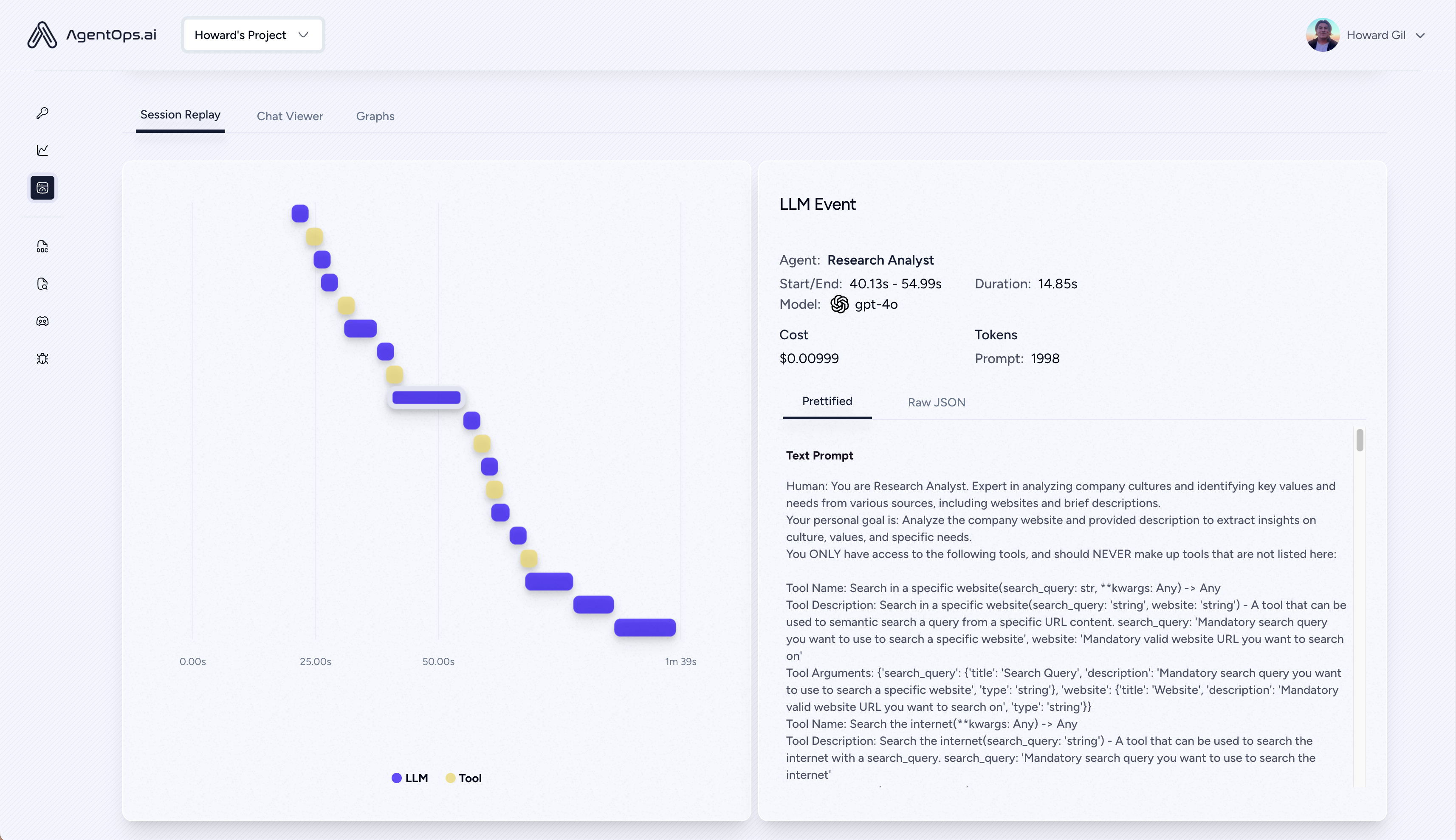
- Session replay / time travel debugging: The official website emphasizes that Agent runs can be replayed. The Session Replay panel in the screenshot shows the event timeline LLM Event, model, duration, cost and tokens. This capability is suitable for reviewing long link task failures, tool parameter errors, and context pollution.
- LLM cost tracking: The official website publicly states that it supports LLM Cost Tracking (400+ LLMs), token counts and up-to-date price monitoring. Its role is not to reduce the unit price of the model itself, but to allow the team to see which agent, tool chain or model selection is causing the cost anomaly.
- Debug and audit: The official website clearly mentions the full data trail of logs, errors, and prompt injection attacks, which is suitable for Agent projects that need to retain audit trails from prototype to production.
- Framework Integration: README and documentation list integration portals such as OpenAI Agents SDK, CrewAI, AG2/AutoGen, LangChain, LangGraph, LlamaIndex, LiteLLM, Anthropic, Google Generative AI, xAI, etc., reducing the team's need to write observation adaptation layers for different frameworks.
- Decorator and span system: The official
llms.txtdisplays session, agent, operation/task, workflow and other decorators, which are used to create hierarchical spans for the Agent workflow. This design allows non-framework built-in business functions to be included in trace. - Self-hosting and enterprise deployment: The self-hosting directory of docs contains pages such as overview, backend setup, Docker guide, native development, etc. The Enterprise layer of the official website also exposes AWS/GCP/Azure self-hosting options.
Model and version evolution
AgentOps itself is not a model version product. The main version line is mainly reflected in the SDK, open source warehouse and cloud platform capabilities. The current version lines that can be stably verified come from GitHub Releases, PyPI and pyproject.toml, all three point to Python SDK 0.4.21.
AgentOps SDK Mainline
0.4.21 (2025-08-29): This version is made public by both GitHub Releases and PyPI. The release record includes OSS dist synchronization, new screenshots, library file recovery, etc., and can be used as the baseline version for current Python SDK access.
0.4.20 (2025-08-15): The previous version release record contains document videos embedded in OSS release and back-end operation instructions updates, indicating that the team is continuing to maintain documentation, open source distribution and local operation paths.
0.4.19 (2025-08-01): The previous version release record includes OpenAI Responses API testing, sample document updates and AG2 migration-related changes, reflecting AgentOps’ follow-up to the new Agent/LLM SDK ecosystem.
Product form evolution of AgentOps
From the "Session replays in 2 lines of code" in the README to the traces, spans, decorators, TypeScript SDK and self-hosting directories in the v2 document, the evolution direction of AgentOps is to expand from simple SDK management to a more complete Agent observation system. The SDK version should be fixed when using it in production, first verify the event structure, sensitive field processing and cost caliber in staging, and then promote it to the core Agent service.
Technical advantages
A small amount of code access: The quick starts given by the README are pip install agentops, agentops.init() and agentops.end_session('Success'). Mechanically, it automatically captures LLM/Agent events through the SDK and integration framework; the effect is that early teams do not need to build complex observability pipelines; applicable scenarios are PoC, prototype Agents, and development situations that require rapid review.
Span level expresses Agent process: Official documents and llms.txt display session, agent, operation/task, workflow and other decorators. Mechanically, it splits an Agent execution into parent-child spans; the effect is to locate "which step of tool call, which prompt or which model response" affects the final result; applicable scenarios are multi-tool call, multi-Agent collaboration and asynchronous workflow.
Cost and quality evidence on the same screen: The LLM Event in the AgentOps screenshot simultaneously displays model, duration, cost, tokens and prompt content. Mechanically, it binds cost indicators to specific events instead of just summarizing them at the billing level; the effect is that the team can put "why it is expensive" and "why it failed" in the same playback link for analysis; applicable scenarios are high-frequency customer service agents, research agents, code agents and internal enterprise knowledge assistants.
Framework coverage: AgentOps official materials cover OpenAI, CrewAI, AutoGen/AG2, LangChain and other ecosystems. Mechanically, it reduces the management differences of different Agent frameworks; the effect is that the platform team can use a more consistent event model to manage multiple projects; the applicable scenario is the stage when multiple Agent frameworks are tested simultaneously within the organization.
How to use
| Usage path | Entrance | Typical steps | Adaptation scenarios |
|---|---|---|---|
| Python SDK quick access | PyPI / GitHub README | Install agentops -> Obtain API key -> Call agentops.init() at program entry -> Run Agent -> View session on dashboard |
Personal developer PoC, small Agent service |
| Framework integration | docs.agentops.ai/v2/integrations | Select integration pages such as CrewAI, AG2, OpenAI Agents, LangChain, etc. -> Configure contextual variables/API key -> Run the example -> Verify whether the trace is complete | Existing Agent framework project |
| Custom span/decorator | v2 concepts / usage docs | Use session, agent, operation/task, workflow decorator to annotate business functions -> Check span level and input and output records | Complex workflow, non-standard framework, self-developed Agent |
| Enterprise self-hosting | v2 self-hosting docs / Enterprise Business | Confirm Enterprise terms -> Assess AWS/GCP/Azure or on-premises -> Deploy backend and database -> Configure permissions, retention policies, and auditing | Organizations with high data boundary, compliance, and security requirements |
Minimum landing path: First select a high-value Agent link, such as research assistant, customer service diversion, sales lead processing or code agent. In the first stage, only trace and replay are connected to verify event coverage and fault recovery time; in the second stage, cost tracking and token indicators are added; in the third stage, permissions, exports, retention policies and enterprise deployment are included in the management.
Product Pricing
The AgentOps official website publicly provides three tiers: Basic, Pro, and Enterprise. The specific quota and terms should still be based on the official real-time page, especially event billing, export, retention period, and enterprise security terms.
| Plans | Disclosed Prices | Disclosed Capabilities | Typical Positioning |
|---|---|---|---|
| Basic | $0/month | Free up to 5,000 events; Agent Agnostic SDK; LLM Cost Tracking (400+ LLMs); Replay Analytics | Personal, Early PoC, Free Validation |
| Pro | starts at $40/month | Pay as you go; unlimited event limit; unlimited log retention; session/event export; Slack/email support; role-based permissioning | The team that is launching Agent |
| Enterprise | Custom | SLA; Slack Connect; custom SSO; on-premise deployment; custom data retention policy; self-hosting (AWS/GCP/Azure); SOC-2, HIPAA, NIST AI RMF | Enterprise security, compliance, self-hosting and governance at scale |
Billing Boundary: The public price of AgentOps does not equate to the underlying LLM inference cost. Model invocation costs are still billed separately by model vendors or cloud platforms such as OpenAI, Anthropic, Google, Mistral, etc.; AgentOps is mainly responsible for recording, attribution, and governance of these costs. Before formal purchasing, you need to confirm the event caliber, team seats, log retention, export permission SSO, SLA, self-hosted resources and data processing terms.
Application scenarios
- Production Agent fault review: When the multi-step Agent encounters incorrect tool calls, long delays, abnormal costs, or unstable output, Session Replay can restore events according to the timeline, helping the team locate the problem to model selection, tool parameters, context prompts, or external services.
- LLM Cost Management: For frequently called customer service, research, sales and code agents, cost tracking and token counts can identify high-cost nodes and assist in comparing model prompts, tool call times and retry strategies.
- Agent pre-release verification: After staging is connected to AgentOps, the team can record test samples, failure traces and key indicators to avoid launching complex Agents based solely on demonstration effects.
- Security and Audit: The official website clearly mentions the data trail of prompt injection attacks. For Agents processing internal knowledge bases, customer data, or compliance texts, the complete event trace helps review risk inputs and outputs.
- Multi-framework platform governance: When an enterprise simultaneously tests frameworks such as CrewAI, OpenAI Agents, LangChain, AG2, etc., AgentOps can be used as a unified observation layer to reduce the need for self-built observation scripts for each business line.
Applicable people
- AI Agent Developer: Need to quickly know what the Agent did at each step, how much the model cost, and which node the failure occurred. The prerequisite is the willingness to integrate SDK or framework into the code.
- Platform Engineering/LLMOps Team: Need to provide unified trace, cost tracking, event export and permission management for multiple Agent projects. The prerequisite is that the organization already has multiple Agent projects or a clear production plan.
- Product and Quality Team: Online failure samples, replay evidence and quality indicators need to be included in the release process, rather than just looking at a single manual experience.
- Enterprise Security & Compliance Team: Focus on self-hosted SSO, log retention, auditing SOC-2/HIPAA/NIST AI RMF, etc. This group should prioritize verification of Enterprise contracts, data areas, retention policies, and internal security requirements.
Not suitable for the boundary: One-time demos, personal scripts without long-term online plans, projects that only need to view the basic logs of the model supplier may not be able to reflect the full value of AgentOps in the short term. If the team has not defined key Agent links, event naming conventions, and sensitive information processing methods, direct large-scale access will also easily produce noisy data.
Summary and Outlook
The core value of AgentOps is to centralize the "running evidence" of Agent applications into a replayable developer platform: trace to see the steps, replay to restore the process, cost tracking to explain costs, debug/audit to retain risk clues, and framework integration to lower the access threshold. It is most suitable for teams that have moved from Agent prototype to quasi-production or production stage, because what such teams really need to solve is whether the quality is stable, whether the failure is reproducible, whether the cost is controllable, and whether the data is auditable.
There are four main categories of current limitations and uncertainties: First, Enterprise quotation SLA, SSO, self-hosting and data retention details require business confirmation; Second, the number of independent paying customers, revenue, retention rate and industry distribution are not disclosed; Third, the effect of AgentOps depends on the quality of event management. If the team does not have a clear span structure and sensitive field management, playback data will become difficult to maintain; Fourth, the underlying model cost is charged separately by the model supplier, AgentOps It can only help observation and attribution, but cannot replace the model cost optimization strategy.
The implementation suggestion is to first pilot 1-2 high-value Agent links to quantify trace coverage, average review time, failure recurrence rate, single task cost and abnormal event ratio; when these indicators can stably enter the release process, then expand to multiple projects, permission management, export, long-term retention and enterprise self-hosting. Before formal purchasing, you should review the official website price, event billing caliber, data processing terms, log retention SSO/RBAC, SLA, self-hosted environment and SDK latest version compatibility.
Related tools:  GitHub Copilot,
  Cursor
Version Info
- AgentOps Python SDK 0.4.21 :The latest version of the Python SDK is published by both GitHub Releases and PyPI. The release record includes updates such as OSS dist synchronization, new screenshots, and library file recovery.
- AgentOps Python SDK 0.4.20 :GitHub Releases is a public pre-release version, and the release record includes document videos embedded in OSS release and back-end operating instructions updates.
- AgentOps Python SDK 0.4.19 :GitHub Releases is a public pre-release version. The release record includes OpenAI Responses API testing, sample document updates, and AG2 migration-related changes.
User Reviews