 AGI-Eval
Free
AGI-Eval
Free
AGI-Eval is a Chinese evaluation community for large models. It aggregates multi-dimensional evaluation sets, model lists and capability comparisons, and serves model development, selection and AI training model evaluation scenarios.
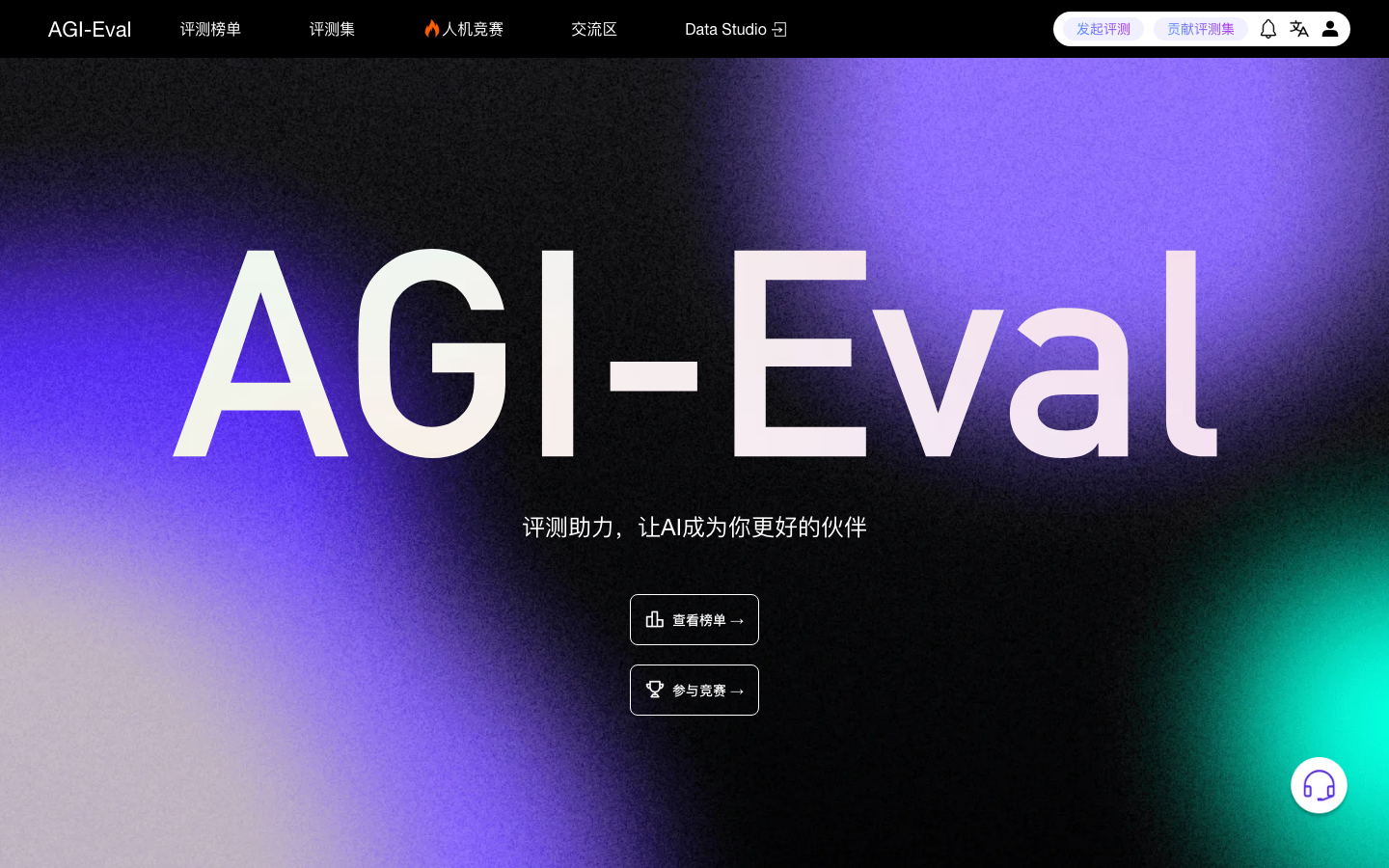
AGI-Eval
Core parameters and statistics
AGI-Eval is a Chinese community focusing on large model capability evaluation. The core issue it wants to solve is "Is the model strong and where is it strong?" - When there are endless large models on the market and each company reports its own indicators, the R&D and selection team lacks a relatively neutral and comparable evaluation reference. AGI-Eval provides such a frame of reference by organizing review sets, lists, and ability comparisons.
| Projects | Public Information |
|---|---|
| Official positioning | AI large model evaluation community |
| Product form | Web evaluation community / list |
| Core content | Evaluation set, model list, ability comparison |
| Evaluation objects | Various large language models |
| Target users | Model development, selection decision makers, researchers |
| Support Platform | Web |
| Place of Belonging | China |
| Billing Form | Free View |
Product Boundary: It provides an "evaluation reference", not the model itself or the deployment service. The results of the list reflect the performance under a specific evaluation set and cannot be directly equated to the actual effect of the business scenario.
Source of ability: The value comes from the design quality of the evaluation set and the way the list is maintained - whether the evaluation dimensions cover the real ability and whether it resists score brushing determines the reference value of the list.
User and market recognition
Gradually build user awareness in the field, and product capabilities are used by content creators and teams to improve work efficiency. Some industry users have incorporated it into their daily workflow. It is recommended to refer to the latest official disclosures for specific user scale and industry adoption rate data.
Cost advantage
- C-side/Individual: Usually a free version is provided to experience the core functions, and high-frequency use requires a paid package subscription.
- API/Developer: Billed by call volume, suitable for development teams that can be flexibly integrated into their own systems.
- Enterprise/Privatization: Contact the business owner to obtain customized quotation and deployment plan. The specific price is subject to the official real-time pricing page.
Main functions
- Evaluation Set: Evaluation question sets and methods are organized around different competency dimensions.
- Model List: Rank and display the performance of participating models.
- Capability comparison: Compare different models horizontally in multiple dimensions.
- Community Participation: Gather discussions and contributions related to evaluation.
Hidden linkage: Its value is not in a single score, but in the combination of "multi-dimensional evaluation + horizontal list" - selectors can first look at the comprehensive ranking, and then drill down to the capability dimensions most relevant to their own business to avoid being misled by a single total score.
Model and version evolution
Continuous iterative updates, the latest version introduces performance optimization and new features. Historical version information can be viewed on the official release page. There is no complete public version evolution timeline yet. It is recommended to pay attention to the official announcement to understand the rhythm of feature updates.
Technical advantages
Mechanism: By designing a Chinese evaluation set covering a variety of abilities, the model is tested in a standardized manner and a comparable list is formed.
Effectiveness: Compared with manufacturers’ self-reported indicators, community-based and multi-dimensional evaluations provide a more neutral horizontal comparison and reduce selection bias.
Applicable scenarios: R&D and selection teams that need to make objective comparisons between multiple large models can best benefit from this third-party evaluation reference.
How to use
- Open the AGI-Eval community website.
- Browse the model list to understand the overall performance of the participating models.
- Drill down to the capability dimensions related to your own needs for comparison.
- Understand the meaning of scores based on the evaluation method.
- Incorporate the model of interest into your own scenario for actual testing and verification.
The entrance is purely Web, free to read.
Product Pricing
The pricing model is subject to the official real-time page. Usually a freemium or subscription system is used, and basic functions can be used for free. Advanced functions or high-frequency use require paid subscriptions, and users are advised to evaluate the optimal solution based on actual usage.
Application scenarios
- Model Selection: Make horizontal comparisons between multiple candidate models.
- R&D Evaluation: Evaluate the performance of self-developed models on public evaluation sets.
- Industry Research: Track the evolution trend of large model capabilities.
- Technical Research: Quickly establish an understanding of the current model landscape.
Applicable people
- Model R&D Team: Evaluate self-developed models and benchmark against competing products.
- Technical Selection Decision Maker: Choose the appropriate large model for the business.
- AI researchers and analysts: Research model capability landscape and trends.
Unsuitable Boundary: Ordinary users who only need to use large models to complete specific tasks do not need to pay attention to the details of the evaluation; it is not advisable to directly use the list scores as a guarantee of business results, and must be combined with actual measurements of your own scenarios.
Summary and Outlook
AGI-Eval provides a third-party evaluation reference for the Chinese large model ecosystem, using free, multi-dimensional lists to help R&D and selection teams establish a relatively neutral comparison benchmark. Its limitation is that there is always a gap between evaluation scores and real business results, and the results can only be used as a starting point for screening.
Implementation suggestions: The selection team can use the AGI-Eval list as the first step to narrow down the candidate range, and then conduct small-scale actual tests on the shortlisted models on their own data and scenarios, and use actual task performance rather than a single list score to make the final decision.
Related tools:  Hugging Face, replicate
Version evolution of AGI-Eval
As an online evaluation community, the content continues to iterate as models evolve and evaluation methods are updated, without traditional discrete version numbers.
Main line context
- Community establishment period: Build an evaluation set and ranking system, and establish a basic evaluation framework.
- Continuous update period: The list will be expanded as new models appear, and the evaluation dimensions and methods will be iterated.
The exact version date has not been officially disclosed, and the text is marked with the online version at the time of collection.
Version Info
- AGI-Eval (online community version) :The evaluation community operates online, and the evaluation set and ranking list are continuously updated as the model evolves; the official independent version number has not been disclosed, and the online version at the time of collection is marked here. There is no official precise date yet.
- AGI-Eval community is online :The evaluation community is online and a evaluation set and model ranking system have been established; there is no official precise date yet.
User Reviews