 Agno
Free
Agno
Free
Agno is an AI agents framework and runtime for developers and enterprises. It is officially positioned as a high-performance framework for multi-agent systems. It is equipped with the enterprise-level agent operating system AgentOS and supports the construction, operation and management of Agent platforms in its own cloud.
Agno
Core parameters and statistics
Agno combines the "multi-agent framework" and the "enterprise-level runtime" into the same product line: the upper layer is a Python framework for orchestrating Agents, and the lower layer is a runtime called AgentOS. Officials advocate that it can be deployed directly in the user's own cloud. Its difference is not in the capabilities of a certain model, but in the convergence of the link from "writing Agent" to "running Agent platform" into one project.
| Projects | Public Information |
|---|---|
| Official positioning | Agent Framework + High-Performance Runtime for Multi-Agent Systems |
| Runtime | AgentOS, officially the first enterprise-level agentic operating system |
| Deployment form | Build, run, and manage Agent in the user's own cloud |
| Development language | Python framework, open source |
| Code repository | github.com/agno-agi/agno |
| Community size | About 40,612 stars, 5,500 forks |
| Latest version | v2.6.12 (2026-06-05, GitHub Releases) |
| Predecessor | Phidata |
Performance orientation: The official repeatedly emphasizes "high-performance runtime", which means that its design goal is not to run a toy example of only one or two Agents, but to carry the instantiation and concurrency of a large number of Agents in a single instance. The instantiation overhead and memory usage at the framework level are the core competitive points it claims to the outside world.
Own cloud deployment: AgentOS emphasizes "inside your cloud" and keeps the data and execution aspects within the user's territory. This is a key prerequisite for teams that are subject to compliance constraints and are unwilling to send Agent calls and contexts outsourced.
Iteration Density: GitHub Releases shows that 2.6.x was released multiple times between May and June 2026 (such as v2.6.9 to v2.6.12), indicating that the project is still in the intensive maintenance stage, and specific minor versions should be locked during seal evaluation.
User and market recognition
Recognition of Agno mainly comes from the size of the open source community and engineering reputation, rather than public revenue or number of paying customers (the latter is not officially disclosed).
Community Popularity: GitHub currently shows about 40,612 stars and 5,500 forks, which is a head-level level for an Agent framework, indicating that its connectors, examples and documents have formed an ecosystem that can be reused and verified externally.
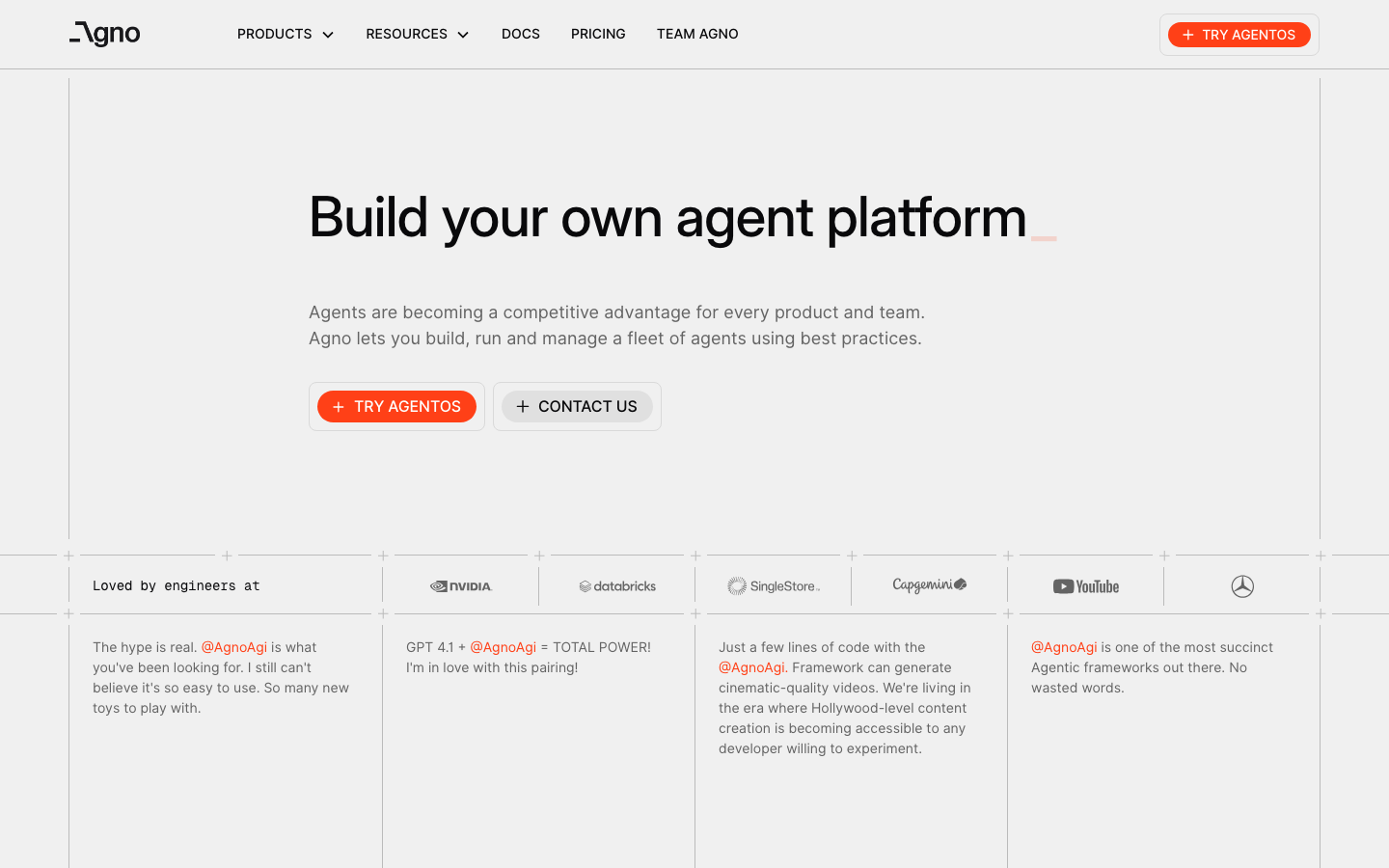
Brand exposure: The first screen of the official website displays the logos of NVIDIA, Databricks, SingleStore, Capgemini, YouTube, Mercedes and other engineering teams in the form of "Loved by engineers at", which is a brand endorsement display; this reflects the popularity of the engineering circle, but is not equivalent to the number of commercial customers that have been signed. The specific procurement relationship has not been officially disclosed.
Prerequisites for implementation: The value of framework tools relies on the team having Python engineering capabilities and having identified the multi-agent tasks to be solved (such as retrieval enhancement, tool call orchestration, and long-process task disassembly). If you only need a dialog assistant, the abstraction layer of the framework will be a burden.
Cost advantage
- C-side/Individual: Usually a free version is provided to experience the core functions, and high-frequency use requires a paid package subscription.
- API/Developer: Billed by call volume, suitable for development teams that can be flexibly integrated into their own systems.
- Enterprise/Privatized: Contact the business owner for customized quotation and deployment plan. The specific price is subject to the official real-time pricing page.
Main functions
Agno's capabilities are organized around the main line of "from single Agent to Agent platform". The public capabilities can be summarized as:
- Multi-agent orchestration: Define Agents, tools, memories and collaboration relationships in code, suitable for complex processes that require task decomposition and role division.
- High-Performance Runtime: The framework emphasizes low instantiation overhead and aims to host a large number of concurrent Agents within a single instance.
- AgentOS runtime: Converging the operation, management and governance of Agent into an operating system layer that can be deployed on your own cloud.
- Tool and model access: Use framework abstraction to unify external tool calls and multi-model access, reducing the need to rewrite glue code for each model.
- Self-hosted data plane: Execution and context remain in the user cloud to meet the requirement that data not be sent out.
The actual benefits of these capabilities depend on three points: whether the collaboration links between agents are observable, whether tool call failures can be met with retries and alarms, and whether they remain stable when running under the target concurrency.
Model and version evolution
Continuous iterative updates, the latest version introduces performance optimization and new features. Historical version information can be viewed on the official release page. There is no complete public version evolution timeline yet. It is recommended to pay attention to the official announcement to understand the rhythm of feature updates.
Technical advantages
Agno's technical advantages focus on the two lines of "framework performance" and "runtime unity":
Instancing performance: The framework uses low-overhead instantiation as its selling point, and the goal is to not be slowed down by the framework itself in multi-agent concurrent scenarios. The trade-offs in the mechanism directly affect the number of Agents that can be carried under fixed computing power and the response delay, so it is suitable for scenarios that require large-scale running of Agents.
Framework to runtime integration: From defining Agent to deploying and running, it is converged into the same project, which reduces the migration cost of "using one set of libraries for prototypes, then changing to another set of platforms when going online", making it easier to smoothly push experimental code to production.
Own cloud data surface: AgentOS emphasizes running in the user's cloud, allowing enterprises to control context and calls within the internal network. This is a substantial advantage for compliance and data sovereignty, but at the cost of having to bear the responsibility for runtime operation, maintenance and monitoring.
How to use
Agno provides a progressive path from local development to your own cloud deployment:
- Local framework: Install the framework through the Python package, first define the Agent, access model and tools locally, and run the single-Agent and multi-Agent collaboration logic.
- AgentOS runtime: Deploy the runtime in your own cloud and push the verified Agent to a manageable and observable running environment.
- Enterprise Access: When involving higher levels of governance, support and services, business terms need to be confirmed with the official.
Typical implementation proceeds according to "prototype → self-hosting → expansion": first use the framework to verify the stability of Agent collaboration and tool invocation on 1 to 2 high-value tasks, then migrate to AgentOS for observable operation management, and finally gradually expand the scale of Agent and access to the system. In the first stage, it is especially important to clearly measure tool call failure handling and context costs.
Product Pricing
The pricing model is subject to the official real-time page. Usually a freemium or subscription system is used, and basic functions can be used for free. Advanced functions or high-frequency use require paid subscriptions, and users are advised to evaluate the optimal solution based on actual usage.
Application scenarios
Agno is suitable for scenarios where multi-agent capabilities need to be engineered:
- Retrieval enhancement and knowledge-based Agent: Build a question and answer/analysis agent with memory and tool calling, focusing on retrieval quality and context cost control.
- Multi-role task orchestration: Split complex tasks to multiple agents for collaborative completion. It is necessary to focus on verifying the observability and failure fallback of the collaboration link.
- Internal Enterprise Agent Platform: Unified construction and management of Agents in their own cloud, suitable for teams that have strict requirements for data not to be sent out.
Applicable people
Agno's framework + runtime strategy mainly serves three types of roles:
- AI/Backend Engineer: Possess Python capabilities and need to finely control Agent behavior and collaboration with code.
- Platform and Infrastructure Team: Want to uniformly run and manage multi-agent systems in their own cloud.
- Technical Product Leader: It is necessary to embed AI Agent into formal products instead of staying in the demonstration stage.
Situations that are not very suitable are: the team does not have engineering implementation capabilities, only wants an out-of-the-box conversation assistant, or the task itself can be completed with a single prompt. In these scenarios, the abstraction layer of the multi-agent framework will bring additional learning and maintenance costs.
Summary and Outlook
The core value of Agno is to integrate the high-performance multi-agent framework and the self-hosted runtime AgentOS into one product line, so that the team does not have to change the technology stack from writing Agents to running Agent platforms. Its head-level open source community scale and intensive version iterations give it the foundation for continuous evolution in the crowded track of the Agent framework. The current uncertainties are mainly that the commercial terms of AgentOS's enterprise-level capabilities are not yet open and transparent, and the stability of the self-hosted runtime needs to be self-verified under target concurrency.
The implementation suggestion is to first use the open source framework to conduct a small-scale pilot on 1 to 2 high-value tasks, quantify the stability of Agent collaboration and the cost of single-task tokens, and then decide whether to migrate to AgentOS for large-scale operation; before purchasing, enterprises should focus on verifying their own cloud deployment requirements, runtime governance capabilities, support service terms, and the performance of the locked version under the target load.
Related tools:  CrewAI,
  LangChain
Version evolution of Agno
Agno, formerly Phidata, is currently iterating on the 2.x main line with an intensive release rhythm.
Mainline release
- v2.6.12 (2026-06-05): The latest official version that can be verified currently, as the deployment evaluation baseline.
- v2.6.11 (2026-06-02): Maintenance version, reflecting daily level repair rhythm.
- v2.6.9 (2026-05-21): An earlier public node, indicating that 2.6.x continues to make small steps in a few weeks.
Since small versions are updated frequently, it is more suitable for the production environment to first lock a 2.6.
Comparison of competing products
| Comparison dimensions | Agno | Competitor A | Competitor B |
|---|---|---|---|
| Core Differences | — | — | — |
| Price | — | — | — |
| Target Users | — | — | — |
Note: The above comparison is based on product public information, and actual differences are based on user experience.
Version Info
- Agno v2.6.12 :The latest version released by GitHub Releases continues to optimize the stability and performance of the multi-agent framework and AgentOS runtime along the 2.x main line.
- Agno v2.6.11 :2.x mainline maintenance version, continuously fixing problems and enhancing framework and runtime details.
- Agno v2.6.9 :The earlier public node of the 2.x mainline reflects its high-frequency iteration release rhythm.
User Reviews