 AI University Hall
AI University Hall is an online AI learning website launched by iFlytek, which provides systematic courses, practical training and certification around artificial intelligence skills for students, developers and practitioners.
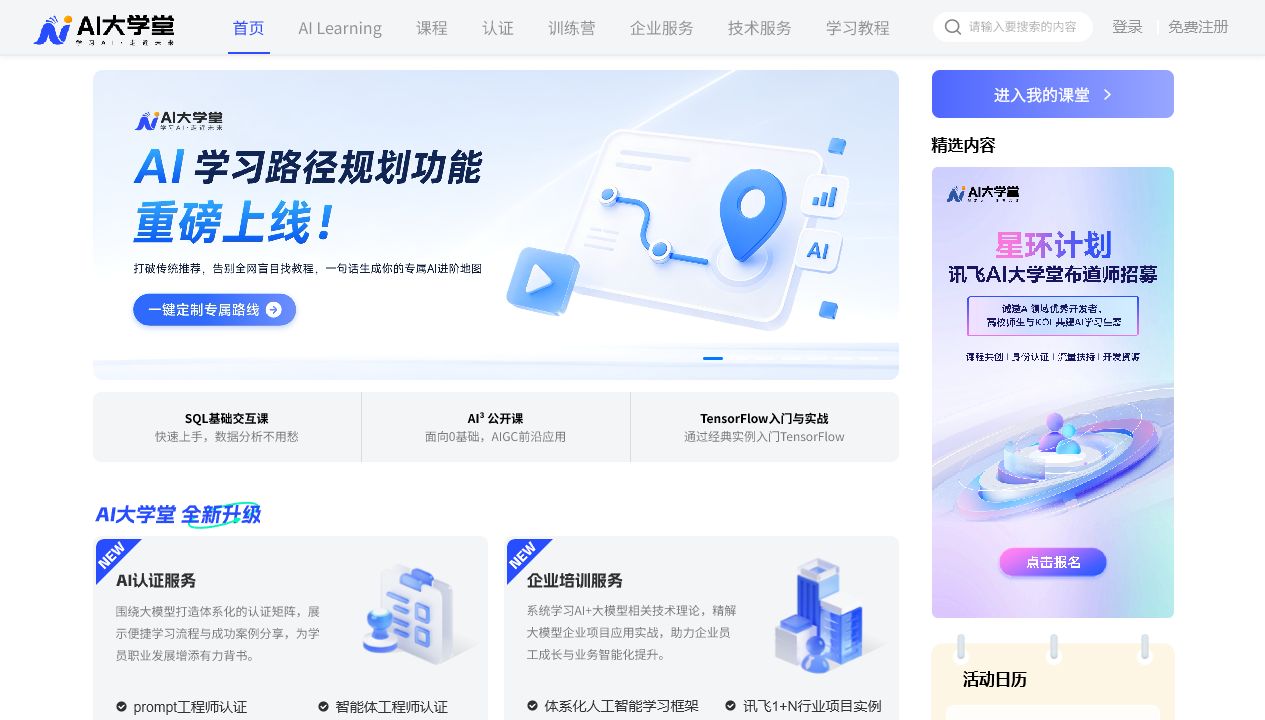
# AI University Hall
Core parameters and statistics of AI University Hall
AI University Hall is an artificial intelligence online learning platform officially operated by iFlytek, which is positioned as an integrated talent cultivation entrance of "learning-practice-certification-application". It is not an aggregation site for scattered tutorials, but organizes AI knowledge into an advanced course system according to direction, difficulty and application scenarios, and cooperates with practical training, certification assessments and corporate services to form a complete learning link from theory to implementation.
| Projects | Public Information |
|---|---|
| Official positioning | One-stop AI online learning and certification platform |
| Producer | iFLYTEK |
| Product form | Web online education platform |
| Content format | Systematic courses, online training, certification assessment, internal corporate training |
| Course coverage | AI general knowledge, programming basics, machine learning, deep learning, large model development Prompt engineering, agent development, voice technology, etc. |
| Certification direction | Prompt engineer, agent engineer, RAG application engineer, fine-tuning engineer, etc. |
| Target users | Students, developers, AI practitioners, corporate training teams |
| Support platform | Web (including responsive mobile) |
| Place of Belonging | China |
| Billing Form | Free Courses + Paid Courses + Enterprise Customized Quotes |
| First online | ~2018 |
| Related technologies | iFlytek Spark model, iFlytek open platform |
Product Boundary: AI University Hall is oriented towards systematic learning rather than fragmented knowledge inquiry, and is suitable for learners who are willing to invest time to complete learning according to the course path. To truly transform courses into deliverable AI skills, it still needs to be coordinated with after-class practice and project implementation. It is not suitable for scenarios where you just want to quickly retrieve a technical point or require real-time Q&A interaction - the latter is not as efficient as a search engine or AI conversational product.
Source of ability: The curriculum system relies on iFlytek’s engineering accumulation in the fields of speech recognition, natural language processing and large models. The platform is deeply bound to the technology stack of the iFlytek Spark model, and the content is biased toward industrial practice. It emphasizes cultivating application-oriented talents who can directly get started with project delivery, rather than purely theoretical researchers.
Users and market recognition of AI University Hall
AI University Hall has established a certain reputation in the field of AI education, but its market influence is characterized by "clear ecological positioning and undisclosed operational data."
Ecological positioning: As the core carrier of iFlytek's AI talent training strategy, the AI University Hall assumes the dual role of delivering developers to iFlytek's open platform and cultivating AI talents for the industry. iFlytek has more than 7 million open platform developer users, and the AI University Hall plays the role of the backend of "skills education" - after developers learn through the platform, they can more smoothly use iFlytek's API, SDK and Spark large model capabilities.
Corporate Customers: The platform provides customized AI talent training programs for enterprises, and has served many leading companies in the fields of finance, manufacturing, and education. Corporate training takes "demand research → layered courses → practical coaching → certification assessment" as the link, covering four levels from senior executives' AI strategic awareness to front-line engineer job practical operations. The official has not disclosed the specific number of companies and cooperation case database, and the large-scale industry penetration rate is subject to official communication.
Industry recognition of certification: Prompt engineer certification, intelligent agent certification, etc. are officially issued by iFlytek and have high technical endorsement value within the iFlytek ecosystem. The certification assessment combines theoretical examinations and practical projects. After passing the exam, you can access the relevant rights and interests of the iFlytek open platform. However, the cross-industry versatility of the certification—that is, whether it is recognized by corporate recruiters outside the iFlytek ecosystem—still needs to be tested in actual job hunting and business scenarios.
The cost advantage of AI University Hall: lower the threshold of AI learning with free entry
AI University Hall adopts a three-tier cost structure of "free content customer acquisition + paid courses/certification monetization + enterprise customization premium", which corresponds to different cost models according to user roles.
C-side/individual learners: The platform provides a large number of free course resources, including AI open courses, 45-minute AI small classes, developer talks and other series, covering multiple directions from zero-based entry to professional skills popularization. Paid courses are priced based on individual courses or certification packages. The specific price is subject to the official page. The quality and coverage of free content are key dimensions for evaluating the "sincerity" of a platform - compared with other AI learning platforms (such as Andrew Ng's DeepLearning.AI, OpenAI Academy, Baidu AI Studio), the density of free content in AI University Hall is above the average level in the industry.
| Learning Platform | Free Content | Certification Fees | Corporate Training | Domestic Availability |
|---|---|---|---|---|
| AI University Hall | A large number of open classes, 45-minute small classes, developer talks | Pricing based on certification courses | Customized quotations | Fully available, no need to circumvent the firewall |
| Baidu AI Studio | A large number of free courses + computing resources | Some certifications are charged | There is an enterprise version | Fully available |
| Alibaba Cloud University | Basic courses free | Special certification fees | Enterprise plan available | Fully available |
| DeepLearning.AI | Some open courses are free | Specialized courses are charged | Enterprise version available | Overseas payment required |
| OpenAI Academy | All free | No certification system | Unpublished | Requires overseas access |
Developers/Ecosystem Participants: For developers who have already used the iFlytek open platform API, the courses in the AI University Hall can reduce the cognitive cost of learning the iFlytek technology stack. This part of the implicit value is reflected in - after mastering the calling methods of iFlytek speech recognition and Spark large model API through the platform, the time investment of consulting documents and trial and error can be reduced. However, the platform itself does not provide free API calling quota, and the computing power consumption during the learning process must be borne by oneself or used for limited purposes in the practical training context provided by the platform.
Enterprise/Institution: Enterprise training adopts a fully customized quotation. The cost depends on the depth of the course, the number of participants, whether it includes certification assessment, and whether it involves the construction of privatized practical training. The pricing structure is not public, and the business team will issue a plan after submitting the requirements. Before purchasing, it is recommended to clarify the following cost items: unit price of training courses, certification examination fees (per person/time), customized course development fees (one-time, if the company has specific business scenarios that require customized cases), and possible travel or offline training expenses. The hidden benefit of corporate training is that after employees learn the system, they can reduce the cost of exploring AI technology in the early stages of the project and shorten the learning cycle from demand to delivery.
Implicit Cost: The true cost is the learner’s time investment. Free content lowers the financial barrier, but systematically mastering AI skills (especially large model development and Prompt engineering directions) requires weeks to months of deliberate practice. The platform courses are more "application-oriented", and a deep understanding of the underlying principles still requires self-study with papers and open source projects. Certification exams require additional preparation time, and the cost of this time needs to be factored into the overall decision.
Main functions of AI University Hall
The functions of the AI University Hall are designed around a five-layer progressive design of "courses-exercises-competitions-certification-ecology". It is not simply to move teaching materials online, but to build a followable learning system.
-
Systematic Course Matrix: The courses are developed in three levels: "General → Technical → Practical". The general knowledge layer covers AI concepts, industry application scenarios and career development paths; the technical layer includes Python programming, data structures, machine learning algorithms, deep learning frameworks (TensorFlow), and large model development and deployment; the practical layer is driven by industry cases and covers AI implementation methods in finance, medical, manufacturing and other scenarios. The value of use lies in reducing information screening costs for learners to independently search, filter, and sort learning materials.
-
Online training environment: Some courses are equipped with online programming environments and virtual laboratories, which support writing and running code directly in the browser, eliminating the cumbersome local environment configuration. This is consistent with the platform's positioning of "lowering the entry barrier" - zero-based users do not need to bother with Python installation and CUDA configuration first, they can start programming exercises by opening the browser. The course coverage and performance stability of Practical Training are subject to actual experience.
-
Official Certification System: The current public certification directions include Prompt Engineer Certification, Agent Engineer Certification, RAG Application Engineer Certification and Fine-tuning Engineer Certification. The certification adopts the dual assessment method of "theoretical learning + practical assessment". After passing the exam, you will receive the official iFlytek certificate. Hidden linkage: The value of certification is not just on paper - students who pass the Prompt engineer certification can access the "certified developer" rights of the iFlytek open platform and obtain higher API frequency control quota and technical support priority. This is an ecological linkage that directly converts "learning results" into "development rights", which is relatively rare among other independent AI learning platforms.
-
AI Competition and Developer Community: The platform regularly organizes AI competitions and technical challenges (such as multilingual speech recognition challenges), and provides a live developer talk column, inviting iFlytek technical experts and industry KOLs to share practical cases. The value of this type of activity lies in incorporating learning output into the competition track - students solve real problems in the competition and have the opportunity to win awards, forming a positive cycle of "learning → application → feedback → reinforcement".
-
Enterprise customized training service: Provide corporate customers with a complete link from demand research to effect evaluation, covering the four stages of "AI strategic awareness → job skills training → practical training and coaching → certification assessment". An easily overlooked hidden capability in enterprise services is that training courses can be customized based on the enterprise's real business data - for example, for financial risk control scenarios, the model training data is replaced with the enterprise's desensitized business data set to minimize the migration cost of learning.
Hidden linkage: The above five layers of functions do not operate in isolation. Course content provides knowledge reserves for competitions, which stimulate deeper learning motivation; certification endorses learning results and feeds back to the developer ecosystem; corporate training uses the teaching assets accumulated in public courses to reduce customization costs, and feeds back course iterations through corporate feedback. This closed structure means that students' investment in any section will amplify the benefits of other sections - this is the core difference between AI University Hall and pure course platforms (such as pure video course websites) and pure certification institutions (such as pure examination centers).
Version evolution of AI University Hall
As a continuously operating online education platform, AI University Hall does not have discrete software version numbers in the traditional sense. Its evolution is reflected in three dimensions: expansion of course scope, upgrade of practical training capabilities, and improvement of the certification system.
Platform establishment period (about 2018-2020)
iFlytek launched the AI University Hall, initially positioned as a supporting learning resource station for the iFlytek open platform. The initial courses focus on iFlytek’s advantageous technical fields such as speech recognition and natural language processing, and are aimed at iFlytek’s existing developer ecosystem user groups. The content form at this stage is mainly recorded and broadcast video courses, and the certification system and practical training environment have not yet been introduced.
Capacity expansion period (about 2020-2023)
The course direction has gradually expanded from speech technology to general AI technology stack, with new directions such as machine learning and deep learning framework Python programming. Practical training has been launched online, and the platform has evolved from "purely watching classes" to "learning and practicing at the same time". The certification system was initially established and AI skills certification services began to be provided. During the epidemic, the demand for online education surged, and the number of platform courses and the number of corporate customers increased significantly.
Large model era (2023 to present)
Based on the technology accumulation of Spark large models, the platform has added a large number of new courses focusing on large model applications, including prompt engineering, agent development RAG (retrieval augmented generation), model fine-tuning and other directions. The certification system was adapted accordingly, and four major certifications were launched: Prompt Engineer, Agent Engineer, RAG Application Engineer, and Fine-tuning Engineer, marking the platform's formal transition from "AI general education" to the "large model professional talent training" track. The enterprise service segment has also been upgraded to provide customized training solutions for enterprise AI transformation.
| Evolution stage | Time frame | Core changes | Course focus |
|---|---|---|---|
| Platform establishment period | ~2018-2020 | iFlytek open platform supporting learning station | Speech recognition NLP and other iFlytek advantageous technologies |
| Capacity expansion period | ~2020-2023 | Practical training goes online, certification starts | ML/DL/programming basics, broadened curriculum |
| Large model era | 2023 to present | Large model course matrix, new certification system, enterprise service upgrade | Prompt, agent RAG, fine-tuning, etc. |
The official has not disclosed the precise time nodes and milestone events of each stage. The above stages are based on public information and industry timelines. The precise dates are subject to the official real-time page.
Technical advantages of AI University Hall
The technical advantages of AI University are not reflected in the self-developed underlying algorithms or model performance - it is an educational platform, not an AI model research and development institution. The core of its technical competitiveness is "how to transform complex AI technology into teaching assets that can be delivered on a large scale."
Engineering organization of course content: AI technology iterates extremely quickly—last year’s popular models may have been surpassed this year. The AI University Hall relies on iFlytek's internal technical team to quickly transform the cases and methodologies accumulated by iFlytek in industrial practice into course content. This "integration of industry and education" mechanism means that the course naturally has an engineering practical perspective rather than academic theoretical deduction. Effectiveness: What students learn is not outdated textbook knowledge, but technology stacks and methodologies that are being used by the industry. Applicable scenarios: Job seekers and transition developers who have a direct desire to "use it after learning it" can best benefit from this content that integrates industry and education.
Capability injection into Spark Large Model: Courses involving large model development in the platform can directly call the Spark Large Model API for practical exercises. Students do not need to prepare their own computing power, nor do they need to bear the cost of API calls (within the practical training quota). This design lowers the technical and economic thresholds for learning large model development. Effect: The feedback delay of Learning Boundary is shortened from "days to configure Boundary" to "several seconds to open the browser", allowing learners to focus more on understanding concepts and debugging logic rather than building Boundary. Applicable scenarios: Beginners who are new to large model development and developers who need to quickly verify their ideas.
Certified technical authority: The certification exam questions are jointly designed by iFlytek technical experts and industry consultants, covering the two dimensions of theoretical understanding and practical coding. Compared with pure third-party certification, the certification of AI University Hall is directly related to the developer rights of iFlytek Open Platform - after passing the certification, you can obtain higher API call quota and exclusive technical support. Effectiveness: Certification is not only a proof of skills, but also a "passport" for the development ecosystem, which has practical value in job hunting and project cooperation scenarios within the platform ecosystem. Applicable scenarios: Individuals or teams who want to engage in AI development within the iFlytek ecosystem.
Technical limitations: The overall platform courses are biased towards the iFlytek technology stack - the Spark large model API is used in practical training instead of competing product APIs such as OpenAI/Gemini. If the student's goal is to master general AI skills that are independent of the manufacturer, they need to generalize and absorb the course content. In addition, there is no public data on indicators such as load capacity, course update frequency, and depth of lecturer interaction for practical training, and needs to be evaluated after actual experience.
How to use AI University Hall
The usage paths of AI University Hall are different according to roles and needs, forming three main entrances:
Standard path for individual learners: Visit the official website (aidaxue.com) → Register and log in → Browse the course list or filter by learning path → Select a free course to start learning → Complete after-class training → Decide whether to purchase paid courses or certification based on learning progress → Register for the certification exam → Obtain a certificate. The entrance is purely Web, and mobile browsers can adaptively access it.
Advanced path for developers: After mastering the basic courses, enter the large model development area → use the Spark large model API to complete the practical training project → sign up to participate in developer talks or AI competitions → obtain the Prompt engineer/agent engineer certification → associate the certification information with the iFlytek open platform account to obtain developer rights.
Enterprise training procurement path: Visit the official website enterprise service page → fill in the training demand form (or contact the business team directly) → the business team will provide demand research → customize the training plan (including course content, trainee stratification, class schedule, certification assessment plan) → sign the contract and implement the training → training effect evaluation and feedback.
| Entrance method | Suitable for the crowd | Minimum cost to complete a study | Obtainable core output |
|---|---|---|---|
| Direct learning from the official Web website | Individual learners | Free (select free courses) | Knowledge mastery + practical training experience |
| Certification registration channel | Job seekers, transition developers | Paid (priced according to certification courses) | Official certification certificate + ecological rights |
| Corporate customization services | Corporate training department | Business quotation (customized) | Team AI skills improvement + certification |
Practical Reminder: Free courses can be taken without any payment, but some advanced courses and certification exams require payment. The platform does not disclose a unified course pricing table, and the specific fees are subject to the course details page. Enterprise customers are advised to explicitly ask for training program templates and references to past cases during the first communication.
AI University Hall product pricing
AI University Hall adopts "tiered penetration pricing" - using free content for market coverage, single course products/certification packages for personal monetization, and enterprise customized services for high customer unit price revenue. The three-tier pricing model covers everyone from individual learners with no budget to corporate customers with ample budgets.
Personal free tier: A large number of public courses, 45-minute AI mini-classroom series, developer talk live replays, etc. are completely free. Free content accounts for a considerable proportion of the total courses on the platform and is mainly used for entry guidance and interest cultivation.
Individual payment tier: Advanced courses, certification training courses and certification examination fees are charged per single product or package. Paid courses usually include more practical training projects, more in-depth case analysis and interactive lectures. The specific price is shown on the course page. The platform has not published a standard "certification package price list", and it is recommended to make decisions step by step in the learning path - first learn the free content to verify the match, and then purchase as needed.
Enterprise/Institution Customization Level: The price is fully customized and depends on the following variables: the number of participants (ranging from dozens to thousands), the depth of the course (basic cognition vs. advanced practice), whether it includes certification (and the number of people certified), whether to customize industry case content (such as case replacement in vertical fields such as financial NLP, quality inspection vision, etc.), and the training format (pure online vs. mixed vs. offline training). Before purchasing, it is recommended that enterprises obtain training quotations from at least 2-3 competing product platforms for horizontal benchmarking.
Cost Benchmarking with Competitive Products:
| Learning Platform | Free Content | Single Certification Course Estimate | Corporate Training Model | Corporate Training Price Transparency |
|---|---|---|---|---|
| AI University Hall | Rich (a large number of open classes + small classes) | Unpublished, subject to the page | Customized, covering four levels of strategy → practical operation | Not public, business communication required |
| Baidu AI Studio | Rich (including free computing power) | Intensive courses about 200-500 yuan/course | Enterprise version quotation | Partially public |
| Alibaba Cloud University | Basic courses are free | Special certification is about 300-800 yuan | Enterprise plan quotation | Not public |
| Huawei Cloud AI | Partially free | Certification exam about 200-500 yuan/time | Customized training | Not public |
| Geek Time | A small amount is free | AI column is about 100-300 yuan | Enterprise version by seat | Partially public |
Implicit value assessment of paid courses: The core value of paid courses is not in the "content increment" - because some of the same topics are also covered in free courses - but in the certification qualifications, depth of practical training and instructor feedback. If the student's ultimate goal is to collect evidence or solve AI implementation problems in specific work scenarios, paying is more cost-effective than pure self-study; if the goal is just to understand concepts, free content is enough.
Application scenarios
The scene adaptation of the AI University Hall revolves around the learning needs of "non-real-time, structured, and with assessment goals". The following four types of scenarios have been verified in practice:
-
Systematic learning of personal AI skills: From zero-based entry to a complete knowledge system to master a specific AI direction. Compared with watching scattered tutorials on Bilibili or YouTube, the value of AI University is that it provides a preset learning path - you don't need to decide "what to learn next" by yourself. Implementation Tips: It is recommended to use free courses to test the matching between the platform style and your own learning rhythm before deciding whether to purchase paid courses. The platform is more "application-oriented". If the goal is academic research or algorithm innovation, additional paper reading and mathematical foundation are required.
-
AI course supplement and laboratory co-construction in colleges and universities: College teachers can use platform courses as supplementary resources for classroom content, or use practical training to reduce laboratory construction costs. The practical industry cases (such as medical image analysis and financial NLP) provided by the AI University Hall can make up for the shortcomings of "few industrial cases and lack of practical data" in university teaching. Implementation Tips: It is recommended to select 1-2 courses for a few students to try out, evaluate the consistency of the content and teaching objectives, and then decide whether to introduce it in batches or apply for school-enterprise cooperation.
-
Enterprise AI talent echelon construction: This is the most differentiated value scenario in the AI University Hall. Between "wanting to use AI" and "knowing how to use AI", the most lacking thing for an enterprise is not technology selection documents, but someone who can use AI tools to actually produce value. The enterprise customized services of AI University Hall can set courses at four levels: "Executive AI cognition → Middle-level AI application → Development-level AI engineering → Business-level AI tool use" to avoid the misalignment problem of "senior management thinking it is too shallow and executive level thinking it is too weak" caused by all employees listening to the same set of courses. Implementation Tips: Enterprises are recommended to conduct an internal AI maturity assessment first to identify the most urgent capability gap at the current stage (whether it is the lack of AI project management talents or the lack of front-line employees who can write prompts to improve business efficiency), and then tailor the course accordingly, rather than buying out all the content at once.
-
AI Career Certification and Job Search Preparation: For job seekers, obtaining official certification from iFlytek can enrich the skills endorsement section of their resume. Certification titles such as Prompt Engineer and Agent Engineer directly match the popular job responsibilities in current corporate recruitment, and the label matching degree is high. Implementation Tips: The value of certification is the highest among iFlytek ecological enterprises; if the target enterprise uses the technology stack of Alibaba Cloud AWS or Google Cloud, the bargaining power of certification will be diluted. It is recommended that certification be positioned as "supplementary material to prove ability" rather than "the only bargaining chip for job hunting".
Quantitative deduction of cost reduction and efficiency improvement (reasonable deduction based on horizontal comparison of the platform's public information and similar platforms, unofficial commitment): For new media operation positions to learn AI content creation, use platform courses + practical training paths, the expected learning cycle is shortened from "3 months of trial and error" during self-study to "1.5 months of systematic learning"; for junior programmers turning to AI application development, through certification courses + practical projects, the expected learning to output cycle is shortened from "6 months of trial and error" to "2-3 months" Monthly path-based learning". However, the specific effect is highly dependent on the learner's foundation, time investment and adaptability of learning methods.
Applicable people
AI University Hall covers a complete spectrum of people from zero-level individuals to corporate training teams through free/paid tiering and certification systems:
-
AI zero-based learners: The platform provides an introductory link from Python programming AI general knowledge to Prompt engineering, and the course difficulty is progressively reasonable. The "45-Minute AI Mini Classroom" series has short single lessons and low threshold, making it suitable for fragmented entry. Unsuitable boundary: Learners with absolutely zero programming experience may need additional basic mathematics and logical thinking training; if the goal is to achieve an extremely deep understanding of AI principles (such as understanding the mathematical derivation of Transformer), the depth of the application-oriented platform courses may not be enough.
-
Students (undergraduate/graduate): Suitable as a supplement to school AI courses, especially practical training that can bridge the gap between teaching context and corporate practice. Certifications can add skills endorsement to a resume. Unfit Boundary: For graduate students or competitive players who already have practical experience in high-quality AI projects, the value of basic platform courses is limited and they can directly focus on certification exam preparation or advanced corporate case courses.
-
AI Practitioners and Transformation Developers: Software engineers, data analysts and product managers who already have a certain programming foundation and want to systematically master the development of large model applications. Certified "Prompt Engineer" and other directions are directly linked to corporate recruitment positions. Unfit Boundary: For users who aim to become basic AI algorithm researchers (such as model pre-training, reinforcement learning algorithm innovation), the platform lacks sufficiently in-depth theoretical courses and research-oriented projects. It is recommended that such users give priority to taking open courses in universities or reading original papers.
-
Corporate Training Buyers: HR departments, training managers, and technical team leaders who need to purchase AI skills training in bulk for their teams. The value of enterprise customization services lies in the fact that they can be customized to avoid the waste of efficiency caused by "all employees learning the same course". Unsuitable Boundary: For enterprises that lack clear AI implementation scenarios and quantitative goals, it is recommended to verify the causal relationship between "AI training investment → business effect improvement" through internal pilots before deciding on the scale of procurement. It is not appropriate to regard training as a formal investment in "following the trend of AI".
Human-machine collaboration boundary (key): The learning process of the AI University Hall itself does not involve automation - it provides content and paths for human learning. However, there are rules for application after learning. Students should apply the "skills learned in the AI university class" to actual work. At this time, the division of labor between humans and machines needs to be clear: content generation can be completed by AI for the first draft, but manual confirmation points must be set for compliance review, high-value customer delivery, and irreversible operations (such as contract signing, payment decisions). Whether the platform clearly teaches practical methods of "human-machine collaboration boundaries" in courses - such as how to add "confirmation prompts" to prompts to avoid AI misjudgments - is an implicit dimension in evaluating course quality, and it is recommended to pay active attention during the learning process.
Summary and Outlook
Through the five-layer structure of "courses-training-competition-certification-ecosystem", the AI University Hall transforms iFlytek's technology accumulation in the AI industry into systematic teaching assets, which is of practical value for systematically learning AI skills, obtaining manufacturer certifications, and improving the AI capabilities of corporate teams. Its core competitiveness does not lie in the number of courses, but in the content organization method of "integrating production and education" - the platform is backed by iFlytek's engineering practice, the courses naturally have an industry perspective, and the certification feeds back to the developer ecosystem, forming a differentiated positioning different from other independent AI learning platforms (such as Coursera, Geek Time).
Current main limitations: The course content is biased towards the iFlytek technology stack and Spark large model ecology, which requires additional knowledge migration costs for users who use competing technology stacks; the scale carrying capacity and stability of the training are not disclosed SLA, stress testing is required before large-scale enterprise training; the cross-industry versatility of certification still needs market testing - its value within the iFlytek ecosystem can be confirmed, but its recognition among non-iFlytek companies varies by industry and position; the platform does not disclose a unified course and certification price list, making it difficult for individual users to make horizontal price comparisons before making payment decisions.
Unsuitable boundary reiterated: Not suitable for pure theoretical researchers (biased towards application), not suitable for fragmented queries that require real-time question and answer (biased towards system learning), not suitable for expert developers who already have senior AI engineering experience (biased towards entry-level to intermediate-level advanced). Certification is not a "master key". The actual bargaining power in job hunting needs to be comprehensively evaluated based on the target company's technology stack and recruitment preferences.
Follow-up observation points: Whether the platform can continue to follow the rapid iteration of AI technology (such as the latest progress of multi-modal AI Agent) and update courses in a timely manner; whether the certification system expands to more vertical industries (such as medical AI certification, financial AI certification); whether corporate training services form a standardized effectiveness evaluation methodology (such as pass rate, student satisfaction, skill application rate within 3 months after training); whether the course introduces more technical content from non-iFlytek ecosystem to expand the audience.
Procurement and Adoption Risk Assessment: Individual learners: First use free content to verify the match between the platform style and your own goals, and then choose paid courses and certifications according to your career plan - the financial risk of this path is extremely low, and the time cost depends on the intensity of learning investment. Schools: It is recommended to first verify the suitability of the content and teaching objectives through a trial study with a small number of students, and then decide whether to introduce it in batches or apply for school-enterprise cooperation qualifications. Enterprises: Three questions must be clarified before purchasing - ① What are the specific business problems to be solved by this training (whether it is "AI literacy for all employees" or "enhancement of engineers' large model development capabilities"); ② How to quantify the training effect (certification passing rate, improvement in project delivery quality, usage rate of AI tools, etc.); ③ Is there a "no use after learning" implementation gap - without the support of supporting AI tools and project resources after training, learning results will be lost quickly. It is recommended to stipulate in the training contract the update cycle of course content, guarantee terms for passing certification exams, and refund/adjustment mechanisms. In compliance-sensitive industries (such as finance and medical care), you should confirm whether the data privacy and case desensitization solutions involved in the training content meet industry regulatory requirements. The final plan should be expanded in phases after passing the small-scale pilot verification.
Related tools:  Khanmigo, quizlet
Model and version evolution of AI University Hall
Continuous iterative updates, the latest version introduces performance optimization and new features. Historical version information can be viewed through the official release page. There is currently no complete public version evolution timeline.
How to use AI University Hall
- Web client: You can use it by visiting the official website and registering an account. Most functions do not require installation.
- API access: Provides RESTful API, developers can obtain the API Key and integrate it into their own applications.
Version Info
- AI University Hall (online version) :The online learning platform is continuously updated, and the course and training content are adjusted on a rolling basis with the evolution of AI technology; the official independent version number has not been disclosed, and the online version at the time of collection is marked here. There is no official precise date yet.
- AI University Hall is online :iFlytek launches an online AI learning platform and establishes an artificial intelligence course system; there is no official precise date yet.
User Reviews