 AI Dungeon
AI Dungeon combines AI chat assistant with narrative creation, allowing users to continuously advance plot branches through natural language.
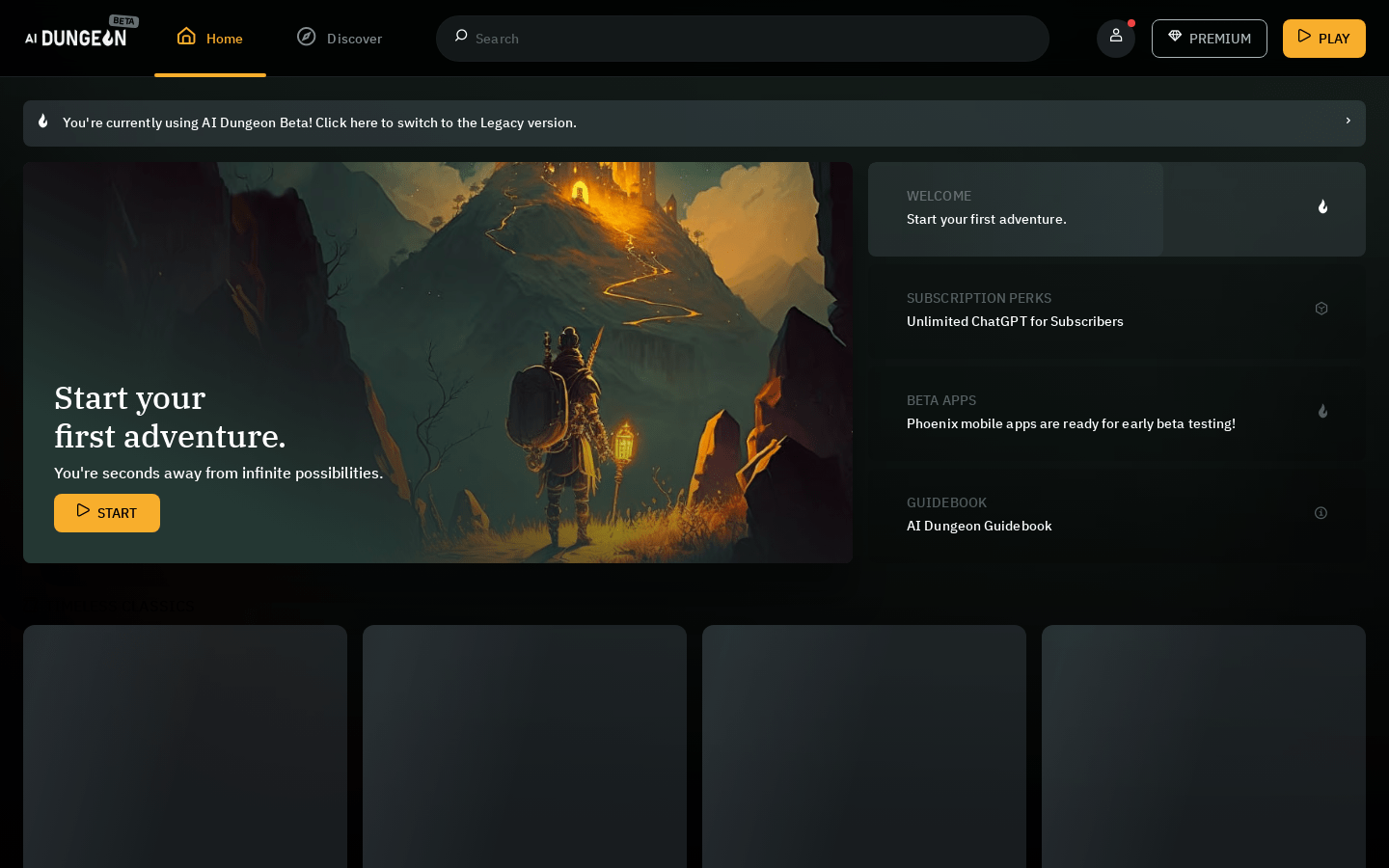
AIDungeon
Core parameters and statistics of AI Dungeon
AI Dungeon is an AI-native interactive storytelling platform developed by the Latitude team. It is also one of the first consumer products in the world to apply large language models (LLM) to open plot generation. It is not a "chat robot" in the traditional sense, but a game engine that embeds LLM's text generation capabilities into a complete narrative cycle of "character setting → plot advancement → branch selection → world evolution". As of mid-2026, the product has evolved from an initial text prototype based on GPT-2 to a mature platform equipped with multiple self-developed and third-party fine-tuned models, covering Web, iOS, Android and Steam clients.
| Projects | Public Information |
|---|---|
| Official positioning | AI-powered text-based adventure-story game |
| Developer | Latitude (Founder Nick Walton) |
| Online time | 2019-12 (initial version) |
| Home | US |
| Delivery form | Web (aidungeon.com), iOS, Android, Steam |
| Business model | Free-to-play + subscription (multi-tier tiering) |
| Available languages | Mainly English |
| Community size | Discord / Reddit active community, thousands of community-made scenes |
| Latest major update | Rise Update (2025 Q3) |
| Number of available models | Multiple self-developed fine-tuned models + third-party models (DeepSeek, Mistral, etc.) |
Positioning boundaries: AI Dungeon is neither a traditional "writing assistant" nor a "chatting AI". Its core difference lies in "an open narrative with no rules, no goals, and purely driven by player decisions" - players do not passively read, but influence the direction of the world through every action choice. It is not suitable for proposition writing that requires strict outline constraints, nor is it suitable for serious creation that pursues highly original literary qualities (the model output still has routine expressions).
Technical Base: The platform does not rely on a single basic model, but runs multiple fine-tuned models with different positioning simultaneously - from the lightweight free Muse (12B level) to the flagship paid Nova (70B level), and the deeply integrated DeepSeek v3.1 (671B MoE). Players can select models based on their preferences, and the platform backend manages inference resource allocation and context windows.
Users and market recognition of AI Dungeon
AI Dungeon's market position is based on the first-mover advantage of being a "category pioneer" and its continuously iterative product capabilities, rather than pure marketing.
Category Creation Effect: The initial version based on GPT-2 at the end of 2019 caused viral spread in the technology and gaming circles, attracting hundreds of thousands of users in the first week of its launch. As the definer of the "AI text adventure game" subcategory, AI Dungeon has accumulated a stable core user base in the following years - according to public reports, monthly active users have exceeded 2 million, and the cumulative number of story creations has reached hundreds of millions.
Community Ecology: An active community of creators has formed around AI Dungeon, with Discord and Reddit being the main communication sites. Community users have spontaneously created and shared thousands of "scenario" templates, covering almost all narrative genres such as fantasy, science fiction, mystery, horror, and love simulation. This UGC ecosystem has greatly lowered the threshold for new users to participate—you don’t have to start with a blank story, you can directly choose a community scene of interest to jump in. At the same time, Latitude regularly holds creative competitions and model evaluation activities to maintain community activity.
Third-party reference popularity: The product has been reported by mainstream technology media (TechCrunch, The Verge, Wired) many times, and has received high attention on new product platforms such as Product Hunt. In the field of AI storytelling and AI gamification, AI Dungeon is the most cited reference among similar products.
Controversies and Challenges: The platform has also experienced controversy during its development process - the adjustment of the content filtering policy in 2021 (restricting NSFW content generation) caused dissatisfaction among some core users; in 2022, Latitude was revealed to have privacy disputes about using user-generated data to train models, which affected community trust to a certain extent. These events prompted the platform to roll out more transparent privacy policies and data control options during 2022-2023. The current version has restored community trust, but historical controversies remain a factor to consider when assessing the platform's long-term stability.
Differences from competing products: Compared with NovelAI (which focuses on auxiliary writing) and Character.AI (which focuses on character chatting), AI Dungeon emphasizes more on the "game feel" - it has a clear turn-based action mechanism, character status system (life/stamina/experience points) and game-based ending determination (GAME OVER). It's not an ebook generator, but an AI-powered text RPG engine.
Cost Advantages of AI Dungeon
As a consumer-oriented entertainment product, AI Dungeon's cost structure is designed around "free experience + tiered subscription", with the goal of striking a balance between low-threshold customer acquisition and paid depth.
Free Tier (C-side Individual): The platform is open to all users for free play, with no download fees and no mandatory subscription. Free users can use basic models (such as Muse, Wayfarer Small) to experience the core narrative within a limited context window (2K tokens). After Rise is updated in 2025, the free tier also introduces the "Daily Premium Actions" mechanism - paid models can be used for free a certain number of times per day, allowing non-paying users to experience the capabilities of high-end models intermittently. This strategy effectively lowers the psychological threshold for users to switch from free to paid.
Subscription Tier (C-side Paid): Pricing is divided into tiers based on context length and available model range. Taking the price structure in 2025 as a reference (specific):
| Subscription tiers | Reference prices | Typical context | Range of available models |
|---|---|---|---|
| Free | $0 | 2K tokens | Muse, Wayfarer Small (Basic) |
| Adventurer | ~$10/mo | 4K+ tokens | Mid-range model access |
| Champion | ~$15/month | 8K+ tokens | Expanded model selection |
| Legend | ~$20/month | 16K+ tokens | Includes DeepSeek V3, etc. |
| Mythic | ~$25/month | 32K+ tokens | Including Nova, etc. |
| Wraith+ | ~$30-50/month | 64K-128K tokens | Full model, maximum context |
Price Anchor: AI Dungeon’s subscription pricing is mid-to-upper-average among similar tools. AI Dungeon has a slightly higher entry price than NovelAI (approximately $10-25/month), but offers more model choices and stronger "gamification" mechanics. For narrative-heavy players, context windows of more than 32K at levels above Mythic are the core threshold for experiencing complex and long stories.
Hidden costs: In addition to the subscription fee, users also need to consider the following costs - (1) Network delay: AI Dungeon's inference is completed in the cloud, and network quality directly affects the response speed. Players in some areas may experience significant delays; (2) Model switching cost: The output styles of different models for the same plot are significantly different, and users need to spend time finding a model combination that suits their narrative preferences.
Developer/API layer: AI Dungeon currently does not disclose independent API products for third-party developers, and platform capabilities are mainly delivered through the official client (Web/App). For teams that want to carry out secondary development or integration based on it, they need to pay attention to Latitude's product announcements - there is no official independent API access channel.
Enterprise/privatized layer: AI Dungeon does not provide enterprise privatized deployment solutions. Its business model is built entirely around cloud SaaS + subscription and is not suitable for organizations that require data localization or private deployment.
Main features of AI Dungeon
The functional system of AI Dungeon revolves around the narrative concept of "Create→Promote→Customize→Share". It does not encapsulate AI into a single generation button, but provides a virtual world engine that can be deeply interactive.
-
Open plot generation: Core mechanism - the player inputs any action ("I drew my sword and charged at the dragon ahead", "I asked the tavern owner for information"), and the AI generates the following narrative text in real time, including contextual descriptions of NPC reactions and event advancement. Unlike traditional games, there is no preset plot tree, and every interaction is generated by the model in real time. Implementation Tips: The model is highly adaptable to open-ended inputs, but the output quality is highly dependent on context accumulation - the input quality of the first 50 steps directly affects the coherence of the subsequent 500 steps.
-
Character Cards and World View Management: Players can inject structured information into the model through "Character Cards" and "Author's Note" - character name, appearance, personality traits, current goals; world tone, special rules, key events. This information is continuously injected into the reasoning context in the form of system prompt words to ensure that the model does not "forget" the core settings. Mechanic→Effect: Character cards solve the most common "character drift" problem in pure LLM-driven plots - allowing the model to remember that the protagonist is a "one-eyed pirate captain" rather than an "ordinary crew member" after 50 interactions.
-
Multiple model selection and switching: This is the core differentiating capability of AI Dungeon compared to competing products. The platform simultaneously runs 6+ fine-tuned models with different positions, from the lightweight Muse (emotional and delicate) to the hard-core Wayfarer Large (high risk and high reward), to the third-party DeepSeek v3.1 (elegantly written). Players can switch models at any time in the same story and observe the differences in how different AI "styles" interpret the plot. Expert View: Multiple models are not stacked, but rather make the "model style" itself a part of the game mechanism - some models are more suitable for romantic plots, and some are more suitable for survival challenges. Players can actively control the narrative tone through model selection.
-
Community Scenarios Marketplace: Thousands of preset scenarios created by community users, covering the full spectrum from classic D&D style fantasy to experimental storytelling. Each scene contains predefined world settings, characters, initial states, and style guidelines. New users can choose a story of interest directly from the scene library and start immediately without having to face a blank page. Synergy: The scene library and multi-model selection form a double lever - the same scene with different models will produce a completely different narrative experience, greatly extending the playable life cycle of a single scene.
-
Branch Archives and Plot Rewind: Supports the creation of branch archives at key decision points (similar to "Save Slots" in the game). When the plot goes unsatisfactory, you can return to the archive point and make another choice. This mechanic solves the frustration caused by the "uncontrollability" of pure AI narratives - players can safely try high-risk choices because there is a safety net. Human-machine collaboration boundary: 100% automated sections include NPC dialogue generation, combat description, and contextual rendering; however, key plot branch decisions, character development direction, story tone adjustment, etc. are still made by the player, and the system does not "automatically advance".
-
Advanced customization function: Paid users can access the AI configuration panel to adjust parameters such as generation temperature (randomness control), repetition penalty (reduce the model repeating the same content), and context length. You can also use the Phrase Mask feature to filter out unwanted narrative elements. These layers of control allow AI Dungeon to evolve from a "black box generator" to a "tunable narrative engine."
Model and version evolution of AI Dungeon
The version evolution of AI Dungeon is deeply bound to the development of its underlying AI model. Different from the year/month version number system of traditional software, major product updates are released in the form of "Named Updates". Each theme update corresponds to the launch of a new model, interface redesign, or core mechanism improvement.
Founding period: GPT-2 to GPT-3 (2019-2020)
- v1/Initial Launch (2019-12): Initial prototype based on GPT-2, demonstrating the feasibility of LLM-driven open narrative. It had a simple interface and limited context, but the novelty of "AI writing stories" ignited early spread.
- GPT-3 Integration in 2020: After accessing the OpenAI GPT-3 API, the quality of storytelling has undergone a qualitative leap. The context length, role consistency, and output naturalness have all been greatly improved, driving the number of users from hundreds of thousands to millions. At this stage, AI Dungeon relies entirely on OpenAI’s model capabilities, and inference costs are subject to third-party API pricing.
Self-research model transformation and content controversy (2021-2022)
- Investment in self-developed models: In order to reduce dependence on OpenAI and control inference costs, Latitude began to develop and fine-tune models on its own. At this stage, a fine-tuned version based on open source base models (such as GPT-Neo, OPT) was launched. Although the performance is not as good as GPT-3, it significantly reduces operating costs.
- Content Filtering Controversy (2021): The platform launched a mandatory content filtering system to restrict NSFW content, triggering community backlash. Some users turned to competing products such as NovelAI.
- Phoenix/Renaissance/Pathfinder/Ember Update: A series of iterative updates continue to improve model performance UI and community functions, but the overall optimization is progressive and no major architectural leap has occurred.
Open source base + self-research and fine-tuning dual-track period (2023-2024)
- Forge Update: Introducing improved fine-tuning based on open source models to strengthen character consistency and command following capabilities.
- Unchained/Frontier Update: Extended context length, introducing more flexible AI configuration options.
- Model strategy adjustment in 2024: Latitude further expands the model ecosystem and begins to integrate multiple third-party open source models (Mistral, Llama, etc.) and conduct in-depth fine-tuning for narrative scenarios to form a product strategy of "one platform, multiple models available".
Multi-model ecological maturity period (2025-present)
- Gauntlet Update (2025 Q1): Launched Wayfarer Large (based on Llama 3.3 70B) and Wayfarer Small (based on NeMo 12B), focusing on the hard-core narrative style of "high risk and high reward". Also introduces Dynamic Large Model - automatically switches between multiple paid models to keep output fresh.
- Saga Update (2025 Q2): Launched three differentiated models - Muse (emotionally delicate type, Mistral NeMo 12B fine-tuning), Harbinger (adventure-punishing type, Mistral Small 3.1 24B fine-tuning), DeepSeek-V3 Chat (writing flagship, 671B MoE). Saga is AI Dungeon's most significant update in terms of model diversity, covering the three dimensions of "emotion + hardcore + writing" for the first time.
- Rise Update (2025 Q3, the latest major update currently): Launched Nova (Llama 70B fine-tuning, upgraded version of Muse), Wayfarer Small 2 (improved narrative pacing), DeepSeek v3.1 (context expanded to 128K tokens). At the same time, the "Daily Premium Actions" mechanism is introduced - free users can obtain a limited number of paid model usage rights every day, narrowing the experience gap between free and paid.
| Update Name | Time | Key Models | Core Changes |
|---|---|---|---|
| Initial Launch | 2019-12 | GPT-2 | First AI Text Adventure Prototype |
| Gauntlet | 2025 Q1 | Wayfarer Large/Small, Mistral Small 3 | Hardcore narrative model Dynamic Large |
| Saga | 2025 Q2 | Muse, Harbinger, DeepSeek-V3 | Three models covering emotion/hardcore/writing |
| Rise | 2025 Q3 | Nova, Wayfarer Small 2, DeepSeek v3.1 | Nova flagship 128K context, daily free premium actions |
Version context description: The above version information is compiled from the official website update archive page. Some early updates (Phoenix, Renaissance, Pathfinder, Ember, Forge, Unchained, Frontier, Aura, etc.) will not be discussed here because the official has not provided precise release dates and detailed release instructions. It is recommended to refer to the real-time archive at aidungeon.com/updates.
Technical advantages of AI Dungeon
The technical competitiveness of AI Dungeon does not lie in the original capabilities of the basic model, but in the engineering ability of "how to transform a general LLM into a game engine suitable for interactive narratives."
Fine-tuning pipeline and domain specialization: Latitude has built a dedicated fine-tuning data set for interactive narrative scenarios, covering multiple narrative styles (fantasy, science fiction, mystery, horror, romance) and game mechanism data (turn-based, state tracking, ending determination). Fine-tuning is not a one-time operation - before each release of a new model, the team will make targeted enhancements to the data set based on community feedback and A/B testing results. Causal chain: General-purpose LLM tends to generate "safe but bland" narratives (avoiding conflict, avoiding death), while Latitude's fine-tuning dataset intentionally adds high-risk, high-conflict training samples, making the model willing to make "kill the protagonist" in the narrative, a decision that is crucial to the game experience but avoided by general training.
Multi-model routing architecture: The platform does not rely on a single model, but runs multiple model instances simultaneously within the same inference framework, and players can switch in real time during the story. This means that the backend needs to maintain hot loading, context synchronization and inference resource scheduling of different models at the same time. Engineering cost: Multi-model architecture increases operation and maintenance complexity - each model has different inference characteristics (latency, throughput, memory usage) and requires dynamic allocation of GPU resources. This also explains why the context window of the free tier is usually shorter: the platform needs to reserve more computing resources for the high-end models of the paid tier.
Context Management Strategy: AI Dungeon's "plot length" far exceeds the context window of standard LLM. In order to solve the problem of memory decay in long stories, the platform adopts multiple context management strategies - (1) Character card injection: key character information is continuously injected into the reasoning context in the form of structured prompt words; (2) Priority summary: when the context is close to the upper limit of the window, early paragraphs are automatically summarized and compressed, retaining key event summaries instead of verbatim original text; (3) Section archiving: players can manually create branch archives for important nodes, and the archives contain the complete context state, so there is no need to start over when rolling back. Effect: In actual experience, optimized models such as Muse can maintain fairly good character consistency within a 16K context, but the "forgetting" phenomenon will still gradually appear above 32K - the character begins to forget previous details and repeatedly describe the revealed settings. This is a common ceiling for all current LLM-driven narrative products.
Combat AI routine expression: This is the most noteworthy differentiation direction of AI Dungeon at the engineering level. The team put a lot of effort into training the model to recognize and avoid "AI clichés" - catch-all phrases such as "With practiced efficiency" and "A mixture of emotions" that immediately give away the AI's identity. Specific means include: marking and reducing the weight of such expressions in training data; developing specialized detectors to filter and rewrite hit phrases after inference; and conducting targeted diversified training for the beginning of paragraphs and the first words of sentences. Engineering Pitfall Notes: There is no perfect solution to this technical direction - excessive filtering of clichés may lead to unfamiliar and unnatural expressions in the model, which requires continuous tuning between "naturalness" and "novelty".
How to use AI Dungeon
AI Dungeon provides multiple entrances to use, covering the complete path from instant trial play to in-depth customization.
| Entrance | Suitable for the scene | Features |
|---|---|---|
| Web client (aidungeon.com) | Instant experience, heavy narrative | Complete functions, support model switching, scene market |
| iOS / Android App | Mobile fragmented time | Adapted to touch screen operation and supports voice input |
| Steam client | PC gamers | Native desktop experience, supports large screen displays |
| Web Beta / Grayscale channel | Try out new features | Experience models that have not been officially released in advance |
Quick Start Steps:
- Open aidungeon.com, click "PLAY ONLINE FREE" to start, and you can directly experience the initial scene without registration.
- Select a preset scene of interest from the scene market (or click "Create Your Own" to start with a blank world).
- After reading the opening description of the scene, enter your action in the input box - you can enter any natural language description ("I looked around", "I talked to the hooded man", "I tried to open the locked door").
- AI will generate narrative feedback in real time, including situational changes, NPC reactions and event advancement. You can continue to enter the next action to form an ongoing interaction.
- (Optional) After paying, you can choose different AI models in settings, adjust generation parameters, and use character cards to improve narrative consistency and creative freedom.
Advanced usage tips:
- Best Practices for Character Cards: When filling out the character card, avoid overly broad descriptions ("a brave warrior") and use specific and conflicting information instead ("an exiled knight who was stripped of his title for refusing to carry out orders to massacre villages and now makes a living by working as a mercenary"). The specific conflict points in the character card will directly affect the probability of the model generating a "tension plot".
- Model selection strategy: Muse is recommended for emotional/dialogue-intensive scenes; Wayfarer Large or Harbinger is recommended for high-risk survival adventures; Nova or DeepSeek is recommended for long-form stories that pursue writing and narrative depth. You can switch between different models in the same story and observe the differences in narrative styles of different "AI directors".
- Use of Author's Notes: During the advancement of the story, you can use "Author's Notes" to inject temporary guidance ("Add a sudden storm to the story", "Let the innkeeper mention the war in the north"). This is more natural than "scripting" directly in the action description, and the model will treat it as a narrative context clue rather than an explicit instruction.
Product Pricing for AI Dungeon
AI Dungeon adopts a "free trial + tiered subscription" pricing model, and the subscription level is directly linked to the context length and available model range.
Free Tier ($0): Unlimited use of base models (Muse, Wayfarer Small), context window 2K tokens. After Rise is updated in 2025, you can obtain the right to use paid models 10-20 times a day through "Daily Premium Actions" (the specific number is subject to the official website or in-app display). Free users also have access to the full content of the Community Scenario Market.
Paid subscription tier (reference price, subject to real-time display on aidungeon.com):
| Tier | Monthly fee reference | Core value |
|---|---|---|
| Adventurer | ~$9.99/month | 4K+ context, mid-range model access |
| Champion | ~$14.99/month | 8K+ context, expanded model selection |
| Legend | ~$19.99/month | 16K+ contexts, including flagship models such as DeepSeek V3 |
| Mythic | ~$24.99/month | 32K+ contexts, including Nova, suitable for long-form narratives |
| Wraith | ~$29.99/month | 64K Context |
| Banshee | ~$39.99/month | 128K Context |
| Reaper | ~$49.99/month | 256K contexts (covers extremely high demand scenarios) |
| Apocalypse | ~$99.99/month | Highest tier with full contextual options and prioritized reasoning resources |
Pricing Strategy Analysis: AI Dungeon's pricing ladder is obviously designed for "narrative depth" - the length of context is strictly positively related to the monthly fee. The core investment logic is: if you only experience short stories occasionally, the free tier or Adventurer tier is enough; if you are a heavy narrative player, you usually need Legend or above (16K+ context) to support the coherence of a medium-length story. Compared with NovelAI’s pricing of up to $25/month, AI Dungeon’s high-end tiers (Mythic and above) are significantly more expensive, but provide more model choices and game mechanics.
Paid verification tip: It is recommended to start at the Adventurer or Champion level for your first subscription, and confirm within 2-4 weeks whether the current context window meets your narrative habits. If you find that the model begins to "forget" the previous settings in the middle of the story, it means that you need to upgrade to a larger context level.
Application scenarios of AI Dungeon
The applicable scenarios of AI Dungeon cover personal entertainment, creative practice and teaching assistance, but the core always revolves around the vertical field of "interactive narrative".
-
Personal leisure and entertainment: the most mainstream usage scenario. Users can experience "interactive stories starring themselves" during commuting, before going to bed, or during fragmented time. Unlike other mobile games, AI Dungeon does not have fixed levels and numerical values. Each game is a new narrative. Typical feedback: Light users use it for 10-20 minutes each time, and heavy users can play for 1-3 hours continuously. The repurchase rate is highly positively correlated with story immersion.
-
Creative writing exercises and inspiration exploration: Writers can use the low-cost trial and error feature of AI Dungeon to quickly explore narrative possibilities - "If the protagonist is the villain from the beginning, how will the story develop?" "What will happen if this key decision is taken another way?" This "narrative sandbox" capability is directly helpful for script creation, novel conception and world view building. Implementation Tips: AI Dungeon is suitable for generating inspiration and exploring branches, but it is not suitable for direct export as a formal publication - the text output by the model requires a lot of manual modification to reach publication quality, and there is still a legal gray area in the copyright ownership of AI-generated content.
-
Language Learning and Reading Practice: Immersive narrative context for native English speakers can be used as an auxiliary tool for language learning. In the process of advancing the plot, players need to read the English text generated by AI and respond with understanding. Applicable Boundary: The model language is mainly English, and the narrative text has a large vocabulary (fantasy/science fiction themes contain a lot of professional terms), so it is not suitable for beginner language learners.
-
Tabletop Role Playing Game (TTRPG) Assistance: Some TRPG players such as "Dungeons and Dragons" use AI Dungeon as a "single-player group running" tool, or to explore alternative plot routes during playtime (face-to-face group running). AI takes on the work that a DM (Dungeon Master) usually needs to do to describe the scene and manage NPCs in real time. Limitations: AI cannot execute House Rules and complex combat numerical calculations as accurately as human DMs. It is suitable for narrative-oriented light-rules running groups, but not suitable for combat-intensive running groups with strict rules.
-
Teaching and Demonstration: In teaching scenarios where AI and creative industries intersect, AI Dungeon is often used as an interactive demonstration tool for "AI text generation capabilities" - allowing students to intuitively experience how large language models understand context, maintain character consistency, and generate coherent long narratives.
Applicable groups of AI Dungeon
AI Dungeon's tiered pricing and differentiated model strategies enable it to cover the full spectrum of users, from light newbies to serious creators.
-
Light Narrative Player: Enjoy the experience of "being told a story by AI", preferring passive consumption rather than active creation. This type of user usually uses the free tier or Adventurer tier, playing for 10-20 minutes each time and ending after experiencing a preset scenario. Not suitable for boundaries: If you are looking forward to a traditional game experience with clear goals, level design and victory conditions, AI Dungeon's "no rules and no goals" design may make you feel confused - it is not a "game" in the traditional sense, but a "narrative sandbox".
-
Heavy role-playing enthusiasts: Use AI Dungeon as a single-player RPG platform and invest a lot of time in building characters, refining the world view, and advancing the long story. The typical user plays 10+ hours per week, often subscribing to Legend and above to get enough context window. Prerequisites to note: Although long-form narratives (more than 100,000 words) can technically be maintained through section archiving and summary management, the consistency and quality of model output will still decay with the accumulation of length - in the later stages of the story, you need to choose between "accepting flaws" and "frequent manual editing".
-
Creative Writers and Narrative Designers: Leverage AI Dungeon's "narrative sandbox" capabilities for story prototype development, character dialogue testing, and plot branching exploration. This type of user does not necessarily view AI Dungeon as a final publishing platform, but rather as an inspiration tool in the creative process. Key Limitations: The copyright ownership of AI-generated text is unclear - If you plan to commercially publish a story created with AI Dungeon assistance, it is recommended to consult a legal professional to confirm the risks under the current legal framework before publishing.
-
AI technology enthusiasts and researchers: Developers or researchers who are interested in the application boundaries of LLM can observe "the performance and limitations of large language models in long-term interactive narratives" through AI Dungeon. This group of users is concerned about the performance decay curve of the model under different context lengths, the actual effect of multi-model routing, and the impact of domain fine-tuning on the output style.
Not applicable to the crowd: (1) Serious writers who pursue highly original literary creation - there are still identifiable "AI routines" in the model output and require a lot of manual modification; (2) Education or research scenarios that require strict knowledge accuracy - the model will produce "hallucinations" and fictitious facts, and is not suitable as a source of knowledge; (3) Users with extremely high requirements for data privacy - the platform is a cloud service, all interactive data is processed through the Latitude server, and local offline mode is not provided.
Summary and Outlook
The core value of AI Dungeon is that it proves that "AI-driven open narrative" is a real consumer demand, and builds a complete product system around this demand from model fine-tuning, multi-model routing, context management to community ecology. It is not the most powerful text generation tool, but it is the most mature product currently doing "AI narrative gamification".
Current core advantages: The category pioneer status brings brand recognition and community barriers; the multi-model ecosystem (coverage from 12B to 671B) provides style diversity that competing products do not have; continuous theme updates (Gauntlet → Saga → Rise) show that the team maintains a stable delivery rhythm; mechanism design such as Daily Premium Actions shows that the product has clear engineering thinking about the free → paid conversion funnel.
Current main limitations: (1) The quality attenuation of long stories is still a fundamental problem that has not been completely solved - above 32K context, the model's character consistency and event causal coherence will gradually decline; (2) The model's "AI Although "routineization" has been specially optimized, repeated phrases and plot patterns will still appear periodically in long-form output; (3) English monolingualism limits the growth potential of non-English markets; (4) Historical content controversies and data privacy turmoil have had a measurable negative impact on brand trust, and some core users still have a wait-and-see attitude.
Follow-up observation points: (1) Will AI Dungeon introduce multi-language support (especially markets with active narrative cultures such as Japanese and Chinese)? (2) In ultra-long context (above 128K) scenarios, can model memory management achieve breakthroughs through new architecture optimization? (3) Will the platform open up third-party APIs or plug-in ecology, and shift from closed products to platformization? (4) How does the evolution of the copyright legal framework for AI-generated content affect its commercialization path?
Procurement and Adoption Risk Assessment: For individual entertainment users, there is no real risk in zero-cost trial and error in the free tier, and it is worth experiencing. For writers who use AI Dungeon as a creative aid, it is recommended to position it as an "inspiration generator" rather than a "ghostwriting tool". Key original content still requires manual creation and modification. For use in educational or research scenarios, clearly inform audiences of the AI-generated nature of the content and be alert to factual errors in model output. The current version (the latest state after Rise's update) is significantly better than the earlier versions before 2023 in terms of stability and model maturity, making it the right time for new users to start. AI Dungeon is not recommended for use in any production context that requires output accuracy and clear copyright attribution - it is designed as an "entertainment" rather than a "productivity tool".
Related tools:  DeepSeek,
  ChatGPT
Version Info
- Story Engine Update :Optimize the consistency of long plots and character memory, and improve the stability of multi-round interactions.
- Initial Launch :The first version of the open narrative experience is launched, supporting real-time plot generation based on prompt words.
User Reviews