 AI sharing circle
Free
AI sharing circle
Free
AI Sharing Circle is a Chinese sharing website that aggregates free AI resources, tutorials and tool information to help users quickly discover AI learning materials and tool clues. It belongs to the AI Learning Website category resource entrance.
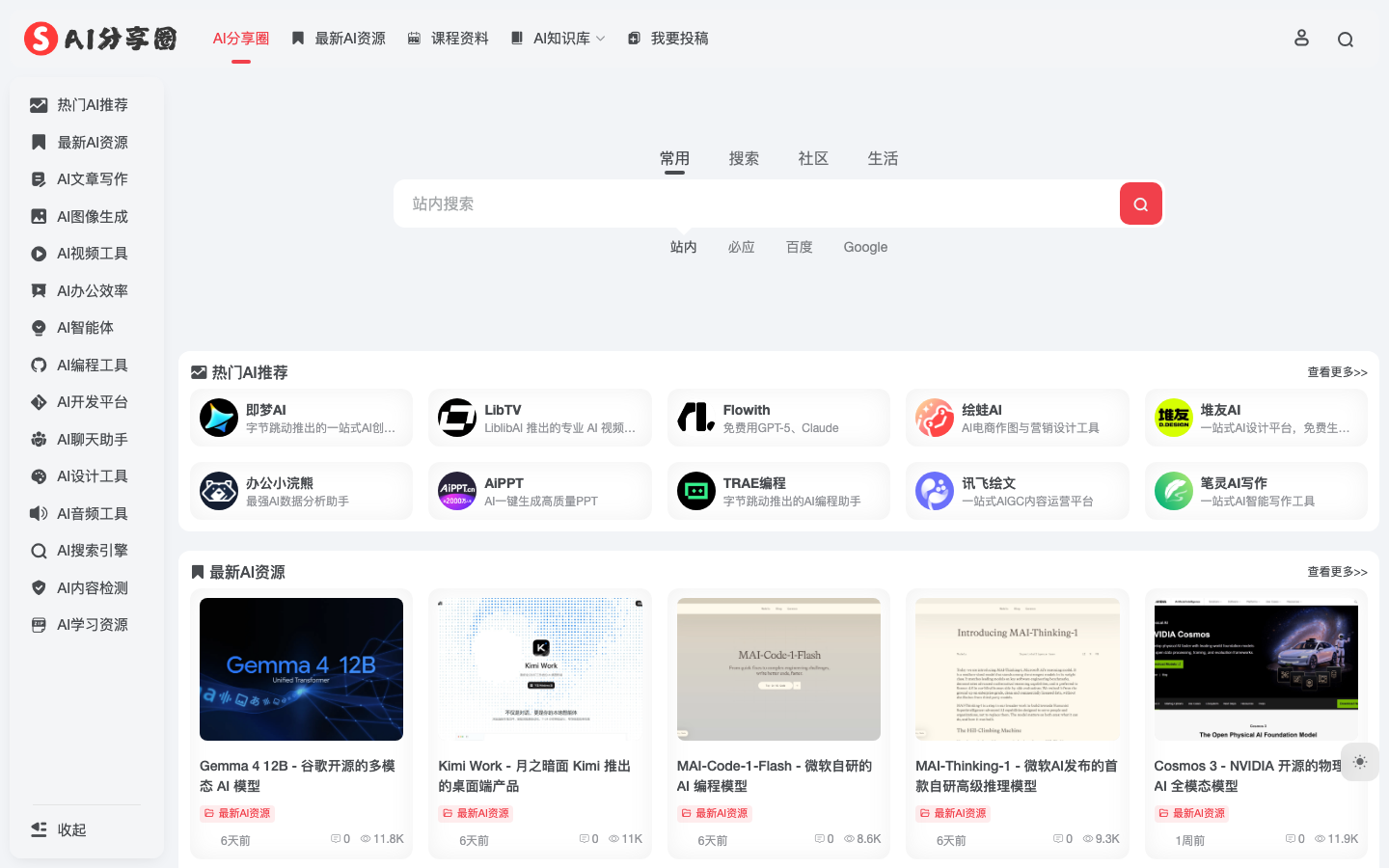
AISharing Circle: In-depth evaluation of AI free resource aggregation and learning portal
A brief comment: It is not the AI tool itself, but a "tool" to help you find AI tools - a Chinese content aggregation site that gathers scattered AI resources, tutorials and tool clues into one place, solving the underlying pain point of "AI information discovery".
Core parameters and statistics of AI sharing circle
AI Sharing Circle (aisharenet.com) is a content-based website for Chinese users. Its core value lies in collecting AI resources, tutorials, tool information and course materials scattered throughout the entire network, providing a one-stop discovery portal. It itself does not provide AI computing power or model reasoning services, and is positioned as "information aggregation and diversion."
| Projects | Public Information |
|---|---|
| Official positioning | AI free resource sharing website |
| Product form | Web content station/resource aggregation |
| Content Language | Simplified Chinese |
| ICP filing | Anhui ICP filing number 2024051185-11 |
| Online time | About 2022 |
| Core Content Section | Latest AI Resources AI Knowledge Base, Course Materials AI News 14+ Tool Classification Navigation |
| The latest collection of AI resources | 3133+ articles |
| AI knowledge base included | 1235+ articles |
| Number of course materials included | 21+ articles |
| Tool classification navigation | 14 categories (AI writing, image generation, video, office, agent, programming, development platform, chat, design, audio, search, content detection, learning resources, popular recommendations) |
| Content update frequency | Daily updates |
| Place of Belonging | China |
| Billing form | Free browsing, some external links may contain promotion or rebate logos |
Content Boundary: The scope of inclusion covers model releases, open source projects, tool reviews, technology popularization, practical tutorials, prompt word instructions, industry reports and other dimensions. However, the actual quality of the content depends on the diligence of the editors and screeners - the natural shortcoming of the aggregation site is that it "emphasizes breadth over depth". The detailed information of each resource needs to be verified by the user at the original source.
Source of capabilities: Value is determined by three factors - breadth of inclusion (how many sources are covered), update timeliness (how quickly to follow up on new releases), and screening quality (whether the content has been manually screened). As of July 2026, the latest AI resource section has accumulated 3100+ pieces of content, and the knowledge base section has 1200+ pieces, and the activity can be seen in the average daily updates.
Users and market recognition in AI sharing circle
As a Chinese AI resource aggregation site, AI Sharing Circle serves a large number of user groups who "need to continue to follow the AI ecosystem but have limited energy." The market recognition of this type of content site does not come from financing or industry endorsement, but from real access data and return visit rates.
User portrait:
- AI Beginners: Quickly establish awareness of the AI tool ecosystem through aggregation sites and lower the learning threshold
- Tool Enthusiasts: Continue to pay attention to the release of new AI tools, and use aggregation sites to scan information
- Content Creator: Find free-to-use AI materials and creation tools
- Industry Practitioners: Quickly understand competing tools and industry trends
Market positioning comparison: The differences in content focus and coverage between AI sharing circles and similar Chinese AI resource stations are as follows:
| Comparative Dimensions | AI Sharing Circle | Typical AI Navigation Stations (such as |
|---|---|---|
| Content form | Articles + tool navigation + knowledge base + courses | Tool list + category navigation mainly |
| Depth of content | Contains knowledge popularization, practical tutorials, prompt word instructions | Mainly tool introduction and entrance |
| Included focus | Chinese resources + international tools considered | Focus on international popular tools |
| Knowledge base system | There is an independent knowledge base section (1200+ articles) | Usually there is no independent knowledge base |
| Course resources | There is an independent course material section (21+ articles) | Usually there is no course section |
| Content update frequency | Updated daily, content source comes from operational editors | Rely on user submission + editorial review |
| Commercialization degree | Low (free browsing, some external link promotion) | Low to medium |
Real value: What the AI sharing circle focuses on is not "not enough tools", but "too many tools and I don't know where to start." From Kimi K3 to GPT-Live, from DeepSeek-V4 to Gemini 3.5 Flash, new models and tools are released every day. Individual users rely on RSS and social media to follow up, which is time-consuming and laborious. The aggregation site centralizes this step. Each article provides a summary + original link. The user first reads the summary to determine whether it is worth understanding in depth, and then jumps to the original source - this saves time in information screening.
Recognition source: For resource aggregation sites, recognition is reflected in the number of visits, content quality and update continuity. The official has not disclosed specific traffic data, but judging from the accumulation of 3100+ resource articles and the continuous update rhythm, the site has formed a stable content production process. Rational users should regard it as a "clue discovery portal" and conduct a secondary verification of key resources and then to the original source.
The cost advantage of AI sharing circle
The AI sharing circle is completely free for users, and the cost advantage is reflected in the zero-money threshold for obtaining AI resource clues.
C client/individual users:
- Free access to all content, no need to register to browse resources and tutorials
- No limit on views, no paywall
- Some external links to tools may contain rebates or promotion parameters (such as
utm_source=aifenxiangquan), but this does not affect normal access for users.
Content Creator/Learner:
- Free access to AI knowledge popularization content (knowledge base 1200+ articles)
- Free access to high-quality course clues at home and abroad (21+ course materials)
- Get free prompt word instructions, practical tutorials and other practical resources
Enterprise/Professional Users:
- Can be used as a source of clues for market research and obtain free information on competing product tools
- No API or private deployment scenario, not suitable for enterprise-level procurement
Cost comparison of similar resource sites:
| Comparison items | AI sharing circle | Futurepedia (English) | |
|---|---|---|---|
| Browse fee | Free | Free | Free |
| Registration Requirements | None (Browse) | None | None |
| Paid content | Not found | Not found | Pro version available |
| Promotion of external links | Some tools contain promotion parameters | Few | There are rebate links |
| Commercial authorization | Not involved (aggregation site) | Not involved | Not involved |
Implicit cost analysis (the real threshold is not money):
- Screening costs: The quality of resources included in aggregation sites varies, and some articles may be promotional or contain expired information. Users need to invest time to judge the true value of each resource
- Timeliness Cost: The AI field changes extremely fast, and the resources included today may be outdated next week. The management and maintenance of 3100+ articles is a challenge in itself. It is difficult to mark the timeliness of historical articles one by one.
- Security Risk: When jumping to third-party tools or resources through aggregation sites, users need to judge the download security and copyright compliance by themselves.
- Information overload: 3000+ pieces of content itself constitute new information noise, and users need to filter twice
Suggestion: Treat the AI sharing circle as the "starting point" rather than the "end point" - use it to discover clues, and then go to the original source for verification. For important resources, it is recommended to use in-site search or category browsing to improve filtering efficiency.
Main functions of AI sharing circle
- Latest AI resource aggregation (core): The latest developments in the AI field are updated daily, covering model releases, open source projects, tool launches, industry reports, etc. Each resource provides an abstract, release date, and page views (such as 6.9K, 20.5K) to help users determine the popularity of the resource. As of July 2026, 3133+ articles have been included.
- AI Knowledge Base: Systematically collects popular science articles on AI technology concepts, including 1,200+ technical science articles from neural network Transformer to large language models, diffusion models, etc. Classified by subject (AI Q&A, AI practical tutorials, AI practical instructions, AI knowledge base), it can be used as a reference for introductory learning.
- Course Material Navigation: Collection of high-quality AI course clues at home and abroad, including 21+ course materials such as Andrew Ng's series of courses, Microsoft AI Agent introductory course, Zhejiang University's "Basics of Large Models" PDF, etc.
- 14+ tool classification navigation: Tool categories are divided by purpose (AI writing, image generation, video, office, agent, programming, development platform, chat, design, audio, search, content detection, learning resources, etc.), and popular tools are listed under each category with introductions and jump links.
- On-site search and multi-engine switching: Supports on-site search, and also provides Bing, Baidu and Google three-engine switching to facilitate users to expand the search scope.
- Popular Recommendations and Rankings: The home page displays popular AI tool recommendations to help new users quickly understand the tools that are currently attracting the most attention.
Hidden linkage effect: The real product power of the AI sharing circle is not in a single function, but in the four-layer information architecture combination of "resources + knowledge + courses + tool navigation" - users can complete the complete combination of "discovering new tools → reading knowledge and understanding principles → learning through the course system → accessing tools directly through navigation" in one site. Compared with the pure tool navigation station, it has an additional layer of cognitive support of "why this tool is valuable"; compared with the knowledge base, it has an additional layer of practical guidance of "what tools to use to implement it". This series of "cognition → learning → tools" reduces the friction of users jumping back and forth between different sites.
Model and version evolution of AI sharing circle
AI Sharing Circle is an online content website, and there are no discrete version numbers of traditional software. The following is a summary of the evolution based on the milestones of the public page.
| Stage | Time | Key changes |
|---|---|---|
| Website establishment | ~2022 | The domain name aisharenet.com will be launched and start aggregating free AI resources |
| Tool classification navigation is online | ~2023 | Establish a tool classification system and divide tool navigation pages according to purposes |
| AI knowledge base online | ~2024 | Added a new AI technology concept popularization section and systematically collected knowledge articles |
| Course materials online | ~2025 | New course materials section, including domestic and foreign AI courses |
| AI News Channel | ~2025-2026 | New AI news section covering industry trends |
| Continuous deep cultivation period | 2026 | The latest AI resources reach 3133+ articles, the knowledge base has 1235+ articles, and the average daily update is continuous |
Content evolution trend: From the early "pure tool navigation" to the composite form of "content + knowledge + navigation". The knowledge base section that will be launched in 2024 is an important turning point - upgrading from "telling users what tools are available" to "helping users understand the principles of AI", which improves the depth of content and the length of time users stay.
Milestone node description:
- The launch of the knowledge base channel marks an attempt to transform from a "navigation station" to a "learning platform"
- The course information channel complements the "systematic learning" section and complements the scattered tool articles.
- The daily update rhythm shows that the operations team has formed a stable content production pipeline
The exact version date has not been publicly disclosed by the official. The above nodes are calculated based on the content timeline, and the actual official page shall prevail.
Technical advantages of AI sharing circle
Information architecture mechanism: The core technical advantage of the AI sharing circle is not the underlying engine, but the information organization method. The content of the entire site is organized according to the four-dimensional structure of "Resource Timeline → Knowledge System → Course Path → Tool Classification". Each dimension is independent but forms a jump closure through internal links.
Effect: Compared with users jumping back and forth between search engines, social media, and technology blogs, aggregation sites reduce the cost of information discovery from "multi-site parallel search" to "single-site centralized browsing." Users open the AI sharing circle every day to browse the latest resources and get an overview of the key events in the AI ecosystem that day.
Engineering Details:
- The content management system supports multiple classification tags (a resource can belong to "Latest AI Resources" + "AI Knowledge Base" + specific classification tags at the same time)
- View counter helps users identify interest
- Multi-engine search switching reduces the frustration of "cannot be found on the site"
- External link
utmparameters can track the traffic diversion effect and support operational decisions
Limitations:
- As a content station, it does not produce AI capabilities itself, and its value is highly dependent on the editing quality and update speed of the editorial team.
- On-site search recall relies on title matching and tagging systems, and has limited retrieval support for long-tail content
- There are no AI-driven personalized recommendations or smart summaries, content screening is all done by human editors
- The management and maintenance of 3100+ resources requires a high level of continuous investment from the operations team
How to use AI sharing circle
There is no need to register or log in to use AI Sharing Circle, you can directly open the website to browse all the content.
Standard usage process:
- Browse the latest news: Open the homepage, view the "Latest AI Resources" section, and browse the updated AI news of the day according to the timeline. The category tag, release date and number of views are displayed below the title of each resource, which helps to quickly determine the timeliness and popularity.
- Search by category as needed: Navigate to a specific category through "Popular AI Recommendations" or 14 tool categories, find the tool category you are interested in and browse the list of included tools.
- System learning knowledge: Enter the "AI Knowledge Base" section and browse 1,200+ technical science articles. The knowledge base supports subcategory screening (AI Q&A, AI practical tutorials, AI practical instructions, AI knowledge base).
- Search for course resources: Enter the "Course Materials" section and browse the collected high-quality course clues at home and abroad, including course introductions and original links.
- Site search: Use the search box at the top of the page to search the site, or switch to Bing/Baidu/Google to expand the search scope.
- Jump to original source: After finding the resource you are interested in, click the title or "View Details" to jump to the original source page and verify the accuracy and timeliness of the information yourself.
Efficiency Tips:
- Use page views and publication date to prioritize - content with high page views + recent content is usually more valuable.
- For key tools or models, it is recommended to refer to the technical popular articles in the knowledge base and understand the principles before deciding whether to use them.
- Although there are currently only 21+ articles in the course material section, the quality is high (Ng Andrews series, Microsoft AI Agent series) and deserves regular attention and updates.
Product pricing of AI Sharing Circle
AI Sharing Circle is completely free for users, with no membership system, no paywall, and no limit on the number of views.
Monetization method (subject to the actual presentation of the website):
- Some tool external links may contain CPS/CPC promotion parameters (such as
utm_source=aifenxiangquan), and promotion revenue can be obtained through traffic diversion - No display or pop-up ads found
- No membership subscription or paid content found
Interpretation of free model: The confidence of free comes from lower content production costs and promotion monetization model. The main cost of a website is the labor of the editorial team, not servers or computing power. This model is user-friendly, but long-term sustainability depends on whether promotion revenue can cover operating costs. Users should be aware that the price of "free" is that some content may be promotion-oriented, and they need to think independently when recommending tools.
Application scenarios of AI sharing circle
- Scenario 1: Daily scan of AI ecosystem (individual): Spend 5-10 minutes every day browsing the latest AI resource section to quickly understand which new models are released that day, which tools are online, and which open source projects are worthy of attention. Benefits: Maintain a comprehensive awareness of the AI ecosystem with the lowest time cost and avoid information islands.
- Scenario 2: Building an introductory learning path for AI (students/career changers): Start with "What is AI" in the knowledge base, gradually learn technical concepts such as neural network Transformer and large language models, then find systematic courses through course materials, and finally find the practice entrance through tool navigation. Benefits: An AI learning path from scratch without having to piece together resources yourself.
- Scenario 3: Tool Selection Research (Product Manager/Entrepreneur): For specific needs (such as AI writing and AI design), quickly understand what optional tools are currently on the market through tool classification navigation, and then go to the original source for in-depth research after comparison. Benefits: Compress the initial scanning time of selection research from "several hours of full network search" to "half an hour of classified browsing".
- Scenario 4: Prompt words and practical reference (content creators/developers): The "AI Practical Instructions" and "AI Practical Tutorials" subcategories in the knowledge base provide a large number of prompt word templates and operation guides that can be directly used, such as "Prompt words that remove the AI flavor", "Jimeng generates articles with pictures", "Using AI to answer questions on self-media platforms", etc. Benefits: Ready-to-use practical resources, reducing the cost of starting from scratch.
- Scenario 5: Competitive product dynamic monitoring (AI industry practitioners): Track the new releases of competing product companies (such as OpenAI, Google, ByteDance, Tencent, etc.) through the latest AI resource section to understand changes in the industry competition landscape. Benefits: Passive competitive product monitoring reduces the energy investment in actively collecting information.
Applicable groups of AI sharing circle
- AI Beginners: Need a systematic but low-threshold entrance to AI knowledge. The popular science articles in the knowledge base + the systematic courses of course materials + the practical entrance of tool navigation constitute a complete learning path. Fitness: ★★★★★
- Tool Enthusiasts/Technology Geeks: I want to know what’s new in the AI field as soon as possible. The latest AI resource section updated daily can meet the needs of "sweeping the streets" under information anxiety. Fitness: ★★★★☆
- Content Creator (self-media/operation): Need to obtain AI materials, prompt word templates, and tool clues to assist creation. Prompt word commands and hands-on tutorials in the knowledge base provide productivity tools right out of the box. Fitness: ★★★★☆
- Product Manager/Entrepreneur: Need to conduct AI tool selection research or competitive product analysis. Classified navigation and the latest resources section can greatly reduce the initial time of information collection. Fitness: ★★★★☆
- Developer/Engineer: Focus on open source models, development platforms, and programming tools. AI Programming Tools AI Development Platform Two category navigations provide relevant entrances, but in-depth information requires jumping to the original source. Fitness: ★★★☆☆
- Corporate Procurement Decision Maker: Need in-depth and authoritative technical assessment and business information. The shallow summary of the aggregation site cannot support the decision-making needs of enterprise-level procurement, and the core value is limited to "lead discovery". Fitness: ★★☆☆☆
Not fitting boundaries:
- Purchasing decisions requiring in-depth technical evaluation: Summary information from aggregation sites is insufficient to support technology selection, and detailed technical documentation and performance benchmarks must be obtained from the original source
- Learners who want to obtain systematic courses: The course materials only provide course clues and introductions, but do not provide complete course content. System learning still needs to jump to original platforms such as Coursera and DeepLearning.AI
- Professional scenarios with extremely high requirements for information authority and timeliness: The content of the aggregation site has been reorganized, and there may be delays or deviations. Information about AI tools in high-risk fields such as law and medicine needs to be verified from official channels
- Users who need personalized recommendations and intelligent filtering: The content display of the AI sharing circle is a unified list sorting, there is no personalized recommendation based on user interests, and the filtering efficiency is limited when information is overloaded.
Summary and Outlook of AI Sharing Circle
The AI sharing circle uses "free aggregation" to address the underlying pain point of "difficulty in information discovery" for Chinese AI users. 3100+ latest resources, 1200+ knowledge base contents and 14 tool classification navigation constitute an AI information hub with wide coverage. For individual users who need to maintain awareness of the AI ecosystem every day, it is a low-cost "information sweeping" entrance; for beginners, it is a cognitive starting point from scratch; for product managers who need to do tool research, it can shorten the time of early information collection.
Core competitiveness: breadth of content coverage (multi-dimensional, multi-source) + continuity of updates (average daily updates) + completeness of information architecture (four layers of resources-knowledge-courses-tools).
Current Limitations:
- Insufficient content depth: 3100+ resources are mainly abstracts + jumps, and the decision-making value of a single piece of information is limited
- Lack of intelligent features: There is no AI-driven personalized recommendation, summary generation or intelligent filtering, and it is still stuck in the traditional content station stage
- Historical content management: The timeliness annotation of historical articles is missing, making it difficult for users to determine which article’s information has expired.
- High operational dependence: content quality and update frequency completely rely on the continuous investment of the editorial team, and there is a risk of slowdown or discontinuation of updates.
Follow-up observation points:
- Whether the AI sharing circle will introduce AI capabilities to assist content summary, personalized recommendations or intelligent search
- Whether the knowledge base and course material sections will continue to expand and evolve towards the "AI learning platform"
- Whether the commercialization model will be adjusted (such as the introduction of membership, paid content or more promotional links)
- Changes in the competitive landscape: The increase in similar aggregation sites will dilute user attention, and the AI sharing circle needs to find differentiated content barriers
Procurement/Adoption Risk Assessment: As a free content site, AI Sharing Circle has no obvious procurement risks. However, we need to be vigilant: ① The promotion orientation of the content may unconsciously affect the judgment of tool selection; ② When jumping to a third-party tool, you need to evaluate the security and compliance yourself; ③ The aggregation site itself has no commercial guarantee, and any problems caused by third-party resources cannot be held accountable. It is recommended to use the AI sharing circle as the "first springboard for information discovery" - use it to scan the ecology, discover clues, and then go to the original source for in-depth verification and decision-making. For beginners, a self-study path with the lowest cost can be constructed by combining popular science articles in the knowledge base and course links to course materials. For enterprise users, be sure to obtain complete technical documentation and business terms from the tool’s official channels before making purchase decisions, and do not make judgments based solely on summary information from aggregation sites. It is recommended to pay attention to the expansion progress of its knowledge base and course sections - if these two sections continue to be developed, the AI sharing circle is expected to be upgraded from a "resource navigation station" to an "AI learning infrastructure".
Related tools:  Khanmigo, quizlet
Version Info
- AI Sharing Circle (Online Version) :The online content website is continuously updated, and resources and tutorials are added over time; as of the time of collection, it has included 3133+ pieces of the latest AI resources, 1235+ pieces of AI knowledge base, and 21+ pieces of course materials; the official independent version number has not been disclosed, and there is no official precise date yet.
- Course material channel is online :A new course materials section has been added, which includes high-quality AI learning courses and guides at home and abroad; there is no official precise date yet.
- AI knowledge base channel is online :A new AI knowledge base section has been added to systematically collect articles on popular science concepts and technical principles of AI; there is no official precise date yet.
- AI sharing circle is online :The website is online and begins to organize and share free AI resources, tutorials and tool information; there is no official precise date yet.
User Reviews