 AI/ML API
AI/ML API provides unified model interface, billing and routing management capabilities for AI model training and application development.
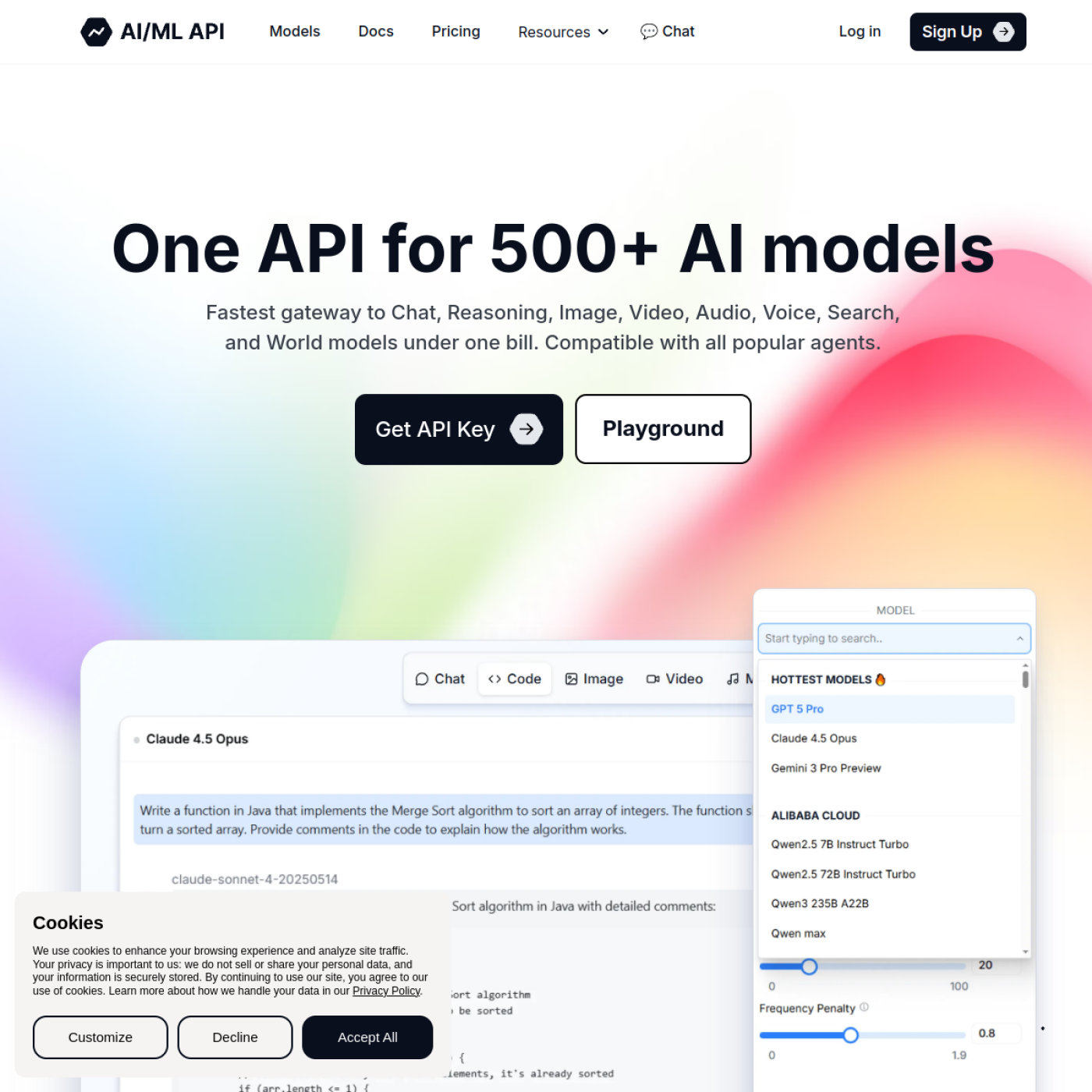
AI/ML API - Multi-model unified access gateway
Core parameters and statistics of AI/ML API
The AI/ML API is positioned as a multi-model aggregation inference gateway, providing a unified API access layer for AI application developers and platform teams. The core value of its product lies in: integrating the access, billing, routing and monitoring of 1000+ models into a single backend through a set of OpenAI compatible interfaces, reducing the complexity of integration and operation and maintenance in a multi-model context.
| Projects | Public Information |
|---|---|
| Official positioning | One API for 1000+ AI models |
| Delivery form | API + Web console (AI Playground) |
| Covering model categories | Chat, Code, Image, Voice, Video, Music, Embedding, Language, 3D, OCR |
| Number of models | 1000+ (continuous growth) |
| API compatibility | OpenAI style interface, you can access it by changing the endpoint and key |
| Deployment method | Cloud hosting (Serverless infrastructure) |
| Data Security | Official Promotion #1 Data Security |
| SLA | Official promotion 99.9% Uptime SLA |
| Support Platform | API, Web |
| Home | US |
| Latest version | Unified Routing Update (2026-03) |
Model Density: 1000+ models ranging from head-mounted closed-source models such as GPT-5.6 Sol, Claude Sonnet 5, Gemini Omni, etc., to open source/low-cost models such as DeepSeek V4 Flash, Qwen3.7 Max, Mistral Small 3, etc., to image and video generation models such as Flux 2 Pro, Kling 3.0, Sora 2, etc., basically covering mainstream AI capability categories. Developers can complete API calls for multi-modal tasks such as conversation, code, image, video, voice, music OCR, etc. on a single platform.
Access path: There is no need to register an account, apply for an API Key, and configure billing for each model supplier. You only need to obtain a master key after registering the AI/ML API, and you can access all models by switching through base_url. For teams that need to frequently do model A/B testing or grayscale switching, this can compress the switching cycle from days to minutes.
User and market recognition of AI/ML API
Enterprise Customer Endorsement: The official website publicly shows that organizations such as Adobe, Washington State, Sigma, Teknikforge, Datastax, and GlobalGPT have accessed and used it. Although the specific usage and contract amount have not been disclosed, the customer list covers government and enterprise departments, large SaaS companies and data platforms, indicating that it has passed enterprise security and compliance acceptance of a certain scale.
Community and Industry Recognition: The official page displays awards/ratings entries from SoftwareSuggest, SourceForge and ProductHunt, indicating that it has received certain positive feedback from both the developer community and B2B software review channels. ProductHunt’s comments section allows you to view real user reviews on aspects such as difficulty of getting started, model coverage, and pricing transparency.
Typical adoption scenarios: Judging from the customer types on the official website, the core adoption scenarios of AI/ML API include: built-in AI capabilities in SaaS applications (Embedding and Chat API), media and content generation pipelines (Image/Video/Music API), and unified management and control of enterprise internal AI gateways (routing, auditing, cost attribution). The access efficiency of multi-model aggregation is the common reason why these users choose it.
Cost Advantages of AI/ML APIs
Cost advantage: Pay-as-you-go + no upfront payment + Token-level pricing with no hidden model
The cost structure of the AI/ML API is designed around "pay as you consume, no seat locking". The three-tier cost path is as follows:
C client/individual developer: Sign up and use it, no prepayment required. Model calls are billed by token or pay-per-view. The pricing page publicly shows that the price per million tokens ranges from $0.013 (such as Ling-2.6-flash output price $0.039/1M tokens) to $780 (such as o1-pro output price $780/1M tokens), covering the complete spectrum from low-cost experiments to high-performance inference. Individual developers can get started with the Pay As You Go model starting at $20, with no monthly minimum purchase.
API/Developer Team: The public pricing table shows that all models are marked with independent unit prices of Input/1M and Output/1M, allowing developers to flexibly choose based on model accuracy and budget. For example, the input price of DeepSeek V4 Flash is $0.182/1M tokens and the output price is $0.364/1M tokens, which is basically the same as or even slightly lower than the official direct connection price (there is no significant price increase at the aggregation layer). Developers do not need to commit to usage and will be charged based on actual calls. Community version models (such as Deepgram Nova series Whisper and some Embedding models) are marked $0 and can be used for prototype verification and low-frequency scenarios.
Enterprise/Private Deployment: The official website provides Enterprise plans, including dedicated servers, custom/private models, unlimited RPMs and TPMs, extended data storage Slack dedicated support channels, complete team training and integration support. The price needs to be booked through Calendly for business communication, and the official figures are not disclosed. For high-throughput or compliance-sensitive scenarios, the total cost of ownership of the enterprise version needs to be calculated comprehensively: the integration and operation and maintenance manpower saved by the aggregation layer compared with direct connection to each supplier, the current limiting loss avoided by unlimited RPM, and the differentiated capabilities brought by the customized model.
Hidden costs and precautions: In addition to convenience, aggregation gateways also have some hidden costs - unified billing means that you cannot directly enjoy the native discounts or reserve capacity plans of each model supplier; in scenarios that are extremely sensitive to delays (such as real-time voice conversations), additional route jumps may increase millisecond delays; the data processing and model training terms in the enterprise version of the business terms need to be confirmed item by item.
Main functions of AI/ML API
-
Unified OpenAI style API: All models share a set of Chat Completions interface, and you only need to modify the
modelparameters to switch suppliers. This means that the existing OpenAI SDK calling code, tool chain (LangChain, LlamaIndex) and monitoring system require almost no changes. You only need to changebase_urltohttps://api.aimlapi.com/v1to complete the migration. -
1000+ model catalog and on-demand routing: covering Chat, Code, Image, Video, Voice, Music, Embedding, 3D, OCR and other categories. Each model is marked with type, status and context length. Developers can query the real-time model list through the web console or API, dynamically select routing targets in the code according to task requirements, and implement a refined calling strategy of "one type of task corresponds to one type of optimal model".
-
AI Playground Online Debugging: You can select a model, adjust parameters (temperature, max_tokens, top_p, etc.), enter prompt words, and view responses in real time in the web sandbox without writing code. Playground consumes paid tokens, but the call billing of PRO models is transparent, which is suitable for completing model selection and Prompt project verification before integration, and reducing the cost of repeated adjustments after API integration.
-
Call statistics and cost management: The Billing panel provides Token consumption, model distribution and time trend views by project, and supports setting budget alarms. For teams that need to break down AI costs to business lines or customer projects, this observable system is the basis for financial compliance and cost attribution.
-
Keys and project-level permissions: Supports the creation of multiple API Keys, associated with different projects or contexts (development/test/production). With the quota restriction function of the model, visibility control of "who uses what model and how much money is spent" can be achieved within the team to avoid unlimited calls after the Key is leaked.
-
Enterprise-grade governance and downgrade policy: The Enterprise plan provides dedicated servers, custom model deployment, and unlimited RPM/TPM to eliminate "noisy neighbor" interference from shared instances at the architectural level. In terms of fault degradation, users need to implement retry and fallback logic at the application layer themselves - the AI/ML API itself does not publicly declare a cross-vendor automatic failover mechanism. This is different from directly using the multi-region architecture of cloud vendors. Disaster recovery plans need to be prepared before production deployment.
Model and version evolution of AI/ML API
Main version
| Version node | Date | Change point |
|---|---|---|
| API Gateway Launch (v1) | 2024-04 | Unified API Gateway launched, supporting multi-model access and basic authentication |
| Unified Routing Update (latest) | 2026-03 | Enhance model routing strategy and cost control, add new calling observable indicators |
Interpretation of version context
Initial stage (2024-04): Entering the market in the form of a unified API gateway. The core capability is to realize single point access and basic authentication of multiple models. The focus of this stage is to verify the feasibility of the "gateway model" on the product side - whether developers are willing to accept the additional delay brought by the middle layer in exchange for integration efficiency.
Routing and Observable Phase (2026-03): The latest update focuses on the refinement of routing strategies (automatically dispatching requests according to cost, delay, or model capabilities) and observable indicators (call success rate, Token consumption distribution, error rate). These two directions directly correspond to the two major pain points in multi-model production: "How to choose the most cost-effective model" and "How to locate a problem if something goes wrong." The official has not disclosed a more detailed version number system (such as semantic version), nor has there been a public Changelog or Release page. Subsequent version plans are subject to official announcements.
Model ecology continues to expand: Compared with internal version iterations, the more significant change in the AI/ML API is that the model catalog has expanded from dozens of early mainstream models to 1,000+, covering long-tail categories such as head-closed source, open source communities, and vertical fields (OCR, music 3D generation). The growth in the number of models itself is also a core dimension of product evolution - the value of the gateway does not increase linearly as the number of access models increases.
Technical advantages of AI/ML API
OpenAI Compatible Plug and Play: The core technology choice of AI/ML API is to keep the API surface fully compatible with OpenAI, which means developers only need to modify two lines of code (base_url and api_key) to migrate existing applications from OpenAI to the AI/ML API gateway, or switch routing targets arbitrarily among them. This "zero-invasion" integration model significantly lowers the migration threshold, allowing gateway value verification to be completed within hours.
Serverless architecture and automatic scaling: The underlying serverless inference infrastructure is used, and users do not need to pre-purchase instances or manage expansion and contraction. The official website claims to provide 99.9% Uptime SLA, and ensures availability through multi-vendor redundancy at the architectural level - when a single model provider fails, users can switch traffic to an alternative model under the same gateway at the application layer, which theoretically has higher disaster recovery resilience than direct connection to a single provider. The actual disaster recovery effect depends on whether the user implements automatic fallback logic in the code. The gateway layer itself is opaque and provides automatic failover across vendors.
Performance and Throughput (Rule B mandatory): As an aggregation gateway, the performance of AI/ML API is affected by three factors: the network delay from the user to the gateway, the inference delay from the gateway to the upstream model, and the routing and authentication overhead of the gateway itself. The official disclosed some performance indicators - "Fastest Inference" and "Infinite Scalability" as promotional selling points, but did not disclose the specific TTFT (first word delay), TPM/RPM frequency limit value or concurrent stress test data. For production environments, it is recommended to simulate the target load through playground and API before purchasing, measure the P50/P95 latency, and compare it with the baseline when each model is directly connected. The following are some representative model reference prices and context lengths that can be verified on the official website pricing page:
| Model classification | Example model | Context | Input price/1M tokens | Output price/1M tokens |
|---|---|---|---|---|
| Flagship Reasoning | GPT-5.6 Sol | Unpublished | Subject to the official website | Subject to the official website |
| High cost performance | DeepSeek V4 Flash | 1M | $0.182 | $0.364 |
| Lightweight Embedding | Ling-2.6-flash | 256K | $0.013 | $0.039 |
| Speech Recognition | Nova-3 General | — | $0 (Free) | $0 (Free) |
| Image generation | FLUX.2 | — | $0.016/Mpx | — |
Adaptation Boundary (Rule B mandatory): The scenario that AI/ML API is best at is "multi-model selection and rapid switching" - teams that need to frequently compare the effects of different models on specific tasks, or make a dynamic balance between cost and quality. Scenarios for which it is not well suited include: (1) Real-time applications that are extremely sensitive to latency and cannot accept additional route jumps (such as real-time translation, voice dialogue), direct connections to suppliers are usually shorter; (2) Scenarios that require deep customization of model behavior (such as fine-tuning LoRA adapter dynamic loading), the gateway layer currently does not publicly support the same model customization capabilities as a single supplier; (3) Compliance requirements of specific industries (such as medical HIPAA, finance Whether PCI-DSS) is suitable for data intermediate processing at the aggregation layer requires business confirmation.
How to use AI/ML API
AI/ML API provides two entrances: Web console and API, which correspond to the two stages of model exploration and production integration respectively:
| Entrance | Purpose | Suitable stage |
|---|---|---|
| AI Playground (Web) | Model comparison Prompt debugging, parameter adjustment | Model selection and prototype verification |
| API (OpenAI compatible) | Production context integration and application development | Online deployment |
Quick Start Guide
Step 1: Register and obtain API Key
Visit https://aimlapi.com/app/sign-up to create an account, and after logging in, create an API Key at https://aimlapi.com/app/keys. Available by default for new accounts, no pre-payment is required to access free models priced at $0.
Step 2: Test the model in the Playground
Enter the AI Playground (https://aimlapi.com/app), select the target model (such as deepseek/deepseek-r1), adjust parameters such as temperature and max_tokens, enter the prompt word and observe the response. This step is used to confirm whether the model's output quality, latency performance, and cost consumption are as expected.
Step 3: Integrate into the application (Python example - Rule B mandatory)
import os
from openai import OpenAI

client = OpenAI(
    base_url="https://api.aimlapi.com/v1",
    api_key="<YOUR_API_KEY>",
)

response = client.chat.completions.create(
    model="deepseek/deepseek-r1",
    messages=[
        {"role": "system", "content": "You are an AI assistant who knows everything."},
        {"role": "user", "content": "Tell me, why is the sky blue,"}
    ],
    temperature=0.7,
    max_tokens=1024,
    stream=False
)

message = response.choices[0].message.content
print(f"Assistant: {message}")
Key parameter description:
model: The format is{vendor}/{model name}, such asdeepseek/deepseek-r1,openai/gpt-5.6-sol. See the model catalog page for a complete list.temperature: Controls the randomness of the generation, 0 is deterministic output, 2 is the highest randomness.max_tokens: Controls the maximum number of Tokens generated at a time.stream: Set toTrueto enable SSE streaming output, suitable for real-time conversation scenarios.- Supports
response_format(structured output),tools/tool_choice(tool call) and other OpenAI extended parameters.
Step 4: Configure production context Create an independent API Key for production, set monthly budget alerts, and enable call logs and error monitoring. It is recommended to implement retry and fallback mechanisms at the application layer - for example, automatically switching to an alternative model when the main model returns an error to cope with upstream supplier failures.
Product Pricing for AI/ML API
The pricing model of AI/ML API is based on "pay-as-you-go", with enterprise customization plans added. There are no seat fees or monthly subscription fees (except Enterprise).
- Pay As You Go: The minimum recharge is $20, and the balance is common among all models. The per-Token/per-time prices of all models are transparently listed on the pricing page, and users only pay for actual consumption. Supports Crypto payments.
- Free models: Some Deepgram speech models (Nova-2/Nova-3 series Whisper) and some Embedding models are marked $0 and can be used for prototype verification and low-frequency tasks.
- Playground Consumption: Using Playground to call PRO models will consume paid Tokens. Non-PRO models are subject to the official website billing rules.
- Enterprise Plan: Includes dedicated server, custom model deployment, unlimited RPM/TPM, expanded data storage, dedicated Slack support, full team training and integration support. Prices are subject to communication via Calendly Business. Enterprises need to confirm three things before purchasing: whether the dedicated instance exclusively occupies the GPU (to avoid performance fluctuations of shared instances), whether the data processing terms include the right to use model training, and the compensation terms and exceptions of the SLA.
- Price comparison with direct suppliers: Judging from public pricing sampling (such as DeepSeek V4 Flash $0.182/$0.364 vs. official direct price), the price increase at the aggregation layer is small. However, the price of some scarce models or exclusive models on the aggregation platform may be the same as or slightly higher than the official price. It is recommended to compare the direct price and the gateway price of the target model side by side during the selection stage to ensure that there is no significant "aggregation tax".
Application scenarios of AI/ML API
-
Multi-model A/B testing and grayscale switching: Quickly compare the output quality and latency of GPT-5.6 Sol, Claude Sonnet 5, and Gemini 3.5 Flash under the same prompt in the Playground, and determine the optimal model before going online. After going online, you can modify the
modelparameter in the code to achieve second-level grayscale switching without waiting for the supplier's API change cycle. It is suitable for AI product managers and algorithm engineers to do model selection and effect verification. -
High-availability inference gateway construction: When a single model fails, is throttled, or has a spike in latency, traffic is routed to alternative models within the gateway. Since all models share the same API format, switching logic only requires modifying strings, and there is no need to reconstruct the interface adaptation layer. Suitable for B2B SaaS and enterprise-level applications that require high availability of AI services.
-
Production Bounded Cost Control: Use the Billing panel to dismantle Token consumption by project, model and time dimensions to locate cost hot spots. For example, if it is found that Embedding calls account for 60% of the total tokens, the model can be switched from the high-priced Text Embedding 3 Large to the low-priced Qwen Text Embedding v4 ($0.091/1M tokens) or Voyage 2 ($0.13/1M tokens), reducing the cost to 1/2 to 1/3 of the original without significantly reducing the effect. Ideal for medium to large teams that need to incorporate AI costs into line-of-business P&L.
-
Multi-modal content generation pipeline: In one pipeline, the Chat model generation script, the Image model, the image model, the video model, and the Music model are sequentially called to generate background music. All calls are billed and tracked through the same API Key. Compared with managing keys, quotas and logs separately at each supplier, the aggregation gateway can shorten the development cycle of multi-modal pipelines from weeks to days. Suitable for building AI pipelines for media, advertising and content platforms.
Applicable groups of AI/ML API
-
AI application developers and independent developers: need to quickly connect multiple models and frequently compare and switch models. The OpenAI-compatible interface of the AI/ML API means that existing code can be accessed without refactoring, and the pay-as-you-go model starting at $20 also reduces the capital occupied by individual developers. If you are building an AI application for the first time and are not sure which model to choose, Playground’s online debugging capability is particularly useful.
-
SaaS product team: Need to build AI functions into the product (such as intelligent search, content generation, voice interaction), but do not want to connect with suppliers separately for each AI capability. After unified access through the AI/ML API, subsequent new model categories only need to modify one
modelparameter, reducing cross-supplier communication costs in product iterations. -
Enterprise AI Platform Team: Responsible for the unified access, governance and cost attribution of AI capabilities within the enterprise. The AI/ML API's multi-key management and Billing panel provide basic visibility control, and the Enterprise plan's dedicated server and unlimited RPM can meet high-throughput scenarios. It should be noted that enterprise compliance terms (data storage location, model training disabling, audit log export) need to be confirmed one by one during the business stage. The transparency of aggregation gateways in these dimensions is usually lower than directly contracting with suppliers.
-
Not Applicable Scenarios: (1) Enterprises in highly compliant industries (medical, financial) should not adopt it directly without confirming whether the data processing terms comply with HIPAA/PCI-DSS; (2) For real-time audio and video applications with sub-100ms latency requirements, the direct connection architecture usually has a shorter path than the gateway architecture; (3) For teams that require in-depth model customization (fine-tuned LoRA deployment), the current model customization support range at the gateway layer is limited, and it is more suitable to use the API after the training platform is completed Access; (4) Teams with extremely sensitive budgets can usually obtain better unit prices by directly connecting with suppliers and signing annual contracts if their usage is stable and huge.
Summary and Outlook
The core competitiveness of AI/ML API lies in the aggregation efficiency of "a set of interfaces with 1000+ models" - it integrates registration, authentication, billing, routing and monitoring in multiple model contexts into a technology stack, providing AI application development and platform teams with a model access solution that can be quickly verified and progressively expanded. Its OpenAI compatibility strategy makes migration costs extremely low, the pay-as-you-go model lowers the entry threshold, and the wide coverage of the model catalog from Chat to OCR also makes it the prototype of an "AI capability supermarket."
The current main limitations include: lack of public performance benchmarks and frequency limit values, and production-bound capacity planning needs to be measured by itself; the gateway layer does not provide automatic failover across suppliers, and disaster recovery capabilities rely on the implementation of the user application layer; the transparency of the enterprise version's business terms is low, and information required for compliance audits needs to be obtained through offline communication.
Follow-up observation points: (1) Whether the model catalog can maintain a high growth pace while maintaining quality, and whether exclusive models will be introduced to create differentiation; (2) Whether the observability capability has been expanded from simple token statistics to more fine-grained call link tracking and error diagnosis; (3) Whether the enterprise solution can provide standardized compliance white papers and service level terms to reduce information asymmetry in enterprise procurement.
Procurement/Adoption Risk Assessment: It is recommended to complete 2-4 weeks of actual measurement in 1-2 non-core scenarios through Pay As You Go mode (focusing on measuring the difference in delay distribution, error rate, model output quality and direct connection comparison), and then decide whether to connect more traffic or upgrade to the Enterprise solution. Key terms that enterprises must verify before purchasing include: data storage location, model training disabling statement SLA compensation conditions, and data migration plan when exiting. For industries with high compliance requirements, the other party should be required to provide SOC 2 or equivalent certification documents - it is not directly displayed on the official page and needs to be confirmed in business communications.
Related tools:  Hugging Face, replicate
Version Info
- Unified Routing Update :Enhanced model routing strategy and cost control, and added call observable indicators.
- API Gateway Launch :Release a unified API gateway to support multi-model access and basic authentication.
User Reviews