 AiPy
Free
AiPy
Free
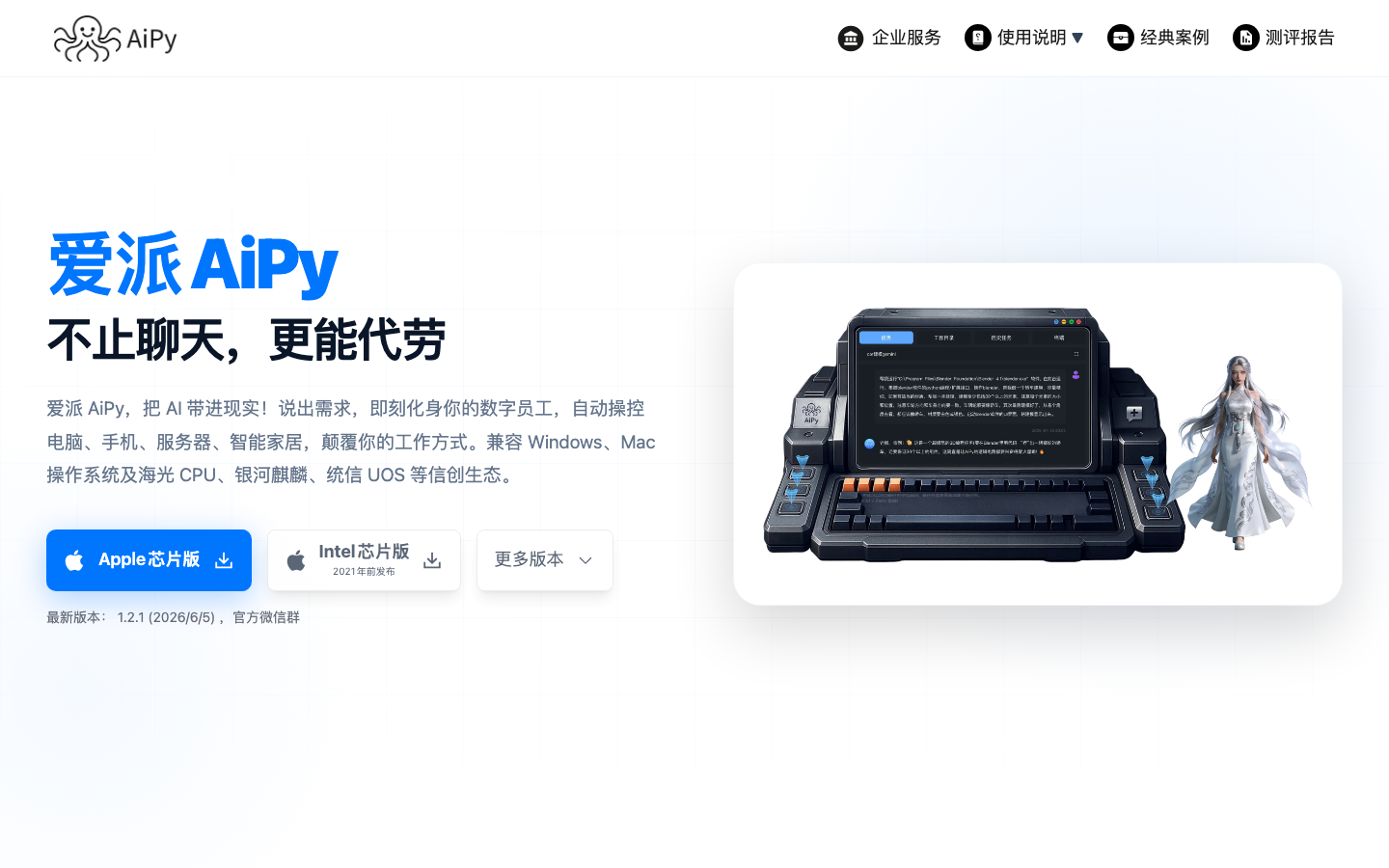
AiPy is an open source and free general-purpose AI agent execution tool. It focuses on "local Manus, domestic use, and intranet use", allowing AI to directly call codes and tools locally to complete tasks.
爱piesAiPy
Core parameters and statistics
AiPy is an open source AI execution body that focuses on "localization". The core pain points it wants to solve are the two obstacles that cloud universal Agents (such as Manus products) face in domestic and corporate intranet scenarios: limited access and concerns about data outgoing. AiPy's idea is to move AI execution capabilities locally - it can be used domestically, can be used on intranets, and is open source and free, allowing AI to directly call codes and tools on the local machine to complete tasks.
| Projects | Public Information |
|---|---|
| Official positioning | Local Manus, general AI executor |
| Open source attributes | Open source and free |
| Run in context | Available locally and intranet |
| Core Competencies | Call codes and tools to automatically complete tasks |
| Target users | Developers, intranet users |
| Supported platforms | Web, Windows, macOS |
| Place of Belonging | China |
| Billing form | Open source and free |
Product Boundary: It is aimed at automated scenarios that "allow AI to perform hands-on execution" rather than simple conversations. To exert value, users usually need to have a certain technical foundation to configure context and access models.
Capability source: The core selling point is "local + open source + intranet available", which puts execution context within the control of the user and avoids cloud Agent access and data compliance issues.
User and market recognition
The recognition of open source AI execution bodies mainly comes from the use and contributions of the developer community. AiPy takes "available domestically and within the intranet" as its differentiated positioning, responding to the availability issues of cloud universal agents in specific contexts. The official has not disclosed specific downloads, community size and other figures. The relevant data is subject to the official real-time page and the open source community.
Real Value: It addresses two very real pain points - the inconvenience for domestic users to access cloud Agents, and the reluctance of enterprises to send task data to the outside due to data security. Localized deployment solves both "can it be used" and "dare you dare to use it".
Source of Approval: For this type of tool, approval depends on stability, ease of use, and flexibility in model access. The credibility of open source projects also comes from code transparency and community activity.
Cost advantage
AiPy is open source and free, and its cost advantage lies in "zero software license cost + independent data control".
C-side/Developer: The software itself is open source and free. Developers can download, deploy and modify it freely without subscription fees.
Model Cost: AiPy is an execution framework. Actual tasks usually require access to large models. Model calls may incur API fees or local computing power costs, depending on the selected model.
Enterprise/Intranet: It can be deployed privately on the intranet to avoid data outflow. Compared with the cloud agent, the compliance cost is more controllable; however, it needs to bear the investment in deployment and operation and maintenance.
Hidden Cost: The real cost is not in the software license, but in "access and maintenance". It is necessary to configure the running context, access model, and ensure stability; allowing AI to perform local operations also involves permissions and security management. Deployment and operation and maintenance manpower should be included in the assessment.
Main functions
- Local execution: Run AI tasks directly on the local machine, and the data does not need to be sent out.
- Intranet available: Can be deployed and used in an isolated intranet environment.
- Code and Tool Calling: Let AI write and execute code and call tools to complete tasks.
- Open source and adaptable: The code is open and can be customized and expanded as needed.
- Multi-platform support: Covers both web and desktop environments.
Hidden linkage: Its value lies in the combination of "local execution + tool invocation + open source controllability" - AI does not just give suggestions, but can actually do it in a context controlled by the user. At the same time, because of open source and localization, enterprises can safely hand over internal data to it for processing.
Model and version evolution
Continuous iterative updates, the latest version introduces performance optimization and new features. Historical version information can be viewed on the official release page. There is no complete public version evolution timeline yet. It is recommended to pay attention to the official announcement to understand the rhythm of feature updates.
Technical advantages
Mechanism: Combine AI reasoning with local execution - the model is responsible for planning and generation, and the local runtime is responsible for executing code and calling tools. The entire process is within the user's domain.
Effect: Compared with cloud Agent, local execution avoids access restrictions and data outgoing, and is more usable and controllable in domestic and intranet scenarios.
Applicable scenarios: Developers and enterprises that need AI to actually perform tasks and have requirements for data security or access restrictions can best benefit from this localized design.
How to use
- Obtain AiPy (open source project) from the official entrance.
- Complete the deployment and run the configuration locally or on the intranet.
- Connect to the required large model (native or API).
- Issue tasks through the interface or instructions and let AI call tools to execute them.
- View the execution results and adjust or expand functions as needed.
It is intended for developers and operation and maintenance personnel with a certain technical foundation.
Product Pricing
The pricing model is subject to the official real-time page. Usually a freemium or subscription system is used, and basic functions can be used for free. Advanced functions or high-frequency use require paid subscriptions, and users are advised to evaluate the optimal solution based on actual usage.
Application scenarios
- Local Automation: Let AI perform data processing, scripting and other tasks locally.
- Intranet deployment: Use AI in an isolated environment without sending data externally.
- Development Assistance: Let AI write and execute code to complete development tasks.
- Enterprise Private Agent: Build an internal AI execution assistant with controllable data.
Applicable people
- Developer: Hope to use controllable and transformable open source execution bodies for automation.
- Enterprise intranet users: Subject to data compliance constraints, localized AI capabilities are required.
- Technical Enthusiasts: Willing to deploy and explore local Agents by themselves.
Unsuitable boundary: Ordinary users who lack technical foundation and want an out-of-the-box conversational experience have a high threshold; enterprises with high requirements for stability and after-sales support need to evaluate the operation and maintenance investment of self-maintained open source projects.
Summary and Outlook
Aipai AiPy takes the differentiated positioning of "local manus, domestic usable, intranet usable, open source and free" to move general AI execution capabilities to a user-controllable environment, responding to the availability and compliance pain points of cloud agents in domestic and corporate intranets. The cost is that deployment and operation and maintenance require technical investment, and the actual tasks still depend on the cost of model invocation.
Implementation suggestions: Developers can first verify the task execution effect and model access method in a small local area; before enterprises implement it on the intranet, they should evaluate the deployment and operation manpower, model costs, and local execution permission security policies, and then decide whether to use it on a large scale.
Related tools:  CrewAI,
  LangChain
Version evolution of AiPy
As an open source project, capabilities are continuously updated with community iterations, and there is no unified commercial version number.
Main line context
- Open source release period: Launch the local AI execution body in open source form to establish the "local Manus" positioning.
- Continuous iteration period: Improve tool calling, model access and multi-platform support to improve stability.
The precise version date has not been officially disclosed. The text is marked with the public version at the time of collection. The specific iteration is subject to the open source warehouse.
Version Info
- AiPy (current public version) :Open source projects continue to iterate, and local execution and tool calling capabilities are updated with the community; the official unified version number has not been disclosed, and the public version is marked here with the time of collection. There is no official precise date yet.
- AiPy open source release :The project is released as an open source, focusing on general AI execution capabilities available locally and on the intranet; there is no official precise date yet.
User Reviews