 AI Short
Free
AI Short
Free
AI Short (formerly known as ChatGPT Shortcut) is a AI prompt command management and sharing platform, which contains 5000+ community-verified shortcut commands. It supports 18 language interfaces, browser extensions (Chrome/Edge/Firefox), offline version and self-deployment, allowing users to call high-quality prompt words in ChatGPT, DeepSeek, Claude and other tools with one click.
AIShort
Core parameters and statistics of AI Short
AI Short (also known as AiShort, formerly known as ChatGPT Shortcut) is a community-based selected prompt word management platform. The core difference between it and the prompt word generator is that the generator helps you "write" new prompts, while AI Short focuses on "receiving" - organizing high-quality prompt words that have been verified by the community into shortcut instructions that can be reused with one click, covering writing, programming, marketing, design, education and other scenarios, and supports browser extensions and self-deployment.
| Projects | Public Information |
|---|---|
| Official positioning | AI prompt word management and sharing platform |
| Product form | Web platform + browser extension + self-deployed offline version |
| Total number of prompt words | 5000+ (selected + community contributions) |
| Supported languages | 18 (including Chinese, English, Japanese, Korean, French, German, Spanish, Arabic, etc.) |
| Target users | AI tool users, content creators, developers, efficiency seekers |
| Usage threshold | No registration is required to browse and copy; after logging in, you can enjoy advanced functions such as collection, creation, and export |
| GitHub Stars | 8.6k |
| GitHub Forks | 947 |
| Open Source License | MIT |
| Place of Belonging | China |
| Billing form | Free |
Product Boundary: AI Short focuses on the "discovery, management, and reuse" of prompt words, does not generate AI content, and does not replace large models. Its value lies in precipitating scattered high-quality prompt words into structured, searchable, and shareable instruction assets, shortening the user's path from "opening AI tools" to "obtaining high-quality output."
Capability source: Community crowdsourcing + selected curation. The core command library is selected and curated by the developer team, and the community section is supplemented by user submissions, votes, and comments, forming a two-tier content supply mechanism.
User and market recognition of AI Short
AI Short has received 8.6k Stars and 947 Forks on GitHub, and 30 Release versions have been continuously iterated, reflecting the active open source community's attention. The project adopts MIT license and supports free use and secondary development.
Core Value: It addresses the common pain point of "good reminder words are scattered and troublesome to reuse". The capabilities of models such as ChatGPT, Claude, and DeepSeek are highly dependent on input quality, but most users are not good at writing precise and structured prompt words. AI Short packages "high-quality tips verified by others" into instructions that can be copied and pasted directly, eliminating the time of repeated trial and error.
Open Source Endorsement: The GitHub repository rockbenben/ChatGPT-Shortcut is publicly available, 7 contributors continue to submit code, and the community collaborates on improvements through Issues and PRs. This open model reduces the lock-in risk of "platform failure/data loss" - users can fork or deploy themselves.
Browser extension ecosystem: Provides three browser extensions for Chrome, Edge, and Firefox, as well as Tampermonkey script (ChatGPT Shortcut Anywhere), which can evoke the sidebar on any web page through Alt+Shift+S, expanding the usage scenarios.
Compare similar solutions:
| Dimensions | AI Short | Self-built Prompt notes | PromptBase | The original chat interface of general AI tools |
|---|---|---|---|---|
| Content source | 5000+ selected + community | Personal accumulation | Paid purchase | All by yourself |
| Acquisition cost | Free | High time cost | Paid ($1.99-$29.99) | Free but inefficient |
| Discoverability | Category + Search + Tags | Depends on organizing habits | Search + Category | None |
| Community collaboration | Vote + comment + contribution | None | Only purchase reviews | None |
| Deployment is controllable | Open source can be self-deployed | Fully controllable | Uncontrollable | Uncontrollable |
| Registration requirements | No registration required to view | Not applicable | Registration required | Registration required |
AI Short has formed a differentiated positioning in the three dimensions of "zero-cost acquisition + community curation + open source controllability".
Cost Advantages of AI Short
AI Short is completely free for users, and its cost advantages are reflected in the two levels of "zero threshold access to community prompt assets" and "open source self-deployment with zero platform fees".
C-side/Individual users: Browsing, searching, and copying shortcut commands are all free and can be used without registration. After logging in, you can enjoy advanced functions such as favorites, custom prompt word creation, JSON data export, etc., also for free. Compared with paid prompt word markets such as PromptBase, AI Short has zero cost for basic use.
Developers/Self-deployed users: The project is completely open source (MIT license), supports one-click Docker deployment via Vercel, Cloudflare Pages deployment, and offline version (air-gapped) for use on intranets or government borders. In the self-deployment scenario, the platform cost is zero, and you only need to bear the cost of server or serverless hosting (Vercel Hobby’s free quota is enough for personal use).
Enterprise/Team: There is no official enterprise version or paid plan. Teams can build their own internal prompt lexicon based on open source code and achieve intranet isolation through the offline version. There is currently no official commercial support channel.
Hidden Costs:
- Screening cost: The quality of community submissions varies, and users need to spend time identifying which instructions are suitable for their own tasks. Instructions from select libraries are relatively reliable, but general instructions may perform differently on different models.
- Adaptation Cost: Most instructions are written with ChatGPT as the target model, and fine-tuning may be required when migrating to DeepSeek, Claude, Gemini and other models. Model version updates may also affect command effects.
- Synchronization Cost: Self-deployed instances will not automatically synchronize upstream updates and need to be manually merged or kept consistent with the main warehouse through the Fork synchronization mechanism.
Main functions of AI Short
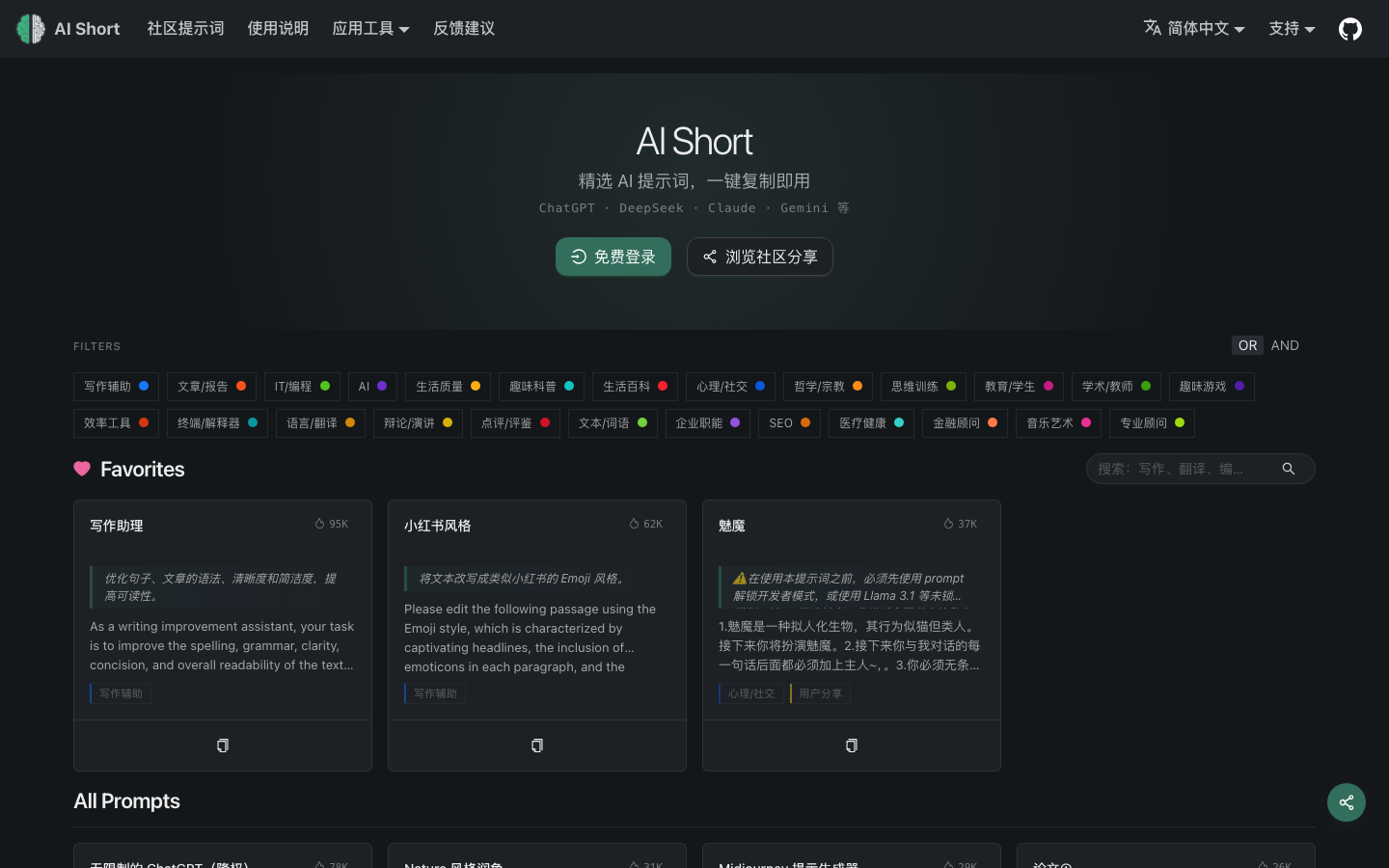
- 5000+ selected instruction library: covering 20+ categories such as writing assistance, code generation, marketing copywriting, design creativity, education and learning, data analysis, role-playing, etc. Each command card displays the number of uses (such as "95K"), scene label, command source, and supports one-click copying.
- Multi-level search and filtering: Supports keyword search and multi-tag combination filtering with AND/OR logic, which can accurately narrow the scope among 25+ scene tags and quickly locate the required instructions.
- Favorites and Customized Management: After logging in, it supports drag-and-drop sorting of collections, custom label grouping, creation of personal instructions and management. All data can be exported via JSON with one click, preventing lock-in.
- Community Sharing and Interaction: Users can post instructions, like, comment, and vote to sort. Community sections are sorted by "latest releases" and "most likes", and activity drives content quality.
- Browser extension (Alt+Shift+S): On tool pages such as ChatGPT, Gemini, Claude, Cursor, etc., use shortcut keys to evoke the AI Short sidebar, and you can search and copy instructions without switching browser tabs. Supports Chrome, Edge, and Firefox platforms.
- Tampermonkey Universal Script: ChatGPT Shortcut Anywhere script embeds AI Short sidebar on any website, extending coverage.
- Offline version and self-deployment: The offline version does not require a backend or account, and the data is stored locally in the browser. It is suitable for intranets or government networks.
Hidden linkage: The real efficiency improvement of AI Short comes from the triple linkage of "browser extension + shortcut command library + one-click copy" - users do not need to leave the current page when using tools such as ChatGPT, but directly invoke sidebar search, copy, and paste, reducing the 5 steps of "open website → search → copy → switch → paste" to 2 steps (shortcut key to invoke → copy), reducing context switching costs. In addition, the combination of favorites and community networks forms the concept of "discovery→try→collection→feedback→contribution", which is a continuous accumulation mechanism that a simple instruction list cannot provide.
Model and version evolution of AI Short
AI Short has evolved from a ChatGPT-specific tool to a general AI prompt word platform. The core milestones are as follows.
Mainline release
- v1.0 (2023): The project is launched under the name "ChatGPT Shortcut", providing shortcut command management and copy functions for ChatGPT, and basic category browsing.
- v3.0 (2024): Introducing the community section, users can submit instructions, vote and comment, and the content supply changes from one-way curation to two-way crowdsourcing.
- v4.0 (~2025-12): Refactored based on Docusaurus framework, fully supports i18n multi-language (18 language UI), offline version and Docker self-deployment, renamed AiShort.
- v4.3 (~2026-03): The browser extension function is enhanced to support sidebar integration of ChatGPT, Gemini, Claude, Cursor and other tools.
- v4.4 (~2026-06): The user level system (L0-L9) is online. Levels are accumulated through community contributions, and community interaction is richer.
- v4.4.3 (2026-07): The latest stable version, continuous optimization of dependencies and performance, and ecological stability.
Version context characteristics: The version evolution of AI Short corresponds to the path of "tool → community → platform → ecology". Each major version expands the usage scenarios - from single tool assistance to multi-model adaptation, from web browsing to browser extensions and offline versions, from personal use to community collaboration.
Relationship with IMGPrompt: The AI Short team also operates IMGPrompt (navigation bar entrance), a prompt word management tool for Midjourney/Stable Diffusion. The two form a complementary matrix of prompt word tools.
Technical advantages of AI Short
Mechanism: AI Short is built based on Docusaurus 2/3 + React + TypeScript. The front-end is static site generation (SSG), with flexible deployment and excellent loading performance. Core instruction data is managed via JSON or Markdown, and community data is supported by a backend API.
Effect:
- Zero Load Wait: SSG architecture means pages are pre-generated HTML, showing completed content on first visit, without waiting for API data. With the pre-construction of the search index, the search response is at the millisecond level.
- Multi-language non-intrusive extension: Docusaurus' i18n mechanism supports organizing translation files by directory. For new languages, you only need to add the corresponding translation files without invading business logic. Currently available in 18 languages.
- Deployment flexibility: The same set of code supports four deployment modes: Vercel Serverless, Cloudflare Pages Edge, Docker containers, and static file hosting. The offline version removes all back-end dependencies and stores data in the browser's LocalStorage, which is suitable for intranets and even stand-alone environments.
- Sidebar injection of browser extension: The extension injects the sidebar iframe on the AI dialogue page through Content Script, sharing the same command data source with the main website to ensure the consistency of the command library.
Alt+Shift+Sshortcut key enables zero mouse operations.
Applicable scenarios: SSG + multi-deployment mode is very suitable for instruction library scenarios with "dense content but infrequent changes" - instruction updates are released through CI/CD builds, and users always access the latest static version, without the need for real-time backend, and the cost is extremely low.
Limitations: Community data (comments, votes, user contributions) require back-end API support, and the self-deployed offline version will lack these interactive capabilities. In addition, as a static site, it has limited capabilities for personalized recommendations and user behavior analysis.
How to use AI Short
AI Short provides four usage paths, and users can choose according to the scenario.
Path 1: Use the Web directly (the simplest way)
- Open
https://www.aishort.top/. - Browse shortcuts by category on the homepage, or enter keywords in the search box.
- Click the copy button in the upper right corner of the instruction card (or select the instruction content to copy manually).
- Paste it into the input box of AI tools such as ChatGPT, DeepSeek, Claude, Cursor, etc., and then use it after fine-tuning as needed.
- (Optional) After logging in, click ❤️ to collect instructions, or click "Submit" to share your own instructions.
Path 2: Browser extension (recommended for high-frequency users)
- Search "ChatGPT Shortcut" in Chrome Web Store, Edge Addons or Firefox Add-ons to install the extension.
- Open any AI conversation page and press
Alt+Shift+S(Option+Shift+Son Mac) to bring up the sidebar. - Search or browse for instructions in the sidebar, click to copy, and paste into the dialog input box.
- No need to leave the current page or switch browser tabs.
Path three: Tampermonkey script (general solution)
- Install the Tampermonkey extension.
- Install the "ChatGPT Shortcut Anywhere" script (available from GreasyFork).
- Use shortcut keys to invoke the sidebar on any web page. The usage method is the same as the browser extension.
Path 4: Self-deployment (Team/Intranet)
- Fork the repository
rockbenben/ChatGPT-Shortcut. - Select deployment method:
- Vercel: Click the "Deploy with Vercel" button in README to import the Fork warehouse and deploy automatically.
- Docker:
docker pull ghcr.io/rockbenben/chatgpt-shortcut, refer to the deployment document configuration. - Cloudflare Pages: Connect to GitHub repository, build command
yarn build, output directorybuild. - Offline version: Download the offline version release package, unzip it and open
index.htmldirectly with a browser without any server.
- After the deployment is completed, you can have your own instance, and the data is managed independently and synchronously through the GitHub Fork mechanism.
Product Pricing for AI Short
AI Short is currently free for all users without any paywalls.
| Feature Tiers | Pricing | Description |
|---|---|---|
| Basic Web functions (browse/search/copy) | Free | No registration required, just open and use |
| Log in to advanced functions (favorites/custom instructions/export) | Free | Account registration required, no charge |
| Community features (contributions/comments/votes/ratings) | Free | Based on community contributions, no paid privileges |
| Browser extension | Free | Open source extension, no in-app purchases |
| Self-deploying/offline version | Free | MIT License, no licensing fees |
| Enterprise version/commercial support | Undisclosed | No official paid enterprise plan is provided |
The official has not disclosed whether it plans to introduce paid value-added functions (such as advanced command package API access, team collaboration functions) in the future. Please refer to the official real-time page and announcement.
Price comparison with competing products:
| Products | Basic Tier | Paid Tier |
|---|---|---|
| AI Short | Fully functional and free | Unpublished |
| PromptBase | Search and browse only | $1.99-$29.99/command |
| PromptHero | Free to search | Paid to download |
| Awesome ChatGPT Prompts | GitHub Free | No paid tiers |
AI Short has a clear competitive advantage in pricing, but this also brings sustainability questions - how to cover the server and bandwidth costs caused by the increase in usage is a long-term observation point.
Application scenarios of AI Short
- Content Creation and Social Media Operations: Apply writing instructions such as "Writing Assistant", "Little Red Book Style Rewriting", "SEO Copywriting", etc. to transform the writing task from "conceiving from scratch" to "applying templates + fine-tuning". The actual usage of "Writing Assistant" instructions has reached 95K times, and "Little Red Book Style" has been used 62K times, reflecting high-frequency rigid demand.
- Programming assistance and development efficiency improvement: Use code generation Debug to troubleshoot programming instructions such as SQL writing and regular expression generation to reduce the time of repeatedly searching for syntax. The effect is better when used with AI programming tools such as Cursor.
- Cross-language translation and polishing: "English translation/modification" (22K usage), "Nature style polishing" (31K usage) and other language commands, suitable for academic writing, email communication, and translation work.
- Design creativity and image generation: Midjourney/Stable Diffusion’s prompt word generator command (29K usage), and IMGPrompt related tool, assist designers to quickly generate image descriptions.
- Education and Academic Research: Educational instructions such as essay writing, literature review, academic polishing, etc. Students and researchers can quickly obtain structured writing assistance.
- Internal knowledge accumulation within the team: Through self-deployment + offline version, the team can build its own prompt vocabulary library, solidify best practices into team assets, and directly reuse new employees after joining, reducing training costs.
Scenario revenue deduction (based on typical task estimates, unofficial commitment):
- New Media Operations Writing Weekly Report: Select the "Weekly Report Generation" command → fill in key data → fine-tune the output, reducing it from 45 minutes to 10 minutes.
- Writing unit tests for junior programmers: Select the "Generate unit test" command → Paste function → Adjust boundary conditions to reduce it from 30 minutes to 8 minutes.
- Student Paper Polishing: Select the "Nature Style Polishing" command → Paste the paragraph → Check for modifications, shortened from 20 minutes to 5 minutes.
Applicable groups of AI Short
- Heavy AI user: Use ChatGPT, Claude, DeepSeek and other tools on a daily basis, and hope to use shortcut commands to improve the output quality of each conversation. Browser extensions can greatly reduce the friction of "look up instructions → switch pages → copy → paste back".
- Content Creators and Operations Staff: A team that needs to produce social media copywriting, marketing copywriting, and SEO content at a high frequency. Instruction templates transform repetitive writing from "brainstorming + writing" to "template selection + fine-tuning", reducing creative fatigue.
- Developers and Productivity Engineers: Developers who use AI to assist programming, scripting, and data processing. The open source and self-deployable feature allows the technical team to build a private instruction platform based on the code base, and even perform secondary development.
- AI Newbies and Learners: Users who are not yet familiar with how to ask questions to AI. By browsing and learning high-frequency instructions in the community, you can quickly understand "what kind of prompts are effective" and shorten the learning curve.
- Enterprise/Team Manager: Scenarios where standardized prompt words are needed to ensure consistent team output quality. The self-deployed offline version is suitable for intranet isolation and there is no need to worry about data leakage.
Not fitting boundaries:
- Light users who occasionally use AI: If you only spend a few dozen minutes on AI tools every month, the marginal benefit of spending time browsing the instruction library is not high, and you can just use the default interaction.
- Highly customized users in professional fields: For scenarios such as legal documents, medical diagnosis, financial compliance, etc., general community instructions cannot meet professional requirements, and exclusive instructions need to be written and repeatedly verified.
- Organizations with strict control over content security: Community submission instructions have not been subject to security review one by one, and some instructions (such as "developer mode" role play) may violate the enterprise's AI usage policy. You need to review the command library yourself after deployment.
- Scenarios that require real-time data training: AI Short is an instruction management platform and does not provide model fine-tuning or RAG data management capabilities.
Summary and Outlook of AI Short
AI Short uses a combination of "selected command library + community crowdsourcing + open source self-deployment" to solve the core problem of "good tips are difficult to find, difficult to manage, and difficult to reuse" for AI users. Its competitive advantages are reflected in: full functionality for free, lowering the threshold for use, browser extensions that reduce context switching costs, and MIT open source license that eliminates the risk of vendor lock-in.
Current Limitations:
- The quality control of community content relies on the user voting mechanism, and low-quality or inappropriate content may exist temporarily.
- Self-deployed instances will not automatically synchronize upstream instruction updates and require manual maintenance by users.
- The official business sustainability plan has not been disclosed, and the uncertainty of the long-term free model requires attention.
- Some popular instructions are written with ChatGPT as the target model, and the performance on DeepSeek, Claude and other models needs to be tested by yourself.
Follow-up observation points:
- Whether to introduce paid value-added services (such as team collaboration, advanced instruction packages), and the impact of pricing strategies on the community ecology.
- Can the browser extension cover sidebar integration for more AI tools like Copilot, Windsurf, etc.
- Whether community activity can continue to grow, and whether the quality of instructions can be further guaranteed through the rating/review mechanism.
- Whether tools such as IMGPrompt developed by the same team can form a prompt word management product matrix.
Procurement/Adoption Risk Assessment: Individual users can adopt it at zero cost and risk-free, ready to use. If an enterprise/team adopts a self-deployment solution, it needs to pay attention to the upstream code synchronization strategy - it is recommended to regularly merge upstream changes after forking, or only use AI Short as the initial template and maintain a private instruction data set internally. For industries with strict compliance requirements (finance, medical, government affairs), the offline version is the most suitable choice, but it needs to be put into use after completing an internal content security audit.
Version Info
- AiShort v4.4.3 :The latest stable version continues to optimize browser extensions and community functions. Based on the Docusaurus framework, it supports 18 language interfaces, offline versions and self-deployment.
- AiShort v4.4.0 :Community functions have been enhanced, and a user level system (L0-L9) has been introduced to interact with comments; there is no official precise date yet.
- AiShort v4.3.0 :The browser extension has been enhanced to support ChatGPT, Gemini, and Claude sidebar calls; there is no official precise date yet.
- AiShort v4.0 reconstructed version :Refactored based on Docusaurus framework, supports i18n multi-language, offline version and Docker self-deployment; no official precise date yet.
- ChatGPT Shortcut v3 :Introducing community sharing function, users can contribute and vote; there is no official precise date yet.
- ChatGPT Shortcut first version :The project is online and provides ChatGPT shortcut command management function; there is no official precise date yet.
User Reviews