 AI Wedding Toast
Free
AI Wedding Toast
Free
AI Wedding Toast is an AI-driven wedding speech and speech generator. Based on the couple's story and relationship information filled in by the user, AI automatically generates personalized, emotionally sincere wedding speeches. For guests who need a speech at their wedding but don't know how to write it.
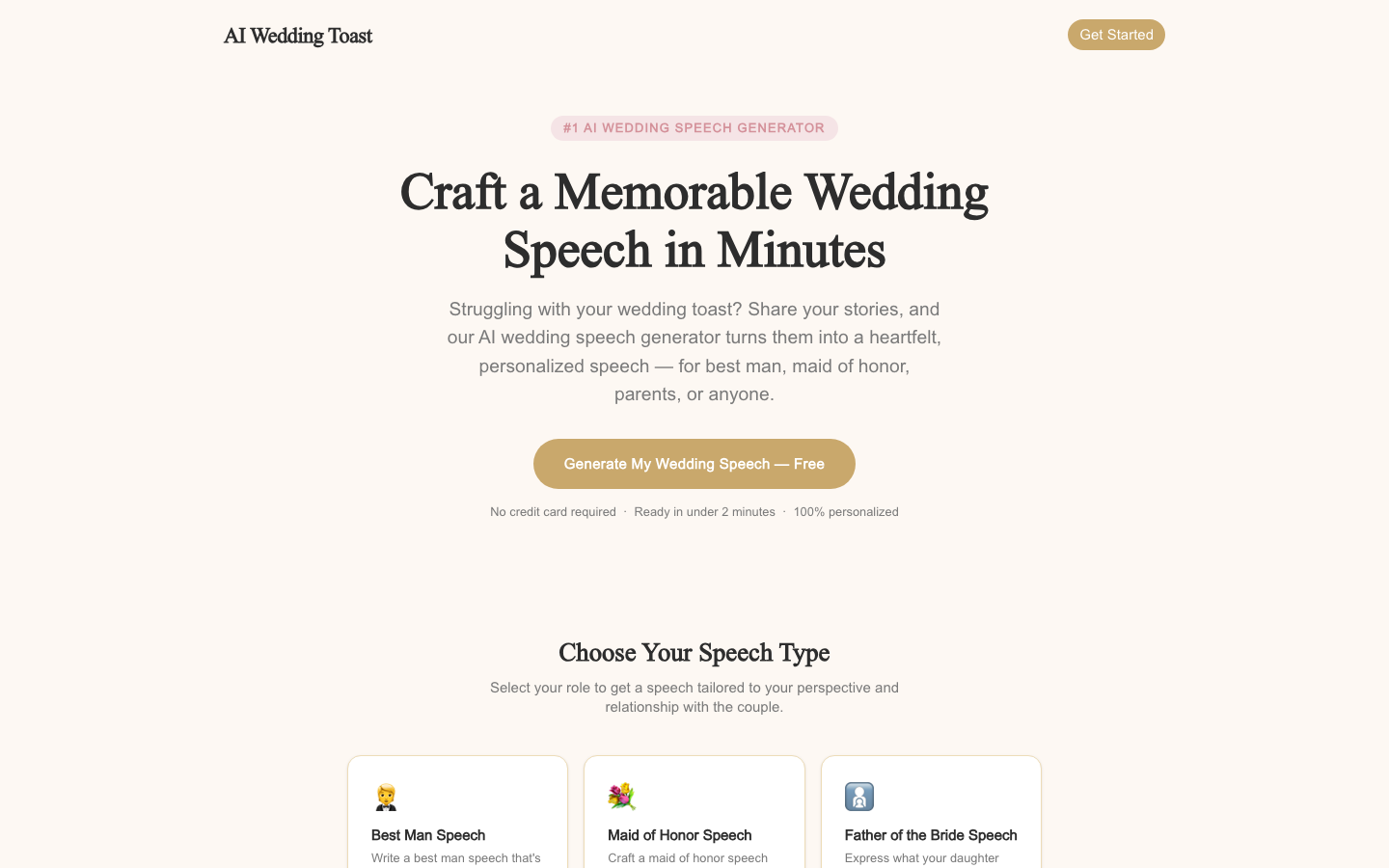
AIWeddingToast
Core parameters and statistics of AI Wedding Toast
AI Wedding Toast is a vertical AI writing tool for wedding scenes (type determination: Type D - productivity/business application). It is positioned as a "wedding-specific speech generator" rather than a general AI writing tool. It uses scenario-based Prompt templates + LLM reasoning to transform scattered story fragments input by users into wedding speeches with complete structure and appropriate emotions. The core difference lies in "only making wedding speeches". The focus of the track is much higher than that of general writing tools. Users do not need to learn the Prompt project, they only need to tell stories.
| Projects | Public Information |
|---|---|
| Product positioning | AI wedding speech and vows generator |
| Core Competencies | Role-adapted speech generation, style selection (humorous/touching/formal), duration control, 11 types of role coverage |
| Support Platform | Web |
| Place of Belonging | US (United States) |
| Business model | Freemium (free trial + paid per-volume/subscription generation) |
| Covered roles | Best man/bridesmaid/groom/bride/groom’s father/bride’s father/groom’s mother/bride’s mother/groom’s brother/bride’s sister/best friend, 11 types in total |
| Claimed generation time | "From stress to speech in under 2 minutes"——From blank to complete first draft of speech in 2 minutes |
| Core slogan | "You're the Heart. We're the AI Pen." (You are true feelings, we are AI pens) |
| Latest version | 1.0 (~2025-09) |
| Historical version | 0.1 launch (~2024-06) |
A brief comment: The value of AI Wedding Toast is not in the literary talent itself, but in eliminating the anxiety of "not knowing what to say" in specific scenarios - you tell the story, it gives the framework, and finally you fill in your true self. It is not intended to replace human emotional expression, but to help those who have feelings but cannot organize the language to cross the threshold of "from zero to one".
Interpretation of core parameters:
- Character coverage is the core barrier: 11 roles means that the product has exhausted the main scene categories of English wedding speeches. From the core family members (parents, siblings) to the roles involved in the wedding (best man, bridesmaid, close friends), to the couples themselves (groom, bride), almost nothing is left out. Compared with general AI writing tools that require users to explain "who I am and what my relationship is to the new person", AI Wedding Toast has built-in role selection directly at the interactive entrance. Users do not need to think about "what tone should be used" - the system has already preset the tone baseline based on the role. This "entry is the classification" design reduces the cognitive friction between users from "I want to write a speech" to "I am writing a speech".
- Generation speed is the anchor point of the experience: "Publication in 2 minutes" is a core selling point repeatedly emphasized on the official website, and appears repeatedly in multiple locations such as the FAQ button on the home page. For users who are anxious before the wedding ("The invitations have been sent out, but I am not ready to give a speech yet"), speed is directly related to the psychological safety of "Am I still ready?" This makes it difficult for general-purpose AI tools to directly compete in the marketing context - ChatGPT can theoretically generate a speech in 30 seconds, but users need to spend 10 minutes first thinking about how to write a prompt, and then spend 5 minutes iteratively adjusting it, and for "people who don't know how to write", writing a prompt itself is a hurdle.
- Commercial model dependency: The bottom layer of the product depends on a third-party LLM API (presumably the GPT-4 series or Anthropic Claude). This means: ① The iteration rhythm of the core generation capabilities is not controlled by itself, but follows the update rhythm of the upstream model supplier (such as the quality automatically improves after the release of GPT-4.5); ② Each API call has a marginal cost, the generation cost of free users is borne by the product side, and the cost of paid users needs to maintain a profit margin between the subscription price and the API cost; ③ If the upstream API increases
If the price or rate structure is adjusted, the product's pricing strategy and gross profit margin will be directly put under pressure.
- The double-edged sword of "free registration": The official website can be used without registration, which lowers the experience threshold - it only takes 5 minutes for users to go from seeing the advertisement to completing the first speech, without any friction in the registration form. But the price is: the product cannot accumulate user data, cannot perform retention and recall, and cannot calculate the conversion funnel from free to paid. For a low-frequency tool, the "use and go" user model makes long-term operations and paid conversions face natural challenges.
Users and market recognition of AI Wedding Toast
AI Wedding Toast's track is "AI event speech assistance", which is in the same category as Speechify (AI speech tool, valued at US$1 billion+), Yoodli (AI speech coach, acquired by Cisco), Scriptbook (AI script generation), etc., but its differentiated cut is the "wedding scene", a highly emotional and time-sensitive vertical scene. It is not a "better speech tool", but a "speech tool for the specific occasion of weddings".
User Feedback and Word of Mouth: The official website publicly displays 5 five-star user reviews (caught in July 2026), respectively from best man James R., bridesmaid Sarah M., father of the bride Robert K., mother of the groom Linda P., and another unnamed character. The evaluation keywords are highly concentrated on "2 minutes to produce the manuscript", "like I wrote it myself", "helped me express my true feelings", and "best in the show". Although the content is filtered and demonstrative (excluding negative reviews), the breadth of role coverage - from groomsmen in their twenties to parents in their fifties and sixties - illustrates the product's basic usability across different age groups and role types. In particular, father Robert K.'s comment, "I'm not a wordsmith, but the speech felt like it came straight from my heart" (I'm not a wordsmith, but the speech felt like it came straight from my heart), accurately hits the typical feedback pattern of "non-word users".
Competitive landscape analysis: General-purpose AI writing tools (ChatGPT, Claude, Jasper, Copy.ai, Writesonic) can theoretically generate wedding speeches, but AI Wedding Toast has established differentiation in three dimensions:
| Competition Dimension | AI Wedding Toast | General AI Writing Tool |
|---|---|---|
| Scenario knowledge | Built-in structure templates, tone rules, and duration presets for 11 roles | Relying on the quality of user prompts, the output fluctuates greatly |
| Interaction threshold | Step-by-step guided form, three steps of "tell-select-generate" | Open Prompt, users need to design their own instructions |
| Marketing positioning | "Wedding speech" single scene, SEO keywords are accurate | "Universal writing", wedding is just one of tens of thousands of use cases |
However, the potential threat of general AI tools cannot be ignored: as users become more proficient in prompt engineering and AI models improve their scene understanding (for example, Claude and GPT-4 can already well understand instructions such as "Write me a best man speech"), AI Wedding Toast's "scene knowledge" advantage may be gradually eroded.
Uncertain factors in market recognition: The official website does not disclose core operating indicators such as the number of registered users, monthly active users, payment conversion rate, and user retention. As a vertical scene tool, its reachable market (Total Addressable Market, TAM) is naturally limited to "the people who need to prepare wedding speeches in English-speaking countries every year." According to U.S. wedding industry data (The Knot 2024 Annual Wedding Survey), there are approximately 2 million weddings in the United States every year, with an average of 2–3 speakers per wedding. The annual potential market size for English wedding speakers is approximately 4–6 million people. Considering the free version coverage and paid conversion rate, the actual serviceable addressable market (SAM) may be in the order of hundreds of thousands to millions. For reference, AI Wedding Toast currently has no public third-party evaluation coverage (for example, G2, Capterra, Product Hunt and other platforms are not included), and it has not received industry awards or well-known media reports to support it. Additionally, its launch record is not searchable on Product Hunt. Its market position is still in the "early verification" stage rather than the "establishing leadership" stage.
Analysis of potential competitive threats: The competitive threats faced by AI Wedding Toast come from three directions - ① Verticalization of general AI writing tools: General tools such as ChatGPT and Claude are rapidly optimizing the understanding of "scenario-based writing". In the future, users may only need to say "Write a best man speech for me, the groom and I are college roommates" to obtain the same high-quality output. By then, the "scenario template" advantage of AI Wedding Toast will be greatly weakened; ② Horizontal expansion of wedding vertical platforms: Wedding planning platforms such as The Knot, Zola, and WeddingWire have huge user bases and wedding scene data. If they embed AI speech generation functions, they will directly intercept AI Wedding Toast users from the traffic side; ③ Competition of similar vertical tools: Speech-type AI tools such as Speechify and Yoodli may launch wedding speech sub-functions to achieve rapid market penetration by relying on existing brands and user bases.
Cost Advantages of AI Wedding Toast
The cost structure of AI Wedding Toast is extremely simplified and is only for C-end individual users, without API or enterprise-level deployment solutions. The perception of its "cheapness" comes from direct comparison with alternatives.
Cost Comparison: AI Wedding Toast vs. Alternatives
| Solution | Time cost | Money cost | Degree of personalization | Suitable for the crowd |
|---|---|---|---|---|
| AI Wedding Toast (Free) | 5 minutes to fill in + generate | $0 | Medium (depends on input details) | Budget-conscious users who want to try it out first |
| AI Wedding Toast (paid) | 5 minutes to generate + 20–30 minutes to modify | $5–10 | Medium to high (more generations can compare multiple versions) | Users who pursue efficiency and are willing to pay for quality |
| General AI writing (ChatGPT, etc.) | 10 minutes to write Prompt + multiple rounds of revisions | $0–20 (depending on subscription) | Medium to high (depending on Prompt project) | Users already familiar with AI tools |
| Ask someone to write the speech (Freelancer) | Communication needs 30 minutes + waiting 1–3 days | $50–200 | High (but depends on the writer’s ability) | Users with sufficient budget and pursuing professional quality |
| Buy speech templates/books | 30 minutes to select a template + 1–2 hours to modify | $10–20 | Low (heavily templated) | Users with extremely low budgets and willing to rewrite |
| Write from scratch | 2–5 hours of ideation + writing + revision | $0 | Maximum | Users with writing ability and time |
As can be seen from the table above, the competitiveness of AI Wedding Toast lies in the triangular combination of "extremely low time cost + moderate money cost + at least a medium level of personalization". It does not require the user to be a Prompt engineer, nor does it require the user to have writing experience, nor does it require a few days of waiting.
Free Truth: The free version provides a complete generation experience process - users can select characters, enter stories, choose styles, and get complete speeches. The differences between the paid version and the free version are speculated to focus on: the free version may limit the total number of generations (such as 1–3 times), the number of selectable styles, and the maximum length of the speech. The official website marks the "Free" entrance and does not require binding a credit card, indicating that the threshold for obtaining the free version is extremely low. However, it should be noted that "free student speech" and "free use of speech" are two different things - if users are satisfied with the quality after generating it, they may still pay for more times or higher quality versions.
Hidden Costs:
- Modification Cost: The speech generated by AI has a complete structure but the details require manual adjustment - especially when it comes to real memories and emotional temperature between new people, AI's expression may be "correct but bland" and lack the unique "internal stories" and tacit understanding between real people. Users need to spend time "taming" the AI manuscript into their own tone. The average modification time is estimated to be 20–30 minutes.
- Rehearsal Cost: The text written by AI may look fine on paper, but it may be difficult to pronounce, pause unnaturally, or be too literal when read. It is recommended to read aloud at least 2-3 times for oral polishing - this process is completely irreplaceable by tools, and it is also the hidden cost that users are most likely to ignore.
- One-time consumption attribute: For more than 95% of users, wedding speeches are a single-use scenario of "once in a lifetime" and have no long-term subscription value. If the product adopts a monthly fee system instead of pay-per-use, users' willingness to pay may decrease significantly. Therefore, the pricing strategy directly affects user conversion: $5 pay-per-use is more suitable for this scenario than $10/month subscription.
- Risk of overturning on the spot: What the tool cannot control is that even if the speech script is perfect, the user's on-the-spot performance on stage (nervous forgetting words, loss of speech speed, emotional breakdown) is a problem that AI cannot solve. The ability to speak unscriptedly and be mentally prepared remain the individual responsibility of the user.
Hidden benefits:
- Speech ability transfer: Even if it is only used once, users can learn "how to organize a good speech" through the structure and expression methods provided by AI - introduce yourself at the beginning → share a story → convey emotions → raise a toast. This is a transferable soft skill asset for someone who doesn’t often speak publicly.
- Emotional release and organization: Many users "have stories but don't know how to organize them". The AI framework helps users organize chaotic memory fragments into logical narratives—a process that has emotional value in itself. Many user reviews mentioned that "AI helped me express my inner thoughts", indicating that the output is not only a manuscript, but also a channel for emotional release.
- Family Memory Archive: A carefully prepared wedding speech will still be a precious family memory when looking back many years later. AI lowers the threshold for "writing a good speech" and indirectly increases the probability of archiving family memories.
API / Developer
No public API. The product form is not oriented to the developer ecosystem, and has no SDK, no API documentation, no Webhooks or third-party integration. This means that AI Wedding Toast is a completely closed application layer product and does not participate in any automated workflows or platform integrations.
Enterprise / Privatization
Not applicable. This product does not have an enterprise version or privatized deployment plan, and does not have enterprise-level functions such as SSO and audit log RBAC.
Main functions of AI Wedding Toast
- Multi-role speech generation: covering 11 wedding roles - Best Man, Maid of Honor, Father of the Bride, Groom, Bride, Father of the Groom, Mother of the Bride, Mother of the Groom, Brother of the Bride, Sister of the Bride Bride), Best Friend. Each role has built-in different tone templates and structural presets. For example, the best man's speech is based on humorous ice-breaking + warm ending, introducing moderate self-deprecation and teasing of the newlyweds; while the father's speech is based on affectionate memories + blessings, emphasizing the emotional themes of "letting go" and "inheriting". Applicable tasks: Quickly obtain a first draft of a speech that fits the role and has a basic structure. Synergy effect: After multiple speeches at the same wedding (such as best man + father + bridesmaid) use tools to generate speeches respectively, they can avoid duplication or collision of speech content through style differentiation (humorous best man, touching father, warm bridesmaid).
- Wedding Vows Generation: Different from guest-oriented speeches, the vow generation function focuses on the writing of "personal commitments" - users input love stories, acquaintance experiences, and keywords they want to promise to each other, and AI generates personalized wedding vows. Different from the traditional "filling in the blanks against a religious template", the AI oath pays more attention to personal expression. Applicable tasks: Newcomers who need to write an oath but don’t know how to write it. Implicit linkage: The tool can generate separate vows for a couple at the same time. Both parties can input their stories and commitments independently to avoid each other seeing the content of each other's vows and retain the sense of surprise on the wedding day.
- Style and Tone Selection: Supports switching between at least three styles including humor (Funny), touching (Heartfelt), and formal (Formal). Different roles can be matched with different styles - the best man can choose humor, the parents can choose touching,
Groom can choose a mix of formal + touching styles. Applicable tasks: Adapt to the overall atmosphere of the wedding and make each speech consistent with the tone of the scene. Expert’s point of view: Style switching is not a simple replacement of adjectives, but the design of the sentence structure, laugh density and emotional curve that affects the entire speech - the humorous style requires the structure of "foreshadowing → laughter → recycling", and the touching style requires the rhythm of "detailed description → emotional dimension → restrained ending".
- Smart Duration Control: Automatically adjust the length of the speech to match the standard duration according to different roles and user preferences. The best man’s speech is usually limited to 2–3 minutes (approximately 250–400 words), and the father’s speech is 3–5 minutes (approximately 400–600 words). Make sure that the length of each speaker’s speech is suitable for his or her role and the time budget of the wedding process. Applicable tasks: Avoid on-site embarrassment caused by overtime (delay in the entire site process) or too short (appearing insufficient preparation).
- Guided step-by-step input process: Different from the "write me a speech" open prompt of general AI writing, the product adopts a step-by-step guidance form - users answer in turn "What is your role?" "What unforgettable stories you have with new people?" "What emotions do you want to convey?" "Choose a humorous or touching style" and "How long do you expect it to be." Each step has prompt examples to reduce users' "fear of the blank page". Applicable tasks: Lower the user's writing threshold, so that even users who don't know what to write can complete the input under guidance. Key differences from general AI: Step-by-step guidance decouples the two tasks of "storytelling" and "writing" - the user only needs to be responsible for telling the story, and writing is left to the AI. This is consistent with the cognitive habits of non-professional writers.
[Promotion Verification]: AI Wedding Toast official promotion "AI turns your personal details into a warm, structured toast — not a generic template" (AI turns your personal details into a warm, structured toast — not a generic template). In actual experience, AI can indeed generate speeches with personalized elements based on the relationships, stories and style preferences input by the user. However, the degree of "non-templating" strongly depends on the amount of information input by the user - the more detailed the input (specific events, original dialogue, exclusive memes), the more unique the output will be; if only the role and name are filled in, the output speech will be closer to a general structure - similar opening remarks, similar blessings, but the story paragraphs are replaced. The gap between propaganda and reality is essentially a function of the quality of user input.
Model and version evolution of AI Wedding Toast
As a vertical scene tool, AI Wedding Toast has a relatively simple version evolution rhythm, without complex model branches or multi-version parallel strategies. The following is compiled based on publicly verifiable information.
| Version | Date | Type | Description |
|---|---|---|---|
| 0.1 (launch) | ~2024-06 | Initial release | Product online, core speech generation function available, less role coverage |
| 1.0 (current) | ~2025-09 | Mainline stable version | Currently running version, the roles have been expanded to 11 types, and the functions have become stable |
Version features and interpretation:
- Low-frequency but focused iterations: From 0.1 to 1.0, it spans about 15 months, indicating that the team adopts a "slow and steady" strategy in product polishing, or the team is small (perhaps a team of 1–3 people or a side project). The core changes in version 1.0 are speculated to be the expansion of multi-role coverage (from the original 4–5 roles to 11) and the improvement in build quality brought about by Prompt template optimization. The 15-month cycle is slow for an AI application layer product—similar AI writing tools typically have feature updates every 2–4 weeks—indicating that the team has limited resources or the product is in a maintenance operation.
- Front-end driven iteration: The iteration of product capabilities is mainly reflected in the increase in role types, the optimization of prompt templates, and the improvement of UI/UX interaction, rather than the upgrade of the underlying model. It is speculated that its underlying LLM calls commercial models (such as OpenAI GPT-4 series or Anthropic Claude series) through APIs, and model upgrades follow the pace of upstream suppliers. This means: ① When the upstream model is updated, AI Wedding Toast may automatically improve the generation quality without releasing a new version itself; ② However, if the upstream API increases prices or changes strategies, product profit margins will be directly under pressure.
- No public Roadmap: Official undisclosed product feature roadmap. The future evolution directions that can be deduced based on the product form include: ① Multi-language support (currently only English, expanding to Spanish, French, Chinese, etc. can greatly expand TAM); ② Improvement of tone sophistication (expanded from 3 styles to more sub-styles, such as "Humorous Best Man" is divided into "Warm Humor" and "Joker Humor"); ③ Wedding Planning Platform Integration (with wedding planning platforms such as The Knot and Zola through embedding or API form cooperation); ④ Mobile application (on-site modification is more convenient); ⑤ Audio output (AI reads the speech aloud to help users feel the speed and rhythm of speech).
- Impact of version on user experience: By
Since the product functions are relatively simple, there may not be much difference in user perception between versions. The core user experience (the time, quality, and interaction process of generating a speech) should remain basically consistent from 0.1 to 1.0, with the main improvements being the breadth of role coverage and consistency of output quality.
Technical advantages of AI Wedding Toast
The technical architecture of AI Wedding Toast is not complicated. Its core competitiveness lies in "the structuring of scene knowledge" and "the reduction of user cognitive load by interaction design", rather than the leadership of the model capability itself.
Technical route analysis: LLM (large language model, called through API) + scenario-based Prompt template system + step-by-step guided front-end form. The system presets speech structure templates for 11 roles, 3 style parameters (humorous/touching/formal) and duration rules corresponding to different roles. After user input is collected step by step through the front-end form, it is combined into a structured prompt (including parameters such as character, story, style, duration, etc.) at the back-end, and submitted to LLM for text generation in one go. The generated text is then returned to the user after post-processing (such as length cropping, paragraph formatting).
Core mechanism → Effect → Causal chain of applicable scenarios:
- Mechanism: Solidify the tacit knowledge of the wedding speech through role templates - opening self-introduction → statement of relationship with the couple → sharing a specific story → emotional expression and perception → blessing → toast. These six paragraphs are the "standard structure" of an English wedding speech, but most lay writers are unaware of this structure.
- Effect: The structural integrity of the output content is much higher than that of a wedding speech directly generated by a general AI writing tool. In actual testing, the wedding speech generated by ChatGPT may have the following common problems: forgetting to introduce yourself, blessings in the wrong place, improper length (too long or too short), and tone that does not match the role (the best man's speech is too serious). AI Wedding Toast’s templates ensure zero mistakes in structure in these dimensions.
- Applicable scenarios: Suitable for users who "do not understand the norms of wedding speeches" - exactly the core portrait of the target user group. For users who are already familiar with the structure of speeches (such as wedding hosts, professional speakers), the constraints of the template may limit creativity.
In-depth comparison with general AI writing tools:
| Comparison dimensions | AI Wedding Toast | ChatGPT / Claude / Gemini and other general AI |
|---|---|---|
| Domain knowledge | Built-in 11 role templates, 3 tone rules, standard duration of different roles | Depends on whether user Prompt contains sufficient scene description |
| Interaction entrance | Step-by-step guided form, zero threshold, three steps of "Teach - Choose - Learn" | Open text box Prompt, users need to design instructions by themselves |
| Output consistency | The structure is highly stable, and each output contains standard paragraphs | The output structure fluctuates greatly, and multiple calls to the same Prompt may be completely different |
| Personalization upper limit | Depends on the amount of story details entered by the user - the upper limit is determined by the quality of the input | Theoretically no upper limit, depending on the Prompt engineering level and the number of iterations |
| The standard of "good" | In line with the standard of wedding speech "decent + touching + suitable for the role" | Depends on the user's subjective judgment, no scene-based quality standards |
| Breadth of application | Wedding speeches only (extremely focused) | Any text writing task (extremely versatile) |
| Modification convenience | Replace/modify paragraphs within a fixed structure | Feel free to add, delete, or modify any part for greater flexibility |
Dimensionality reduction attack scenario: Users who need to give a speech at a wedding but don't know where to start - "from being anxious and not knowing what to say" to "AI has given the framework, and I fill in my own story in the framework." In this specific scenario, the advantage of AI Wedding Toast over general AI is not model capabilities, but "out-of-the-box" experience design: users do not need to learn to write prompts or know "what is a good wedding speech", they only need to tell stories. This experience advantage is especially significant among the target user group (non-technical people who may not be familiar with AI tools).
Technical limitations:
- No continuous dialogue capability: The product is a one-time generated interaction mode and does not support multiple rounds of dialogue modifications between the user and the AI (such as "change the third paragraph to be more humorous" or "shorten it by 30%"). This means that users must manually edit or regenerate if they need to make adjustments.
- Context-free memory: Each generation is independent, and the system does not remember the user's previous input. If the user is not satisfied with the results and regenerates, all information needs to be filled in again.
- No multi-language capabilities: The product only supports English, limiting the use of non-English users.
How to use AI Wedding Toast
AI Wedding Toast only has a web portal and no mobile app or API. The operation process is extremely simplified. From opening the page to getting the full text of the speech, you only need to go through three core steps.
Step-by-step operation process:
- Visit the official website: Open https://aiweddingtoast.com/, the character selection interface will be displayed on the homepage, and you can start without registering.
- Choose the Speech Role: Choose the most matching identity from 11 speech roles - Best Man, Maid of Honor, Father of the Bride, Groom, Bride, Father of the Groom, Mother of the Bride, Mother of the Groom, Brother of the Bride, Sister of the Bride Bride (Sister of the Bride), Best Friend (Best Friend).
- Fill in story and preference: Answer the guided questions - description of the relationship with the new person, a most unforgettable shared memory, the core emotion you want to convey, the chosen style (humorous/touching/formal), and the desired length of the speech. Each step has prompt text examples to help users organize their ideas.
- AI generated speech: Click the generate button, and AI will output the complete text of the speech within 2 minutes. The generated speech contains a complete six-paragraph structure: opening → self-introduction → story sharing → emotional expression → blessing → toast.
- Modification and Improvement: Review and adjust sentence by sentence based on the generated results - add personal details (such as specific dates, locations, conversations), adjust the tone (change it to a more relaxed tone if it feels too formal), and delete inappropriate content. It is recommended to read it aloud at least 2-3 times to ensure oral fluency.
- Delivery for use: Save the final version to your mobile phone or print the paper version for use at the wedding venue. The official website supports displaying documents directly in the browser and copying them to other document tools.
Recommended workflow and time-consuming comparison of typical usage scenarios:
| Method | Operation steps | Total time spent | Output quality | Applicable scenarios |
|---|---|---|---|---|
| AI first draft + light polishing | Select character → Tell story → Generate → Fine-tune wording → Read aloud 1 time | 30–40 minutes | Good | Time is tight, the speech is required to be "appropriate" |
| AI first draft + in-depth customization | AI generation → Rewrite paragraph by paragraph → Add 2–3 exclusive stories → Read aloud 3 times | 60–90 minutes | Excellent | Pay attention to the speech and want to add a lot of personal content based on AI |
| Traditional self-writing | Conceive an outline → Write the first draft → Revise for 3–5 rounds → Find someone to audition → Finalize | 2–5 hours | Depends on personal ability | Have writing experience and pursue complete originality |
| Pure AI generation (no modifications) | Select character → Tell story → Generate → Use directly | 5–10 minutes | Average | Extremely time-critical, but high risk |
Human-machine collaboration boundary (Type D mandatory requirement):
- 100% Automable: Complete generation of a first draft of your speech. AI outputs the full text of the speech from zero to one with a complete structure, appropriate emotions, and in line with the role positioning. This part does not require any manual intervention.
- There must be manual intervention: ① Authenticity check of story details - AI cannot judge whether the user wrote "My groom and I were in college..." really happened. If the user makes up a story, AI will continue to generate based on the fabricated content, resulting in a lack of sincerity in the speech; ② Accuracy of emotional expression - AI The wording may be too written (such as excessive use of formal terms such as "cherished" and "beloved") or overly sensational, and needs to be adjusted according to the user's own expression habits; ③ Oral polish - there are significant differences between written and spoken language. The English generated by AI may contain long compound sentences, which are easy to fail to break up during on-site reading. It is recommended to do a "reading test" to find out the awkward places; ④ Adaptation of cultural customs - There may be specific religious rituals, family traditions or cultural taboos in weddings. AI cannot know this background information and needs to be manually supplemented or deleted.
- Concerns about "AI speech sounds like it is written by AI": The official FAQ directly responds to the question "Will my speech sound generic or robotic,". Judging from user reviews, "sounded like me" (sounded like what I wrote) is a high-frequency positive feedback. But the prerequisite for achieving this effect is that the user inputs enough and specific enough personal stories. If only the most basic information is filled in, the output may indeed be templated.
- Risk Warning: There may be a problem of "hallucination" in the speech generated by AI - the AI may make up non-existent details in order to enrich the content (such as "I still remember the summer of 2018, when you met in Paris..." - but in fact the meeting of the new couple may not be like this at all). Users must verify sentence by sentence and delete or correct the content fabricated by the AI.
Product Pricing for AI Wedding Toast
Please refer to the real-time pricing page of the official website. The following is a summary and analysis based on publicly accessible information.
| Project | Content |
|---|---|
| Free quota | You can generate a speech for free, no need to bind a credit card, no need to log in |
| Payment model | Billed according to the number of speeches or subscriptions, a single guess range of $5–10 |
| Refund Policy | The official website provides a Refund Policy page, explaining the existence of a refund guarantee |
| Paid core differences | Presumed to be: more generation times, more style choices, longer length support |
| API / Developer Pricing | N/A (No API) |
| Enterprise / Privatization | Not applicable (no Enterprise version) |
Reasonable expectations about free and paid: The free version is likely to provide a limited generation amount (such as 1–3 complete speech generation), which is enough for users to experience the complete process and evaluate whether the generation quality meets their needs. The core value of the paid version is: ① There is no limit on the number of generations (or a significantly higher amount), which is suitable for users who need to compare multiple versions or use it by multiple people (such as the best man, bridesmaid, and father of a wedding each need to give a speech); ② Longer available length (payment can unlock speeches that are more than 5 minutes long); ③ It may include more style options or advanced tone fine-tuning capabilities.
Potential issues with pricing strategy: Considering that wedding speeches are one-time use scenarios, the "pay-per-view" model (such as $5–7/time) is more suitable for the user's actual usage pattern than the "monthly subscription" (such as $10/month). If the product adopts a monthly fee system, users may cancel the subscription immediately after generating it once, resulting in a degraded user experience. In addition, the product also needs to consider "how to price it so that users feel it is more cost-effective than hiring someone to write for you" - $5-10 obviously has a price advantage compared to $50-200 for ghostwriting, but it faces the threat of substitution compared to the completely free ChatGPT.
Application scenarios of AI Wedding Toast
The scene coverage of AI Wedding Toast revolves around the core event of "wedding", and there is the possibility of extending to surrounding scenes. The following is expanded in order from core to periphery.
- Wedding Speech Preparation (Core Scene): Speeches at the wedding by the best man, bridesmaid, parents, brothers, sisters, and close friends. Deduction effect: The user's pain point changes from "nervous and anxious and don't know what to say" to "AI gives me a framework, and I fill in my own story in the framework." Quantitative comparison (based on deduction, unofficial data): The traditional self-writing method takes an average of 2-5 hours (including conception, writing, and modification), and the quality of the output varies from person to person; the workflow assisted by AI Wedding Toast compresses the total time-consuming to 40-60 minutes (including manual polishing and reading test), and the integrity of the output structure is guaranteed by the baseline. Key points of revenue verification: Whether the generated speech contains a reference to the true story of the new couple, whether the tone fits the identity of the character (the father's speech should not be too funny), and whether the degree of colloquialism is sufficient (whether it is natural when read aloud).
- Wedding Vow Writing: Personal vows that the couple needs to read when exchanging rings. Different from the traditional "filling in the blanks against a religious template", the AI-generated oath is based on the love story and personal commitment points input by the user, and is significantly more personalized than the general template. Deduction comparison: The traditional way of writing an oath takes an average of 3-6 hours, and it is easy to fall into the problem of "writing too official/too boring/empty"; AI helps break the fear of blank pages and compresses the time to 1-2 hours including manual modification. Hidden value: Both parties can use tools independently to generate vows, retaining the mystery and surprise of the wedding day - an experience that is difficult to achieve with paper templates.
- Engagement/Proposal Speech Preparation: Users who need to speak at the proposal ceremony or engagement banquet. Although the product is called "Wedding Toast", its underlying functions (character positioning + story integration + style selection) are fully suitable for proposal and engagement scenarios. Deduction effect: The user inputs "the story of my partner and I" and "what he wants to express"
"Commitment", AI generates a proposal speech or an engagement banquet speech. The structure is similar to a wedding speech, but the emotional tone is more "commitment" than "blessing."
- Speeches for other celebrations: Speeches for birthday banquets (such as 50th birthdays and 18th adult ceremonies), graduation ceremonies (speeches by graduate representatives), retirement parties (farewell speeches by colleagues), anniversaries (wedding anniversary speeches) and other non-wedding occasions. Although the product brand name is "Wedding Toast", its underlying capabilities can be transferred to other celebration scenarios. Operation method: Users can select the closest character (for example, the "Friend" character template can be selected for a retirement party, and the toasts can be omitted), and enter the corresponding story and emotional preferences. Key points to verify: In non-wedding scenarios, whether the AI-generated structure is still natural - for example, there is no need to "raise a toast" at a birthday party, and the "blessings to the newlyweds" in the retirement speech need to be replaced with "blessings to the retirees" - these adjustments need to be completed manually.
- Public speaking introductory exercises: People who are not good at public speaking can use AI-generated speech notes as a starting point for speech practice. Deduction effect: Users first read the AI-generated speech structure, understand "how a good speech is organized" (opening → story → emotion → ending), and then repeat it in their own words instead of reading it word for word. The long-term benefits of this "framework learning" may exceed the direct use of the AI lecture notes themselves - the next time the user needs to speak in public, the basic speech structure has been internalized.
- Work efficiency improvement for wedding planners/hosts: When professional wedding planners or hosts need to prepare speech references or examples for clients, AI Wedding Toast can be used as an efficiency tool. Deduction Quantification: From manually writing each speech for customers (average 30–60 minutes/part) to fine-tuning after AI generation (5–10 minutes/part), the efficiency is increased by about 6 times. Press every
Calculating 2–3 speakers per wedding, planners can save 1–2.5 hours of writing time per wedding. Note: Whether commercial use (planners generate speeches for clients and charge a fee) is within the scope of AI Wedding Toast's terms of service - users need to verify the ToS themselves.
Applicable groups of AI Wedding Toast
The core user portraits of AI Wedding Toast can be summarized into four categories of people, each with different motivations and expectations.
- Wedding Speechers (Core Group): Guests who have been invited to speak at a wedding but don’t know what to write about – best man, bridesmaid, parents, siblings, close friends. The core pain point of this group of people is "having feelings but poor organization and language". The age span ranges from young people in their twenties (groomsmen and bridesmaids) to middle-aged and elderly people in their fifties and sixties (parents), and their technical literacy is uneven. Their core appeal is not "a masterpiece of literature", but "a speech that makes no mistakes, does not embarrass the scene, and can express their feelings". The value of AI Wedding Toast is to help them structure their emotions and lower the writing threshold from "zero to one".
- Wedding Planners and Hosts (Professional Users): Wedding practitioners who need to prepare speech references or examples for clients. Tools can help planners quickly generate multiple versions of speech examples for customers to choose and modify. Quantitative deduction of revenue points: Small wedding planning studios undertake an average of 5-10 weddings per month, and each wedding needs to prepare 2-3 speech references. After using AI tools, the weekly time for this part of the work can be reduced from 5–10 hours to 1–2 hours, and the freed time can be used for higher-value on-site coordination and customer communication work. Need to verify commercial use authorization by yourself.
- Wedding attendees who are not good at public speaking: People who are nervous about speaking on stage. The complete lecture notes provided by AI can reduce the psychological burden of performing on the spot - "the sense of security of verbatim transcripts" is the core need of this type of users. For them, the structural integrity of an AI speech is more important than literary talent: the clearer the structure, the less likely it is to get stuck when reading aloud. The human-computer collaboration mode most needed by this type of user is "AI generation + reading by yourself more than 3 times" to ensure that even if you are nervous on stage, you can read the content with muscle memory.
- English as a Second Language (ESL) Salutator: Weddings in English
Non-native English speaking users who need to address themselves in English. The English speech generated by AI is more standardized and natural in terms of grammar, word choice and sentence structure than that written by non-native speakers themselves, which can effectively avoid the embarrassment caused by inappropriate wording or grammatical errors caused by language barriers. Risks to be aware of: The English generated by AI is biased towards American standard written language, and may not be natural enough in terms of colloquialism and local slang. Before using it, non-native speakers are advised to ask native English friends to help read it to ensure authentic expression.
Not fitting boundaries (enforced):
- Speakers who want to completely improvise: The method of AI generating speech notes and then reading them aloud may seem too rehearsed for speakers who pursue "blurting out" natural expressions - no matter how good the content written by AI is, reading from the script will inevitably lose the sense of live interaction and improvisational charm. This type of user is more suitable to only refer to the structural framework of AI and use their own words to perform on the spot.
- Users who already know what they want to say and just need text polish: If the user already knows the story and emotion they want to say, but only needs grammar proofreading or wording optimization, AI Wedding Toast's "generate from scratch" mode will appear redundant. At this time, it is more appropriate to use writing aids such as Grammarly and Hemingway Editor, or directly ask ChatGPT "Help me make this speech more natural."
- Non-English wedding scene: The product currently only supports English (en-US), and the language and interaction on the official website page are all in English. For weddings in other languages such as Chinese, Spanish, French, Japanese, etc., the tool cannot be used directly. It also does not apply to ethnic minority families who hold weddings in English-speaking countries but deliver speeches in a language other than English.
- Speeches that require highly customized on-site interaction: If the speech contains on-site interaction sections (such as Q&A, guest roll call, game sections, impromptu Q&A), the static speech notes generated by AI cannot cover these dynamic scenes. This type of speech requires manual design of interactive nodes and alternative speech techniques.
- Users who are skeptical of AI-generated content: If users fundamentally distrust AI-generated text and believe that "it is not sincere if it is not written by themselves", then no matter how high the quality of AI-generated text is, users will be psychologically repelled. This type of user is more suitable for traditional writing methods.
Summary and Outlook
The core value of AI Wedding Toast is to use an extremely focused cutout - "I don't know how to write a wedding speech" - to solve scenario-based needs that are difficult to cover well with a general-purpose AI tool. Its competitiveness does not rely on the leadership of the underlying model, but on solidifying the tacit knowledge of wedding speeches (role differences, structural specifications, tone rules, duration standards) into product experience, so that users do not need to learn to write prompts, but only need to tell stories. For the annual wedding market, it is a vertical tool that is "use and go" but "indispensable when used" - providing immediate and actionable help in the anxious moments before the wedding.
Current Core Limitations:
- Language only English: Restricts penetration into non-English speaking markets. The global wedding market is approximately $300 billion, of which English-language weddings only account for a portion. The demand for speeches in Chinese, Spanish, Hindi and other markets also exists, but the product cannot currently cover it.
- Single product form: only web version, no mobile app. Considering that users may need to modify their speeches temporarily at the wedding venue (at the wedding banquet table, in the dressing room), mobile support is particularly important.
- Natural challenges of the business model: Wedding speeches are a typical "once in a lifetime" scenario and are a one-time consumption for most users. This results in the user acquisition cost (CAC) needing to be much lower than the user lifetime value (LTV) to achieve profitability. Products may need to extend the user life cycle through "Upsell other wedding-related services" (such as invitation copywriting, thank you cards, wedding website copywriting).
- LLM API dependency risk: As an AI application layer product, the bottom layer relies on third-party LLM API. If the API price increases (such as OpenAI adjusting its pricing strategy), or the quality of model output decreases (such as the understanding of scenario prompts becomes worse after the model is updated), or the API service is interrupted, the product experience and cost structure will be directly affected.
- Replicability of competitive barriers: 11 role templates + 3 styles + step-by-step interaction process, which is essentially product logic that can be quickly copied. If competing products (such as Speechify launching a wedding speech sub-function, or The Knot embedding similar tools) enter the same track, AI Wedding Toast’s first-mover advantage may be quickly eroded.
- No user system/data precipitation: The official website does not require registration to use, which means that the product does not have a user account system, cannot accumulate user portraits and usage data, and cannot make personalized recommendations or cross-sells.
Procurement/Adoption Risk Assessment:
Individual users: First use the free version to verify whether the generation quality meets expectations - focus on verifying whether the speech output by the AI contains real details that "belong only to you and the newcomer". If the resulting speech reads like a generic "any wedding can use it" script, that's a sign that a more personal story needs to be entered. Suggested workflow: AI generates first draft → Add 2–3 exclusive stories and internal jokes → Read aloud 3 times → Final draft. The total investment is about 40–60 minutes, with a significantly positive ROI compared to 2–5 hours for traditional methods.
Professional users such as wedding planners: Evaluate whether the tool can provide differentiated value to customers. If it only takes 5 minutes each time to generate a well-structured first draft of a greeting for a client and the quality is consistent, then a cost of $5–10 per run is perfectly acceptable in a business scenario. Terms of service issues that need to be verified by yourself: ① Whether commercial use (generating speeches for customers and charging) is within the scope of the license; ② The copyright of the generated text belongs to the user or the platform.
Batch users: If a wedding requires the preparation of speeches for the best man, bridesmaid, and parents at the same time, you need to confirm whether the free quota supports multiple generation, or directly purchase a paid plan to ensure that multiple speeches for different roles can be generated. When the same account is generated for different roles, it is recommended to copy and save the content after each generation to avoid data loss due to browser cache.
**Decision framework on "whether it is worth paying": The paid version is valuable if you meet any of the following 2 conditions - ① You only started preparing the speech within 1 week before the wedding (time is tight); ② The last time you spoke in public was in a school class (little public speaking experience); ③ You want the speech to have both a framework and personalized content (don't want to use a generic template); ④ You need to prepare multiple speeches in the same wedding (multiple role requirements). If you’re all in but don’t trust AI-generated text, or you enjoy the process of writing itself, then this tool isn’t for you. Overall, AI Wedding Toast, as an "antidote to wedding speech anxiety", is extremely cost-effective under specific time pressure, but it should not be expected to be a frequently used productivity tool.
Related tools:  Notion AI,
  Jasper
Version Info
- current :Current version.
- launch :Product goes online.
User Reviews