 AI2sql
AI2sql is a AI data processing tool that can quickly convert business problems into SQL to improve analysis efficiency.
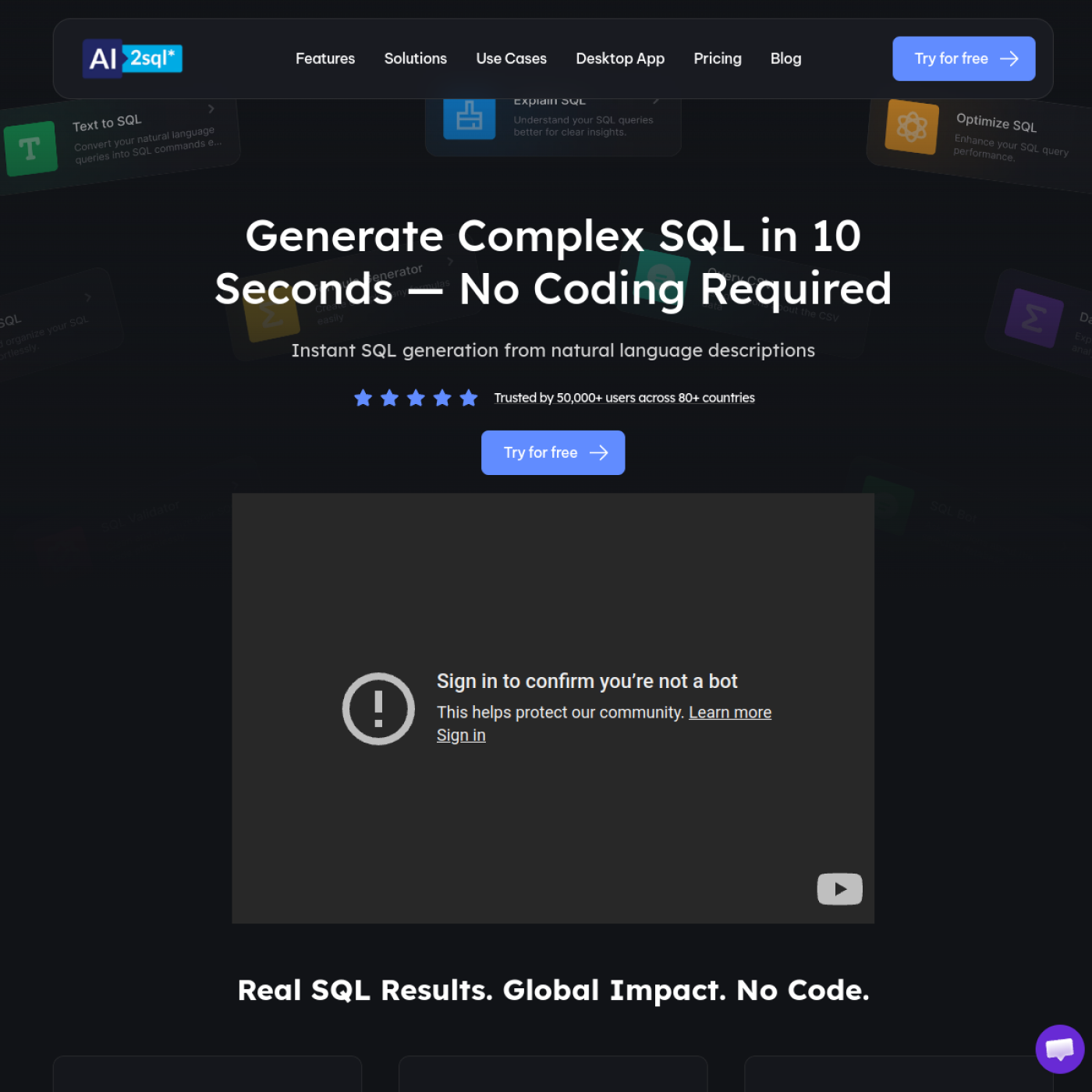
AI2sql — Professional tool for converting natural language to SQL
Core parameters and statistics of AI2sql
AI2sql's product positioning has experienced an upgrade from "online SQL generator" to "AI Agent's data layer". It is not only a natural language to SQL tool for analysts, but also opens structured query capabilities to the AI Agent ecosystem through MCP Server and Gateway, forming a dual-track delivery structure of "Web for humans + MCP for machines".
| Projects | Public Information |
|---|---|
| Official positioning | The data layer for AI agents — schema-aware, governed, metered |
| Delivery form | Web, Desktop App (macOS/Windows), MCP Server, REST API |
| Database support | PostgreSQL, MySQL, SQL Server, Snowflake, BigQuery, MongoDB, Oracle (7 in total) |
| Security mechanism | Read-only default (sqlGuard blocks write operations), connection encryption, each query audit log |
| MCP endpoints | run_query, describe_schema, list_connections |
| Semantic layer | Table/column description + business term mapping, build an independent semantic layer for each database |
| User scale | The official website claims 50,000+ users, covering 80+ countries |
| Customer Cases | Nutanix, Gusto, OCado, Prime Therapeutics, Montefiore, etc. |
| latest version | latest (Query Accuracy Update, ~2026-01) |
| Supported platforms | Web, Desktop (macOS/Windows), API |
The actual meaning of dual-track delivery: Analysts can directly input natural language into the browser to obtain SQL; the AI Agent development team uses the MCP protocol to allow tools such as Cursor, Claude Desktop, ChatGPT, etc. to directly query the database - the two sets of entrances share the same semantic layer and security policy, avoiding the security vulnerability of "manual query goes through the audit agent query and skips the background".
Difference in depth of database coverage: Although the official website lists 7 databases, the depth of functions of each connector is different. PostgreSQL and MySQL have the most complete support (including semantic layer building and dialect optimization), MongoDB is built for NoSQL queries, and Oracle and SQL Server have relatively limited coverage of complex window functions and stored procedures. Actual verification on the target database is required before selection.
Hosting method: AI2sql is in SaaS form. An encrypted connection is established between the user database and AI2sql through read-only credentials, and the data is not persisted through the AI2sql server. Desktop App completes all reasoning and query execution locally, and the credentials do not leave the machine, making it suitable for scenarios with high security and compliance requirements.
Users and market recognition of AI2sql
AI2sql's market recognition is characterized by "word-of-mouth driven, long-tail coverage" rather than large-scale advertising or open source community popularity.
User scale: Official website data shows that there are 50,000+ users covering 80+ countries. This level of magnitude ranks among the leading echelons in the NL2SQL vertical track. Users are mainly distributed in North America and Europe, and the proportion in the Asia-Pacific region has not been disclosed. Considering that NL2SQL itself is a relatively narrow tool category (users need to have basic data analysis awareness), the scale of 50,000 users means that it has established a stable cognitive foundation among the target customer group.
Customer quality: The customer list involves medium and large organizations such as Nutanix (hyperconverged infrastructure), Gusto (payroll and benefits SaaS), OCado (online retail), Prime Therapeutics (health insurance), and Montefiore (health care system). These customers come from four industries: financial technology, medical, retail and SaaS, covering areas with the highest demand for structured queries. It should be noted that these customer names come from the public page of the official website, and the specific depth of use (whether it is a team-level or single-department pilot) has not been disclosed.
User feedback features: The customer reviews displayed on the official website focus on three themes - "Non-SQL experts can get started quickly", "Compressed from hour-level manual writing to minute-level", and "Tutorial value for SQL learners". One of the self-employed analysts clearly mentioned that "a certain basic knowledge of SQL is required to exert value", which implies that the best effect of the tool still relies on the user's basic understanding of the data model, rather than "zero-threshold magic".
Market position with competing products: Compared with Text2SQL.ai (more focused on education scenarios) and Airtable AI (built into its table products), AI2sql's differentiation lies in the complete link of "database connector + semantic layer + MCP gateway", rather than a simple SQL generated text box. This means that it is more suitable for scenarios where there is an existing database and team query needs, rather than one-time use by individuals.
The cost advantage of AI2sql: flexible options from $5/month to pay-as-you-go billing
AI2sql's cost structure is clearly layered between C-side subscriptions and B-side API metering. There is no permanent "free and unlimited" solution, but the entry threshold for each level is low.
C client/individual user
The official website discloses three subscription tiers, all of which are monthly payments and provide a 7-day free trial:
| Gear | Price | Core restrictions | Applicable crowd |
|---|---|---|---|
| Start | $5/month | Basic SQL generation, interpretation and syntax fixing, no database connector | Occasional individual learner |
| Pro | $11/month | Unlimited queries, advanced AI models, all 7 database connectors Desktop App | Analysts who use databases every day |
| Team | $23/month (includes 5 seats) | Shared query library RBAC access control, execution priority, advanced analysis | Small teams that need collaboration |
Key limitations: The Start gear only provides basic SQL generation capabilities and does not support database connectors - this means that users need to manually enter the table structure and cannot directly associate with the real database. The Pro file is the actual "entry-level productivity plan" with a monthly fee of US$11 (approximately 80 yuan), which is at a moderately low level in the same category. The Team profile is priced at US$23 for 5 seats, which is only US$4.6 per person per month, which is a low-price range among collaboration tools.
API/developer call
AI2sql provides a per-query metering solution based on credit packs. API Key supports decentralization by context, application, and agent. The specific price details (unit price per inquiry, credit point package price) are not fully disclosed on the official website pricing page, and need to be viewed after registration or confirmed through the API document. The free tier provides 100 query credits (no credit card required) and is suitable for proof-of-concepts.
Enterprise/Private Deployment
AI2sql Gateway is an enterprise-level product for AI Agent scenarios, providing a unified read-only MCP endpoint combined with rate limiting and full auditing. The public page does not show Gateway's independent pricing, and you need to contact the business for confirmation. For enterprises with data sovereignty requirements, Desktop App provides a compromise solution - queries are executed locally and the credentials do not leave the machine, but inference still relies on the AI2sql cloud model (Desktop is not a complete offline solution).
Hidden Cost Tip: When using the database connector, although AI2sql itself is read-only and encrypted, the database-side load (CPU/IOPS) generated by high-frequency queries may affect production environment performance. It is recommended to evaluate whether the query frequency is within the tolerance range of the database before use, and control it through the Gateway's rate limit if necessary.
Main functions of AI2sql
AI2sql's capabilities cover the entire link from "natural language → executable SQL", but the most differentiated thing is not the text-to-SQL itself, but the semantic layer, security gateway and MCP interface built around query generation.
-
Natural language to SQL generator: core capability layer. Users describe query requirements in business language (such as "Display the top ten customers this year"), and AI generates corresponding SQL within 3-10 seconds. Supports common SQL structures such as SELECT, JOIN, aggregation, subquery, and window functions. Acceptance concerns: The grammatical correctness of the generated results in different database dialects needs to be verified item by item - the correct syntax on PostgreSQL may cause errors due to function differences on SQL Server or Oracle.
-
Semantic Schema Layer: This is the key difference between AI2sql and the pure Prompt solution. After connecting to the database, AI2sql builds a semantic layer containing table/column descriptions, association relationships, and business term mappings. For example,
cst_idis automatically recognized as "customer number" andord_amtis mapped to "order amount". The more complete the semantic layer, the higher the accuracy of the fields that generate SQL, and the lower the misjudgment rate of cross-table associations. Implementation Tips: Time needs to be invested in improving column descriptions and business term mapping during initial deployment. The accuracy of using default information directly may not meet production requirements. -
MCP Server (Agent interface): Through the three tool endpoints of
run_query,describe_schema, andlist_connections, the database query capability is packaged into the standard MCP protocol. Any Agent that supports MCP (Cursor, Claude Desktop, ChatGPT, etc.) can be called directly. Architectural Implications: This means that the AI Agent does not have to go through the roundabout path of "letting the user manually export the data and then upload it", but directly obtains controlled read-only access to the production database. -
sqlGuard read-only security layer: inserts SQL firewall by default, blocking
INSERT,UPDATE,DELETE,DDLand other dangerous statements. Audit logs are recorded for each query, including the initiation key, execution time SQL content and blocking records. Actual experience: The gateway management background will display the "blocked write operation attempts" count, which is a convincing evidence of capability in corporate compliance reviews. -
Query explanation and optimization suggestions: Not only generates SQL, but also explains the business meaning of existing SQL, and gives suggestions for index optimization, query rewriting, etc. For team members who are new to a database schema, the explain function can speed up understanding of the data model.
-
Desktop App (local execution): desktop application for macOS and Windows, supporting MySQL, PostgreSQL, and SQL Server databases. The query is executed locally and the credentials do not leave the machine. Suitable for teams that have requirements for data sovereignty but are not prepared to completely build their own NL2SQL solution. Limitations: The Desktop version does not support remote data sources such as Oracle, BigQuery, Snowflake, etc., and does not provide MCP interfaces.
-
Cross-database converter: Provides MySQL ↔ PostgreSQL, MySQL ↔ SQL Server, Oracle ↔ PostgreSQL and other dialect conversion tools, as well as generators for common functions (DATEADD, CASE WHEN). These converters can be used as auxiliary tools in database migration or multi-dialect contexts.
Model and version evolution of AI2sql
Continuous iterative updates, the latest version introduces performance optimization and new features. Historical version information can be viewed through the official release page. There is currently no complete public version evolution timeline.
Technical advantages of AI2sql
The technical value of AI2sql is not in the model parameters or inference speed, but in the engineering design of "how to push NL2SQL from a toy-level demo to a production-level tool."
Semantic layer takes precedence over generic prompts: Most NL2SQL solutions rely on stuffing table structures directly into prompts, letting the large model infer field meanings on its own. AI2sql's approach is to first establish a semantic layer - mapping the physical table/column names of the database to business terms, and injecting relationships and column descriptions between tables. The advantage of this mapping layer is that field ambiguities (such as cst_id vs customer_number) are resolved at the semantic layer instead of letting the model re-guess each time; when the database structure changes, only the semantic layer needs to be updated instead of adjusting the Prompt. Cost: The initial establishment of the semantic layer requires human investment, and the accuracy of automatic inference is not enough to cover all scenarios.
Native adaptation of MCP protocol: AI2sql is one of the earlier products to encapsulate database queries into standard MCP tools. Let the Agent discover available data sources through list_connections, describe_schema to obtain the table structure, and run_query to perform read-only queries - the three endpoints cover the complete life cycle of the Agent operating database. The benefit of MCP compared to directly exposing REST APIs is that Agents can dynamically discover and invoke tools without the need for hard-coded API endpoints.
sqlGuard's two-layer protection: The first layer intercepts non-SELECT statements on the AI2sql gateway side, and the second layer uses read-only credentials on the database connection side. Even if the first layer is bypassed, the second layer can still protect you. The audit log records the complete context of each query (Key identity, timestamp SQL content, execution results), meeting the traceability requirements of SOC2 compliance scenarios.
Reuse logic of connector architecture: 7 types of database connectors share the same set of semantic layer construction and query generation pipelines, but the dialect adaptation layer maintains function mapping and syntax templates separately for each database. This means that the marginal cost of adding a new database connector is contained in the dialect adaptation layer, without the need to reimplement the entire pipeline. The official website does not disclose the connector development roadmap, but in theory communities or enterprises can request new data sources.
How to use AI2sql
AI2sql provides four usage paths to adapt to different roles and usage scenarios:
| How to use | Suitable for the crowd | Core competencies | Cost |
|---|---|---|---|
| Web console (builder.ai2sql.io) | Data analysts, operations personnel | Natural language input → SQL output, trial without registration | 100 free queries after registration |
| Desktop App (macOS/Windows) | Data security-sensitive teams | Local execution, credentials do not leave the machine, supports MySQL/PostgreSQL/SQL Server | Pro and above subscriptions (starting at $11/month) |
| MCP Server | AI Agent Developer | Let Cursor/Claude/ChatGPT directly query the database through MCP protocol | Pay-as-you-go billing (credit package) |
| REST API | Custom integration developer | Programmatically invoke SQL generation and query execution | Pay-as-you-go billing (credit package) |
Typical steps for using the Web console:
- Visit builder.ai2sql.io to register an account (free 100 query quota, no credit card required).
- Select "Connect to database" or manually enter the table structure (only basic SQL generation is supported when the database is not connected).
- Use natural language to describe the query requirement in the input box (such as "Sales statistics of each product category by month, including comparison with the same period last year").
- AI2sql generates SQL and displays a preview of the results (if the database is connected, execute it directly and return data).
- Fine-tune, save or export the generated SQL. Supports one-click copying to the clipboard or sharing to team members.
MCP Server Quick Enablement: AI2sql's MCP endpoint can be called by any Agent client that supports the MCP protocol. Taking Cursor as an example, add the MCP Server address and API Key of AI2sql in the MCP configuration of Cursor, and you can directly execute database queries in the conversation. The specific configuration method is subject to the AI2sql official MCP document (ai2sql.io/mcp).
Gateway management background: A web console for administrators that can view activity records of all API Keys - executed queries, blocked write operation attempts, and query volume statistics for each Key. Supports single-Key one-click revocation.
Product pricing for AI2sql
AI2sql's pricing strategy is a three-tier structure of "low-price subscription + pay-as-you-go billing + enterprise commerce":
- C client/individual: The Start plan is $5/month suitable for occasional use, and the Pro plan $11/month is the main plan for data analysts. All plans come with a 7-day free trial and no upfront payment. Note that the Start plan does not include a database connector, and accessing a real database requires at least the Pro plan.
- API/Pay-as-you-go: Provides a free trial quota of 100 queries, and will be billed as a credit package after exceeding the limit. The specific unit price (cost per inquiry) and credit package specifications are not fully displayed on the official website pricing page. It is recommended to check the dashboard after registration or contact sales to obtain a quote.
- Enterprise/Gateway: For AI Agent large-scale access scenarios, including enterprise-level functions such as rate limiting, full auditing, and custom semantic layers. Pricing needs to be confirmed by contacting the business. The starting price is not displayed on the public page.
Comparison with other NL2SQL tools:
| Compare Dimensions | AI2sql | Text2SQL.ai | Airtable AI |
|---|---|---|---|
| Starting price (individual) | $5/month (Start) | Free credit + subscription (undisclosed) | Airtable subscription included ($20+/month) |
| Database direct connection | 7 databases, read-only connection | Limited support | Only Airtable's own data |
| MCP/Agent interface | Native support | Not supported | Not supported |
| Semantic layer configuration | Support custom column descriptions and term mapping | None | None |
| Desktop App | macOS/Windows | None | None |
Application scenarios of AI2sql
The applicable scenarios of AI2sql are concentrated in teams that have existing databases and need to query frequently, but not all queryers are SQL experts:
- Daily data query for business operations: Operations personnel need to extract daily/weekly/monthly report data from the database, but SQL capabilities are limited. Through AI2sql, operations can directly obtain results in natural language such as "the registration conversion rate of each channel last week, displayed by day". Efficiency Improvement Deduction: An intermediate operator spends about 2-4 hours per week asking analysts to write queries or learn the grammar themselves. AI2sql can shorten this to 15-30 minutes, saving about 2 hours per week on average for a single person. On an annual basis, a single person can improve efficiency by about 100 hours.
- Ad hoc query acceleration for data analysts: Analysts write an average of 5-15 SQL queries every day, about 60% of which are "similar queries that have been executed" (different time windows, different dimension combinations). AI2sql's semantic layer and query history can help reuse existing query templates instead of writing them from scratch each time. Efficiency Improvement Deduction: A medium-complexity multi-table related query takes about 8-15 minutes to manually write and about 3-10 seconds to generate with AI2sql. Including manual verification time, a single query can still save 5-10 minutes. With an average of 10 queries per day, you can save about 1-1.5 hours per day.
- AI Agent data query integration: Through MCP Server, LLM-based Agents can directly operate the production database. For example, when writing code in Cursor, let AI directly query the database table structure and generate the corresponding data operation code; or in a customer service scenario, let the customer service agent query the order status and directly answer the user. Human-computer collaboration boundary: All queries initiated by the Agent are subject to sqlGuard constraints (read-only), and each query has an audit log. However, before executing the SQL automatically generated by the Agent, it is recommended to set up manual verification points in key business scenarios (such as involving amount calculation and customer grouping) to avoid erroneous data extraction due to semantic understanding deviations.
- SQL Learning and Tutoring: AI2sql's "Explain SQL" function can translate a complex SQL into business language to help beginners understand
Existing query logic. At the same time, the "Optimization Suggestions" function can prompt missing indexes and query rewrite directions. Not suitable for boundaries: Not suitable for SQL teaching at the computer science level - it does not involve underlying knowledge such as query optimizer principles and B-tree index structures.
Applicable groups of AI2sql
AI2sql's target group is centered on teams that "need to deal with data on a daily basis but have varying SQL skills" and extends to AI Agent developers:
- Data Analyst: Main user group. For daily writing a large amount of SQL, AI2sql can speed up the writing of repetitive queries and release energy on data interpretation and business suggestions. Prerequisites: Basic SQL reading and understanding skills are required - the SQL generated by AI2sql may still require manual adjustment in complex scenarios, and users who rely entirely on the generation are likely to get stuck when encountering edge cases.
- Business Operations and Product Managers: Groups who have certain data analysis needs but SQL is not a core skill. AI2sql's semantic layer and natural language interface lower the query threshold, but the effect is highly dependent on the completeness of the semantic layer configuration. If table/column descriptions and business term mapping are imperfect, the accuracy of generated results will significantly decrease. Not suitable for boundaries: Not suitable for users with absolutely zero SQL foundation. AI2sql downgrades "cannot write SQL" to "can read and judge whether SQL is correct", rather than completely eliminating the need for SQL understanding.
- AI Agent Developers and AI Application Teams: Development teams that need to integrate database query capabilities into AI workflows. Through MCP Server, developers do not have to implement the NL2SQL pipeline and security audit by themselves, and can directly reuse the semantic layer and sqlGuard of AI2sql. Implementation Tips: When used in Agent scenarios, it is recommended to assign an independent API Key to each Agent/application, and configure the rate limit and query range separately in the Gateway background. In this way, even if a key is leaked or abused, the scope of the impact is controllable.
- Small Teams & Startups: Don’t have a dedicated DBA or data analyst, but need to gain business insights from the database. The price-performance ratio of the Team plan ($23/month, 5 seats) is more friendly to teams with data needs of 3-5 people. Not suitable for boundaries: Not suitable for ultra-large-scale data (above terabytes) or OLTP scenarios that are extremely sensitive to query delays - AI2sql's query generation and semantic layer construction will introduce additional delays, and it is positioned as
Analytical query (OLAP) scenarios, not online transaction processing.
Summary and Outlook
The core capability of AI2sql is to upgrade NL2SQL from "single text conversion" to "governable database query infrastructure" - improving accuracy through the semantic layer, ensuring security through sqlGuard, and opening capabilities to the Agent ecosystem through the MCP interface. It is not the only product that can convert natural language to SQL, but it may be the most complete commercial solution that currently combines "accuracy + security + integrability".
Current core advantages: The database connector covers 7 mainstream engines, and the semantic layer mechanism is a differentiated design in the NL2SQL category; MCP native support gives it a first-mover advantage during the window period when AI Agents are rapidly popularizing; the pricing threshold is low (starting at $5/month), and both individuals and teams can try it out at a low cost.
Main current limitations: Version information and update logs are opaque, and the technology stack and underlying model information are not disclosed; the initial configuration of the semantic layer requires manual investment, and the automatic construction capability is limited; the Desktop version does not support remote data sources such as Oracle/BigQuery; MCP and Gateway, as newer features, have not yet been verified on a large scale for enterprise-level stability; the free tier only has 100 queries, which is a bit tight for in-depth trials.
Follow-up observation points: Whether AI2sql will open the automatic construction of the semantic layer (automatically infer column descriptions and association relationships through AI) to reduce initial configuration costs; whether Gateway will launch independent pricing and SLA guarantee; whether the connector will cover more domestic databases (such as TiDB, GaussDB) to adapt to the needs of the Chinese market.
Purchase and Adoption Risk Assessment: The trial risk for individual users starting from the Pro plan ($11/month) is extremely low, and the verification of the main scenarios can be completed within the 7-day free trial period. The team recommends that an analyst pilot the Pro plan for 2-4 weeks to verify the generation accuracy and semantic layer configuration efficiency on actual business queries, and then decide whether to upgrade to the Team plan or introduce the Gateway. Before purchasing at the enterprise level, it is important to confirm: whether the rate limit of the Gateway meets the peak concurrency demand; whether the retention period and export format of the audit log meet the compliance requirements; the availability of the Desktop App in offline or weak network environments; and the data processing compliance certification (such as SOC2, GDPR) of AI2sql (the official website does not clearly show this, and needs to be confirmed with sales). In financial and medical scenarios that require extremely high query accuracy, it is recommended to set up a manual verification process before executing all AI-generated SQL as the last line of security.
How to use AI2sql
- Web client: You can use it by visiting the official website and registering an account. Most functions do not require installation.
- API access: Provides RESTful API, developers can obtain the API Key and integrate it into their own applications.
Version Info
- Query Accuracy Update :Improve the accuracy of complex query generation and optimize support for multi-table associations and aggregation statements.
- Public Launch :Released the first version of NL2SQL generator, supporting mainstream SQL dialects.
User Reviews