 Aidbase
Aidbase is a AI Office and Efficiency tool that focuses on the customer support process. It integrates AI Chatbot, Ticket Form, Email Inbox and FAQ/Knowledge Base to help teams build automated customer service and support operations at a lower cost.
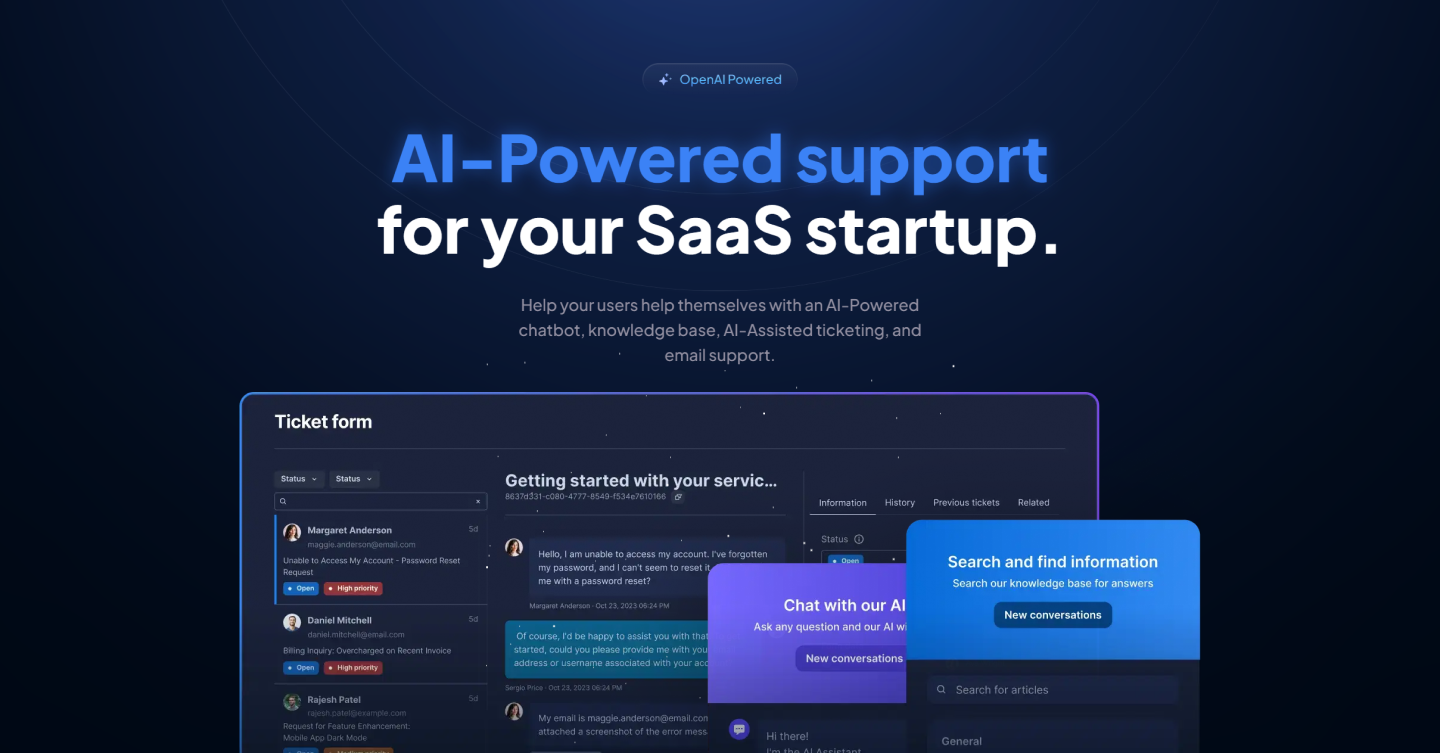
Aidbase - AI customer service automation and ticket related platform
Core parameters and statistics
| Parameters | Details |
|---|---|
| Product positioning | AI-powered support ecosystem |
| Core module | AI Chatbot, Ticket Form, Email Inbox, FAQ/Knowledge Base |
| docking capabilities | Webhooks, API, React/Next.js, JavaScript embedding |
| Package structure | Standard €29, Pro €39, Expert €199 (monthly) |
| Monthly message quota | 2,500 / 10,000 / 100,000 |
| Team size | 5 / 25 / 100 people |
Brief comment in one sentence: Aidbase is not "adding a customer service robot", but pulling the consultation entrance, knowledge accumulation, work order collaboration and email processing into the same support workbench.
User and market recognition
Gradually build user awareness in the field, and product capabilities are used by content creators and teams to improve work efficiency. Some industry users have incorporated it into their daily workflow. It is recommended to refer to the latest official disclosures for specific user scale and industry adoption rate data.
Cost advantage
| Package | Price | Core Quota |
|---|---|---|
| Standard | €29/month | 2,500 Messages 2 Chatbot 2 Ticket Forms 5 Members |
| Pro | €39/month | 10,000 Messages5 Chatbot5 Ticket Form25 Members |
| Expert | €199/month | 100,000 Messages50 Chatbot50 Ticket Form100 Members |
Cost reduction and efficiency increase deduction (unofficial commitment):
- E-commerce customer service: For teams with a high proportion of FAQs, the first round of manual processing can be reduced from about 70 orders per 100 orders to about 30-40 orders.
- SaaS support: After the FAQ coverage is complete, the first response time can be compressed from 10-30 minutes to second-level automatic response + manual supplement.
- Small team night support: Through AI + work order queue, the risk of missing orders at night can be significantly reduced.
Main functions
- AI Chatbot: Automatically answer questions based on knowledge sources, responsible for high-frequency repetitive questions.
- Ticket Form: Structured entry of uncertain questions for easy allocation and tracking.
- Email Inbox: Integrate email support into a unified queue to reduce channel fragmentation.
- FAQ/Knowledge Base: Precipitate retrievable knowledge and reversely optimize robot answers.
- Webhooks/API: Write support events back to CRM, ticket system or alert system.
- Team Collaboration and Permissions: Let support, operations, and product teams collaborate around the same problem context.
Hidden linkage: When the AI Chatbot cannot answer with high confidence, the question will naturally be transferred to the Ticket Form and manual queue, and then the processing results will be deposited into the knowledge base, forming a system of "automatic question answering -> manual filling -> knowledge retraining".
Model and version evolution
| Stage | Time | Change |
|---|---|---|
| FAQ automatic Q&A stage | ~2024-01 | Mainly site knowledge Q&A |
| Multi-module integration stage | ~2025-06 | Integrate work orders, emails, and knowledge bases into a unified backend |
| Hierarchical commercialization stage | ~2026-01 | Formation of Standard/Pro/Expert quota system |
Technical advantages
- Unified data plane: Chat, email, and work orders share the same context, reducing "information loss caused by channel switching".
- Iterable Knowledge System: Continuously correct wrong reply sources through "Knowledge Gap Identification".
- Low embedding and docking costs: Front-end integration and webhook mechanism lower the entry threshold.
Human-machine collaboration boundary (mandatory):
- Can be 100% automated: Logistics inquiries, return and exchange rules, basic account questions, document-based Q&A.
- Manual confirmation required: refund approval, order exception compensation, compliance-sensitive complaints, VIP customer complaint handling.
- It is recommended to set confirmation points: high-value customer changes, amount-related operations, work orders that require cross-department decision-making.
How to use
| Entrance | Description |
|---|---|
| Official website | https://www.aidbase.ai/ |
| Sign up | https://app.aidbase.ai/signup |
| Pricing | https://www.aidbase.ai/pricing |
| Product Module | AI Chatbot, Tickets, Email Support |
Implementation suggestion process:
- First access the FAQ and historical common work orders to complete the first version of the knowledge area.
- Configure the robot's answer boundaries and define "automatic reply" and "must transfer to manual" rules.
- Connect to Ticket Form and Email Inbox to support unified entrance.
- Use webhook to synchronize high-priority events to the team’s internal system.
- Review high-failure questions and answers every week, revise knowledge and iterate strategies.
Product Pricing
The pricing model is subject to the official real-time page. Usually a freemium or subscription system is used, and basic functions can be used for free. Advanced functions or high-frequency use require paid subscriptions, and users are advised to evaluate the optimal solution based on actual usage.
Application scenarios
- E-commerce pre-sales and after-sales support: Automate product Q&A, return policy, and logistics inquiries.
- SaaS customer success: Unify the help center, work orders and email support to collaborate.
- Small team 24/7 support: maintain response continuity when manpower is limited.
- Cooperation between operations and products: Precipitate high-frequency issues into product optimization inputs.
Applicable people
- Small and medium-sized customer service teams: Want to go online quickly and reduce repetitive support costs.
- E-commerce and Subscription Business Team: Customer service issues are highly structured and suitable for automation.
- Product/Operations Team: User problems need to be turned into knowledge assets and improvement clues.
- Not suitable for boundaries: Organizations that strongly regulate industries and require highly localized deployment and deeply customized approval links.
Summary and Outlook
It provides competitive solutions in its field, and its core value lies in lowering the threshold for AI use in this field.
Current limitations: Some advanced features require paid subscription, and the free version has function or usage restrictions; specific technical details and performance benchmarks have not yet been fully disclosed.
Related tools:  Notion AI, google-workspace
Business process integration and ROI analysis
As a productivity tool for enterprises or professional positions, the true value of Aidbase depends on the depth of integration with existing workflows and the quantifiable efficiency improvement effect. The following is a systematic analysis from three core dimensions.
System integration and data interoperability The ability to interoperate with existing business systems is a key prerequisite for productivity tools to be integrated into workflows. It is recommended to focus on evaluating the following integration dimensions: the openness and documentation quality of the RESTful/GraphQL API (whether a complete API reference and SDK examples are provided), the support scope of Webhook event notifications (which business event types are supported for automatic push), the number and depth of pre-built integrations with common collaboration SaaS tools (WeChat Enterprise, DingTalk, Feishu, Slack, Notion, Jira, etc.), and enterprise-level identity authentication support (SSO/SAML/OAuth and LDAP/AD directory integration). Products that lack integration capabilities are easily isolated into information islands, which in turn increases the cognitive cost and operational friction for teams to switch between different tools.
Efficiency Quantification and ROI Estimation Methodology Before purchasing decisions, it is recommended to quantify the input-output ratio through a structured method: Step 1, choose 3-5 Standardized tasks that are frequently repeated and time-consuming in each team are used as test samples; in the second step, the average time consumption of a single task before and after tool intervention, first-time pass rate or error rate, and the number of links requiring manual intervention are recorded under controlled conditions; in the third step, the saved manpower time is converted according to the comprehensive cost of the position (salary, benefits, management sharing), and soft benefits (increased employee satisfaction, standardization of work quality, and improvement in response speed to core business) are superimposed to obtain a comprehensive ROI estimate. It is recommended to continue tracking ROI trends on a monthly basis, as the value of a tool usually increases over time as team proficiency increases and workflows are optimized.
Phase-based implementation strategy and risk control It is recommended to adopt a three-stage implementation path of "pilot verification-gradual promotion-continuous optimization". In the pilot stage (1-2 weeks), a single team or a single business scenario is selected for small-scale verification. The core goal is to verify technical feasibility and user acceptance, and establish preliminary usage specifications and success standards; in the promotion stage (2-4 weeks), after the pilot verification is passed, the coverage is gradually expanded, and standardized activation processes and training materials are developed; in the optimization stage (continuous), the workflow configuration is continuously adjusted based on actual usage data and user feedback, and more high-value application scenarios are explored. Clear quantitative key result indicators should be set at each stage to avoid blindly expanding the scope of use without data support.
Version Info
- Standard/Pro/Expert packages and AI support capability upgrades :The official pricing page shows three packages (Standard, Pro, Expert), and provides stratification according to message quota, team members, number of robots, work orders and email capabilities, and continues to strengthen AI customer service automation and team collaboration.
- AI Chatbot + Ticketing integration stage :The product has gradually expanded from a single chat robot to knowledge base, work orders and email support, forming a complete support workflow, and continues to make improvements in the integration and automation dimensions.
User Reviews