 Frame Like
Framezan is the world's first professional-level AI film and television creation and collaboration agent launched by HiDream.ai. It integrates the entire process of script analysis - storyboard design - screen generation - video production - AI rough cutting - dubbing and soundtrack, supports multi-character online collaboration, and has mass-produced over 5,000 minutes of commercial-grade AI short dramas.
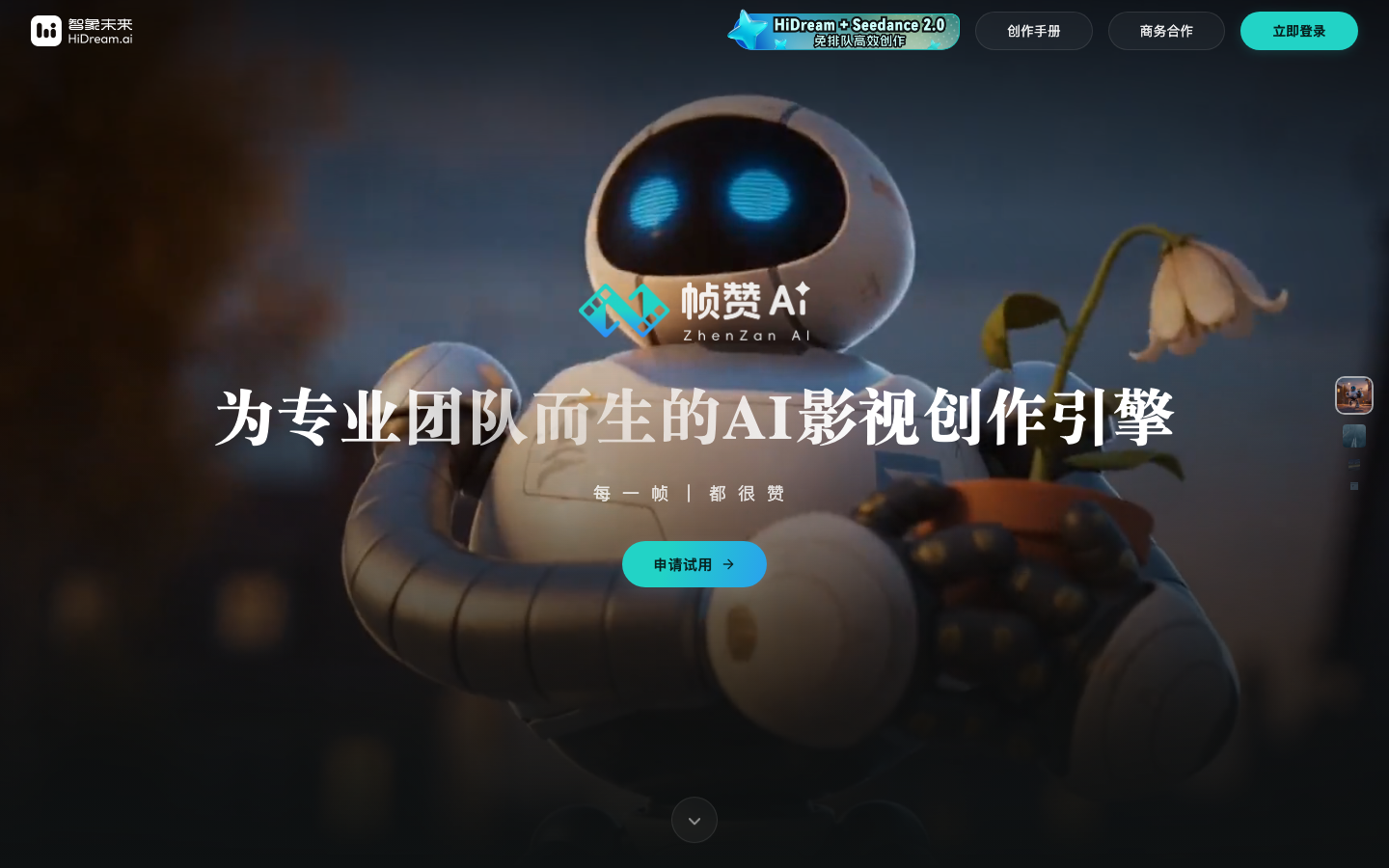
framelike
Core parameters and statistics of frame likes
Framezan is the world's first professional-level AI film and television creation and collaboration agent launched by HiDream.ai, and is positioned as an "AI film and television creation engine for professional teams." It is not an AI video toy for individual creators, but an industrialized production platform that covers the entire process of script analysis, storyboard design, screen generation, intelligent rough editing, and dubbing and soundtracking. It also natively supports online collaboration among directors, storyboard artists, artists, editors, and other roles.
| Projects | Public Information |
|---|---|
| Official positioning | Professional AI film & TV creation agent (Professional AI film & TV creation agent) |
| Workflow coverage | Script analysis → Storyboard design → Screen generation → Video production → AI rough cutting → Dubbing and soundtrack → Finished film delivery |
| Team collaboration | Multi-role online collaboration (director, producer, storyboard artist, artist, editor, etc.) |
| Commercial mass production results | 5000+ minutes of commercial-grade AI short dramas (as of 2026-07) |
| Scale of settled teams | Nearly a thousand professional film and television teams (as of 2026-07) |
| Representative case | "Qinling Bronze Strange Stories" ranked first in Tencent Video's vertical screen popular list, with over 10 million views |
| Entry mode | Professional team application review |
| Developer | HiDream.ai - Beijing HiDream Technology Co., Ltd. |
| Parent company ecology | HiHarness (enterprise-level multi-modal AI platform), HiBurst (AIGC marketing), vivago (AI video generation), HiDreamFans (3D holographic marketing) |
| Technical support platform | Web access, individual independent registration is not supported |
Brief review in one sentence: Frame Like is not an AI video toy, but an industrialized AI production platform for professional film and television teams - its core difference lies in "full process closure + multi-role collaboration" rather than single-point picture generation capabilities.
Core Competency Panorama: Framezan disassembles the entire film and television creation link into six major modules - multi-modal canvas (free divergence and structured regularity), intelligent generation engine (long drama dismantling, setting generation, creative generation, intelligent quick cutting), director-level camera control (Precise control of camera movement, light and shadow, composition), film and television asset management (full-process asset archiving and version tracing), global collaborative creation (real-time collaboration, precise annotation, authority control) and project management (multi-project parallelism, cost accounting, human efficiency analysis). These six modules constitute the industrialization process from idea to finished film.
Differences from ordinary AI video tools: Mainstream AI video tools such as Runway, Pika, and Kling focus on "screen generation of a single video". Users need to complete scripts, storyboards, editing, dubbing, etc. on their own, and lack a team collaboration mechanism. Framezan attempts to solve all problems from creativity to delivery within the same platform, and has built-in storyboards, project management tools and digital asset libraries that comply with film and television industry standards. This is not a competition of "who can generate more beautiful pictures", but a choice of "whether industrialized processes are needed".
Frame Like users and market recognition
Although the market verification time of FrameZan is short (it will be launched in April 2026), its mass production results and industry cooperation have already formed an initial reputation in the professional film and television circle. Its market recognition presents a dual-line pattern of "work-driven + industry endorsement".
Mass production results: In less than three months after being launched (as of 2026-07), a total of more than 5,000 minutes of commercial-grade AI short dramas have been mass-produced, and nearly a thousand professional teams have been stationed. This number is at the top level in the field of AI film and television - most AI video platforms are still dominated by single experimental short films by individual creators. The scale of 5,000 minutes of commercial mass production means that frame likes have achieved a leap from "demo level" to "production level".
Benchmark Case: "Qinling Bronze Strange Stories" topped Tencent Video's vertical screen popular list within 12 hours of its launch, with over 10 million views. This film is the first time that an AI short drama has topped the list on a mainstream long-form video platform, which is of symbolic significance for the commercialization verification of AI film and television. In addition, the official website of Framezan displays three demonstration short films - the steampunk theme "Rainy Night Raid" (3A industrial level with zero crashes throughout), the giant monster theme "Behemoth" (industrial-level rendering capabilities), and the urban speed car theme "Hot Pursuit" (theatrical-level visual effects and complete narrative), which demonstrate the boundaries of its capabilities in action, visual effects and narrative from different dimensions.
Industry Cooperation: The parent company HiDream.ai has received strategic investment from Shanghai Film Group and Huace Film and Television. The entry of these two film and television giants has provided industry resource endorsement and content distribution channels for Framezan. Shanghai Film Group's accumulation in theater distribution and IP operations, and Huace Film and Television's production capacity in TV series and online series production can provide real demand input for the implementation of Framezan.
API ecological foundation: HiDream.ai’s HiHarness enterprise-level multi-modal AI platform has accumulated 200+ APIs, 100+ major customers and 5000+ billion API calls, which provides a large-scale industrial verification basis for the underlying model capabilities of Framezan. The self-developed HiDream-O1-Image-1.5 large model ranks first in China and second in the world, further strengthening the technical credibility of Frame Like in the accuracy of picture generation.
Market Acceptance Assessment: Framezan is still in the early professional team testing stage, and the non-public registration system shows that it prioritizes the pursuit of "finished product quality" rather than "user scale". This positioning is conducive to polishing industrial-level processes in the short term, but whether it can expand from nearly a thousand teams to a large-scale market in the medium and long term depends on whether the overall process efficiency can continue to be better than the combination of "traditional tool chain + AI single point tool".
The cost advantage of frame likes
The cost advantage of Frame Like is not suitable to be measured by the traditional model of "free on the C side / pay-as-you-go on the B side" because its target customer group is professional film and television teams rather than individual consumers, and its cost structure consists of three parts: "entry threshold + point consumption + implicit efficiency gains".
C client/individual users: Frame Like is not open to registration for individual users. Individual creators or independent video producers cannot use it directly and must apply through a team. This means that there is no cost competition for frame likes in the personal market - it is not the "free scale" logic of DeepSeek or ChatGPT, but to filter non-target users through professional thresholds.
Corporate/Film and Television Teams: The first 1,000 teams to join will receive 10,000 points for free, and thereafter the fee will be calculated based on the consumption of points. Point consumption covers the entire process of script analysis, screen generation, AI rough cutting, dubbing and dubbing. Specific pricing is not fully displayed on the public page. Three key variables in cost assessment:
- Single project point consumption: depends on the project duration, number of storyboards, and number of generation iterations. The point cost of a 10-minute skit is typically higher than a single 30-second spot, but the cost per minute decreases as the project scales.
- Points to Cash Exchange Ratio: Undisclosed, the team needs to calculate the ROI through actual use after settling in.
- Hidden efficiency gains: Compared with the multi-player collaboration model of "traditional screenwriter + storyboard artist + art + editing + dubbing", Frame Like merges multiple sections into the same platform, reducing cross-tool switching and communication costs. Efficiency deduction: A typical 10-minute vertical screen short drama requires a team of 5-8 people and about 7-14 working days to complete in the traditional production process (covering script creation, storyboard drawing, material shooting/collection, editing, dubbing, and post-production). On the FrameZan platform, the same work is expected to be completed by a core team of 2-3 people in 3-5 working days, reducing overall manpower investment by approximately 50%-60%. This deduction is based on 5,000 minutes of mass production results and feedback from nearly a thousand teams, and is an unofficial commitment.
API/Developer: Frame Like itself does not provide a public API. However, the parent company HiDream.ai provides 200+ API interfaces through the HiHarness platform, covering image generation, video generation, 3D model generation and other capabilities, and is oriented to enterprise-level AI integration scenarios. This means that if the team has customized development needs, it can obtain the underlying capabilities through HiHarness, but does not directly follow the film and television creation workflow of FPS.
Three-tier cost structure comparison
| Cost level | Service model | Charging method | Suitable scenarios |
|---|---|---|---|
| C-side/Personal | Not open | Not applicable | Not applicable |
| Film and television team | Frame Like Platform | Application-based registration, points consumption and billing (the first 1,000 people will receive 10,000 points) | Mass production of short plays, advertising production, comic picture books |
| Enterprise API integration | HiHarness platform | Subscription/pay-as-you-go billing (specific rates not disclosed) | Customized AI capability integration, privatized deployment |
Cost Comparison: Frame Like vs Traditional Production vs AI Point Tools
| Cost Dimension | Traditional Production | AI Single Point Tool Combination (Runway + Others) | Frame Like |
|---|---|---|---|
| Team size | 5-8 people | 3-5 people | 2-3 people |
| Production cycle (10-minute short play) | 7-14 working days | 5-10 working days | 3-5 working days (deduction) |
| Tool fees | Software licensing + outsourcing fees | Multiple AI tool subscription fees ($50-200/month/unit) | Points consumption system (undisclosed specific rate) |
| Communication costs | Cross-role and cross-tool collaboration | Still need to transfer across tools | No internal platform, communication costs are significantly reduced |
| Asset reuse | Difficult to reuse assets between projects | No unified asset library | Automatic archiving, tag retrieval, one-click reuse |
Main functions of frame like
The functional design of Frame Like revolves around "moving the industrialized process of film and television production onto the AI platform". It does not make a certain AI capability stronger, but rewrites every section of the entire creative chain with AI and connects them on a unified canvas. The following six functional modules constitute its core capability matrix:
-
Full-process creative process: Starting from script uploading or online writing, AI automatically analyzes the script structure (scenes, characters, dialogue, emotional curves) and generates a structured storyboard; after the storyboards are confirmed, screen materials are generated in batches; the materials enter the intelligent rough cutting engine to automatically match rhythm and transitions; finally, the post-production is completed through AI dubbing and soundtrack. The entire process is completed within a single platform, and there is no need to switch back and forth between ChatGPT, Midjourney, Runway, and clipping. For short drama and commercial production teams that pursue delivery speed, this means "one person can complete the work of a team in the past."
-
Director-level storyboarding and lens control system: This is the most significant difference between FrameZan and ordinary AI video tools. The built-in industry standard storyboard supports full-dimensional filling of shot serial number, scene type (long shot/medium shot/close-up/extreme close-up), camera movement method (push/pull/shake/shift/follow/raise/lower), picture content description, dialogue, duration, etc. The screen generation of each shot is not a "random drawing", but strictly follows the storyboard instructions. In actual use, the more detailed the storyboard, the higher the consistency of the picture - this is a positive feedback loop of "the more investment, the higher the return", but it also means that the team's creative habits need to change from "improvisation" to "structured planning".
-
Multi-modal canvas: Framezan’s original free canvas + structured module hybrid design. Multi-modal elements such as text scripts, storyboards, reference images, generated results, and annotation stickers can coexist on the canvas. Creators can freely drag and drop to arrange, or they can switch to structured mode with one click and let AI organize the content according to standard storyboards. This "divergence->convergence" switching ability is a natural need for film and television creation - the flexibility of brainstorming is needed in the early stage, and the industrial structure is needed in the later stage.
-
Intelligent Generation Engine: Integrate self-research and Intelligent Future flagship models, support multi-style output - Pixar 3D animation style, realistic human simulation video, ink style, cyberpunk, etc. The core capabilities include: long-form drama dismantling (automatically splitting long scripts into manageable storyboard paragraphs), setting generation (generating visual settings of characters, scenes, and props based on text descriptions), creative generation (automatically recommending visual styles and color schemes based on the emotional curve of the script), and intelligent quick editing (automatically editing the generated scenes into the first version of the film according to the narrative rhythm). However, it is important to note: AI-generated images may still drift in the consistency of characters’ faces, and the details of characters and scenes in long shots may be deformed in emotionally intense clips. This is a common bottleneck of current AI film and television technology.
-
Global collaborative creation and project management: supports simultaneous online collaboration among directors, producers, storyboard artists, artists, editors and other roles. Each member has role-based permission control - the storyboard artist can only edit the storyboard, the artist can only modify the screen generation parameters, and the director has full process approval rights. The project level supports multi-project parallelism, progress Gantt chart visualization, cost accounting, computing power consumption statistics, and version backtracking. For a production company managing 3-5 short-form projects simultaneously, this suite of management tools may be worth more than the AI generation capabilities themselves—project management confusion is often the number one cause of production delays.
-
Film and television asset management (digital asset library): All scripts, storyboards, generated screens, dubbing files, and finished films are automatically archived, supporting tag classification, intelligent retrieval (searching through screen content similarity), and outbound collaboration (sharing asset links with external customers or partners). Characters, scenes, props and other elements can be reused in new projects with one click, continuously reducing production costs. The depth of utilization of the asset library depends on whether the team has established a standardized labeling system - the initial stage requires some investment to establish asset classification standards.
Model and version evolution of frame like
As a new product launched in April 2026, Frame Like has a short version history, but the technology accumulation behind it by Wisdom Future can be traced back even earlier. Here we sort out its version context from the two dimensions of "company technical route" and "product release node".
The company’s technology foundation period (2023-2025)
- 2023-07: Beijing Zhixiang Future Technology Co., Ltd. was established to position the research and development of multi-modal AI basic models.
- 2023-12: HiDream.ai’s self-developed multi-modal basic model has been registered (model registration number: Shanghai-ZhiXiang-20231207). It is one of the few domestic basic models that supports the four modalities of text, image, and video 3D at the same time.
- 2024: HiHarness enterprise-level multi-modal AI platform is launched, accumulating 200+ API interfaces and 5000+ billion API calls. HiDream-O1-Image-1.5 large model ranks first in China and second in the world.
- 2025-01: Reached strategic investment cooperation with Shanghai Film Group and Huace Film and Television, and officially entered the film and television industry.
Frame Like Product Line (2026)
- 2026-04 (~2026-04): Frame Like is online, positioning itself as a professional-level AI film and television creation and collaboration agent. The initial version supports the entire process of script analysis → storyboard design → screen generation → AI rough cutting → dubbing and soundtrack. Launched the "10,000 bonus points for the first 1,000 settled teams" recruitment plan.
- 2026-04 to 2026-07 (continuous iteration): Cumulative mass production of more than 5,000 minutes of commercial-grade AI short dramas, with nearly a thousand teams involved. The representative work "Qinling Bronze Strange Stories" topped Tencent Video's vertical screen popular list. The product continues to iterate with new style models, project management functions and asset library capabilities. There is currently no public semantic version number (such as v1.0, v2.0), which is oriented towards feature updates.
Version Note: Frame Like is a continuously iterative cloud service and has no semantic version number. The above milestones are based on public page information and industry reports. The specific release date is subject to the official announcement. Since the product has been online for less than three months, the version context is still in the early stages. It is recommended to pay attention to the official help documents and product update logs for more detailed version nodes.
Technical advantages of frame like
The technical advantages of FrameZan not only come from the image generation capabilities of the AI model, but also from the overall architecture design of "translating film and television industry standards into AI executable engineering systems". According to the writing standards of this chapter, the causal chain of "mechanism -> effect -> applicable scenario" is explained below.
Main Type Determination: Productivity/Business Application—Professional AI film and television creation and collaboration platform. Not part of the Agent/MCP tool (Rule A), the underlying large model (Rule B), or the RAG/Knowledge Base (Rule C). Therefore enforce the mandatory deepening content of Rule D (Productivity/Business Side Application).
Self-developed advantages of multi-modal basic model: The underlying model of FrameZan comes from the multi-modal basic model self-developed by Zhixiang Future - this is one of the few self-developed models in China that supports the four modalities of text, image and video 3D at the same time. Compared with solutions that call third-party APIs (such as OpenAI, Stability AI), self-developed models mean that Frame Like can achieve semantic consistency of "script text -> storyboard images -> video images" at the model level, without the need to "translate" between different models (for example, copy the script written in ChatGPT to Midjourney to generate images, and then import it into Runway to generate videos). Mechanism: The unified multi-modal representation space allows text description and visual generation to share semantic understanding, reducing cross-model information loss. Effect: The semantic alignment accuracy from storyboard description to screen generation is higher than the combination solution of calling a third-party model. Scenes: Short plays and commercial productions that require accurate reproduction of script descriptions, especially shots involving complex scene compositions and character movements.
Engineering encapsulation of industrial workflow: The core technical asset of Framezan is not the AI model itself, but the ability to "engineer the film and television creation process." Specifically, it is reflected in: two-way mapping between the storyboard and the screen generation engine (modifying the storyboard automatically triggers the regeneration of the corresponding screen), the automatic association of the project progress and the generation task (the generation task is automatically submitted after a storyboard is completed and the editor is notified), and the circulation of training data between the asset library and the generation engine (highly used characters and scenes are better understood by the model). Mechanism: Convert the SOP of traditional film and television production into a programmable workflow engine. The AI model is just an execution unit in this engine. Effect: Compared with directly using the AI model API, the workflow engine of FrameZan reduces the waiting time for "people looking for tools, tools and other results". Scenario: The high-intensity production rhythm of multiple projects in parallel requires a professional film and television team with strict process control and version management.
The underlying logic of director-level camera control: The control granularity of ordinary AI video tools is usually prompt level - the user writes a description, and AI generates a video. FrameZan's lens control system reduces the control granularity to the lens level - parameters such as scene, lens movement, composition, light and shadow direction, and color tendency can be specified independently. Mechanism: Inject structured control signals (control signals) during the model inference phase, instead of relying solely on prompt text guidance. Effect: In demonstration works such as "Rainy Night Raid", the AI picture maintains visual consistency across shots (the same character looks stable in different shots, and the same scene is logically continuous under different lighting conditions). Scenes: Short series, brand commercials and comic book adaptations that require strict visual consistency - character/scene unity from shot to shot is a basic requirement for professional film and television.
Domestic Computing Power Adaptation and Compliance Capabilities: Zhixiang has achieved adaptation verification with domestic GPUs (such as the Shengteng series) in the future, and its model registration and network information computing preparation qualifications are complete (Network Information Computing Registration No. 110108618889801240011). Mechanism: Supports model training and inference deployment on domestic computing clusters. Effectiveness: For state-owned film and television institutions and cultural enterprises and institutions that have Xinchuang compliance requirements, Frame Like can be seamlessly deployed as a landing solution. Scenario: State-owned film and television groups, new media departments of TV stations, government promotional video production and other institutions that have requirements for data sovereignty and supply chain security.
Quantitative deduction of cost reduction and efficiency increase (mandatory in Rule D): Based on the product design goals and public mass production data of FrameZan, the following is a deduction of working hours efficiency for specific positions and tasks (marked as a deduction, unofficial commitment):
| Position/Task | Traditional process working hours | Framezan platform working hours (deduction) | Savings | Key variables |
|---|---|---|---|---|
| 10-minute vertical screen short play: script to storyboard | 1-2 days (screenwriter + storyboard artist) | 0.5-1 day (director + AI assistance) | About 50% | Script structured level |
| 10-minute vertical screen short play: screen material generation | 3-5 days (art + outsourcing) | 1-2 days (AI batch generation + manual screening) | About 60% | Number of generation iterations |
| 10-minute vertical screen short play: rough cut + post-production | 2-3 days (editor + post-production) | 0.5-1 day (AI pre-editing + manual refinement) | About 70% | AI first-cut availability rate |
| Cross-project asset reuse (role/scenario) | Need to re-create or manually search | One-click reuse, automatic tag retrieval | About 80% | Preliminary asset tag standardization |
| Multi-project progress management and cost accounting | 0.5-1 day/week (producer manually summarizes) | Real-time visualization, automatic report generation | About 70% | Team usage habits |
Human-machine collaboration boundary (mandatory by rule D):
- Can be 100% automated and organized: structured analysis of scripts, storyboard format generation, first rough cut and splicing, AI pre-generation of dubbing and soundtracks, automatic asset archiving and tag extraction, and data statistics on project progress and costs. These sections focus on "processing existing information". AI errors are within control and easy to be corrected manually.
-
You must set up the manual confirmation point (Human-in-the-loop) section:
- Storyboard finalization: The storyboard suggestions generated by AI need to be confirmed by the director, especially key scenes involving narrative logic and emotional rhythm. The AI doesn't understand the abstract intention of "this shot should make the audience nervous", it can only generate visual solutions based on text descriptions.
- Key role visual settings: The first generation of the protagonist's appearance requires confirmation by the team to ensure that it meets the script settings and brand requirements. Once confirmed, the character's appearance in subsequent shots will be based on this.
- Final Screen Review: Every frame generated by AI requires manual review before entering the final film - AI may appear in complex scenes with details that violate physical logic (such as abnormal hands, intersecting objects), which are easily perceived by the audience during fast editing.
- Dubbing and Emotional Expression: AI dubbing can handle narration and basic dialogue, but for key lines that require specific emotional performance, professional voice actors still need to be recorded.
- Compliance and Content Security Review: AI-generated content may have hidden risks (such as unauthorized use of well-known IP styles, generated content triggering sensitive word rules), and manual final content security review is required.
- AI intervention is not recommended: business negotiations (pricing, copyright, licensing terms), strategic decisions on creative direction (whether to start the project, target audience positioning), and approval of the final delivered version.
How to use frame likes
The usage path of frame likes takes the "team application review system" as the core threshold and does not support direct registration by individuals. The following are the currently publicly available usage portals and processes:
| Entrance | Suitable for team type | Process description | Prerequisites |
|---|---|---|---|
| Web terminal (aidrama.hidreamai.com) | Professional film and television team, short drama company, advertising company | Visit the official website → Click "Apply for Trial" → Submit team information and work link → Log in after passing the review | Basic team information, past portfolio |
| Business cooperation entrance | Large film and television institutions, corporate customers | Contact through the official website business cooperation form or email ([email protected]) | Clear project needs and cooperation intentions |
| Framezan Academy | Already settled in the team | Production guide (Feishu documents) and help documents provide operation guides and best practices | Completed settlement |
Typical usage process (5 steps):
- Script import and analysis: Upload or write the script online, AI automatically analyzes the scenes, characters, and dialogue to generate a structured storyboard draft. Acceptance concerns: script format (it is recommended to use standard script format), number of characters (AI’s accuracy in parsing complex scripts with 5+ characters may decrease).
- Storyboard design and confirmation: Confirm or adjust the lens parameters (scenery, camera movement, picture description) one by one in the storyboard. You can use canvas mode to freely arrange inspiration and reference images, or you can switch to structured mode to fill in standard storyboards. Acceptance focus: The more detailed the storyboard is, the higher the consistency of the screen generation - it is recommended to fill in at least the two core fields of "Screen Content" and "Scenery".
- Screen batch generation: Submit the storyboard, and AI will batch generate screen materials according to the lens parameters. Supports multi-style selection and batch management. Acceptance concerns: The first generated screen may require 1-3 rounds of iterations to meet delivery standards. It is recommended to reserve sufficient generation time.
- Intelligent rough editing and post-production: AI automatically completes the first version of editing based on the narrative rhythm, matching background music and sound effects. The team can review and comment online. Points of concern for acceptance: AI rough cutting has limited ability to judge the emotional rhythm. It is recommended that key transitions and emotional passages be manually refined.
- Asset Archiving and Delivery: The finished film and all process assets are automatically archived into the digital asset library, supporting tag classification and version management, and can be directly reused in subsequent projects. Acceptance concerns: Establish a unified label naming specification before archiving, otherwise the retrieval value of the asset library will decrease as the amount of data increases.
Team Collaboration Configuration Recommendations: It is recommended that each project be configured with at least a three-role minimum configuration of 1 director (responsible for storyboard finalization and final review) + 1 art/visual person in charge (responsible for screen generation parameter tuning) + 1 editor/post-production (responsible for refinement and dubbing). For teams with adequate budgets, consider adding a producer (who will be responsible for project management and cost accounting) to free the director from administrative duties.
Product pricing for Frame Like
The pricing system of FrameZan is a two-tier structure of "team application system + points consumption system". It is still in the early promotion stage, and public pricing information is limited.
Free Trial: The first 1,000 registered teams will receive 10,000 points for free. This grant is suitable for completing the full process testing of 1-2 short play projects to help the team establish an ROI evaluation model in actual use. The free trial threshold is low - as long as it is a professional film and television team that has passed the review, there is no need to pay upfront.
Point consumption model: The whole process of script analysis, storyboard generation, screen generation, AI rough cutting, dubbing and soundtrack, etc. are all billed based on point consumption. Different sections have different consumption coefficients - picture generation (especially high-resolution, multi-style iteration) is usually the most expensive section. The official real-time pricing shall prevail.
Business Cooperation Model: For large film and television institutions or customers with privatization deployment needs, we can negotiate individually through the business cooperation channel. Pricing and service terms need to be confirmed directly by contacting the Zhenzan business team ([email protected]). Business cooperation may include: customized model style training, private deployment API integration, exclusive technical support, etc.
Procurement Risk Assessment:
- Point consumption transparency: Since the public page does not display the specific point consumption coefficient of each section, the team needs to complete a "cost calibration project" after settling in - run through the entire process at the minimum cost, record the point consumption of each section, and establish its own cost baseline model. It is not recommended to go directly to large-scale projects to avoid the situation of "exhausting points and interrupting the process" in the middle of the project.
- Points Renewal Price: The renewal price after the bonus is exhausted is not disclosed. The team should proactively consult the business team to obtain a renewal quote during the trial period, and include the renewal cost into the project budget.
- Potential risk of long-term lock-in: Once a team accumulates a large number of storyboard templates, asset libraries, and project data on Frame Like, the migration cost of switching to other platforms will be high. Before deciding on large-scale adoption, it is recommended to evaluate the feasibility of data export and migration, or confirm the relevant terms of data portability with the Framezan business team.
Application scenarios of frame likes
The positioning of Frame Like determines that its application scenarios are concentrated in the field of professional video production that "requires industrial-grade delivery quality." The following four types of scenarios have been initially verified.
-
Mass production of short plays and comics: This is the current flagship application scenario of FrameZan. Vertical screen short dramas (1-3 minutes per episode, 30-100 episodes in total) have a relatively fixed script structure, unified picture style, and large production batches, which are very suitable for AI full-process production. FrameZan has mass-produced 5,000+ minutes of commercial-grade AI short dramas, and its representative case "Qinling Bronze Strange Stories" ranked first on the popular list on Tencent Video. Implementation Tips: The core indicator of mass production of short dramas is not the quality of a single frame but the "cost per minute" - the advantage of frame praise lies in the diminishing marginal cost of mass production. It is recommended that the first 3-5 episodes be used as the "style finalization" stage to confirm the character's appearance, tone, and editing rhythm before starting mass production.
-
Advertising and Brand TVC: Brand videos, product ads, and promotional videos usually require rapid delivery of multiple versions (different lengths, different editing focuses). The storyboard control capability of FrameZan allows advertising companies to quickly generate multiple versions such as "15-second version", "30-second version" and "60-second version" on the same set of script materials without the need to re-shoot or re-produce. Implementation Tips: Brand customers have strict requirements for product appearance, logo display and brand tone in the picture. AI-generated pictures may require more iterations to meet the acceptance standards in such accurate restoration scenarios. It is recommended to reserve 2-3 rounds of "AI screen iteration buffer" in the project quotation.
-
Picture book and comic flip animation: Converting static picture books or comics into dynamic videos is a rapidly growing content category on content platforms (such as Douyin, Bilibili, and Xiaohongshu) in recent years. Frame Like can convert each page of the original work into one or more shots through the storyboard, generate dynamic pictures and dubbing in batches, and achieve large-scale production of "static content short videos". Implementation Tips: The high degree of unity of the original painting style places high demands on the AI's ability to maintain style. It is recommended to give priority to picture books or comics with a relatively uniform style. For mixed works with multiple artists cooperating, additional training of style adaptation layers may be required.
-
Education and Training Videos: Produce teaching animations, popular science videos, and corporate training films - these contents usually have high information density, less picture changes, and have lower requirements for visual consistency than short dramas and advertisements. The full-process capability of FrameZan can convert text teaching materials into storyboards and then generate animated videos in batches, which is suitable for content production in educational institutions and corporate training departments. Implementation Tips: Professional terms, formulas, and charts in educational content need to be accurately presented. AI currently still has limitations in text rendering and formula display. It is recommended to manually review the accuracy of all text and charts in the later stages.
Not suitable for scenes: Frame Like is not suitable for art films that require extreme visual originality, feature films that require real-life shooting and performance, live broadcast content that requires real-time interaction, and advertising blockbusters that require single-frame picture quality to reach the level of theatrical movies. In these scenes, AI-generated images cannot yet replace the quality of professional photography, live-action performances, and hand-made special effects.
Applicable people for frame likes
FrameZan's "professional team application system" determines that its target users are organizations rather than individuals. The following instructions are layered by team role and team type.
-
Professional film and television production team: This is the core user group of Frame Like. Including independent short drama production company, film and television studio MCN organization's production department. This type of team usually has stable script output capabilities and project delivery pressure, and has a strong need to "shorten the production cycle and reduce labor costs." FrameZan's full process control and project management functions can significantly reduce the staffing pressure on such teams - a small team of 2-3 people can complete the production volume of a team of 5-8 people in the past. Not suitable for the boundary: The team needs to have basic script writing skills and film and television production experience. Teams with purely technical backgrounds (such as teams that switch from game development to making short plays) may need to supplement film and television narrative capabilities. In addition, the team needs to set aside a learning and adaptation period for the "AI workflow" - switching from the traditional process to the full AI process usually requires 1-2 project cycles of running-in.
-
Advertising agencies and brand content departments: Advertising agencies and brands that need to produce branded video content at a high frequency but lack internal production capabilities. FrameZan's building block creation method is suitable for the advertising material production model of "one set of materials with multiple versions". Unfit Boundary: Brand customers’ requirements for accurate restoration of brand elements (logo, product appearance, brand color) in the picture may be higher than the current upper limit of AI’s capabilities. It is recommended to use mid- to low-end product videos to verify the quality consistency of the AI before getting involved in high-end TVC projects.
-
Picture Book and Comic Studio: Picture book authors and comic studios who are exploring the monetization path of "static content dynamization". FrameZan's storyboard → screen → dubbing process can quickly convert existing works into short video content and obtain new traffic and revenue sources. Not suitable for the boundary: The painting style and narrative structure of the work itself determine the upper limit of the quality of AI transformation - works with a highly unified painting style and relatively fixed scenes have the best conversion effects; works with changeable painting styles, complex narrative structures, or relying on text bubbles and onomatopoeia to promote narratives will significantly increase the difficulty and cost of AI transformation.
-
Educational institutions and corporate training departments: Institutions that need to produce teaching videos, popular science animations or training materials in batches. Frame Like is suitable for the production of teaching content with a high degree of standardization. Not suitable for boundaries: Educational content that requires the appearance of real teachers, interactive teaching or real-life shooting is not suitable for frame likes. AI-generated teaching videos are more suitable for the hybrid mode of "knowledge explanation + animation demonstration" rather than one-on-one teaching interaction scenarios.
-
Not Recommended Crowds/Scenarios:
- Individual creators: FrameZan does not allow individual registration, and its team collaboration and project management functions are over-designed for individual creators. Personal video creators are more suitable to use single-point AI video tools such as Runway, Pika, and Kling, combined with traditional editing software such as Cutting to complete their creations.
- Users who only need "single video generation": If you only need to generate an AI video occasionally (such as a short product promotion video), the threshold for the frame-like entry process and full-process workflow is too high, and it is recommended to use lighter tools.
- Filmmakers who have "theatrical-level" requirements for picture quality: Although Framezan's demonstration films "Rainy Night Raid" and "Hot Pursuit" have demonstrated close to 3A-level effects, the consistency of AI pictures in full-length (such as more than 90 minutes) feature films and the delicacy of character performances are still unable to meet the standards for theatrical release.
Summary and Outlook of Frame Like
The core competitiveness of FrameZan does not lie in "how beautiful the AI-generated images are", but in that it has completely moved the creative process of a professional film and television team - from script to finished film, from single-person conception to multi-character collaboration - onto one platform. This kind of "full-process industrialization" positioning is scarce in the current AI video tool market: most competing products solve the problem of "picture generation", while FrameZan is trying to solve the larger proposition of "how to use AI to manage the entire film and television production process."
Current Core Advantages:
- One-stop management of the entire process, no need to transfer across tools from script to finished film, significantly reducing team communication costs and time loss in tool switching.
- Director-level storyboard control system allows AI screen generation to evolve from "random card drawing" to "precise control", which is a key transition from a toy to a tool.
- 5,000+ minutes of commercial mass production results and a benchmark case that topped the Tencent Video Hot List, providing preliminary verification of the commercialization of AI short dramas.
- Parent company Zhixiang Future, with the support of strategic investments from Shanghai Film Group and Huace Film and Television, has film and television industry resources, compliance qualifications (Xinchuang Adapted AI Filing) and multi-modal basic model capabilities.
Major Current Limitations:
- The entry threshold and point consumption pricing are opaque. For teams with limited budgets, the "try first and then pay" model lowers the initial threshold, but it cannot accurately estimate the total cost before entry, which may lead to budget overruns midway through the project.
- The product has been online for less than three months. Although the version iteration speed is fast, the stability has yet to be verified. There is currently no semantic version number, and the team lacks a reference baseline when evaluating "which version can be used for production".
- The character consistency of AI images and the physical rationality of complex scenes are still common bottlenecks in the industry. Although FrameZan has made a lot of optimizations in storyboard control, it has not fundamentally solved these problems.
- Does not support individual users and independent creators, which limits the breadth of word-of-mouth communication and market education to a certain extent.
Follow-up observation points:
- Transparency in point pricing and renewal policies - this will be a key node for teams to evaluate the cost of long-term cooperation. It is recommended to pay attention to whether the official discloses the specific consumption coefficients of each section in the help document or pricing page.
- Horizontal comparative evaluation of the efficiency of the whole process - whether an independent third party has the ability to conduct a "back-to-back" comparative test of the same script with the traditional production plan. The results have important reference value for industry selection.
- Whether and when to open a low-threshold entrance for individual creators - this determines whether Frame Like can move from a "professional team tool" to a "mass creation platform".
- The iteration rhythm of the basic model of the parent company HiDream.ai - the upper limit of framezan's picture quality is directly affected by the performance of the underlying model. Model upgrades after HiDream-O1-Image-1.5 will directly affect the competitiveness of framezan.
Procurement and Adoption Risk Assessment:
- For short drama production companies and advertising companies: Frame Like is currently in a "first come, first served" promotion period (the first 1,000 will receive 10,000 points), which is a low-risk trial window for teams with AI video production needs. Recommended strategy: Apply immediately to settle in, use 1 short drama project (5-10 episodes) as a test target, go through the entire process and establish your own cost baseline model. During the trial period, focus on evaluation: man-days saved in the entire process vs points consumption cost vs picture quality compliance rate. Before the trial period ends, be sure to obtain a renewal quote from the business team and make a complete cost comparison with the traditional production plan.
- For large film and television institutions: It is recommended that before signing a formal cooperation with Framezan/Zhixiang Future, the three core terms of data sovereignty (generated scripts, character settings, and ownership of finished films), data migration (portability of assets when switching platforms), and model updates (the impact of underlying model upgrades on the consistency of the picture style of existing projects) should be clarified and written into the service agreement.
- Key terms that need to be verified before purchasing: points validity and expiration rules, renewal price locking period (whether it will be adjusted with the growth of platform users), data export format and portability, platform service level agreement (SLA - especially the response time and availability guarantee of screen generation), and data processing plan when the contract is terminated.
- Risk Warning: As a new platform that has been online for less than three months, Framezan's business model and service stability have not yet experienced the test of a complete economic cycle. It is recommended that the team adopt a "hybrid production" strategy in the early stage - core projects (projects with rigid requirements on delivery time and quality) retain traditional production solutions as alternatives, and edge projects (rapid trials, internal testing projects) give priority to using the full AI process. Waiting for the frame to be liked
After 3-6 months of stable operation and at least one major version iteration, the core projects will be gradually migrated to the platform.
Related tools: runway, pika
Version Info
- Frame like current :Supports full-process film and television creation, multi-role collaboration, project management, and digital asset library. 5,000+ minutes of commercial short plays have been mass-produced.
- HiDream AI launch :Zhixiang Future was established to develop AI film and television technology.
User Reviews