 AIFlowy
Free
AIFlowy
Free
AIFlowy is an open source enterprise-level AI application development platform based on Java development. Supports intelligent conversation robot RAG knowledge base AI workflow orchestration and large model management. Provides enterprise-level system management modules such as user management, role permissions, and menu management. Apache-2.0 open source.
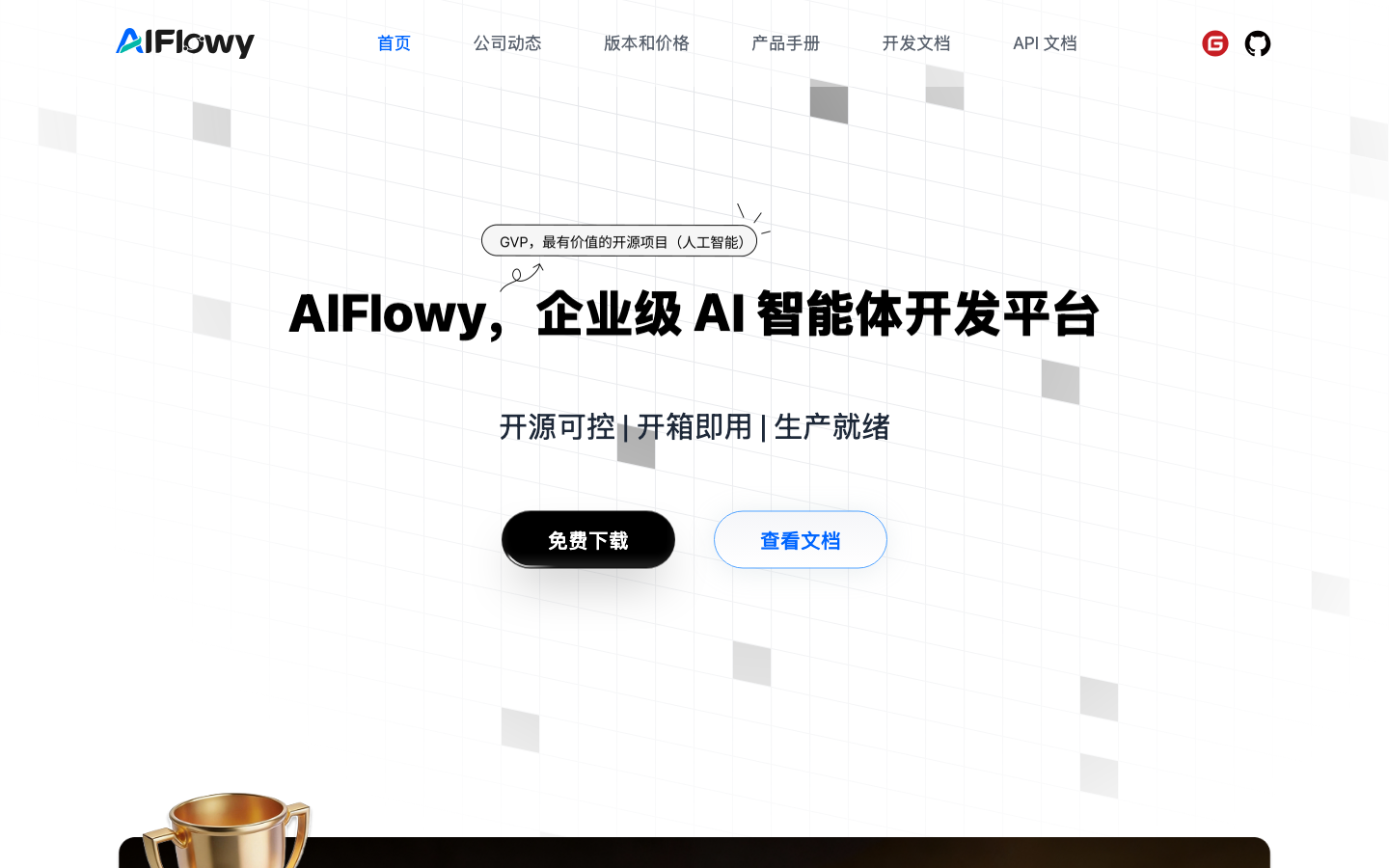
AIFlowy: an open source enterprise-level AI application development platform, a Dify alternative to the Java ecosystem
AIFlowy is an open source enterprise-level AI application (Agent) development platform based on the Java technology stack, positioned as "Dify of the Java ecosystem". It is built by a domestic team based on years of Java open source experience. The bottom layer relies on self-developed Agents-Flex (Java AI Agent framework) and Tinyflow (low-code workflow engine). It is aimed at medium and large enterprise teams that require privatized deployment, secondary in-depth customization, and Java technology stack locking. As of July 2026, GitHub has received 892 Stars, 134 Forks, and is continuously maintained by 13 contributors. The release frequency is about one version every 2-4 weeks, and it has been iterated to v2.1.3.
Core parameters and statistics
| Parameters | Official verifiable information |
|---|---|
| Product positioning | Open source enterprise-level AI application (Agent) development platform |
| Development language | Java 17 + Spring Boot 3 (backend) / Vue 3 + Element Plus (frontend) |
| Code proportion | Vue 50.7%, TypeScript 24.7%, Java 22.1%, CSS 1.4% |
| Open Source License | Apache-2.0 (with additional branding terms) |
| GitHub Stars | 892 (as of 2026-07) |
| GitHub Forks | 134 |
| Contributors | 13 people |
| Latest version | v2.1.3 (2026-06-12) |
| Core AI capabilities | Bot dialogue RAG knowledge base AI workflow orchestration MCP integration |
| System Management | User/Role/Department/Position/Permission/Menu/Scheduled Task/Operation Log |
| Front-end technology stack | Vue 3 + pnpm + Element Plus + Vue Router |
| Back-end technology stack | JDK 17 + Spring Boot 3 + Agents-Flex + MyBatis-Flex + Redis + Quartz |
| Extensibility | Bot plug-in system + Web SDK + public API |
| Deployment method | Docker / Manual deployment / Docker Compose |
| Multi-language support | Chinese (complete), English (complete) |
A brief comment: AIFlowy is the shortest path for domestic Java technology stack companies to access AI capabilities - it is not a general AI framework, but an AI application development scaffolding that is "shipped with the enterprise management module".
Main type judgment: Productivity/business-side application (primary), both Agent/MCP automation platform features (secondary). AIFlowy's core deliverable is an AI application development platform that includes a complete enterprise backend management system, rather than a pure Agent framework or API infrastructure. However, its v2.1+ has been deeply integrated with the MCP protocol and workflow engine, and has the open Tool calling capability of the Agent platform.
User and market recognition
Open Source Community Metrics
| Indicators | Data |
|---|---|
| GitHub Stars | 892 (as of 2026-07) |
| GitHub Forks | 134 |
| Contributors | 13 people |
| Release Cadence | Approximately 2-4 weeks/release |
| Latest version | v2.1.3 (2026-06-12) |
Ecological related projects
AIFlowy is not an isolated project. Its team has previously open sourced several components rated as GVP (Most Valuable Open Source Project) by Gitee:
- Agents-Flex: lightweight Java AI Agent framework, the cornerstone of AIFlowy's underlying AI capabilities
- Tinyflow: low-code AI workflow engine, supporting AIFlow's visual workflow orchestration
- AIEditor: Open source AI content editor
These projects have been widely deployed in enterprise production environments, providing AIFlowy with a proven underlying technology foundation.
Differentiated positioning
AIFlowy has a clear positioning in the Chinese open source community - benchmarking against Dify and Coze, but focusing on the Java technology stack. Although the community size of Dify (143K+ Stars) and n8n in the Python ecosystem far exceeds that of AIFlowy, for traditional enterprises (finance, manufacturing, government affairs) that use the Java technology stack, the Java technology stack means lower team learning costs, a safer compliance review path, and more controllable secondary development capabilities.
Cost advantage
C-side/individual user
| Project | Description |
|---|---|
| Software licensing fee | Zero (Apache-2.0 open source) |
| Must bring your own | Server (4C8G or above recommended), large model API Key |
| Lowest starting cost | One cloud server + one model API Key |
| Commercial use restrictions | Commercial use is allowed, but the brand logo and copyright information must not be removed |
Developer/API Call
- Open source can completely modify the source code without any limit on the number of API calls (you bear the cost of model calls)
- Provide public API controller and workflow execution API, which can directly call AI capabilities through RESTful interface
- You can build your own model gateway and switch the underlying model supplier at zero cost
Enterprise / Private Deployment
| Comparison Dimensions | AIFlowy | Dify (Equally Private) | Coze Business Edition |
|---|---|---|---|
| Software fee | 0 (Apache-2.0) | 0 (Apache-2.0) | Charged by seat/call volume |
| Technology Stack | Java 17 + Spring Boot 3 | Python + Flask | Closed Source SaaS |
| Built-in enterprise management system | Complete (user/role/department/permission/menu/log) | Basic RBAC | None (requires external integration) |
| Secondary development cost | Low (Java developers are abundant) | Medium (Python/ML team required) | Not supported |
| Compliance audit | Controllable (all source code can be audited) | Controllable | Limited by platform |
Hidden Cost Reminder: Although AIFlowy is free, self-deployment requires operation and maintenance costs - configuration and maintenance of database (MySQL/PostgreSQL), vector database (Milvus/ElasticSearch/Redis), cache (Redis) and object storage. In addition, the additional branding terms of the Apache-2.0 agreement require that the brand logo and copyright information within the product must not be removed, and special attention must be paid to compliance details when commercializing distribution.
Main functions
1. AI capability module
- Bot Intelligent Dialogue: Visually build an intelligent dialogue robot that supports multi-modal input (pictures + text), deep thinking mode (thinking chain display), voice broadcast (volcano engine TTS access), and preset questions. Supports switching between ReAct reasoning mode and normal mode, and the number of historical messages can be configured (10-100).
- RAG Knowledge Base: Supports document upload (PDF, Word, Excel, PPT, TXT, Markdown, etc.), automatic segmentation and vectorization, multi-vector database support (Milvus / ElasticSearch / Redis / OpenSearch), hybrid retrieval, metadata filtering AI automatically optimizes titles and descriptions. Supports Markdown title level splitter, and supports dynamic configuration of the maximum recall number and minimum similarity during retrieval.
- AI Workflow Orchestration: Visual drag-and-drop workflow editor that supports conditional branching, loop execution, sub-workflows, confirmation nodes, code nodes (JavaScript/SQL execution), plug-in nodes, knowledge base nodes, content template nodes, etc. Workflows can run API calls independently or be mounted to Bots and used as tools.
- Large Model Management: Unified model access layer, supporting all models of OpenAI API compatible protocols such as DeepSeek, Tongyi Qianwen, Baichuan, Wen Xinyiyan, Spark Ollama (local model), etc. Supports setting dialogue model, vector model, rearrangement model, and provides model capability switch (Function Calling/Multi-modal/Streaming).
- MCP integration (v2.0.4+): Supports the access, execution, and mounting of MCP services to the chat assistant, and realizes automatic invocation. Provides MCP online status management and restart functions. Bot plug-ins support linking and extending AI capabilities.
- Media Center: Management and display of AI-generated multimedia resources such as images, audio, and video.
- Data Center: Customized data tables, workflow can be read and written.
2. System management module
- User Management: User addition, deletion, modification, status management, password reset
- Role Management: Role creation and permission assignment
- Menu Management: Dynamic menu configuration
- Department Management: Multi-level organizational structure
- Position Management: Position Definition and Assignment
- Permission System: Button-level permission control
- Operation Log: Complete audit logging
- Schedule: Quartz integrated workflow scheduled task
- API Key: Access Token management and permission verification
- Appearance Configuration: System theme Logo, login page customization
- Internationalization: Full bilingual support in Chinese and English
- Third-party OAuth login: Supports WeChat, DingTalk, etc.
3. Open capabilities
- Web SDK: an externally publishable AI capability embedding toolkit that supports user center access and embedding
- Public API: Open API controller for workflow and execution, complete RESTful interface
- Bot plug-in mechanism: Customizable tool integration, supports File upload, API Key authentication, etc.
Model and version evolution
AIFlowy's version history clearly reflects its evolution path from "basic Bot platform" to "enterprise-level AI application platform". The following are key version nodes:
| Version | Date | Core Changes |
|---|---|---|
| v1.0.0 | 2025-04-30 | The project is open source and launched, Bot applies RAG knowledge base AI workflow and system management basic functions |
| v1.0.1~v1.0.9 | 2025-05~2025-07 | Rapid iteration of functions: import and export workflow, scheduled tasks, plug-in trial run, thought chain ReAct mode, multi-modal upload, voice input, button-level permission control |
| v1.1.0~v1.1.7 | 2025-07~2025-11 | User center MCP function prototype, in-depth thinking display, file upload enhancement, workflow JSON import, chat history, code generator Docker deployment support |
| v2.0.1~v2.0.4 | 2025-12~2026-01 | Major architecture reconstruction: module splitting (api/commons/modules/starter), JDK 17 + Spring Boot 3 upgrade Jakarta package migration MCP officially integrates OAuth login, system appearance configuration |
| v2.0.5~v2.0.9 | 2026-01~2026-02 | Model verification enhancement, knowledge base classification and rearrangement optimization RAG weighted recall Wiki module Iframe dialogue view MCP online status management |
| v2.1.0~v2.1.3 | 2026-03~2026-06 | Public API controller, system context variable Web SDK, user center embedding, knowledge base AI optimization title MCP automatic call, agent integration document |
Version rhythm characteristics: From 2025-04 open source to 2026-06, 20+ versions were released in 14 months, with an average of one version every 2-3 weeks. The v2.0 series is an important architectural watershed, completing the transition from monolithic to modular, from JDK 8 to 17, and from basic functions to enterprise-level capabilities.
Technical advantages
Architecture design
AIFlowy's technical architecture is divided into four layers:
┌───────────────────────────────────────────────┐
│ Front-end display layer │
│ Management backend (Vue 3 + Element Plus) │
│ User Center (Vue 3) │
│ Web SDK (embedded third party) │
│ Iframe anonymous access │
└──────────────────────┬─────────────────────────┘
                       │REST API/SSE
┌──────────────────────▼─────────────────────────┐
│ API layer │
│ Public API Controller │ Internal API │ MCP Protocol │ │
└──────────────────────┬─────────────────────────┘
                       │
┌──────────────────────▼─────────────────────────┐
│ Core service layer │
│ Agents-Flex (AI Agent Framework) │
│ Tinyflow (workflow engine) │
│ RAG engine (multiple vector libraries supported) │
│ Large model management (unified access layer) │
│ Plug-in system │ MCP client │ Scheduled tasks │
└────────────────

─────┬──────────────────────────┘
                       │
┌──────────────────────▼─────────────────────────┐
│ Infrastructure layer │
│ MySQL/PostgreSQL │ Redis │ Vector database │
│ Object Storage (Local/S3) │ Docker │
└────────────────────────────────────────────────┘
Control flow: User configures Bot/workflow on the front end → API layer forwarding → Agents-Flex orchestrates Agent logic → Tinyflow executes the workflow node → Model layer calls the large model → Result reflow SSE pushes to the front end
Core Differentiation Capabilities
-
Out-of-the-box enterprise management module: This is the most obvious and most underestimated advantage of AIFlowy. Different from pure AI orchestration tools such as Dify and Flowise, AIFlowy has built-in back-end management functions that are essential in Chinese enterprises - user management, role permissions, department structure, position management, menu configuration, and operation audit logs. This means that after the enterprise gets the code, it does not need to spend a month to set up the management backend, and it can be used immediately after decompression.
-
Full-link coverage of the Java technology stack: JDK 17 + Spring Boot 3 + MyBatis-Flex + Redis + Quartz, which is the most familiar technology combination for medium and large enterprises in China. Traditional Java teams can start AI application development directly without learning new stacks such as Python and LangChain. This is particularly critical for Java-heavy areas such as finance, government affairs, and manufacturing.
-
Modular splittable architecture: After v2.0 refactoring, the project was split into
aiflowy-api(API Layer),aiflowy-commons(common components),aiflowy-modules(functional modules),aiflowy-starter(launcher),aiflowy-ui-admin(administrative background),aiflowy-ui-usercenter(user center),aiflowy-ui-websdk(Web SDK) and other independent modules, which enterprises can choose as needed. -
MCP protocol native support (v2.0.4+): AIFlowy is one of the first open source AI platforms in China to natively integrate MCP (Model Context Protocol). MCP support allows bots to dynamically discover and call external tools without the need to hardcode plug-in logic.
-
Double guarantee of self-developed underlying framework: Agents-Flex and Tinyflow self-developed by the team provide underlying control - they do not rely on third-party AI orchestration libraries. If problems occur, the underlying code can be repaired by itself, which is of great significance to ensure the stability of enterprise-level delivery.
Project pitfalls and management
AIFlowy has experienced and solved multiple engineering problems in version iterations. The following are governance experiences worth noting:
- Tool loop call control: v2.1.1 adds an upper limit on the number of dialogue tool calls to prevent the Agent from falling into an endless loop and consuming Tokens during tool calls. When enterprises deploy, it is recommended to set a reasonable
max_tool_callsaccording to the model capabilities. - Security and unauthorized management: v2.1.3 restricts task tools to only access allowed package paths, and adds resource ownership permission verification. It is recommended for production companies to turn on all permission verification switches.
- Data consistency and cascade deletion: v2.1.2 improves the linkage cleanup logic when deleting resources such as Bot/knowledge base/workflow/plug-ins to prevent data islands and reference anomalies.
- Performance optimization under long context: Chat content is automatically collapsed after thinking is completed to reduce front-end rendering pressure; exception handling is enhanced when the SSE connection is interrupted to ensure that the streaming experience is not interrupted.
How to use
Rapid deployment
# Clone the repository (recommended to use Gitee mirror, domestic access is faster)
git clone https://gitee.com/aiflowy/aiflowy.git
cd aiflowy

# Backend build (requires JDK 17+ and Maven)
mvn clean package

# Front-end startup (management background)
cd aiflowy-ui-admin
pnpm install
pnpmdev

#Default login account: admin / 123456
Docker deployment (recommended for production)
# Use Docker Compose to start with one click
docker-compose up -d
Multiple entrance access
| Entrance | Description | Applicable Scenarios |
|---|---|---|
| Management backend Web | Vue 3 management interface | AI application management and configuration |
| User Center Web | Self-service platform for end users | Bot usage and dialogue |
| Web SDK | JS SDK that can be embedded in third-party websites | Embed AI capabilities into existing systems |
| Iframe anonymous access | External embedding without login | Public AI service |
| Public API | RESTful interface call workflow/Bot | Inter-system integration |
| MCP protocol | Model Context Protocol standard access | AI tool ecological interconnection |
Getting Started with Development
- Log in to the management background → enter "Model Management" to add a large model (supports OpenAI, DeepSeek, Tongyi Qianwen and other API Keys)
- Create Bot → Select model → Configure prompt words and plug-ins
- (Optional) Create RAG knowledge base → Upload documents → Mount to Bot
- (Optional) Create AI workflow → Visual orchestration node → Publish as Bot tool
- Publish Bot → Provide external services through user center / Web SDK / public API
Product Pricing
| Dimensions | Pricing |
|---|---|
| Software licensing | Completely free (Apache-2.0 open source license) |
| Cloud hosting | None (only open source self-deployment, no official hosting service yet) |
| Enterprise Edition | None |
| Necessary external costs | Cloud server (deployment and operation), large model API calling fee (pay-as-you-go) |
| Optional external costs | Vector database service (Milvus/ES/Redis), object storage (S3/OSS) |
Cost estimation deduction (taking the PoC of a medium-sized enterprise as an example):
- Server: 4C8G ECS about ¥2,000-4,000/year (Tencent Cloud/Alibaba Cloud lightweight server)
- Large model API: DeepSeek API about ¥10-50/month (medium conversation volume)
- Vector database: no additional cost to use built-in Redis; independent deployment of Milvus requires additional servers
- Total starting operating cost: approximately ¥2,200-4,600/year
Compared with Dify Cloud's SaaS subscription or Coze Enterprise Edition's per-seat charging, AIFlowy's long-term cost advantage is obvious - especially in scenarios with large call volumes, self-deployment only bears computing power costs and no software premium.
Application scenarios
1. Enterprise intelligent customer service/internal knowledge base
- Pain Points: Traditional FAQ has high maintenance costs, long customer service staff training cycle, and difficulty in finding cross-department information.
- Plan: Upload product manuals, technical documents, and internal systems to the AIFlowy RAG knowledge base to build an internal AI Q&A robot
- Effect deduction: The first response time of customer service is reduced from 5 minutes to less than 30 seconds, and the FAQ maintenance workload is reduced by about 60%
2. Business process automation
- Pain Point: AI-assisted judgment is required in the approval process (such as contract review summary, compliance inspection), and existing approval systems cannot embed AI
- Plan: Inject AI capabilities into existing business processes through AIFlowy workflow orchestration + Bot plug-in mechanism
- Effect Deduction: The initial contract review time is reduced from 2 hours to 15 minutes, and manual review points are retained to ensure compliance (Human-in-the-loop)
3. AI transformation of traditional enterprise information systems
- Pain Point: The enterprise system (ERP/OA/CRM) of the Java technology stack requires AI capabilities, but there are gaps in the technology stack using the Python solution
- Option: AIFlowy provides Web SDK and public API, enterprises can embed AI dialogue windows or call AI workflows in existing systems
- Effect deduction: The AI capability access cycle is shortened from 3 months (learning the new Python stack) to 2 weeks (the Java team directly calls the API)
4. Multi-model management and model degradation
- Pain Point: Relying on a single model involves the risk of supplier lock-in, and business interruption when the model is updated.
- Scheme: AIFlowy's model management supports multi-vendor configuration, and can set the main model + downgrade model
- Effect Deduction: Model switching time is reduced from days to minutes, and the risk of single point failure is greatly reduced.
5. Education/Training Scenario
- Pain Point: Corporate training content is frequently updated and trainers are insufficient.
- Plan: Build an AI training assistant based on the RAG knowledge base so that students can query course materials at any time
- Effect Deduction: Training coverage increased from 2 hours of offline courses per week to 7×24 hours of online self-service learning
Applicable people
Highly recommended
- Enterprise development team for Java technology stack: For traditional enterprises such as finance, manufacturing, government affairs, and medical care that use Java as the main language, the team can access AI capabilities without transformation.
- Enterprises that require privatized deployment: Industries with high data security requirements that cannot use SaaS services (banking, insurance, military industry, government affairs)
- Teams that require in-depth secondary development: open source and changeable source code, and the underlying Agents-Flex framework is independently controllable
- Architects who want to build an AI middle platform from scratch: AIFlowy provides a complete enterprise-level management base, which can be used as the starting point for an AI middle platform
Available but subject to evaluation
- Small and medium-sized startups: If the team has a Java background, AIFlowy is the lowest-cost AI platform starting solution; but if you are looking for quick launch, Dify Cloud or Coze are faster out of the box.
- Enterprises that require multi-modal processing: AIFlowy already supports multi-modal uploads, but the experience is not as good as a professional multi-modal platform
Not recommended / Not suitable
- Non-Java technology stack team: Python/Node.js/Go team recommends Dify, Flowise or n8n
- Users who need zero cloud operation and maintenance: AIFlowy currently has no official hosting service and must deploy and maintain it by themselves.
- User-oriented products pursuing the ultimate UI/UX: AIFlowy's front-end experience is lagging behind that of Dify or Coze, and the management backend style is more traditional.
- Applications that require international multi-language support: only Chinese and English bilingual, other languages need to be expanded by yourself
Summary and Outlook
Core competitiveness
AIFlowy's core competitiveness does not lie in the AI capability itself (the underlying model is provided externally), but in the combination of "Java ecosystem + enterprise-level management module + open source controllable" - it solves the three most troublesome problems for domestic Java technology stack companies when accessing AI: technology stack faults, lack of management backend, and supplier lock-in risk. With Dify occupying the Python ecological Coze and locking in the cloud, AIFlowy has accurately entered the privatized deployment market segment of Java enterprises.
Current limitations
- Limited community size: 892 Stars It is relatively small compared to similar open source projects, and the third-party ecosystem of plug-ins has not yet been formed.
- High dependence on operation and maintenance: You need to deploy and manage multiple sets of basic services (database, vector library, cache, object storage) by yourself
- No official cloud service: There is no SaaS version like Dify Cloud, and the threshold for quick experience is relatively high
- Front-end experience needs to be optimized: The management backend UI is more traditional and there is still a gap between it and modern products.
- Lack of enterprise-level high availability: There are no enterprise-level architecture solutions such as cluster deployment, read-write separation, and multi-activity.
Follow-up observation points
- Version iteration rhythm: Can updates after v2.1.3 maintain 2-4 weeks per version, and whether there will be a v3.0 architecture upgrade
- Ecological construction: The richness of the Bot plug-in market MCP service catalog and community template library
- Commercialization path: Whether to launch an official hosting version or enterprise-level support services will directly affect corporate purchasing decisions
- Internationalization Progress: The degree of perfection of English documentation and community support determines whether we can expand overseas markets.
- Underlying Framework Development: The project activity of Agents-Flex and Tinyflow and the depth of binding of AIFlowy
Procurement/Adoption Risk Assessment
- Technical Risk: Low. The Java + Spring Boot technology stack is mature, and the team has self-developed the underlying framework and has been verified in production.
- Supplier Risk: Medium. Open source projects rely on community activity, and if the core team moves to other projects, maintenance speed may slow down. But the Apache-2.0 protocol ensures that the code is permanently available
- Security Compliance Risk: Low. The entire source code is auditable, supports privatized deployment, and meets data sovereignty requirements.
- Ecological Risk: Medium. The number of third-party plug-ins and MCP services is limited, and some scenarios may require self-development and integration.
- Recommendation: It is suitable for Java teams to introduce as an AI capability base. It is recommended to first use PoC in non-core scenarios to verify the capability boundaries of RAG knowledge base and workflow orchestration before expanding to core business. Also keep contributing in the community to speed up issue response.
Related tools:  CrewAI,
  LangChain
Version Info
- AIFlowy current :Support Bot application RAG knowledge base AI workflow orchestration, large model management, and system management.
- AIFlowy launch :The project is open source and launched online, with basic AI application construction capabilities.
User Reviews