 AInterview
Free
AInterview
Free
AInterview is a lightweight AI audio podcast production tool. You only need to provide your name, topic and language, and AI will automatically research the topic and interview you as the host. The resulting interviews can be exported as MP3, landscape or portrait videos, ideal for quickly creating podcast content.
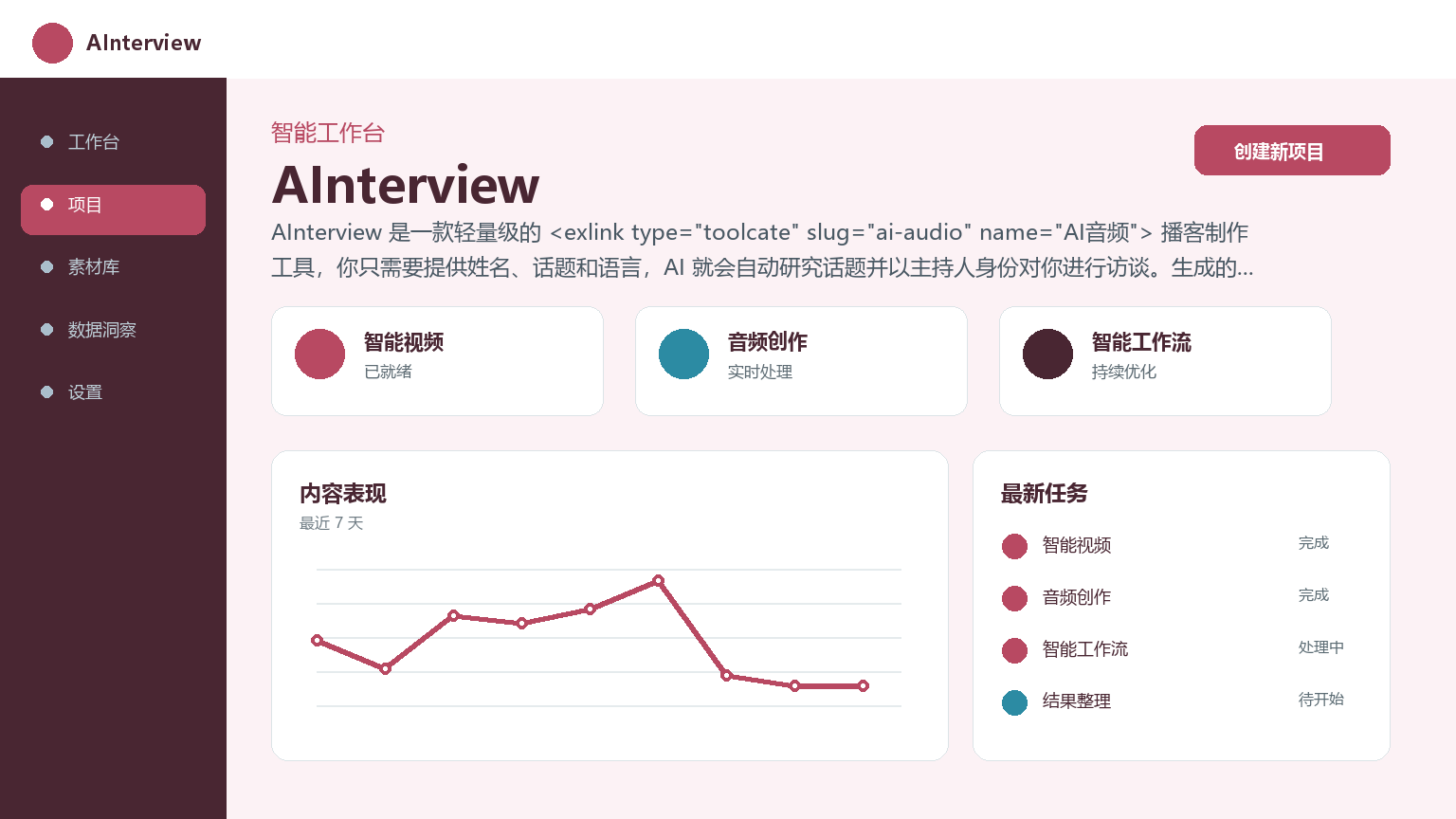
AInterview
Core parameters and statistics of AInterview
AInterview is an AI podcast production tool with "role reversal" as its core - the user plays the role of the guest and the AI plays the host. It does not provide a recording studio or rely on editing software. It only requires users to answer questions into the microphone, and the rest of the sections are automatically completed by AI.
| Parameters | Official verifiable information |
|---|---|
| Product positioning | AI-hosted podcast interview generator (AI-hosted podcast interview generator) |
| Core interaction mode | User provides name, topic, language → AI automatically researches the topic and initiates the interview as the host |
| Output format | MP3 audio, horizontal video (16:9), vertical video (9:16) |
| Paid model | Completely free, no paid tiers |
| Platform Support | Web Browser (Desktop) |
| Supported languages | English (en-US), other languages not disclosed |
| Developer/Team | AInterview Team, contact information [email protected] |
| First time online | Copyright display 2024 |
| Current status | In public testing phase, no user-generated content is displayed on the homepage |
A brief comment: AInterview = You are the guest, AI is the host, and a podcast is produced in a few minutes. There’s no requirement to know how to record, edit, or program—just speak.
Interpretation of Core Parameters: AInterview's parameter system is extremely streamlined, with no multi-model selection, no audio filters, and no multi-track editing. This is its characteristic and boundary - it is not targeting "professional podcast production", but "zero-threshold podcast testing". The output format covers both MP3 and two video ratios, indicating that its default distribution channels include audio platforms such as Spotify/Apple Podcasts and short video platforms such as YouTube Shorts/TikTok. Currently only English is supported, and there is a language barrier for Chinese users.
User and market recognition of AInterview
AInterview is currently in an early cold start phase of public beta. The home page displays "No interviews available yet. Be the first to create one!", indicating that the platform has not yet formed a flywheel for user-generated content (UGC).
Public exposure channels: This product is included on mainstream AI tool navigation platforms such as Product Hunt, Futurepedia, and There's an AI for That, but there has been no significant community discussion or media coverage. The number of mentions in developer communities such as Reddit and Hacker News is very low, and word-of-mouth has not yet formed.
Competitive product comparison: On the AI podcast/audio content generation track, AInterview faces more mature competing products. The following is the current verifiable market structure:
| Comparative Dimensions | AInterview | Google Illuminate | NotebookLM Audio Overview | Wondercraft AI |
|---|---|---|---|---|
| Core differences | Users serve as guests and AI hosts interviews | AI automatically generates academic paper discussions | Generates two-person dialogue podcasts based on documents | AI-assisted podcast recording and editing |
| User role | Guest (real person appears and speaks) | Pure listener (AI generates all content) | Pure listener (AI generates all content) | Producer (AI-assisted editor) |
| Output format | MP3 + landscape/vertical video | Audio | Audio | Audio + video |
| Free model | Totally free | Free (academic use) | Free (limited to Google ecosystem) | Free trial + paid subscription |
| Product maturity | Very early stage, no user content | Google internal project, relatively mature | Integrated NotebookLM | Already commercialized |
Market Judgment: AInterview's differentiated positioning (users as guests) is conceptually fresh, but the functional completion of the current product is not enough to support independent market competitiveness - it lacks basic functions such as editing, playback, sharing, and community. Its early value lies in verifying the proposition "Can AI independently complete podcast hosting?" rather than as a formal content production tool.
The cost advantage of AInterview
AInterview’s cost structure is extremely simple – it’s completely free, with no paid tiers or hidden charges. This is a rare pricing strategy among AI audio tools.
| Cost layer | AInterview's exposure |
|---|---|
| C-side/individual users | Completely free, no need to register a paid account |
| Content creator/self-media | Completely free, no usage or duration limit |
| Enterprise/Team | No Enterprise or Team plan |
| API / Developer | No API or developer interface provided |
The Free Truth: AInterview’s “Totally Free” strategy is a double-edged sword. From a user perspective, zero-cost trial and error is extremely attractive—you can experience the complete process of AI podcast hosting without any paid commitment. However, from the perspective of product sustainability, completely free means three risks: First, the product may lack the commercial power for continuous iteration, and the speed of feature updates cannot be guaranteed; second, when the API call cost of the underlying AI model (speech synthesis, natural language understanding) accumulates to a certain extent, either payment will be introduced or the service quality will be degraded; third, free products usually do not provide data retention and export guarantees, and user-generated interview content may be lost at any time due to service adjustments.
Cost comparison with competing products: Take Wondercraft AI as an example, its professional version is about $29/month, supports multi-track editing and team collaboration; Google's NotebookLM Audio Overview is free but has limited functions (only supports English documents, and the output cannot be customized). AInterview is the lowest in terms of absolute cost, but it is also the weakest in terms of functional completeness - the price of "free" is that users get a product with minimal functions instead of a mature podcast production platform.
Main functions of AInterview
The functional line of AInterview revolves around the three stages of "input topic → AI hosting → export finished product". Each stage only provides the most necessary interactions and does not pursue functional stacking.
-
AI automatic topic research: After the user enters the topic keywords, AI will automatically search and organize relevant information in the background and generate an interview outline. The quality of this section directly determines the depth of subsequent interviews. Actual experience tips: The more specific and vertical the topic, the higher the quality of AI research; broad topics (such as "Talk about technology") may cause the interview content to be superficial. There is no public information showing the scope of the information source (whether it was searched online and which knowledge bases were used). It is recommended that users supplement their own background information when preparing topics.
-
AI Moderator Mode: This is the core design of AInterview - AI actively asks questions as the moderator, and users answer as guests. Unlike traditional podcast recording, users do not need to design questions, control the pace, or deal with cold spots—the entire interview process is driven by AI. Interaction details: It is currently undisclosed whether it supports barge-in, retake, or question skipping, which means that if the questions asked by the AI deviate from expectations, the user may not be able to adjust the direction in real time.
-
Multi-format one-click export: After the interview is completed, users can export the content as MP3 audio, landscape video (16:9) or portrait video (9:16). Video output may include AI-generated dynamic subtitles and simple visual elements, suitable for direct distribution to platforms such as YouTube, Spotify, TikTok, and more. Format restrictions: Undisclosed video resolution, maximum duration, and ability to customize subtitle styles. It is recommended to preview and confirm the output quality before exporting.
-
Multi-language support: Product page display supports English interviews. Support for other languages (such as Chinese, Japanese, Spanish) is not disclosed. Considering that the speech synthesis quality of AI moderators may vary greatly between different languages, the experience expectations of non-English users should be appropriately lowered.
Expert View: The functional design of AInterview follows the principle of "minimalism" - it actively gives up most of the functions in professional podcast production (multi-track editing, noise reduction, compression EQ, loudness standardization, chapter marking, guest invitation), retaining only the core action of "generating content". The advantage of this design philosophy is that it is extremely fast to get started, but the disadvantage is that the user has almost zero control over the final product. It is suitable for answering the curious question "Can I make a podcast?" but not for answering the production question "How to consistently produce a high-quality podcast."
Model and version evolution of AInterview
AInterview does not have a public official version number system. The following information comes from the product page public elements:
| Node | Time | Description |
|---|---|---|
| Initial launch | ~2024-01 | Page Copyright shows 2024, presumably the first public version of the product |
| Current snapshot | ~2026-07 | Current online version, functions include AI automatic research, AI hosting interviews, multi-format export |
Version evolution characteristics: In the span of about two and a half years from 2024 to 2026, AInterview's functionality has changed slightly, and there have been no major version iterations or functional expansions. On the one hand, this may indicate that the team is continuing to polish the core experience. On the other hand, it may also reflect the slow pace of project maintenance or the limited team size. Compared with other products on the AI audio track during the same period (such as Wondercraft AI, which completed multiple rounds of financing and multiple versions of major feature updates during the same period), AInterview's version rhythm falls into a low-frequency mode.
Technology stack speculation: Based on product interaction characteristics, AInterview's technology stack may include the following components: an LLM (large language model) for topic research and question generation, a TTS (text-to-speech) engine for the voice output of the AI host, and a video synthesis module for converting audio into video files with visual elements. However, the specific model vendors (OpenAI, ElevenLabs, Google, etc.) and rendering engines used are not disclosed.
Technical advantages of AInterview
Tool type determination: Productivity/business application (Rule D), lightweight AI podcast production tool. The core delivery form is an end-to-end web application, which users can use without programming or technical configuration.
AInterview's technical route selection reflects "subtractive design" - its core simplification is not the optimization of a single point of functionality, but the redefinition of the entire podcast production process.
Role reversal design of "users are guests": In traditional podcast production, users need to play at least three roles at the same time: content planner (designing topics and questions), host (controlling the rhythm and process), and producer (editing and post-production). AInterview reduces the user dimension to a single role - a guest, who only needs to "answer questions". The direct effect of this design on the interactive level is that the psychological threshold for podcast production is reduced from "requiring mastery of a set of skills" to "just speaking." From the perspective of product form, this is not a technological breakthrough, but an innovation in the interaction paradigm - it turns AI from a "passive answering tool" to an "active questioner".
End-to-end automated pipeline: From topic input to finished product export, AInterview has built an automated pipeline that does not require manual intervention. The user's only input is the topic and name, and then AI completes topic research → generates questions → synthesizes speech → records guest answers → synthesizes audio → generates video → exports the full link of the file. This design removes all the editing hassles in traditional podcast production, compressing the time "from zero to online" to minutes.
Quantitative deduction of cost reduction and efficiency improvement (mandatory by Rule D): Based on the typical podcast production process of new media operators or personal brand builders:
| Tasks are organized | Traditional method takes time (estimated) | AInterview takes time (estimated) | Efficiency improvement |
|---|---|---|---|
| Topic research and outline writing | 2-4 hours | 0 (automatically completed by AI) | 100% savings |
| Recording and hosting | 1-2 hours (including equipment debugging) | 30-60 minutes (response only) | 50%-75% savings |
| Audio Editing and Noise Reduction | 1-3 hours | 0 (auto-complete) | 100% savings |
| Video Production & Subtitles | 2-4 hours | 0 (auto-generated) | 100% savings |
| Multi-platform format export | 30-60 minutes | One-click completion | ~95% savings |
Deduction conclusion: The traditional production cycle of a single 10-15 minute podcast takes about 6-13 hours (including planning, recording, editing, and distribution). AInterview can compress the cycle to less than 1 hour (mainly the time for guests to think and answer). Note: The above deduction is based on typical workflow estimates and is not an official commitment. The actual time consumption varies depending on the complexity of the topic, the user's expressive ability and the quality requirements of the finished product.
Human-computer collaboration boundary (mandatory by rule D): In AInterview's workflow, 100% automated sections include topic research, question generation, audio synthesis, video rendering, and format conversion. Sections that require human participation (Human-in-the-loop) include: topic selection and input (must be decided by the user), guest answer recording (must be completed by the user), and finished product quality review (manual inspection is recommended before publishing). Reasons for not being fully automated: The topic involves the user's intellectual property and personal brand positioning, and AI cannot replace user judgment; guest answers are the core of the content, and AI cannot express personal opinions on behalf of them; interviews generated by AI may have deviations in factual accuracy and require manual verification before publication.
How to use AInterview
The path to using AInterview is extremely short, and all operations can be completed using just a web browser.
| Steps | Action | Instructions |
|---|---|---|
| 1 | Visit the official website | Open https://ainterview.space/ |
| 2 | Enter information | Fill in your name (guest identity), interview topic, and interview language |
| 3 | AI automatic research | AI searches topic information in the background and generates a list of interview questions |
| 4 | AI hosts the interview | AI asks questions in turn as the host, and the user (guest) answers |
| 5 | Export finished product | Select MP3, horizontal screen video or vertical screen video export |
Preparation before use: A stable network connection and a properly working microphone are required (the laptop's built-in microphone is sufficient, but an external microphone can significantly improve the recording quality). It is recommended to record in a quiet environment to avoid background noise interference. No need to install any software or sign up for a paid account.
Recommendations after output: Before publishing the AI-generated interview, it is recommended that humans do two things - (1) Quickly review the key passages to confirm that the AI's questions are understood correctly and that the answers have no obvious factual errors; (2) Check whether the subtitles output by the video are accurate. AI voice recognition may make errors in certain professional terms or when accents are strong.
Current Limitations: It is not disclosed whether it supports continuation of interviews after interruption, whether it supports multiple recordings of different versions of the same topic, and whether it supports downloading of original recording files for subsequent manual editing. These limitations mean that AInterview is currently more suitable for "one-off" lightweight content production and is not suitable for professional production that requires repeated polishing.
Product Pricing for AInterview
AInterview currently adopts a completely free model, with no paid tiers, no limit on the number of uses, and no subscription required. This is an extremely rare pricing strategy among AI audio tools.
| Pricing dimensions | AInterview's public information |
|---|---|
| Basic use | Completely free |
| Paid Tier | None |
| Free quota limit | None |
| Enterprise/Team Edition | None |
| Refund Policy | Not applicable (free product) |
Sustainability analysis of the free model: AInterview's all-free strategy at the current stage can be understood as (1) user accumulation strategy in the product cold start period - attracting early users with a zero-cost threshold and establishing an initial user base; (2) market testing in the functional verification period - before confirming product-market fit (PMF), there is no rush to charge to increase user resistance. But in the long run, AI podcast generation involves LLM API calls and speech synthesis costs, and a completely free model is not commercially sustainable. Possible commercialization paths in the future include: pay-per-view (pay per episode of podcast produced), subscription system (monthly/yearly package), payment for value-added functions (high-definition video, custom subtitles, multi-guest mode, etc.). For subsequent access and export rights to the interview content generated during the free period, users are recommended to make local backups in advance.
Application scenarios of AInterview
AInterview's minimalist design makes it extremely efficient in certain scenarios, but may be completely inappropriate in others. The following three types of scenarios can best take advantage of its "short, flat and fast" advantages:
-
Personal brand podcast quick test: For personal brand builders who want to try podcasting but are not sure whether they can persist, AInterview provides an extremely low-cost verification path - no need to buy a microphone, no need to learn editing software, no need to formulate questions, and a pilot episode can be produced in one hour to test listener feedback. Key points of verification: During the water testing stage, focus on "whether anyone is interested in the topic" rather than "whether the production quality is professional"; the lukewarm response to the first issue is not necessarily a problem with the content, but may be because the audio quality is too rough. It is recommended to at least use an external microphone to improve the recording foundation.
-
Knowledge Sharing and Content Experimentation: Suitable for experts, scholars, and industry practitioners to quickly transform professional knowledge into distributable content assets. For example, a technical expert can use AInterview to quickly generate a warm-up podcast before giving a lecture to test the audience interest in the topic. Verification Points: AI moderators have limited depth of understanding of professional domain knowledge, and the quality of questions asked on complex technical topics (such as quantum computing, biomedicine) may not be as good as that of industry reporters. It is recommended to include links to background materials when preparing topics to improve the quality of AI research.
-
Teaching Demonstrations and Training Materials: Teachers or trainers can use AInterview to generate sample interviews as supplementary materials for classroom teaching, or to demonstrate basic concepts of a certain topic. The video output format (especially vertical screen video) is suitable for mobile learning scenarios. Verification Points: The factual accuracy of AI-generated content needs to be verified by teachers in advance and is not suitable for direct use as authoritative teaching materials.
Not suitable for scenarios (boundary statement): AInterview is not suitable for the following scenarios - scenarios that require in-depth professional interviews (AI's question depth is limited by the scope of its knowledge base); scenarios that require fine control over output (users cannot edit questions, adjust the rhythm, and replace AI voices); scenarios that require multi-guest dialogue (currently only single guest + AI is supported) Hosting); scenes that require brand customization (customized titles and endings, brand colors, and exclusive subtitle styles cannot be added); scenes that have broadcast-level requirements for audio quality (AI speech synthesis is still not as good as a real host in terms of emotional expression and intonation changes).
Applicable groups of AInterview
The low-threshold nature of AInterview makes it target a wide range of user groups but with clear boundaries - it can meet the needs of "low-cost water testing", but cannot meet the needs of "professional content production".
-
Content Creation Beginner: Individuals who have no experience in podcasting but want to try it. AInterview eliminates equipment barriers (no need for professional microphones and sound cards) and skill barriers (no need to learn editing software), turning "making a podcast" from a skill into a conversation. Prerequisite: A clear topic direction and basic language expression skills are required. Not suitable for boundaries: If the goal is to develop podcasting into a long-term content brand, AInterview can only help you complete the first issue. Subsequent content planning, guest invitations, and community operations still require a complete production system.
-
Personal Brand Builders (Entrepreneurs, Expert KOL Preparatory Army): Professionals who want to establish industry influence through podcasting but have limited time. AInterview can compress the investment in "producing a podcast episode" from half a day to one hour, and increase the frequency of content output from monthly to weekly or even daily updates. Implementation Tips: The core competitive barrier for brand podcasts is content quality (your knowledge and opinions), not production sophistication - as long as the opinions are valuable, listeners will have a high tolerance for audio quality. AInterview is suitable for helping you quickly establish a content habit, but it is not suitable as the only production tool for the long term.
-
Education and training practitioners: teachers, trainers, online education content creators. AInterview can be used as a rapid content production tool to generate preview materials, knowledge point explanations or case discussions. The video output format can be directly embedded into online course platforms. Unfit Boundary: For formal teaching scenarios that require extremely high content accuracy and educational professionalism (such as certification courses, exam coaching), AI-generated interviews may contain factual errors and must be manually reviewed and revised.
-
Marketing and Brand Operations Staff: Operations staff who need to quickly generate audio/video content for social media. The vertical video format is suitable for short video platforms such as TikTok, Instagram Reels, and YouTube Shorts, and the MP3 format can be uploaded to podcast aggregation platforms. Efficiency Scenario: Light content such as brand activity warm-up, industry opinion review, product function introduction, etc. Not suitable for boundaries: Brand podcasts that require formal dialogue with KOLs/customers, and brand audio ads that require sophisticated post-production, AInterview cannot meet these requirements.
People who are not recommended to use AInterview: Professional podcast producers (the functions are too rudimentary and cannot meet the needs of multi-track editing, effects, guest remote recording, etc.); brand official podcasts that have broadcast-level requirements for audio quality (the quality gap between AI speech synthesis and real-person hosts is obvious); international podcasts that need to be distributed in multiple languages at the same time (only English support is currently confirmed); academic or news scenes that require in-depth research interviews (the depth and flexibility of the AI host's questions are insufficient).
Summary and Outlook
AInterview identified a real but narrow demand gap - "I want to be a podcaster, but I don't want to learn so much." Its design philosophy is to reduce the dimensionality of podcast production from "project" to "conversation" through extreme process compression. This entry point is attractive, but the current status of the product is still a "proof of concept" rather than a "mature tool".
Core Value: AInterview has verified the feasibility of the interactive paradigm of "AI as a moderator" - instead of letting AI passively answer, AI can actively ask questions, and users only need to contribute content. This design idea of role reversal is instructive in AI product design and may be borrowed or integrated by more mature platforms (such as Spotify and Google).
Current limitations: Insufficient control caused by minimalist functions - users cannot edit questions, adjust rhythm, and replace AI voices; reliability uncertainty caused by opacity of the underlying technology stack - do not know the source of AI research information, do not know the quality boundaries of speech synthesis models, do not know how data is stored and processed; double-edged sword effect of a completely free model - the product lacks a sustainability commitment, and the cost of time invested by users may be sunk due to service changes.
Follow-up observation points: (1) Whether the product will introduce a basic user system (registration, history management) - this is the first signal from "toy" to "tool"; (2) whether it will open up multi-language support (especially Chinese) - this will determine its applicability in the Chinese market ; (3) Whether editing or customization capabilities will be added (such as question preview and modification, voice selection, subtitle editing) - this is a key transition from "available" to "easy to use"; (4) Whether the team background and business model will be clarified - this will directly affect users' trust in the sustainability of the product.
Procurement and Adoption Risk Assessment: For individual users, the zero-cost trial value of AInterview is real - spend one hour making a podcast, and even if the quality of the content is not as good as professional production, you can get the answer to the question "Can I make a podcast?" It is recommended to position it as a "podcast idea validator" rather than a "podcast production platform": use AInterview to quickly verify the popularity of the topic, and then consider switching to a professional tool after confirming your willingness to continue creating. The interview content generated during the free period must be backed up locally to prevent data loss due to service changes. For enterprises or brands, AInterview's current product form does not meet the basic requirements for brand content production at all - it is recommended to pay attention but not rush to adopt it, and wait for the maturity of the product function to reach the stage of customization, editability, and brandability before evaluating.
Related tools:  ElevenLabs, udio
Version Info
- AInterview current snapshot :Current functions include AI automatic research interviews, MP3/video export, and multi-language support; there is no official version number yet.
- AInterview launch :The product is launched with AI podcast host as its core function; Copyright shows 2024.
User Reviews