 AirOps
Free
AirOps
Free
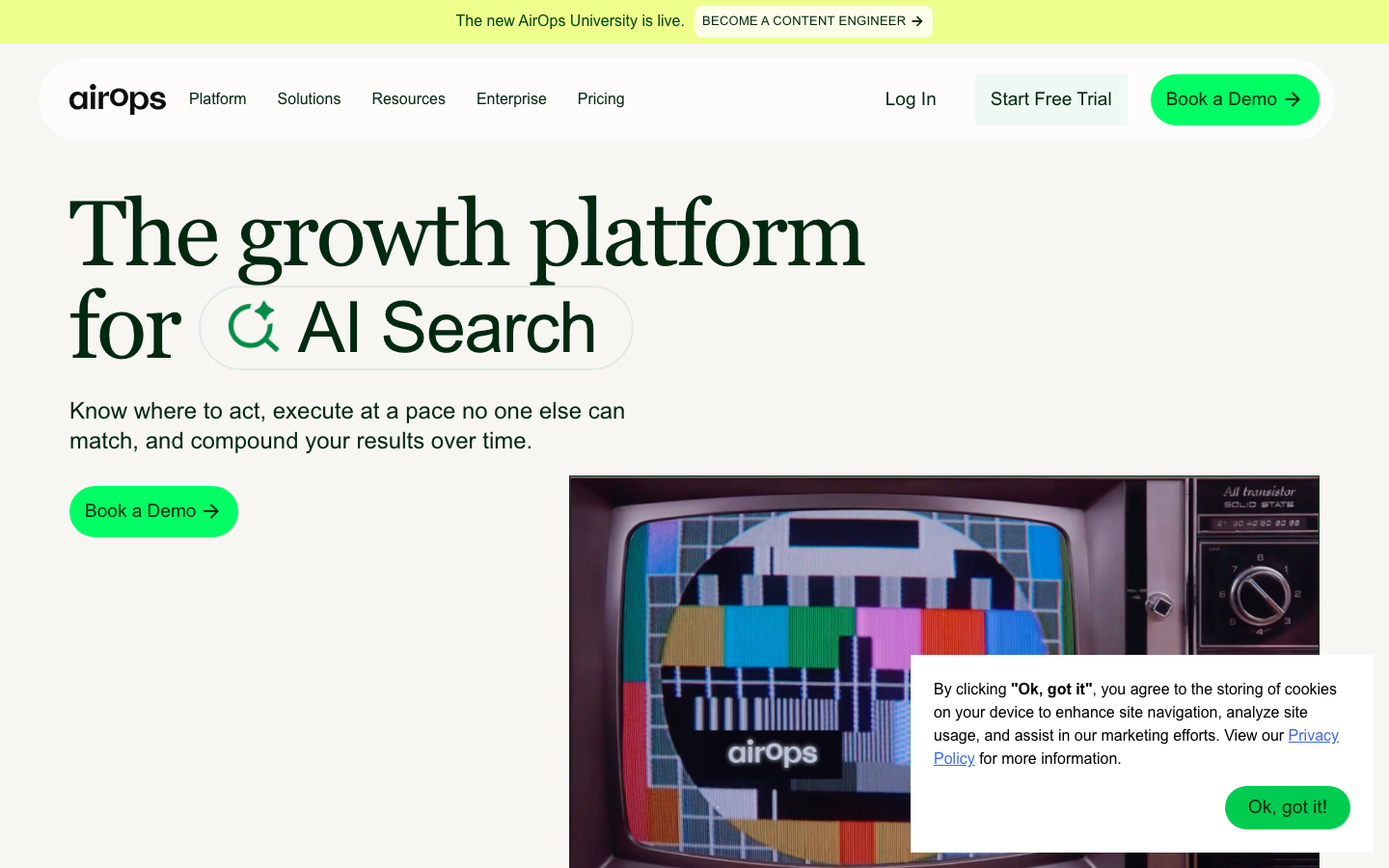
AirOps is an AI Search platform for growth teams that integrates content production, prompt word management, workflow, knowledge base and monitoring into a search growth workbench.
AirOps
Core parameters and statistics
| Projects | Public Information |
|---|---|
| Official positioning | The growth platform for AI Search |
| Core modules | Quill, Workflows, Knowledge Bases, Brand Kits, Monitoring |
| Plan Structure | Solo / Pro / Enterprise |
| Public cases | 93% increase in ChatGPT citations, 500% AI-attributed signups, etc. |
| Typical Target Audiences | SEO, Content, Brand and Growth Teams |
| Support Platform | Web |
A brief comment: Focusing on AI Search and SEO growth, content production, experimentation and monitoring are turned into a growth operating system.
Core positioning and authenticity verification: AirOps is an AI Search platform for growth teams that integrates content production, prompt word management, workflow, knowledge base and monitoring into a search growth workbench. What really deserves attention is not a single AI capability, but whether it compresses the links that originally required multiple people, multiple software, and multiple rounds of communication into a sustainably reusable product workflow. For purchasers, this is more important than the model name, because the bottleneck of most teams is not lack of production capabilities, but too scattered processes, too much rework, and too weak standardization.
Current Limitations: If your scenario requires extremely high professional control, heavy compliance approvals, or relies heavily on senior manual judgment for each delivery, then such tools can usually only cover 60% to 80% of the process, and the remaining parts still rely on manual work or more professional vertical products.
User and market recognition
- What AirOps really focuses on is not traditional SEO, but brand visibility in new search portals such as ChatGPT, Perplexity, and Gemini.
- The official case repeatedly emphasizes citations, signups and organic traffic, which shows that it is selling results rather than simply selling writing tools.
- The launch of Quill further illustrates its move from single point content automation to a complete growth operating system.
Hidden benefits: Once the team begins to centralize templates, assets, reviews, data and historical versions, the real savings are often not single production time, but cross-position communication and repeated rework. This benefit is usually not written in the official website price list, but in real organizations it is often more critical than the monthly fee.
Cost advantage
The Free Truth: The free tier is usually just enough to validate the process, not enough to support ongoing production. Many teams mistakenly think it is "cheap" when they first get started. After they start using it frequently, the cost will expand from subscription fees to quota, seats, asset management and approval link costs.
C-side perspective: The most important thing for individual users is to produce publishable results in a shorter time, so the low-threshold trial is valuable, but the free tier should not be regarded as a long-term solution.
Developer/API perspective: If the product has an open API or deeper integration, the explicit unit price may not be exaggerated, but the real cost will shift to call frequency, fault tolerance, and governance.
Enterprise Perspective: What enterprise procurement ultimately buys is not a button, but authority, auditing, brand control, training SLA and predictable delivery.
- Solo: $199/month.
- Pro: $799/month.
- Enterprise: Customized.
- The price difference is mainly reflected in tracked prompts, pages, tasks, knowledge bases and collaborative governance.
Main functions
- Quill: Organize brand content writing, optimization and experimentation into a more coherent production interface.
- Workflows: Automate content production, refresh, update and distribution processes.
- Knowledge Bases: Precipitate brand facts and reference materials to reduce AI output drift.
- Monitoring: Continuously monitor brand mentions, citations and changes in AI Search.
- Brand Kits: Inject tone, rules and materials into the production process.
Expert View: The most valuable thing about this type of product is not how new a function itself is, but whether multiple functions can form a coherent work chain. As long as you still have to move back and forth between five or six tools, the efficiency gains your team feels will be quickly diluted.
Model and version evolution
Latest main line: AirOps Quill corresponds to the product stage publicly emphasized on the current official website. For SaaS tools, versions do not necessarily appear as traditional semantic numbers, but are more commonly named as capability routes, product stages, or important workflows.
Historical context:
- AirOps AI Search Growth Platform: Release date ~2025-01. The current official website has focused on the growth platform narrative of AI Search, Google, Gemini, Perplexity, Claude, and ChatGPT. There is no official precise date yet.
Key points to observe: What you really should look at is not “whether there is a version number”, but whether each milestone indicates that the product is developing into a deeper workflow, clearer commercialization, and stronger organizational collaboration capabilities.
Technical advantages
- Pitch Verification: AirOps is not a general writing tool, it is more like a growth workbench built around AI Search visibility.
- Quantified cost reduction and efficiency improvement: The official website provides citation and traffic growth cases for Asana, Webflow, Carta and other customers, but these are individual cases and should not be regarded as a unified commitment.
- Human-machine collaboration boundary: Content drafting, structured updates and experiments can be highly automated, but final brand judgment, fact checking and high-value page publishing should still retain manual confirmation.
Why is it faster: Because it leaves the parts most suitable for automation to the model or rule system, leaving the parts most suitable for human responsibility to judgment, review and final release. Once this division of labor is reasonable, efficiency improvements will be relatively stable; if the boundaries of division of labor are unclear, rework will eat up the time saved.
How to use
| Entrance | Suitable for the crowd | Typical value |
|---|---|---|
| Web | Individuals and Teams | Fastest Verification Core Workflow |
| Team collaboration | Operations, marketing, managers | Centralize templates, assets, permissions and approvals |
| Enterprise / API | Medium and large organizations | Connect to existing systems, manage and scale |
- First establish a brand knowledge base and content rules.
- Generate, refresh and extend pages using Quill or Workflows.
- Use monitoring capabilities to continuously view brand performance in AI Search.
- Expand to more knowledge bases, tasks and collaboration nodes as the team matures.
Human-machine collaboration boundary: Drafting, preliminary screening, formatting, batch derivation and low-risk data collection can usually be highly automated; external commitments, key approvals, financial and legal sensitive actions, and final brand release must retain manual confirmation points. This is not conservative, but a necessary condition for long-term stable implementation.
Product Pricing
Charging logic: The public price list looks like three levels: individual, team, and enterprise, but behind it actually corresponds to three completely different value structures. What individuals buy is to complete tasks faster, what the team buys is less rework, and what the company buys is a more controllable, auditable and more sedimentable process.
- Solo: $199/month.
- Pro: $799/month.
- Enterprise: Customized.
- The price difference is mainly reflected in tracked prompts, pages, tasks, knowledge bases and collaborative governance.
Purchase Suggestion: If the team has low frequency of use, weak collaboration relationships, and low standardization, it is more reasonable to start with a trial or low-end package. On the other hand, if high-frequency production, multi-person collaboration and review management already exist, looking at the public monthly fee alone will underestimate the total cost of ownership.
Application scenarios
- AI Search Visibility Operation: Continuously improve the brand's chances of being cited on portals such as ChatGPT, Perplexity, and Gemini.
- Content refresh and large-scale expansion: Batch update of old pages is more stable than manual page-by-page rewriting.
- Growth Experiment: Continuous testing around page structure, theme and brand expression.
Dimensionality reduction attack scenario: When tasks have the four characteristics of high frequency, repetition, templateability, and cross-person collaboration, the somatosensory improvement of such tools is most obvious, because they are best at handling a large number of tasks with medium and low differences, but cannot be completely done manually.
Applicable people
- SEO & Content Teams: Benefit most directly from monitoring, refreshing and scaling production.
- Growth Manager: Pay more attention to the brand’s result visibility in new search portals.
- Enterprise Marketing Organization: Requires brand knowledge base, authority and cross-team collaboration.
Dissuade Scenario: If the team has extremely low frequency of tasks, extremely high creative freedom, or every step involves strong professional responsibility, then it may not necessarily bring efficiency, but may just bring new governance burdens.
Summary and Outlook
The competitiveness of AirOps does not lie in how dazzling a single AI function is, but in whether it can turn a work chain that was originally broken, easy to rework, and difficult to reuse into a replicable, reviewable, and scalable organizational process. For individual users, it lowers the threshold for getting started; for teams, it gradually turns hidden experience labor into structured processes; for enterprises, its value is only truly established after governance, permissions, and traceability are solidly established.
Procurement/Adoption Risk Assessment: Hidden costs are high customer unit prices, knowledge base maintenance, and fact checking; hidden benefits are integrating scattered SEO, content, and AI Search experiments into a sustainable mechanism. A more reliable way to implement it is to first select a high-frequency, low-risk process with the easiest to quantify results as a pilot, and observe whether the working hours are really reduced from X to Y, whether the rework rate is reduced, and whether the manual confirmation points are clearer, and then decide whether to expand to a wider range.
Related tools: perplexity, you-com
Version Info
- AirOps Quill :The official blog "The Next Chapter for AirOps" released Quill to further strengthen the AI Search content production and collaboration route.
- AirOps AI Search Growth Platform :The current official website has focused on the growth platform narrative of AI Search, Google, Gemini, Perplexity, Claude, and ChatGPT, and there is no official precise date yet.
User Reviews