 AIVA
Free
AIVA
Free
AIVA is a AI Audio composition platform founded in Luxembourg in 2016, focusing on the AI generation of classical music and film and television soundtracks. It supports 250+ music styles, emotional soundtracks, style imitations and score exports, and paying users can obtain full commercial copyright.
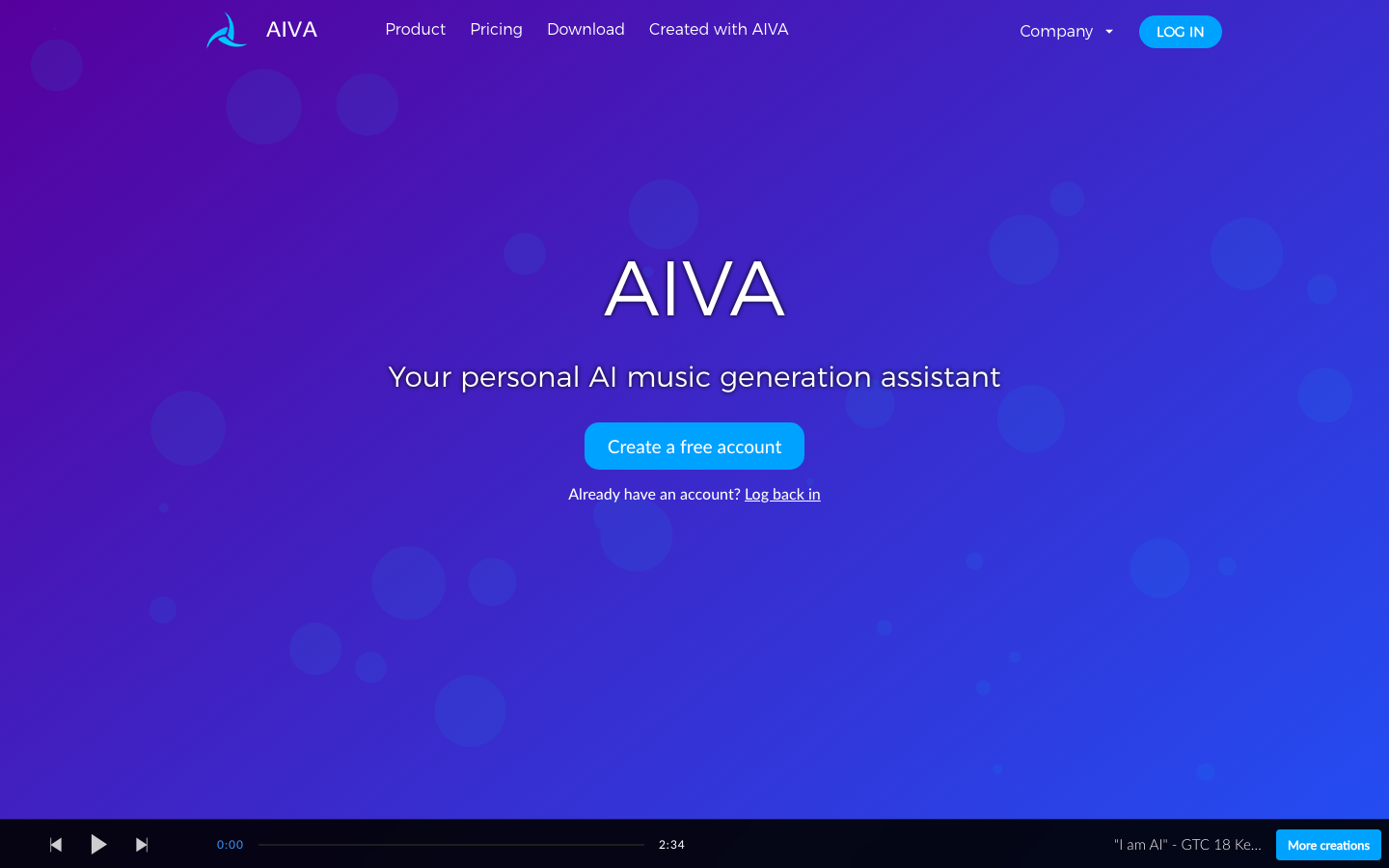
AIVA
AIVA’s core parameters and statistics
AIVA has a first-mover advantage in the field of AI composition for nearly ten years - it was founded in Luxembourg in 2016. It is one of the first AIs in the world to apply deep learning to classical music creation. It has even been officially recognized as a "composer" by the copyright agencies in France and Luxembourg, which is extremely rare among global AI music tools.
| Projects | Public Information |
|---|---|
| Official positioning | AI music generation assistant (250+ styles, covering classical/film and television soundtracks) |
| Founded | 2016, Luxembourg (Aiva Technologies SARL) |
| Style coverage | 250+ music styles |
| Output format | MP3, WAV, MIDI, sheet music PDF |
| Copyright model | The copyright of the free version belongs to AIVA; the copyright of the Pro version belongs to the user |
| Featured capabilities | Self-training style model, audio/MIDI influence file upload, symphony score generation |
| Partner customers | NVIDIA, Vodafone, Globant, TED, Pure Storage, etc. |
| Latest version | web-latest (~2026-06) |
| Support Platform | Web |
Core Difference: AIVA does not generate electronic loops or popular beats. Its core capability is "realistic orchestral scoring" - the arrangement texture of violins, cellos, brass, woodwinds, and percussion. This is an area that most AI music tools (such as Soundraw, Beatoven) cannot cover. Music generated by AIVA can be exported directly to MIDI and score PDF for use by a live orchestra, making it irreplaceable in professional composition scenarios.
Version number description: AIVA does not adopt a semantic version number system, and the official page uses web-latest to identify the current public version. The "2026.1" displayed on the page is an internal version mark, a standard version number that is not publicly released. This record is subject to verifiable information on the public page.
AIVA’s users and market recognition
AIVA's market recognition is mainly reflected in enterprise-level customer endorsement and industry legal status, rather than public DAU or financing figures.
Enterprise Customer Matrix: The cooperative enterprises disclosed on the official website span the fields of technology, communications, consulting and media, including NVIDIA, Vodafone, Globant, Pure Storage, TED, Animo TV, Nordic Business Forum, etc. These customers use the music generated by AIVA for product promotion videos, brand content, event soundtracks and other scenarios, indicating that it has been verified by medium and large enterprises in the field of commercial soundtracks. In addition, the Luxembourg Ministry of Culture appears as a government agency client, suggesting that AIVA has received recognition from the local government at the cultural and creative industry policy level.
Speciality of legal status: AIVA is recognized as a "composer" by the copyright authorities in France and Luxembourg, which means that musical works generated by AIVA can legally have copyright ownership rights. This precedent is of benchmark significance in a global context where AI copyright legislation is not yet complete. It blurs the gray area of "whether AI-generated products are copyrighted" and provides a predictable legal basis for the commercial realization of AIVA users, at least in the jurisdictions of France and Rwanda.
Industry Coverage: The product page showcases more than 150 complete tracks generated by AIVA and arranged by humans, which can be listened to through major streaming platforms such as YouTube, Spotify, Apple Music, SoundCloud, etc. This shows that AIVA has moved from a laboratory prototype to a stage that can be mass-produced and delivered, and the generated music works have a quality basis for public release.
Missing items in public data: AIVA has not disclosed operating data such as the number of registered users, monthly active users, and revenue scale. Its financing history, team size, and technical paper release status are not shown on the public page. This lack of information makes it difficult to make precise judgments about AIVA's commercial health.
AIVA’s cost advantage: structured dismantling of three-tier pricing and copyright games
AIVA's cost structure is not just a price list, it is essentially a set of "copyright ownership grading" business designs - users pay not only for the generation capacity, but also for the legal ownership level of the musical works.
C-side/individual users: AIVA provides three subscription tiers, which are progressively increased based on download volume, sound quality and copyright ownership.
| Plan | Monthly fee (annual payment) | Monthly downloads | Maximum song length | Output format | Copyright ownership | Commercial scope |
|---|---|---|---|---|---|---|
| Free | €0 | 3 times | 3 minutes | MP3, MIDI | AIVA owned | Non-commercial use only, attribution required |
| Standard | €11/month (annual payment €132) | 15 times | 5 minutes | MP3, MIDI | AIVA all | YouTube/Twitch/TikTok/instagram monetization only |
| Pro | €33/month (annual payment €396) | 300 times | 5 minutes 30 seconds | All (including WAV, PDF scores) | User owned | Unlimited |
Real limitations of the free version: Free level is limited to 3 downloads per month, maximum 3 minutes, non-commercial use only and must be marked with AIVA attribution. This positioning determines that the free version is only suitable for experience and evaluation, and any substantive content creation needs cannot be completed within the free framework. For individual creators looking to use AI music for commercial projects, Standard or Pro are the real tickets.
Developer/API Layer: AIVA does not provide a public API or developer access solution. The official website pricing page only has three-column entries for personal subscription, student/school and enterprise. For the enterprise version, you need to contact the business to obtain a customized quotation. This means that AIVA is currently positioned as an "end-to-end product" rather than a "platform capability output", and developers cannot embed AIVA's music generation capabilities into their own applications like they can by calling the API of Stable Audio or ElevenLabs.
Enterprise/Team Tier: Enterprise version pricing is not disclosed, please inquire through the contact form or online chat. Extrapolating from the base price of €396 per year for the Pro version, the Enterprise version may involve multi-seat management, custom-style model training, priority technical support, and more flexible copyright terms. Specific procurement thresholds, minimum seat requirements, and annual contract cycles require business confirmation, which will incur a certain time cost for teams with centralized procurement needs.
Main functions of AIVA
AIVA's feature set is designed around the full link of "from inspiration creation to finished product delivery", and its core value lies in compressing the days-long process of "finding inspiration → drafting → iteration → delivery" in traditional soundtrack work to minutes.
-
250+ styles instantly generated: covering classical (baroque, classicism, romanticism, modern classical), film and television soundtracks (epic, suspenseful, warm, tense), world music and pop styles. The user selects a mood label (sad, joyful, epic, dark, etc.) and duration, and AIVA outputs the complete arrangement in seconds. Value of use: Traditional composers need 2-3 days to complete the first draft arrangement of a 3-minute orchestral piece. AIVA shortens this step to less than 10 seconds, and the output arrangement has a complete structure and reasonable harmonic logic.
-
Custom Style Model: Users can upload their own audio or MIDI files as "influence", and AIVA learns its melody characteristics, harmonic progression and arrangement structure to generate works with the same style but brand-new content. This is the core capability that distinguishes AIVA from static style library tools - it is not a fixed style selector, but a migratory style engine. Use Value: For game soundtracks or brand audio and video projects that need to maintain a unified style for the series, this feature can significantly reduce duplication of work.
-
Deep Arrangement Editor: In the AIVA Web Editor, users can adjust the melody line, modify the harmonic progression, and add or delete instrument tracks (such as adjusting the violin part individually or adding a new brass section). The editing results can be listened to in real time. Use value: AI generates "draft-level" arrangements, which can be delivered as final products after professional users fine-tune them through the editor. From "pure AI output" to "human-machine collaboration refinement", this is the key difference between AIVA and "one-click generation and delivery" tools.
-
Score Export and MIDI Interaction: Supports exporting generated music as standard MIDI files and score PDFs. MIDI files can be further edited in any DAW (e.g. Logic Pro, Cubase, FL Studio); PDF scores can be used for live orchestra rehearsals. Use value: This opens a bridge between AI composition and human performance - composers can complete the arrangement framework in AIVA, export the score to a chamber orchestra or symphony orchestra for recording, which is extremely rare among pure AI audio tools.
-
Full-format download and high-quality WAV output: Pro users can download the highest quality lossless WAV files, suitable for professional film, television, game and broadcast-level broadcast distribution. Output formats cover MP3 (320kbps), WAV (48kHz/24bit), MIDI and PDF, meeting the full spectrum of needs from quick preview to broadcast-grade delivery.
AIVA model and version evolution
AIVA does not have public version numbers and model cards like large language models. Its version evolution is more suitable to be traced from the perspective of "product capability milestones".
2016: Founding Version—Classical Music Deep Learning
The core capability of the initial version of AIVA is classical music generation. The model is based on a deep neural network and trained on a large-scale classical music corpus (Bach, Mozart, Beethoven, Chopin, etc.). At this stage AIVA is recognized as a "composer" by the copyright authorities in France and Luxembourg, and is officially recognized by SACEM (French Association of Authors Composers and Music Publishers) and SOCAN (Luxembourg Copyright Society). The establishment of this legal identity precedes the commercialization of its product functionality.
~2019-2021: Style expansion and emotional soundtrack
AIVA has expanded from pure classical music to the field of film and television soundtracks, introducing an emotional tag system (sad, tense, happy, epic, etc.). Users can trigger the generation of soundtracks of corresponding styles through emotional keywords. The style library gradually expands from dozens to 100+. Commercial client cases began to appear at this stage, including cooperation in advertising soundtracks and game trailers.
~2023-2025: Custom style model and editing capabilities
AIVA launches the Custom Style Model feature, allowing users to upload their own audio or MIDI as a source of influence to train new styles. The web editor is online, supporting melody line and harmony editing. The style library is further expanded to 250+. The list of enterprise customers has grown to include leading brands such as NVIDIA, Vodafone, and TED.
2026 Current: Full-link delivery platform
The capability set of the current version (web-latest) includes: 250+ style instant generation, self-training style model, audio/MIDI influence upload, online arrangement and editing, full-format multi-track download Pro version complete copyright transfer. AIVA has evolved from a single "classical music AI" to an end-to-end platform for professional soundtrack scenes, covering the entire process from creative exploration to finished product delivery.
Version diagram:
- 2016 ~ —— AIVA Classic, classical music generation, recognized as "composer" by the copyright agency
- 2019-2021 ~ —— Emotional soundtrack is online, and the style library is expanded to 100+
- 2023-2025 ~ —— Custom style model + Web editor, large-scale enterprise customers
- 2026 ~ —— web-latest, 250+ styles, full-link delivery, Pro copyright transfer
Version Note: AIVA does not use semantic version numbers. The above time nodes are based on public page milestones and are not anchored by official version release announcements. Regarding the underlying technical details such as model architecture, parameter volume, and training data scale, the official has not publicly disclosed it.
AIVA’s technical advantages
AIVA's technical route selection is fundamentally different from general-purpose AI music tools: it does not pursue "generating any style", but focuses on "producing classical/orchestral music generation quality to a professional level".
Technical path for deep learning music generation: AIVA's core model is based on the Transformer architecture and large-scale symbolic music corpus (MIDI format) training. Unlike most AI music tools that directly generate audio waveforms, AIVA first generates symbolic music representations (i.e., MIDI sequences) and then renders them into audio through high-quality virtual instrument sound sources (VST). This two-stage architecture of "symbol generation → audio rendering" brings two engineering advantages: first, the generated music has the mathematical rigor of harmonic logic (because MIDI is essentially a structured music language), and second, it can output sheet music PDF for human performance. The price is that the upper limit of the output sound quality is limited by the quality of the virtual sound source used by the renderer, rather than the audio directly generated by the model.
Style transfer mechanism: AIVA's Custom Style Model is not a simple style classifier, but implements the process of "style feature extraction → re-synthesis" by fine-tuning the attention weight of the base model. User-uploaded audio/MIDI influence files are first analyzed into multi-dimensional musical features (melodic contours, rhythmic density, harmonic tempo, timbre distribution), which are encoded into style embedding vectors and then injected into the generation process to control the output style. The advantage of this method is that it has high style fidelity and strong controllability. The disadvantage is that it requires users to upload reference materials of sufficient length (usually at least 30 seconds or more), and the training process requires several minutes to tens of minutes of calculation time.
Industry Uniqueness - Pipeline from MIDI to Score: AIVA is currently one of the very few AI composition tools that can output standard score PDF. This means that it serves not only "people who need background music" but also "composers who need to write scores for orchestras." This capability has few competitors among AI music tools—Suno and Udio output pure audio, and Soundraw and Beatoven output stereo WAV, both of which cannot generate symbolic scores. This technical pipeline of AIVA makes it have unique legal and practical value in education (music theory teaching), live performance (orchestral performance) and copyright registration (music scores as the basis for copyright registration) scenarios.
Technical Limitations: AIVA's generation quality on non-classical styles (electronic, pop, hip-hop R&B) is significantly weaker than classical/orchestral styles. This is because its training corpus is mainly based on classical and film and television soundtracks, and does not adequately model the rhythmic characteristics of modern pop music (such as syncopated 808 drum beats and synthesizer timbre design). In addition, the generation speed of AIVA is limited by the sequence length of symbolic music generation - a 5-minute orchestral piece corresponds to about 30,000-50,000 MIDI events, and the generation delay in a Web context is usually 10-30 seconds, which is higher than that of pure audio generation tools.
AIVA usage path
AIVA currently only provides web services, no desktop application or mobile app, and no open API or SDK. The usage path revolves around the three stages of "creation→editing→downloading".
Register and start creating: Visit aiva.ai to create a free account (no credit card required) to enter the creation interface. There is no need to install any software, all processing is done in the cloud. This is AIVA’s most novice-friendly design yet – the entire process from visiting a web page to hearing your first AI-generated track takes less than 2 minutes.
Typical steps:
- Choose a Style/Mood: Choose a base style from a library of 250+ styles, or start from a mood tag (Sad, Joyful, Epic, Tension, Dark, etc.) and let the AI match the style.
- Set parameters: Set the track duration (up to 5 minutes and 30 seconds, depending on the subscription level), instrument arrangement preference (such as only string quartet vs full orchestra).
- Generate and Audition: Click Generate and wait 10-30 seconds before you can audition online. Can be regenerated unlimited times until satisfied.
- Influence file upload (advanced): Upload a reference audio or MIDI file, AIVA learns its style characteristics and generates a new song with a consistent style.
- Editing and Refinement: Adjust the melody line, harmony progression and instrument configuration in the web editor, and you can listen to each modification immediately.
- Download and usage rights confirmation: Select the required format (MP3, WAV, MIDI, PDF) to download. Free users need to confirm the signature terms; Pro users get full commercial use rights after downloading.
Comparison table between multi-entry and multi-form:
| How to use | Suitable for the crowd | Function restrictions | Cost |
|---|---|---|---|
| Web free version | Personal assessment, students | 3 downloads/month, 3 minutes long, signature required, non-commercial use | €0 |
| Web Standard | Content Creator (YouTube/Twitch/IG) | 15 times/month, 5-minute song length, limited platform profit | €11/month (annual payment) |
| Web Pro | Professional composer, film and television/game developer | 300 times/month, all formats, full copyright | €33/month (annual payment) |
| Enterprise version | Team, organization | Business communication confirmation required | Unpublished |
| Students/schools | Educational institutions | Need to contact business to get discounts | Undisclosed |
Remote collaboration capability: AIVA's web-based features naturally support remote collaboration. Team members can work together on the same style library and project assets through shared accounts or the Enterprise version’s multi-seat management, but AIVA does not currently offer online collaborative editing capabilities like Splice or Soundtrap.
AIVA Product Pricing
AIVA's pricing is ostensibly a subscription system, but is essentially "tiered pricing for copyright purchase" - the price paid by users is highly positively correlated with the range of music copyrights acquired, and is not solely linked to the quantity or sound quality generated.
Comparison of three levels of personal subscription (already presented in a table in the previous chapter on cost advantages). The following is the interpretation of the implicit boundaries of each gear:
-
Free version (€0/month): 3 downloads per month seems to be enough for a trial, but since you are not necessarily satisfied after each build, the actual number of available times is much lower than the advertised number. Additionally, the 3-minute limit means that it is impossible to generate full movie trailers or long video soundtracks (usually 60-90+ seconds of sustained soundtrack is required, but 3 minutes is enough for short films). Copyright is owned by AIVA and requires attribution - this means you cannot register the resulting music as your original work, nor can it be used in any commercial projects.
-
Standard version (€11/month, annual payment): annual payment of €132, monthly average of €11, targeted at content creators. Commercial use is limited to YouTube, Twitch, TikTok, and Instagram platforms and is limited to monetizing content on those platforms. Implicit restrictions: Cannot be used for movies, TV, games, radio, podcasts, paid courses, or any commercial projects that are not on the above four platforms. Copyright remains with AIVA and users are granted limited use license only.
-
Pro version (€33/month, annual payment €396): This is the only version where the copyright belongs to the user. The number of downloads has been upgraded to 300 times per month (an average of about 10 times per day), the song length has been extended to 5 minutes and 30 seconds, and WAV lossless format downloads and PDF score exports are supported. Key Terms: Please pay attention to the specific boundaries of "copyright owned by the user" - AIVA's official website states that Pro version users "own the full copyright of your compositions, forever", but this does not mean that the user owns the copyright of the AIVA model, nor does it mean that the user can blockchain NFT the generated music or use it in undefined scenarios. It is recommended that Pro users carefully read the original copyright clause in the Terms of Service before major commercial projects.
Enterprise Edition and Education Edition: Pricing is not disclosed, please contact the business to obtain it. The official website prompts that "Student & School discounts" are provided, and interested educational institutions should inquire through the contact form or online chat. The enterprise version may include services such as multi-account management, custom model training, priority customer service support, etc. The specific price and service scope are subject to business confirmation.
Update and Refund Policy: AIVA has not disclosed its refund policy and subscription suspension/cancellation process on its official website. Whether the subscription can be canceled at any time, whether the paid fees are refundable, and whether the right to use downloaded works will be affected after the account is downgraded from Pro to Free, these terms need to be carefully reviewed before purchasing.
Application scenarios of AIVA
AIVA's application scenarios are highly concentrated in areas that "require orchestral/classical music texture and copyright certainty." The following are four types of proven typical scenarios:
-
Film and Trailer Soundtracks: Independent films, short films, documentaries, commercials and game trailers are AIVA’s core adaptation scenarios. The user selects the mood (such as "epic", "suspenseful", "warm") and duration, and the orchestral soundtrack generated by AIVA can directly match the rhythm of the picture. Actual income: The average lead time for a traditional composer to score a 5-minute short film is 3-7 days (including communication, drafting, revision, and mixing), and the cost is in the range of €500-€3000. AIVA Pro's one-year subscription is only €396, and you can get 300 soundtracks with an annual payment. Although the finished product still requires manual screening and fine-tuning, the initial material output cost is reduced by more than 90%. Boundary Reminder: AIVA generates a "universal emotional soundtrack" that cannot accurately correspond to the specific action beats in the picture (such as the precise synchronization of character punches or explosions), and requires users to edit and align themselves. For cutscene soundtracks that require frame-by-frame matching, it is recommended to use AIVA to generate basic materials and then do fine editing in DAW.
-
Game sound effects and theme soundtrack: Independent game developers can quickly generate character theme songs, scene background music and battle soundtracks. AIVA's 250+ style library covers common game genres from fantasy (epic orchestral music) to science fiction (suspenseful atmosphere). Actual benefits: Independent game teams usually do not have a dedicated scorer budget (the outsourcing cost for a single game theme song is $200-$2000). AIVA can obtain 300 soundtrack materials per month for an annual payment of €396 for the Pro version, which greatly lowers the threshold for audio content production. With the Custom Style Model function, developers can train an exclusive music style library that is consistent with the game's art style to achieve auditory consistency in the series of works.
-
Background music for content creators: Content creators on YouTube, Twitch, TikTok, and Instagram can use the Standard version to generate video background music, and no additional authorization is required for use on this platform. Actual Benefit: The annual fee for traditional copyright-free music libraries (such as Epidemic Sound, Artlist) is in the range of €150-€300, but the music library is fixed and the style cannot be customized. AIVA Standard has an annual payment of €132, which is lower than the above-mentioned music library, but provides customizable AI generation capabilities, and the monthly quota of 15 songs is enough for the mid-range needs of ordinary creators.
-
Music Education and Composition Teaching: Score PDF and MIDI files generated by AIVA can be directly used for music theory teaching - students can analyze the harmonic progression generated by AI and observe the arrangement differences between different styles. Teachers can demonstrate different ways of handling the same melody theme under "Bach style vs Mozart style". Actual Benefits: Traditional composition teaching requires a large number of manual writing examples. AIVA can generate demonstration scores of specified styles in a few seconds, allowing students to intuitively feel the differences in composition techniques in different periods. For beginners in composing, AIVA can help quickly verify creative ideas - enter a motive and AI automatically develops it into a complete paragraph, reducing the frustration of going from inspiration to first draft.
Applicable groups of AIVA
AIVA's target audience is focused on creators and teams who "need orchestral music or high-quality background music, but do not have the budget or time to hire a human composer."
-
Independent Filmmakers and Video Producers: Independent creators who need to obtain professional-grade soundtracks quickly and at low cost and have clear copyright requirements. AIVA's Pro version pays €396 per year to obtain the commercial use rights of 300 complete soundtracks, which is far more cost-effective than hiring a composer or purchasing an existing music library license. Not suitable for the boundary: For commercial film and television projects that have strong artistic personality requirements for the soundtrack and need to be accurately synchronized with the picture to the frame level, it is recommended to use AIVA as an inspiration tool rather than a delivery tool. The final product still requires the participation of a professional composer.
-
Indie Game Developer: An independent game team with a limited budget but in need of a high-quality orchestral soundtrack. AIVA's custom style model is ideal for game development scenarios that require stylistic consistency across a series of works. Unsuitable Boundary: For complex game projects that require dynamic interactive audio (such as real-time switching of music mood layers based on player status in the game engine), the current version of AIVA does not support interactive audio segmented export or adaptive music system integration. For such needs, it is recommended to use Wwise or FMOD in conjunction with a professional composer.
-
Content Creators and Self-Media: YouTube, Twitch, TikTok and Instagram creators can use the Standard version to solve the copyright problem of video background music - the cost of €11/month is much lower than the annual subscription of traditional copyright-free music platforms. Not suitable for the boundary: Anchors who create electronic music (EDM), pop songs, hip-hop rhythms, etc. The generation quality of AIVA in these styles is weaker than that of specialized AI music tools (such as MusicLM or Stable Audio). It is still recommended to use professional DAW or alternative tools with a more matching style.
-
Music Educators and Composition Students: Music school teachers can use AIVA as a teaching aid to generate demonstration scores, and students can study the harmonic arrangement and style imitation of AI output. Prerequisite: Basic music theory skills are required to effectively evaluate and utilize AI-generated scores. Users who cannot read music at all cannot take advantage of AIVA's most differentiated score export feature.
-
Corporate Marketing and Brand Team: Corporate marketing department that needs to produce soundtracks for product videos, brand events, exhibition videos, etc. The complete copyright transfer of the Pro version ensures that the brand has ownership of the music assets and will not cause subsequent legal risks due to soundtrack copyright issues. Not suitable for the boundary: For enterprises that have extremely high originality requirements for brand-customized soundtracks (such as the need to tailor a unique music theme according to the brand's tonality and visual identity system), the universal style generated by AI may not be able to meet the brand's unique needs.
Summary and Outlook
AIVA has established a near-monopoly competitive position in the vertical field of "orchestral AI scoring" - it is not the AI music tool with the widest coverage, but it is the only solution that achieves professional-level quality in the fields of classical and film and television scoring, and it bridges the gap between AI creation and real-person performance through the score export function.
Current core advantages: The first-mover advantage in the past ten years has made its training data accumulation in the field of classical music generation far deeper than that of later-mover competitors; the legal status of being recognized as a "composer" by the French and Luxembourg copyright agencies constitutes a competitive barrier; the 250+ style library and custom style models enable the product to achieve a good balance between breadth and depth; the three-tier subscription pricing accurately maps the copyright demand ladder from non-commercial to full commercial publishing.
Current major limitations: Insufficient generation quality of style coverage outside classical/orchestral (modern styles such as electronics, pop, hip-hop, etc.); lack of API and mobile terminal limits its expansion space as a "platform capability"; the maximum single length of 5 minutes and 30 seconds poses a hard constraint for feature film scenes that require long and continuous soundtracks; web loading and generation delays are between 10-30 In the second range, there is still room for optimization for creative processes that require rapid iteration; the enterprise version price in the pricing strategy is not transparent, which increases the procurement evaluation cost for medium and large teams.
Industry Competition and Substitution Risks: AIVA currently has no direct competitors in the field of orchestral scoring, but potential threats come from two directions - on the one hand, general AI music platforms such as Suno and Udio may enter the orchestral field in the process of expanding style coverage; on the other hand, symbolic music generation tools such as Musico and Orb Composer may also form head-on competition if they introduce stronger AI engines. AIVA’s moat lies not in the technology itself, but in copyright recognition and ten years of accumulated classical music training data.
Follow-up observation points: Whether AIVA will open APIs to access game engines and film and television post-production pipelines; whether the accuracy and training speed of the Custom Style Model can be further improved; whether the mobile App or desktop offline version is in the roadmap; when will the pricing and feature details of the enterprise version be made public.
Acquisition & Adoption Risk Assessment: For independent filmmakers, game developers and content creators, AIVA Pro offers extremely low risk at €396 per year – the equivalent of a high-end dinner for a full year of 300 fully copyrighted commercial soundtracks. It is recommended to use the Free version for 1-2 weeks to evaluate real scenarios to confirm that its generation style meets the project needs before upgrading. For enterprise teams, you should focus on confirming the following terms before purchasing the enterprise version: the issue of the survival of the use rights of downloaded works after the subscription is canceled (whether the copyright purchased by the Pro version is held permanently); whether there are platform or media restrictions on the scope of commercial use (especially the authorization boundaries for TV broadcasts and theater screenings); whether the enterprise version provides the ability to manage multiple accounts, share style libraries, and integrate internal workflows. For educational institutions, it is recommended to apply for discounts through the contact form before making budget decisions, rather than purchasing directly based on the personal version.
Related tools:  ElevenLabs, udio
Version Info
- AIVA Web Latest :The official semantic version number has not been disclosed. It is recorded according to the public page status. There is no official precise date yet. The current version supports 250+ styles, self-trained style models, audio/MIDI influence file uploads.
- AIVA Public Milestone :There is currently no official precise date for historical nodes, and the minimum version context is established based on public milestones. Previous versions have supported emotional soundtrack generation and MIDI export, with a style library of about 100+.
- AIVA Classic (2016) :The initial version of AIVA was released, focusing on deep learning generation of classical music, and was recognized as a "composer" by the French and Luxembourg copyright agencies. There is no official precise date yet.
User Reviews