 Algolia
Algolia is the world's leading AI search engineas-a-service platform, providing AI-driven search and discovery experiences for e-commerce SaaS and enterprise applications.
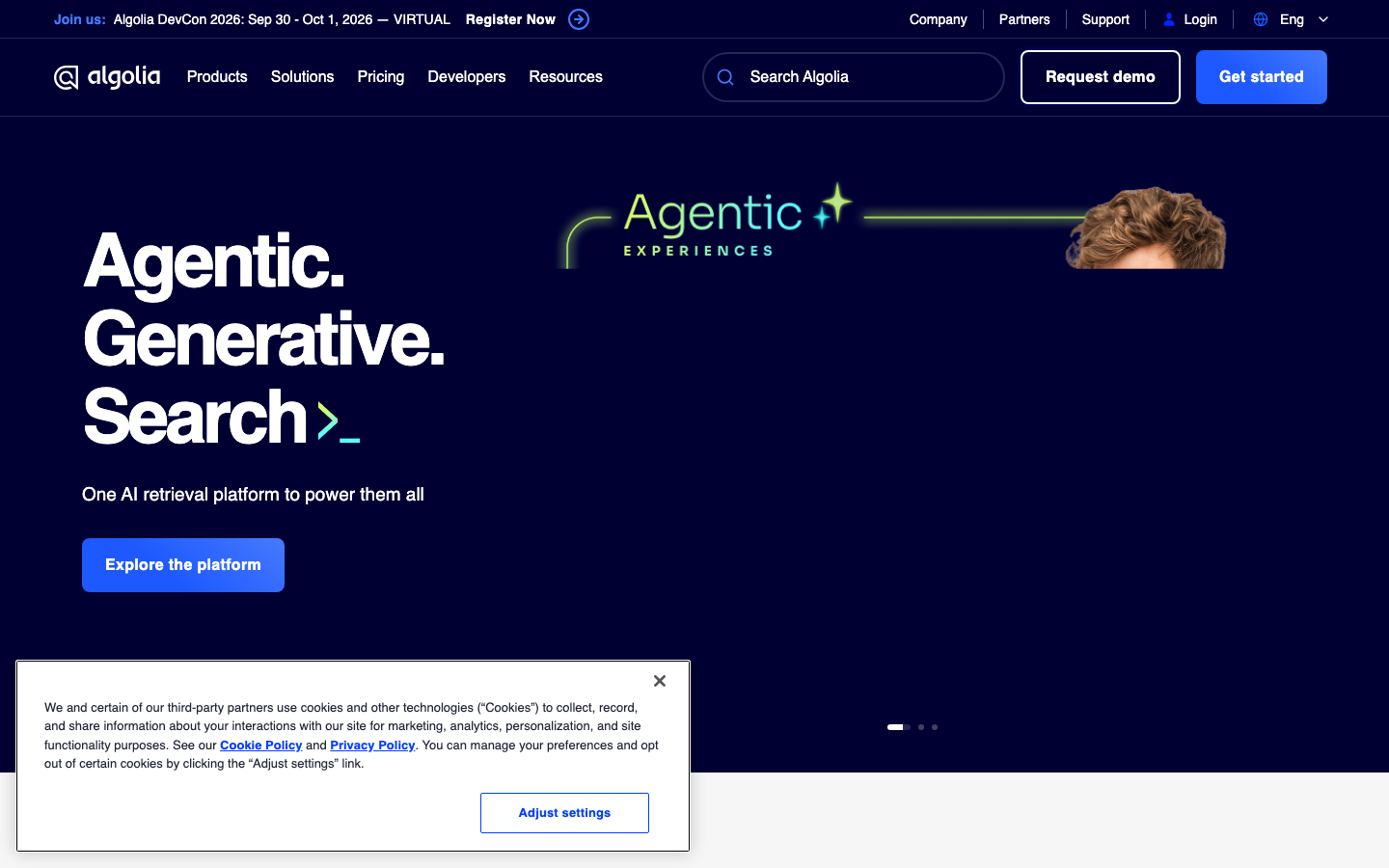
Algolia
Core parameters and statistics
| Parameter | Value |
|---|---|
| Product Positioning | The world's leading search-as-a-service platform |
| Core form | SaaS API + Web Dashboard + Mobile SDK |
| Target users | E-commerce platform SaaS products, enterprise-level applications |
| Core technology | Inverted index AI sorting, vector search, neural hashing, recommendation engine |
| Deployment method | Cloud SaaS / Hybrid cloud |
| Number of customers | More than 10,000 |
| Financing | Over $180 million |
| Latest version | Unpublished |
Algolia is a pioneer and leader in the Search-as-a-Service market. Unlike open source self-built search solutions (Elasticsearch, Typesense, Meilisearch), Algolia is a fully managed closed-source service. The core selling point is that it does not require an operation and maintenance team to obtain high-performance search and AI recommendation capabilities.
User and market recognition
Gradually build user awareness in the field, and product capabilities are used by content creators and teams to improve work efficiency. Some industry users have incorporated it into their daily workflow. It is recommended to refer to the latest official disclosures for specific user scale and industry adoption rate data.
Cost advantage
- C-side/Individual: Usually a free version is provided to experience the core functions, and high-frequency use requires a paid package subscription.
- API/Developer: Billed by call volume, suitable for development teams that can be flexibly integrated into their own systems.
- Enterprise/Privatized: Contact the business owner for customized quotation and deployment plan. The specific price is subject to the official real-time pricing page.
Main functions
- AI-driven search: Combining keyword search and AI semantic understanding, search results are automatically optimized and sorted based on user behavior data. Algolia’s AI ranking model will learn users’ click preferences so that results with high-frequency clicks will be ranked higher.
- Search-as-you-type: A search is triggered every time the user presses a key in the input box, and the response time is usually within 10ms. Search results are refreshed in real time, suitable for e-commerce shopping searches and navigation-based browsing.
- Personalized Recommendations: Embed personalized recommendations in search results based on the user's browsing history, purchase records and similar user behaviors. It is suitable for scenarios such as "guess you like" on e-commerce homepages and product details pages.
- Multi-language and multi-tenant: Built-in multi-language word segmentation, supporting search indexing in 200+ languages. The multi-tenant architecture allows data in an index to be isolated by user/merchant, which is suitable for platform-based e-commerce.
- A/B Testing and Search Analysis: Provides A/B testing capabilities for search effects - compare the click-through rate, conversion rate and other indicators of different sorting strategies, search configuration variants, and use data to drive search optimization.
Model and version evolution
Continuous iterative updates, the latest version introduces performance optimization and new features. Historical version information can be viewed on the official release page. There is no complete public version evolution timeline yet. It is recommended to pay attention to the official announcement to understand the rhythm of feature updates.
Technical advantages
Fully Managed Performance: Algolia's search response time is typically 20-50ms, which is better than most home-built Elasticsearch solutions (typically 100-500ms). This performance advantage comes from its self-developed distributed search network and pre-aggregated index architecture, which is of practical value for high-concurrency search scenarios such as e-commerce promotions.
Search + recommendation in the same index: Search and recommendation use the same data source and index structure, and new data takes effect in both systems at the same time, avoiding synchronization problems between multiple systems. This is a differentiated design at the technical architecture level, but it requires users to accept Algolia’s index model.
InstantSearch front-end ecosystem: Algolia provides an InstantSearch UI component library covering mainstream front-end frameworks, reducing the amount of search UI development. This is the competitiveness of the platform in terms of developer experience, but it should be noted that the customization freedom of the component library is limited, and complex interactions need to be expanded by themselves.
How to use
| How to use | Suitable for people | Features | Cost |
|---|---|---|---|
| Free Plan (Development Edition) | Individual Developer | 10,000 search requests/month | Free |
| Pay-as-you-go | Small and medium-sized teams | Billed by search request and number of records | Billed by volume |
| Enterprise | Large enterprise | Dedicated cluster SLA, SSO | Business confirmation required |
Typical usage process: Create applications and data indexes in Algolia Dashboard, upload data and configure search properties (searchable fields, search weight facets), and integrate into the front end through API or InstantSearch library. For vector search, you need to upload additional data Embedding or use Algolia's built-in Embedding endpoint.
Product Pricing
Algolia adopts a tiered subscription model and is billed based on the number of search records and API calls.
- C-side/Developer (free version): Provides a free community version, including a limited number of searches (about 10,000 searches/month and 10,000 records), suitable for personal projects and small applications.
- Business Client/Professional Edition: Charged monthly based on search quota (number of searches/month) and number of indexed records. It starts at about $500/month, and the larger the search volume and the more features (AI sorting, personalized recommendations, etc.) the higher the price. Overage is charged on a per-use basis.
- Enterprise/Premium: Includes unlimited search quota, dedicated cluster SSO integration, premium SLA, and dedicated Customer Success Manager. Pricing is on an annual contract basis, typically starting in the tens of thousands of dollars per year.
Algolia is more expensive than open source self-built solutions, but it saves the labor costs of DevOps and search engineers.
Application scenarios
- Search within the e-commerce site: Algolia’s core application area. When users search for products on e-commerce websites, they get instant, fault-tolerant, personalized search results, and AI automatically optimizes the sorting - the search results seen by users who prefer high-end brands will prioritize high-end products.
- SaaS application global search: Cross-entity search in SaaS applications such as CRM, project management, customer service systems, etc. Users can find customers, work orders, contracts, documents and other content types in one search.
- Content discovery and navigation: News websites and content platforms use Algolia's recommendation function to implement article recommendation and channel navigation, and adjust the content display order according to readers' historical preferences.
Applicable people
- E-commerce and technical team: For teams that need to provide a high-quality search experience on the front end, Algolia's fully managed solution saves operation and maintenance costs compared to self-built search. It is not suitable for scenarios where the search logic is extremely complex or where complete control of the search algorithm is required.
- SaaS Product Developers: Teams who need to integrate fast search within their product, Algolia's API design and front-end libraries make the integration cycle controllable.
- Content Platform Operation: Media and community teams who need content recommendation and intelligent search to increase user engagement.
- Not suitable for the crowd: Data-sensitive organizations that require complete offline deployment (Algolia has no private deployment option); large platforms with huge search volume (hundreds of millions of searches per month) and can build their own search engineering teams - at this time, self-built Elasticsearch/OpenSearch solutions may have more advantages in long-term costs; and purely semantic search scenarios that only require vector search but not full-text search - the experience of dedicated vector databases (such as Pinecone) is more direct.
Summary and Outlook
Algolia has a solid position in the search-as-a-service space, with AI search and personalized recommendation capabilities as its moat. Compared with open source solutions, Algolia's advantage lies in its rich operation-free AI optimization and global CDN acceleration. However, the higher cost and completely closed-source business model means the risk of supplier lock-in.
Current limitations: Completely closed source commercial product, the underlying code cannot be audited; as search volume increases, the cost increases non-linearly; data is stored in the Algolia platform, and data migration out of Algolia may require additional work; advanced features (AI sorting, personalization) are only available in the enterprise version.
Procurement/Adoption Risk Assessment: It is recommended to use the free version for proof of concept first, and then upgrade and pay after confirming that the search quality is up to standard. When purchasing, you need to pay attention to: ① The matching of search quotas with actual business peaks to avoid excess fees during peak periods; ② Data export capabilities and formats to reduce the risk of supplier lock-in; ③ The terms of the enterprise version contract regarding service availability SLA and data encryption (TLS/static encryption). For enterprises with sensitive data sovereignty, it is recommended to confirm Algolia's data center optional regions.
C client/individual developer: Provides free development version (Free Plan), including 10,000 search requests, 50,000 records and 2 applications per month. Suitable for personal project prototype verification and small traffic sites. After exceeding the limit, you will need to pay for an upgrade.
Developer/API calls: Billed based on the number of search requests and records. Taking the paid starter version as an example, the monthly fee is about $0.50/1,000 search requests (including 10,000 records). The unit price decreases as the traffic increases. AI capabilities such as vector search and NeuralSearch require additional billing, usually based on a combination of the number of index records and query volume. Please refer to the official real-time pricing page for details.
Enterprise/Private: The enterprise version signs an annual contract based on traffic and functional requirements, including SLA, dedicated cluster SSO, audit logs, etc. Enterprise pricing is not public and requires business confirmation. For sites with an average monthly search volume of more than 10 million times, enterprise contracts can usually obtain better unit prices.
Hidden costs: The main cost of migrating from self-built Elasticsearch to Algolia is not the API fee, but the data model reconstruction and search logic adjustment (Algolia uses custom ranking rules instead of traditional inverted indexes). The engineering investment for the initial migration may be underestimated. Additionally, vector searches require an additional fee, the cost of which is linearly proportional to index size and query frequency.
Complete tool guide for Algolia
Key features of Algolia AI
- Full-text search: The core starting point of Algolia, supporting typo tolerance, faceting, instant search and custom ranking rules. The response time is usually within 50ms, which is suitable for front-end scenarios that require extremely high search speed.
- NeuralSearch (vector search): Introducing Embedding vector search to achieve matching based on semantics rather than keywords. Suitable for synonym recognition, long-tail query matching and other scenarios. The data needs to be vectorized and uploaded, and charges are based on the vector index size.
- AI Recommendations: A personalized recommendation engine based on user behavior and product similarity, sharing data index with search to reduce data maintenance work. Suitable for e-commerce product recommendation and content recommendation scenarios.
- AI Answers: Combine search results with LLM to generate natural language answers, suitable for document search, help center and FAQ scenarios. Please note that LLM output latency may affect the overall response experience.
- AI Analytics: Search behavior analysis tool, providing search term ranking, no result rate, click-through rate and other indicators to help optimize search configuration.
Version evolution of Algolia AI
Algolia's product evolution has gone through three stages, from classic search to AI unified platform.
Classic search era (before ~2023)
- Algolia v3 (~2023-11): Full-text search productization milestone, this is the version that most existing users are still using. Marked by instant search, typo tolerance, and manageable ranking.
AI capability loading period (2024-2025)
- Algolia AI Recommend (~2024-09): An independent recommendation engine, with the same index as search.
- Algolia NeuralSearch (~2025-06): Vector search and semantic understanding are online, and the original search logic is upgraded.
AI Unified Platform (2026+)
- Algolia AI (~2026-03): Unifying search and recommended AI answers into a single API, this is the latest stage. Old users may need to migrate their index configuration to adapt to the new architecture.
Product Pricing for Algolia AI
Algolia's pricing model is tiered by search request volume and usage features:
- C client/individual developer: Free Plan has 10,000 search requests and 50,000 records per month. The service will be stopped after exceeding the limit. Good for demos and prototypes.
- Developer/API: The paid starter version is about $0.50/1,000 search requests (including 10,000 records), and AI functions (NeuralSearch, AI Recommend) require additional fees. There is no fixed monthly fee, settlement is based on actual usage.
- Enterprise/Private: Enterprise contracts are signed annually and include dedicated clusters, custom SLA, SSO, audit logs, and pricing is based on search volume and feature set. For details, please refer to the official real-time page and business contract.
Application scenarios of Algolia AI
- E-commerce product search: Algolia's most typical scenario, covering product title search, category filtering, personalized sorting and "search as you type" instant search experience. The benefits are reflected in the shortened time for users to find the target product and the increase in conversion rate, but ranking rules need to be properly configured according to the unique attributes of the product data (price, inventory, sales volume).
- Help Center and Knowledge Base Search: Use AI Answers to combine search results with generative answer output to reduce the number of steps for users to browse help documents. Attention needs to be paid to the accuracy and citation visibility of LLM output.
- Content Discovery and Recommendation: Combined with AI Recommend to push relevant content at the bottom of the article or video list, it is suitable for content platforms and media sites to increase user retention time.
- SaaS In-Product Search: Integrate global search across SaaS products to search commands, settings, documentation, and user data. Algolia's responsive experience better meets user expectations than Elasticsearch in this scenario.
Summary and Outlook
Algolia AI is known in the search API market for being low-latency, fully managed, and developer-friendly. Its transformation from classic search to AI search is the right direction, but core users need to consider the migration costs of upgrading the new architecture and the additional costs of vector search.
Current Limitations and Uncertainties: No private deployment option is a hard boundary for organizations sensitive to data sovereignty; the performance of NeuralSearch and AI Answers is highly dependent on data quality and Embedding strategy, and the initial configuration quality may be lower than expected; the additional billing structure for vector search may exceed the budget when the data volume grows.
Procurement/Adoption Risk Assessment: It is recommended to start with the Free Plan to verify the search effect and response time, focusing on testing long-tail queries and semantic matching effects. Pre-purchase review: Vector search price versus data size LLM cost allocation for AI Answers, SLA coverage in enterprise contracts, and engineering costs for migrating from existing search solutions (Elasticsearch, etc.).
Related tools: perplexity, you-com
Version Info
- Algolia AI Search latest version :There is no official precise date yet, and the AI search and recommendation engine will continue to be iterated.
- Algolia first edition :There is no official precise date yet when Algolia launches SaaS search service.
User Reviews