 Algolia Search
Algolia is the world's leading search-as-a-service platform, providing millisecond-level full-text search AI personalized recommendations and search analysis capabilities, and is used by hundreds of thousands of websites and apps.
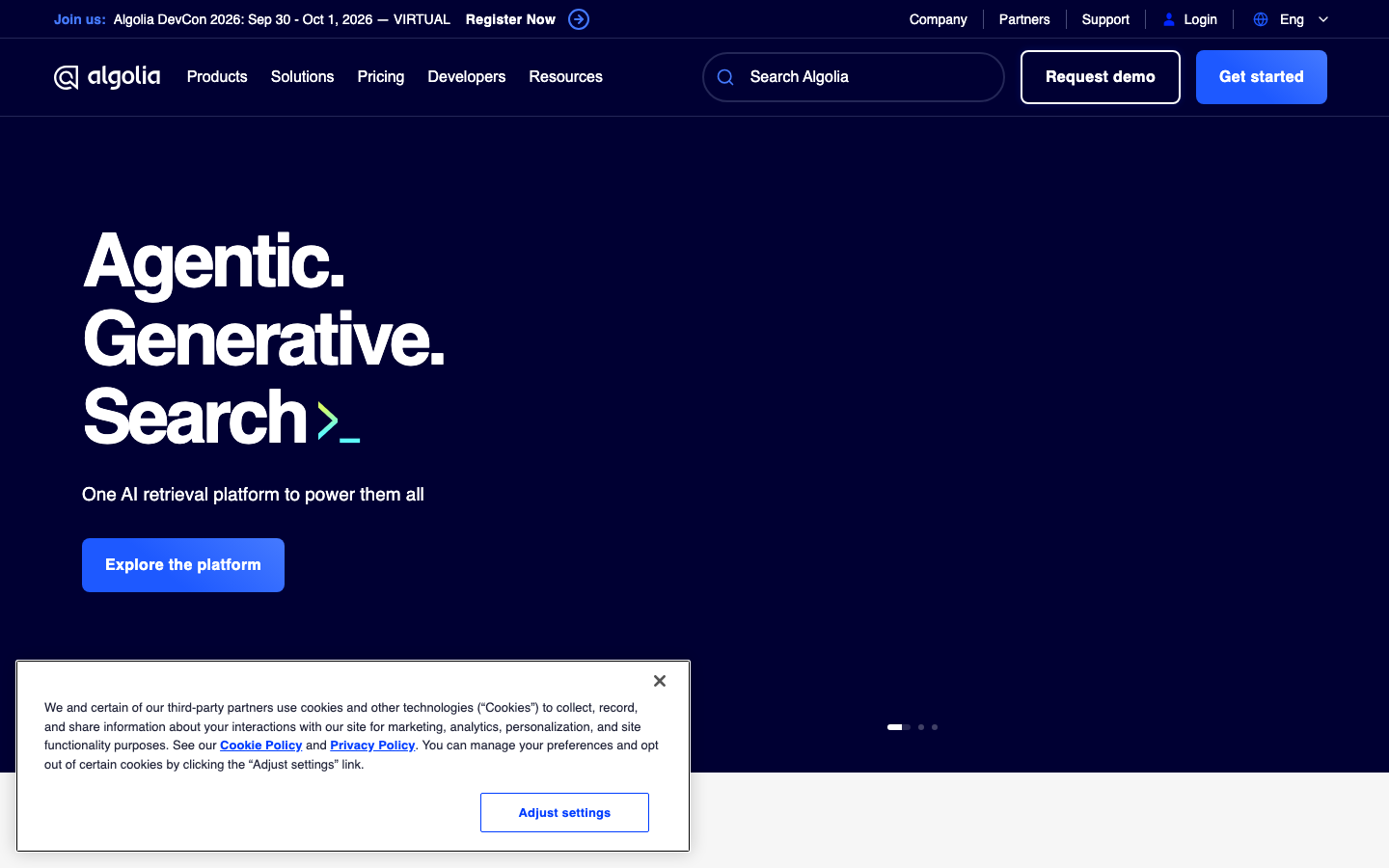
Algolia Search
Core parameters and statistics of Algolia Search
Algolia is a benchmark product in the SaaS search infrastructure market, known for its millisecond response speed and front-end component ecosystem. Unlike Elasticsearch's self-built solutions or open source alternatives such as Meilisearch, Algolia has chosen a fully managed closed path - from index writing to front-end rendering is completed by the same platform, and users do not manage servers, do not tune JVM, and do not worry about sharding strategies.
| Projects | Public Information |
|---|---|
| Official Positioning | Search-as-a-Service (Search as a Service) |
| Search type | Full text search + vector search (NeuralSearch) + hybrid search |
| Response speed | < 50ms (P95) |
| Index writing | Real-time update (effective in seconds) |
| Front-end components | InstantSearch (React/Vue/Angular/iOS/Android/Flutter) |
| Deployment method | Global SaaS multi-region nodes |
| Analytics | Search Analytics Dashboard + A/B Testing |
| Customer scale | 100,000+ (including Stripe, Twitch, Medium, etc.) |
| Total Funding | More than $180 million (including 2022 Series C) |
| Headquarters | San Francisco, USA (established 2012) |
Core Difference: Algolia's moat is not in the search algorithm itself (Elasticsearch's BM25 is not weak), but in the "full-link ownership of the front-end search experience." The InstantSearch component library allows front-end developers to embed a professional search bar with auto-completion, faceted filtering, paging, and highlighting in 30 minutes, with almost no back-end involvement. This "front-end-driven search delivery" model is fundamentally different from Elasticsearch's "back-end index first" engineering paradigm.
What response speed actually means: 50ms P95 means 95% of search requests are returned within 50ms. This is still true during peak e-commerce sales periods (such as Black Friday, when thousands of queries per second occur) because Algolia's distributed search network has pre-set cache nodes in multiple regions. Compared with the typical latency of a self-built Elasticsearch cluster under the same concurrency (100-500ms P95), Algolia has a half-second perceptual advantage in the user experience dimension - user research shows that for every 100ms increase in search latency, the conversion rate decreases by about 1%.
Collaboration method of search types: Algolia's hybrid search is not a simple weighted fusion of "keywords + vectors", but adopts a two-level architecture - keyword search (inverted index) first performs preliminary screening and recall, and vector search (NeuralSearch) performs semantic reordering based on the recall results. This means that even if the user turns on NeuralSearch, the bottom layer still relies on keyword search to ensure the baseline recall rate, and vector search is only responsible for refining the top results. The actual effect of this design is: there is a significant improvement for long-tail, descriptive queries (such as "breathable office chairs suitable for long periods of sitting"), but there is no risk of degradation for precise keyword matching scenarios (such as product model searches).
User and market recognition of Algolia Search
Algolia's market recognition presents a two-tier structure of "leading enterprise benchmark + long-tail site penetration", covering well-known products such as Stripe, Twitch, Medium, Dockers, etc., and also attracting hundreds of thousands of small and medium-sized sites through the free version.
Endorsement from top customers: Publicly available benchmark customers include Stripe (API document search), Twitch (channel and content search), Medium (article discovery), Dockers (e-commerce site search), Macy's (e-commerce search), etc. The common characteristic of these customers is that the search experience directly affects core business metrics (Stripe's developer documentation findability, Twitch's user discovery time, Macy's search conversion rate), and therefore they are willing to pay for professional search infrastructure.
SaaS search market share: In the SaaS search track, Algolia is usually considered to compete with Elastic Cloud, Meilisearch Cloud, and Typesense Cloud. Algolia leads in the two dimensions of "front-end search experience" and "developer integration speed", but is at a disadvantage in "search customization flexibility" and "large-scale self-construction costs". In search market reports by third-party analysts such as Gartner, Algolia is classified as one of the leaders in the "search as a service" category, but specific market share figures are not disclosed.
Community and Developer Ecosystem: Algolia’s InstantSearch and related libraries have a total of more than 30,000 stars on GitHub, and npm’s weekly downloads reach millions. The official documentation (algolia.com/doc) covers integration guides for 20+ languages and frameworks, and the Discord community and forum activity are at the forefront of similar tools. But note: Algolia's GitHub repository is mainly a client library and integration examples. The core search engine code is closed source, and the community cannot review or contribute to the search algorithm itself.
Industry evaluation: In third-party evaluations, Algolia generally receives high scores (G2 score of approximately 4.5/5) in terms of front-end search experience (InstantSearch ease of use, document quality, and speed of getting started), but has low scores in the "cost-effectiveness" and "data control" dimensions. Most criticisms focus on: the non-linear rise in costs as traffic increases, the inability to easily export data to other platforms, and the need for additional fees for AI functions such as vector search.
Cost Advantages of Algolia Search
The cost structure varies depending on the usage method: C-side users can usually experience core functions through the free version, and high-frequency usage requires subscribing to paid packages; developers/API users are billed based on the number of calls; enterprise-level users need to contact the business to obtain customized quotations. The specific price is subject to the official real-time pricing page.
Main features of Algolia Search
Algolia's functional design revolves around "front-end search experience". It does not provide a universal search API, but encapsulates search from back-end capabilities into a complete product that can be consumed by the front-end.
-
Instant Search: The core engine supports typos tolerance (error-tolerant spelling - automatically matches "iPhone" when the user enters "ipnone"), prefix search (enter "sho" to instantly display "shoes", "shorts", "shopping"), facet filtering (dynamic filtering by brand, price range, color, etc.), custom ranking formula (can be combined with sales, reviews, freshness and other business indicators to define sorting rules). Applicable tasks: E-commerce product search, document site content retrieval, SaaS global search. Implementation Tips: The attenuation of the ranking formula's effect after the index data exceeds 100,000 items needs to be tested in advance - Algolia's ranking engine works in a "front-end defined rule" manner and lacks the learning-to-rank depth of Elasticsearch. Complex ranking scenarios (such as personalization + sales + advertising weighting) may require an external ML ranking model for secondary ranking.
-
NeuralSearch (vector search): Semantic search capability officially launched in 2025. The text is converted into vectors through the Embedding model, and semantic reordering is performed on the keyword recall results. The core is to solve the keyword mismatch problem of "descriptive queries" (such as "lightweight headphones suitable for running"). Mechanism: Algolia provides built-in Embedding endpoints (users do not need to build their own Embedding services), and can also upload custom vectors. Vector search fees are independent of full-text search, and are charged based on the number of index records. Applicable tasks: long-tail query matching, synonym identification, content recommendation. Current Limitations: The effect of vector search in Chinese is weaker than in English - the blurred boundaries of Chinese word segmentations lead to fluctuations in Embedding quality, which requires sufficient A/B testing verification.
-
AI Recommendations: A personalized recommendation engine that shares the same data index as search. Based on user behavior (browsing, additional purchase, purchase) and product similarity, recommendation snippets such as "Guess you like it" and "Users who bought this product also bought it" are generated. Synergy: The shared index for search and recommendation means that product information updates take effect in both systems at the same time, avoiding data synchronization delays and consistency issues between the search index and recommendation engine in traditional solutions. But please also note: Shared indexes also mean that the recommendation logic is limited to the schema design of the search index. For scenarios that require independent recommendation feature engineering (such as user portrait embedding splicing), Algolia is less flexible than a dedicated recommendation engine.
-
AI Analytics and Search Analysis Dashboard: Provides zero-result queries (users searched for something but found no results), popular search term rankings, search click-through rate (CTR), search conversion rate and other operational indicators. Use value: Help search operators identify "search blind spots" - for example, a large number of users search for "membership discount" but return zero results, indicating that the relevant content is not included in the index or synonyms need to be added. Search analysis is one of Algolia’s differentiated values compared to Elasticsearch bare clusters—the latter requires the addition of Kibana and search operation dashboards.
-
A/B Test: Comparison between different variations of a search configuration - variation A increases sales weight in certain categories, variation B decreases sales weight. The system automatically allocates traffic, collects indicators, and outputs statistical significance judgments. Applicable scenario: The search team iterates the sorting strategy once a week/bi-weekly, and uses A/B testing data to drive decisions instead of adjusting parameters based on intuition.
Algolia Search model and version evolution
Algolia's product evolution has gone through three stages: "classic search → AI capability embedding → AI unified platform", which is essentially a transformation from "search API provider" to "AI search and discovery platform".
Classic search era (2012-2023)
- 2012: Algolia officially launches SaaS search service. The core selling point is millisecond-level full-text search and easy-to-integrate API. Early customers are concentrated in mobile apps and small and medium-sized websites.
- ~2020: Algolia v3 series has become one of the search industry standards, introducing the InstantSearch UI component system, faceted search, custom ranking rules and rule engine (Query Rules). This is the baseline version currently used by most existing customers.
- ~2023-11: Algolia AI strategy begins to be implemented, acquiring Search.io (vector search technology company) and launching plans to integrate AI capabilities into the main platform. The core issue facing Algolia at this point was how to introduce vector search without disrupting existing customer search configurations.
AI capability loading period (2024-2025)
- ~2024-09: Algolia AI Recommend is independently launched - this is the first recommendation engine that shares an index with search, marking the formal establishment of the product direction of unified data plane for search + recommendation.
- ~2025-04: NeuralSearch vector search is online, and the official version of Algolia is named "Algolia NeuralSearch 2025". Unlike Elasticsearch, which requires users to configure their own Embedding models, Algolia provides end-to-end vectorization services - users upload text data, and Algolia automatically completes Embedding generation and vector index creation.
- ~2025-12: Preview of Algolia AI Answers - combine search results with LLM to generate natural language answers, positioned in document search and help center scenarios. At this time, Algolia's product line has expanded to: search + recommendation + vector search + AI question and answer + search analysis, but the four product lines still use different billing models.
AI unified platform (2026 to present)
- ~2026-01: Algolia 2026 version integrates search, recommendation, and vector search AI Answers into a unified API Gateway and a single billing system. New users can use a set of API Keys to call all capabilities, and old users can choose to migrate. Version Note: There is no official precise date yet. This integrated version is the latest product form.
Version convergence risk warning: Migrating from classic v3 to the AI unified platform involves index configuration changes (vector field declaration Embedding strategy selection). It is recommended to complete compatibility verification in the test environment before deciding whether to migrate the production index. Old users can continue to use the v3 search API if they do not need AI functionality, but new features and performance optimizations will be prioritized for iteration on the unified platform.
Technical advantages of Algolia Search
Algolia's technical capability is not "stronger search algorithms", but "a full-link engineering system designed for front-end search experience."
Distributed search network and edge cache: Algolia has deployed search nodes in 14+ regions around the world, and index data is replicated to all nodes synchronously when written. User requests are responded to by the nearest node to avoid transoceanic delays. Mechanism→Effect→Scenario: During the e-commerce promotion, user requests from different countries are processed by local nodes and returned immediately, without being affected by the pressure of the origin site. For Chinese enterprise customers, please pay attention to Algolia's node coverage in mainland China - as of mid-2026, Algolia has not officially announced the deployment of independent search nodes in mainland China, and domestic access delays may be higher than other regions in the Asia-Pacific.
Pre-aggregated index architecture: Unlike traditional search engines' "query-time calculations", Algolia pre-computes facet counts, ranking signals, and recommendation features at index write time. Effect: When searching, the precomputed results are directly read instead of real-time aggregation. This is the technical basis for maintaining a response time of <50ms. Cost: Each index update triggers a precomputation task, and the write throughput is limited by the processing capacity of the precomputation pipeline—high-frequency data writing (such as hundreds of updates per second) scenarios require attention to write latency and API frequency control limitations.
InstantSearch component library: Covers mainstream frameworks such as React, Vue, Angular, iOS, Android, and Flutter, and provides ready-to-use components such as search box, auto-complete, faceted filtering, paging, highlighting, and sorting. Mechanism: The component encapsulates the construction of search requests, response parsing and state management logic. Developers only need to pass in the Application ID and API Key to use it. Real Value: For teams without dedicated search engineers, InstantSearch compresses search integration development cycles from weeks to hours. Limitations: The freedom of component UI style customization is limited. In-depth customization (such as complex interaction logic, custom animation) requires Fork component source code or implement part of the search interaction layer by yourself.
Search + recommendation unified data surface: Search and recommendation use the same index and schema, and new data takes effect in both systems at the same time. This is the core difference between Algolia and the "Elasticsearch + independent recommendation engine" solution - the latter usually requires maintaining a data synchronization pipeline between the two systems, which increases the engineering complexity of data consistency. Applicable scenarios: E-commerce scenarios where product information changes frequently will benefit most - price and inventory changes are updated simultaneously in search and recommendations, reducing the experience problem of "recommending products that have been removed from the shelves".
How to use Algolia Search
Algolia provides hierarchical usage paths from "30-minute quick integration" to "enterprise-level in-depth customization", with different roles choosing different entrances.
| How to use | Suitable for people | Features | Cost |
|---|---|---|---|
| Dashboard visual configuration | Operational/non-technical role | Create indexes, upload data, configure search rules, and view analysis reports in the algolia.com backend | Free version included |
| InstantSearch front-end component | Front-end developer | 10 lines of code to embed professional search bar, support React/Vue/Angular/iOS/Android/Flutter | Package with plan |
| API integration | Backend/full stack developer | REST API or GraphQL to implement custom search logic, data synchronization, index management | By API call volume |
| AI capability access | AI/data team | Enable NeuralSearch vector search AI Recommendations, AI Answers | Additional payment |
Typical integration steps (front-end search scenario):
- Create an Application in Algolia Dashboard and obtain the Application ID and Search-only API Key (the front-end is secure and can be made public).
- Upload data: Import through Dashboard (CSV/JSON) or API push, specify which fields are searchable and which fields are used for faceted filtering.
- Configure ranking rules: Define the sorting factors of search results (such as descending sales order, evaluation weight, freshness), and set synonym rules (such as "mobile phone" ↔ "smartphone" ↔ "mobile phone").
- Front-end integration: Install
algoliasearchandreact-instantsearch(or the SDK of the corresponding framework), and pass in the Application ID and API Key in the search bar component. - Online verification: Use the Analytics dashboard to monitor the zero result rate and search conversion rate, and iterate the ranking rules based on the data.
API Quick Start Example (Python, Data Indexing):
from algoliasearch.search.client import SearchClientSync

client = SearchClientSync("<APP_ID>", "<API_KEY>")
index = client.init_index("products")

# Push product data (supports JSON array or single push)
records = [
    {
        "objectID": "p001",
        "name": "Breathable Office Chair",
        "category": "office furniture",
        "price": 1299,
        "rating": 4.5,
        "sales_count": 3200,
        "description": "High-strength mesh material, adjustable lumbar support"
    },
    # ... more products
]
index.save_objects(records).wait()

# Front-end search example
results = index.search("Breathable chair", {
    "facets": ["category", "price_range"],
    "hitsPerPage": 20
})
Key parameter description: objectID is a necessary unique identification field for Algolia, used for deduplication and updating; facets declares the facet filtering field (it needs to be configured as attributesForFaceting in Dashboard first); hitsPerPage controls the number of results per page (10-20 is recommended).
How to enable NeuralSearch: Enable it in Dashboard's Configuration > NeuralSearch and select the language and Embedding model. Algolia provides default multi-language Embedding endpoints, and custom vectors can also be uploaded through the API. The cost of vector search is linearly related to the number of index records. It is recommended to test the semantic matching effect on a small-scale index before enabling it in full.
Product Pricing for Algolia Search
Algolia adopts a three-dimensional billing model of "search request + number of index records + AI function additions", which is essentially different from Elasticsearch's "node/storage" billing logic.
Free version (Build)
- Search Quota: 10,000 search requests per month
- Record Limit: 50,000 index records
- Number of applications: 2
- AI functions: Does not include NeuralSearch, AI Recommendations, AI Answers
- Support: Community Support (Forum + Documentation)
- Suitable: personal projects, prototype verification, small sites with monthly UV less than 1000
Professional Edition (Grow)
- Search Quota: Paid starting at about $0.50/1,000 search requests (including 10,000 records), after which you will be charged based on usage
- AI Add-on: NeuralSearch ~$0.20/1,000 vector queries; AI Recommendations are billed by active records
- Support: Email Support + Standard SLA
- Typical monthly fee range: A site with 100,000-1 million monthly searches will cost approximately $500-$5,000 per month
- Suitable: small and medium-sized e-commerce SaaS products and content platforms
Enterprise Edition (Scale)
- Pricing: Quotation based on annual contract, price not disclosed
- Features: Dedicated cluster, customized SLA (99.9%+), SSO/SAML, audit logs, privatized data area, dedicated customer success manager
- Typical annual fee range: tens of thousands of dollars to hundreds of thousands of dollars, depending on peak search QPS, index volume and feature mix
- Suitable: Large e-commerce companies (more than 10 million searches per month), companies with compliance requirements for data sovereignty and data residency
Pricing Strategy Interpretation: The essence of Algolia's pricing is to "pay for developer experience and hosting operation and maintenance." If the team already has Elasticsearch operation and maintenance capabilities and the search volume is large, the self-built solution is better in terms of pure API fees. However, after converting operation and maintenance manpower (tuning, expansion and contraction, backup and recovery, security patching) into full-time costs, Algolia may still be competitive in terms of total cost for a search engineering team of 1-5 people - the specifics need to be deduced based on its own scale and labor unit price.
Implicit cost reminder: The cost of vector search is linearly proportional to the index size. For e-commerce sites with millions of product data, the surcharge of NeuralSearch may exceed the cost of full-text search itself. In addition, the cost of data export is easily overlooked - Algolia does not provide a one-click tool for exporting data to Elasticsearch or Meilisearch, and you need to write your own data conversion scripts during migration.
Application scenarios of Algolia Search
Algolia's implementation scenarios revolve around touch points where "search experience directly affects business indicators". The following four scenarios have been verified at scale:
-
Search within the e-commerce site: The most typical and mature scenario. The user enters "red comfy office chair"—even if the spelling is wrong ("bangongyi") and the description is imprecise—Algolia's typos tolerance and faceted filtering can return matching items in milliseconds. AI sorting dynamically adjusts the display order based on sales volume, evaluation scores, and user preferences. Revenue deduction: Taking a medium-sized e-commerce company (monthly UV 500,000, search usage rate 60%) as an example, every time the search conversion rate increases by 1 percentage point, the average monthly GMV increase is about 150,000-300,000 yuan (based on a unit price of 200-500 yuan, unofficial commitment). Key points of verification: Whether the search zero result rate is less than 5%, and whether the search result click heat map is concentrated in the top 3 on the homepage (if it is too concentrated, it means that the sorting diversity is insufficient).
-
SaaS product documentation and help center search: Embed Algolia in the product help center, and users can instantly search all documents by entering keywords. Benefits: Reduce the time cost for users to search for information and reduce the number of customer service tickets. Taking a SaaS product with 1 million monthly active users as an example, the improved search efficiency of the help center has reduced customer service tickets by 10%-15% (deduction reference value). Verification focus: Whether the accuracy of LLM generation of AI Answers is controllable - it is recommended to display both the original text of AI answers and the source document link in the help center for users to verify.
-
Content platform discovery and recommendation: News websites or blogs use Algolia to realize real-time content discovery of "search while typing", and combine it with AI Recommendations to push relevant content at the bottom of the article. Benefits: The number of articles a user reads in a single visit increases from 1.2 to 2.0+ (deduction value), and the stay time is significantly extended. Key points of verification: Whether the recommendation relevance is sufficient - the coverage of content tags and user interest tags required for content recommendation directly affects the quality of recommendations, and the recommendation effect during the cold start stage may be lower than expected.
-
Enterprise internal knowledge base and work order search: The enterprise indexes internal document FAQs and historical work orders into Algolia, and employees find information through the unified search portal. Benefits: The onboarding time for new employees is shortened (from relying on "asking colleagues" to "searching the knowledge base"), and the rate of repeated answers to IT and HR work orders is reduced. Prerequisites for implementation: Enterprises need to first organize scattered knowledge sources into structured documents, and establish a governance mechanism for document updates and index synchronization - the knowledge base search experience without governance will quickly degrade.
Applicable groups of Algolia Search
Algolia's user stratification ranges from "front-end developers who do not need any search knowledge" to "AI teams who need deeply customized search strategies", covering people with different search integration depths:
-
Front-end developers and full-stack engineers: This is the core user group of Algolia. Through the InstantSearch component library, a developer familiar with React/Vue can complete the integration of a professional search bar in half a day. Not suitable for boundaries: If you need to deeply customize the search interaction logic (such as multi-round filtering linkage behavior, customized search result aggregation), the InstantSearch component library may not be flexible enough, and you need to retreat to the underlying API to build the search UI yourself. In this case, the integration cost will increase significantly.
-
E-Commerce Operations and Search Product Manager: The search analytics dashboard and A/B testing capabilities allow non-technical roles to participate in the optimization of the search experience—adjusting ranking rules and synonym configurations without having to ask the development team. Implementation Tip: The statistical significance of A/B testing requires sufficient search traffic support (recommended daily searches > 10,000 times), and small sites may not be able to obtain credible test results within a reasonable time.
-
AI/Data Team: Teams who need vector search and AI recommendations. Algolia's built-in Embedding endpoint lowers the engineering threshold for vector search, but the black-box nature of the Embedding model means that the team cannot control vector quality - for scenarios that require extreme search accuracy (such as medical literature search, legal precedent retrieval), it is recommended to conduct an offline evaluation on the test index before deciding whether to fully enable it.
-
Technical Decision Maker (CTO/Technical VP): Need to make a decision between "build your own search engineering team vs procure SaaS search". Procurement Evaluation Framework: ① Whether search is the core user experience - if so (such as e-commerce main website search), SaaS's SLA and high availability have strategic value; ② Whether the team has search engineering capabilities - if not, Algolia's operation-free model can save 1-2 search engineers' annual salary (about 200,000-500,000 US dollars); ③ Data sovereignty requirements - regulated industries such as finance, medical, and government affairs need to confirm Algolia Whether the data center region and data residency terms meet compliance requirements.
Obviously not applicable to the crowd: ① Organizations that require complete offline/private deployment - Algolia does not provide privatized deployment options (only the enterprise version can specify the data area, but it is still a SaaS form); ② Large platforms with huge search volume (hundreds of millions per month) and existing search engineering teams - self-built Elasticsearch/OpenSearch has more advantages in long-term costs; ③ Personal blogs that only require lightweight in-site search - 10,000 in the free version The monthly quota is sufficient for low-traffic sites, but once traffic grows, the price jump for upgrading to the paid version may be larger than expected.
Summary and Outlook
Algolia Search's position in the SaaS search track is based on its two differentiated values of "full-link front-end search experience" and "developer efficiency". It is not the search engine with the strongest parameters (Elasticsearch has greater customization flexibility), nor is it the lowest-cost solution (Meilisearch's open source community version is cheaper), but it delivers "search experience" to business teams as a purchasable, measurable, and optimizable product.
Current Core Advantages: The InstantSearch component ecosystem is a unique developer experience barrier - no open source search solution can allow front-end developers to deliver a professional-grade search bar in 30 minutes. The end-to-end integration of NeuralSearch vector search (built-in Embedding endpoint, no need to build a self-built vector pipeline) also lowers the engineering threshold for AI search. The search analytics dashboard enables search operations to shift from "adjusting parameters by feel" to "data-driven iteration".
Current main limitations and uncertainties: ① Completely closed source - the core engine cannot be audited and cannot be customized, and the risk of vendor lock-in is a common problem for all SaaS searches; ② Non-Latin search accuracy - the word segmentation and embedding quality of Chinese, Japanese and other languages are weaker than English, and sufficient A/B test verification is required in the Chinese scenario; ③ Non-linear cost growth - the increase in search request volume and the number of index records may lead to faster than expected cost increases, especially when enabling After NeuralSearch vector search; ④ China regional access delay - Algolia's node coverage in mainland China has not been clearly disclosed, and domestic enterprise users need to test the actual delay.
Follow-up observation points: ① NeuralSearch's progress in optimizing non-Latin languages such as Chinese - whether to introduce special optimizations for word segmentation and Embedding for CJK languages; ② Improvements in LLM illusion control capabilities and reference transparency of AI Answers; ③ Whether to launch privatized deployment or hybrid cloud options in response to data sovereignty requirements; ④ The speed at which competitors (Meilisearch Cloud, Typesense Cloud) are catching up in developer experience.
Procurement and Adoption Risk Assessment: It is recommended to first use the free version (Build Plan) to verify the search quality, response time and operation process in 1-2 applications, and run through the entire process from data import to search online with no more than 10,000 search requests per month. If it is confirmed that the search quality is up to standard, you need to focus on three things when upgrading to the Grow version: ① Estimate the monthly search request volume based on actual traffic + 50% peak margin to avoid excessive fees; ② Run NeuralSearch's Chinese semantic search verification in the test index to evaluate whether the effect is worth the additional cost; ③ Clarify the data export plan (format, frequency, cost) with the sales team, and write it into the contract terms to reduce the risk of supplier lock-in. For enterprise-level purchases, it is recommended to include SLA compensation clauses, data migration assistance commitments, and annual price lock-in periods in the contract to avoid significant increases in renewal prices due to usage growth. Current overall assessment: Medium-sized e-commerce and SaaS products that prioritize search experience and lack search engineering teams are worthy of active adoption; large enterprises that are cost-sensitive or have hard requirements for data sovereignty should prioritize evaluating alternatives such as self-built Elasticsearch/OpenSearch or Meilisearch Cloud, and use Algolia as a parallel alternative to compare the effects for 3-6 months before making a final decision.
Related tools: perplexity, you-com
How to use Algolia Search
- Web client: You can use it by visiting the official website and registering an account. Most functions do not require installation.
- API access: Provides RESTful API, developers can obtain the API Key and integrate it into their own applications.
Version Info
- Algolia 2026 :There is no official precise date yet. Enhance the AI search recommendation engine and improve vector search and hybrid retrieval capabilities.
- Algolia NeuralSearch 2025 :There is no official precise date yet. Introducing NeuralSearch vector search capability to support semantic search.
User Reviews