 Alpaca
Free
Alpaca
Free
Alpaca is an API-first algorithmic trading and brokerage infrastructure platform. It provides Trading API, Broker API, Market Data API and MCP Server, covering stock ETF, options and cryptocurrency trading, and supports Paper Trading simulated trading and real trading automated trading.
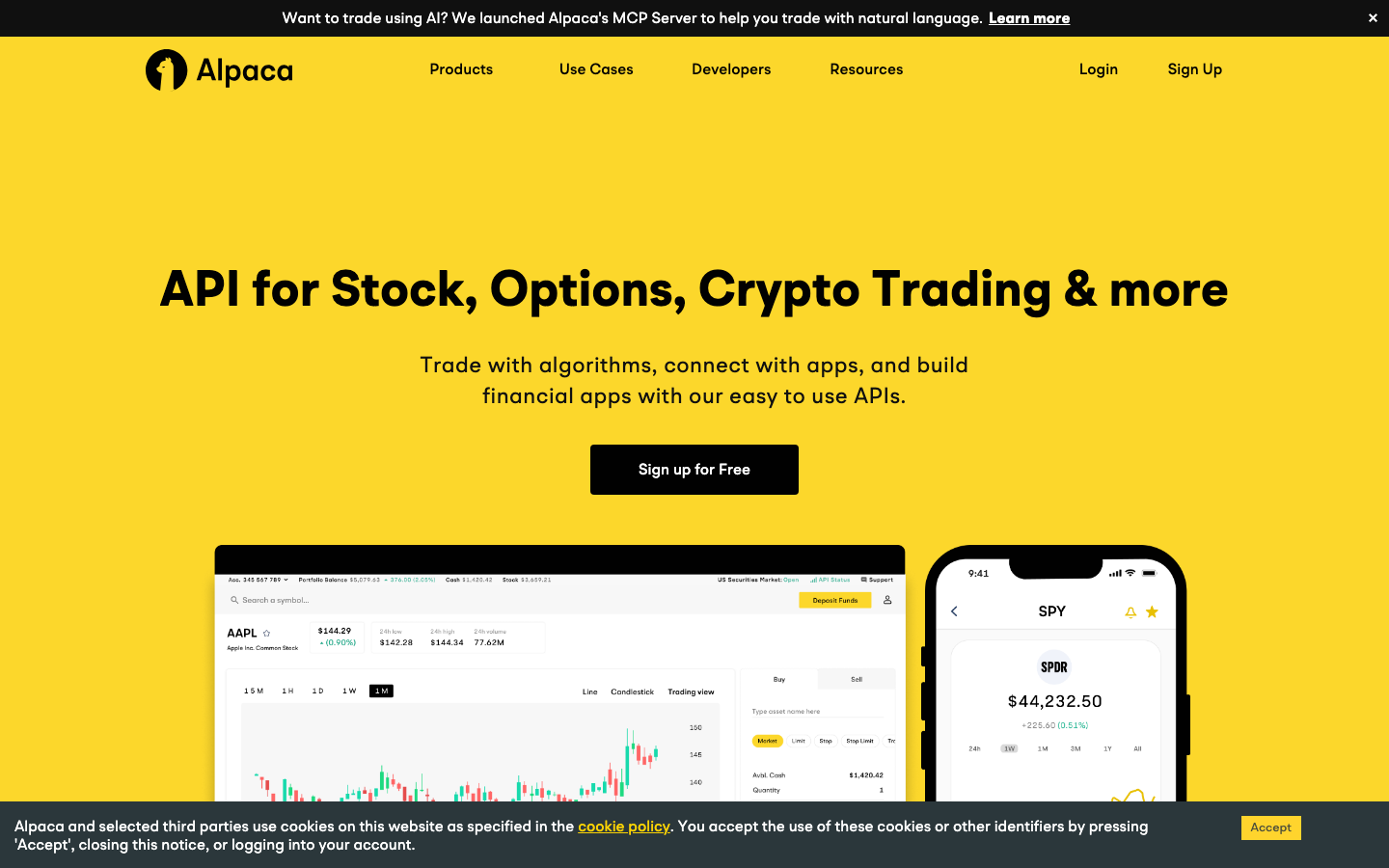
Alpaca: API-first algorithmic trading and brokerage infrastructure platform
Alpaca’s core parameters and statistics
Alpaca is an API-first algorithmic trading and brokerage infrastructure platform. It is not a stock trading APP for retail investors (such as Robinhood or Webull), but a trading infrastructure designed for developers, quantitative funds and financial technology companies - encapsulating complete brokerage capabilities into programmable interfaces through REST, WebSocket and FIX API.
| Projects | Public Information |
|---|---|
| Product positioning | API-first algorithmic trading and brokerage infrastructure |
| Core Product Line | Trading API, Broker API, Market Data API, MCP Server, Alpaca Elite |
| Supported asset classes | US stock ETFs, options (multi-leg strategies), cryptocurrencies |
| Transaction methods | REST API, WebSocket, FIX API, MCP (AI natural language) |
| Platform form | Web console REST API, WebSocket, FIX, MCP Server |
| Place of Residence | US (California) |
| Regulatory Compliance | FINRA/SIPC Registered Brokerage DTCC/FICC/OCC Member ISO 27001, SOC 2 Type II |
| Staff size | 250+ people in 25 countries |
| Total funding | $320 million |
| System Availability | 99.99% (from January 2025) |
| Order processing delay | 1.5ms (OMS v2) |
| Support brokerage accounts | 7 million+, covering 40+ countries |
| Monthly Active Developers | 61,000+ |
Brief review in one sentence: Alpaca is not a stock trading software, but a broker-as-a-service for developers - encapsulating the complete US stock trading and clearing capabilities into an API that can be called with a few lines of code, and further reducing it to natural language interaction through MCP Server.
Alpaca’s users and market recognition
Developer Community Base: Alpaca has more than 61,000 monthly active developers (MAD), and its GitHub open source repository (alpacahq) provides multi-language SDKs such as Python, .NET/C#, Go, Node.js and more. The developer community is active in official Slack channels and technical forums.
Financial Institution Coverage: Alpaca has helped partners open over 7 million brokerage accounts in 40+ countries around the world. Well-known clients and partners include eToro, Midas (Turkey), GoTyme Bank (Philippines), Dime! (Denmark), Ondo Finance, Sarwa (UAE), Kraken, Bitget, Derayah (Saudi Arabia), SBI Holdings (Japan), and more.
Industry Honor:
- "Best Algorithmic Trading Broker" by BrokerChooser (December 2025)
- Benzinga Global FinTech Awards "Best Broker for Sophisticated Traders" (2024)
- Postman API Network Awards "Best API" (2024)
- Forbes "America's Best Employers for Entrepreneurship" (2024)
- CB Insights Fintech Top 250 (2022)
- Y Combinator “Top Private Companies” list (2022, 2023)
Capital Market Recognition: Alpaca has received a total of US$320 million in financing from top institutions such as Y Combinator, Spark Capital, Portage Ventures, Tribe Capital, Social Leverage, and Drive Capital, as well as strategic investors such as SBI Holdings and Derayah.
User reputation: In the product community, developers generally recognize the quality of its API documentation, zero commission policy, and Paper Trading’s practicality. There are many positive reviews on Trustpilot and Product Hunt, mentioning "seamless API connection", "quick customer service response" and "zero commission is really sincere".
Alpaca’s cost advantage
Alpaca's cost structure shows significant differences at three levels. The core leverage lies in "zero commission API + free simulation + flexible transaction costs".
| Cost Hierarchy | Pricing Model | Key Details |
|---|---|---|
| C-side/Individual traders | Zero commission + optional payment based on trading volume | Zero commission on stocks/ETFs/options; no minimum deposit requirements for retail accounts |
| API / Developer | Free API access + trading commission | Paper Trading is free (including $100K virtual funds); real trading is billed based on transaction volume, and the API call frequency is controlled at 200 times/minute (standard) |
| Enterprise/Institution | Broker API on-demand pricing + Elite tiering | Broker API requires business customization; Elite deposit $30K to unlock Smart Router, $100K to unlock preferential margin rate and free market data |
C side/individual traders:
- Zero Commission: Zero commission for US stock ETF and options trading, no minimum deposit requirements.
- Margin Rate: Standard 6.25% (Base + 2.5%), Elite reduced to 4.75% (Base + 1.0%).
- Stock Lending Income: Through the Fully Paid Securities Lending program, users can receive 50% of the interest income from securities lending.
- Idle Fund Yield: The High Yield Cash plan offers an APY of 3.30% (based on the official real-time interest rate).
API/Developer:
- Paper Trading: completely free, provides $100K virtual funds, unlimited backtesting and simulated trading.
- API call limit: 200 times/minute for Standard account, 1,000 times/minute for Elite account.
- Real-time Quotes: Standard accounts get basic quotes for free, and Elite accounts get Algo Trader Plus for free (valued at $99/month).
- MCP Server: completely free and open source, only requires Trading API Key to use.
Business/Institution:
- Broker API: Customized pricing based on the number of accounts, transaction volume and functional modules. Please contact sales for specific fees.
- White Label Solution: Supports broker white label Tokenization networks, digital wallet embedding and other scenarios. Pricing is negotiated based on scale and region.
- Clearing and Custody: As a member of DTCC/FICC/OCC, it provides self-clearing capabilities and reduces intermediate costs.
Hidden Costs and Considerations:
- Strategy Development Cost: The development, backtesting and operation and maintenance of API trading strategies require technical time investment. Strategy logic errors may lead to real trading losses - this is not a platform fee, but needs to be included in the evaluation.
- API Learning Curve: Although SDK is provided, quantitative strategy development itself requires developers to have programming and financial market knowledge.
- Compliance Restrictions: Account opening and real trading by non-U.S. residents must pass local compliance review; cryptocurrency transactions are not available in some areas.
- High-frequency trading scenario: The API frequency limit of 200 times/minute for standard accounts is not enough for high-frequency strategies. You need to upgrade to Elite or contact business.
Alpaca’s main features
- Trading API: Implements order placement, order cancellation, position query, order status tracking and historical transaction record retrieval for stock ETFs, options and cryptocurrencies through REST and WebSocket interfaces. Supports various order types such as market orders, limit orders, stop-loss orders OCO, IOC, MOO/MOC, VWAP, TWAP, etc.
- Broker API (Broker API): full-stack brokerage infrastructure services, covering account opening KYC/AML compliance review, fund deposits/withdrawals, transaction execution, clearing custody, report generation and other core capabilities of brokers. It is suitable for financial technology companies to quickly embed investment functions.
- Market Data API: Provides real-time quotes and Level 1/Level 2 market data for U.S. stock ETFs and options, as well as historical K-line data. Data covers major exchanges across the United States.
- Paper Trading (simulated trading): Use $100K virtual funds to simulate trading in the context of real market data, supporting multiple accounts to run multiple strategies at the same time. All strategy logic is consistent with the real offer API, and switching to real offer only requires modifying the API endpoint.
- MCP Server (AI Transaction Interface): Open source Model Context Protocol Server, allowing AI tools such as Claude, ChatGPT, Cursor, VS Code, and PyCharm to directly perform transaction operations through natural language. It supports complete links such as position inquiry, market analysis, and order placement, and provides advance verification in Paper mode.
- Alpaca Elite (Advanced Trading Plan): Deposit $30,000 to unlock Smart Router smart routing execution (supports dark pool/non-display liquidity access), low-price commission plan (All-in $0.0040/share or Cost Plus starting at $0.0025/share), advanced order types; deposit $100,000 to get an additional 4.75% preferential margin rate, free Algo Trader Plus Quote subscription and white glove account support.
- Alpaca Clearing: As a member of DTCC, FICC, and OCC, it provides complete self-clearing capabilities, reduces intermediate costs and improves transaction processing efficiency. SIPC coverage $500,000/customer, excess SIPC coverage securities $30 million/customer (total pool $150 million).
- **24/5 trading day trading diplomacy
Easy**: Trade stocks and ETFs 24 hours a day, 5 days a week, covering pre-market, post-market and night trading sessions.
- FIX API: Ultra-low latency FIX trading interface for institutional clients, supporting DMA direct market access.
[Expert View]: The core differentiation of Alpaca is not only zero commission or API interface, but the complete capability chain of "brokerage as a service" - from account opening KYC, clearing and custody to transaction execution, all exposed through API. This means that a fintech entrepreneurial team can build a fully functional investment APP in a few weeks, without having to go through several years of applying for a brokerage license and building a clearing system. MCP Server further lowers the interaction threshold from "writing code" to "speaking human language", greatly expanding the coverage of algorithmic trading.
Alpaca’s model and version evolution
Alpaca’s version evolution reflects the transformation path from a database company to a full-stack brokerage infrastructure.
Start-up period (2015–2018): database and machine learning
Alpaca began as a database and machine learning company that built deep learning predictive models for financial institutions to process large-scale market data. During this period the open source time series database MarketStore was developed, optimized for financial time series data.
API Trading Period (2018–2022): Trading API and Paper Trading
| Milestones | Time | Change Points |
|---|---|---|
| Trading API goes online | ~2018-12 | As a FINRA registered broker, launches US stock REST API trading service |
| Released by Paper Trading | ~2020-09 | Launch of free simulated trading, supporting strategy backtesting and virtual fund trading |
| Cryptocurrency goes live | ~2021 | Alpaca Crypto LLC registers as FinCEN MSB and starts supporting cryptocurrency transactions |
| Broker API released | ~2022-06 | Full-stack brokerage infrastructure services for financial technology companies officially launched |
Infrastructure expansion period (2023–2025): self-liquidation and regulatory upgrades
| Milestones | Time | Change Points |
|---|---|---|
| DTCC member approved | ~2023 | Approved to become a DTCC member with self-liquidation capabilities |
| SIPC excess protection | ~2023 | Introducing excess SIPC protection, raising the securities protection limit to $30 million/customer |
| Self-clearing goes online | ~2024 | Successfully transitioned from third-party clearing to DTCC fully self-clearing |
| Nasdaq Exchange Member | ~2025 | Become a Nasdaq Exchange Member to achieve low-latency direct order book access |
| OCC/FICC Member | ~2025 | Become a member of OCC (Options Clearing Corporation) and FICC (Fixed Income Clearing Corporation) |
AI driven period (2026–present): MCP Server and OMS v2
| Milestones | Time | Change Points |
|---|---|---|
| OMS v2 goes online | ~2026-03 | A new generation of order management system, order processing delay reduced to 1.5ms |
| MCP Server released | ~2026-03 | Open source MCP Server, supporting AI tools such as Claude and ChatGPT through natural language transactions |
| Multi-Leg Options | ~2026 | Support option multi-leg strategies (Spread, Straddle, Condor) |
| 24/5 trading live | ~2026 | Stocks and ETFs support 24/5 trading |
| Instant Tokenization | ~2026 | Asset tokenization network, supporting instant minting/redemption of tokenized stocks |
Alpaca’s technical advantages
API-first architecture and multi-layered interfaces: Alpaca provides a complete spectrum of interfaces from REST/WebSocket (developer-friendly) to FIX (institutional-grade low latency) to MCP (AI natural language). The three interfaces target different user groups, but share the same back-end order management system (OMS v2) and liquidation pipeline. Mechanically, OMS v2 optimizes the order processing pipeline to an end-to-end latency of 1.5ms and maintains 99.99% system availability.
Self-clearing network effect: Through membership in DTCC, FICC, OCC and Nasdaq, Alpaca achieves vertical integration from trade execution to clearing custody. Compared with brokers that rely on third-party clearing, the self-clearing structure reduces intermediate costs and controls settlement risks within its own system. Effectively, this integration provides Broker API customers with "out-of-the-box" compliance and clearing capabilities without having to build this layer of infrastructure themselves.
MCP Server: The bridge between AI and financial transactions: Alpaca MCP Server implements a standardized protocol layer between large language models and transaction APIs. Its working principle is: AI client (such as Claude Desktop) sends user intent to Alpaca MCP Server through MCP protocol → Server parses into structured API request and calls Trading API → formats market data or order results and returns to AI client for display. This function allows users to complete the entire operation from "checking profits" to "place a stop-loss order" in one sentence, without switching interfaces or handwriting code.
Safety and Compliance System:
- Regulatory Compliance: FINRA registered brokerage SIPC member (protection limit $500,000/customer), DTCC/FICC/OCC clearing member.
- Information Security: ISO 27001:2022 Certified SOC 2 Type II Controlled GDPR Compliant CSA Level 1 Certified.
- Account Protection: Supports two-factor authentication (2FA), OAuth authorization integration, and excess SIPC protection of $30 million in securities/customer.
Order Execution Optimization (Elite Smart Router): Elite Smart Router has the ability to access multiple exchange ATS and dark pool liquidity, trying to find non-displayed liquidity within the spread. It provides two pricing modes: All-in (fixed rate $0.0040/share) and Cost Plus ($0.0025/share + fees/rebates), allowing users to choose the optimal cost structure based on transaction volume.
How to use Alpaca
Alpaca provides multiple usage paths, and you can choose the corresponding entrance according to the usage scenario:
| Usage scenarios | Entrance | Key steps |
|---|---|---|
| Personal algorithmic trading | app.alpaca.markets/signup | Register Trading API account → Generate API Key/Secret → Select Paper or Live → Write trading strategy |
| Fintech Embed | broker-app.alpaca.markets/sign-up | Register Broker API account → Complete business review → Integrate API into own products → Online brokerage services |
| AI Natural Language Trading | GitHub: alpaca-mcp-server | Install Python 3.10+ and uv → Configure API Key → Enable MCP in Claude/ChatGPT/Cursor → Issue transaction instructions in natural language |
| TradingView Integration | alpaca.markets/tradingview | Authorize OAuth connection → Place orders directly in TradingView charts |
MCP Server quick configuration example (taking Claude Desktop as an example):
Add in mcpServers of claude_desktop_config.json:
{
  "mcpServers": {
    "alpaca": {
      "command": "uvx",
      "args": ["alpaca-mcp-server"],
      "env": {
        "APCA_API_KEY_ID": "<YOUR_API_KEY_ID>",
        "APCA_API_SECRET_KEY": "<YOUR_SECRET_KEY>",
        "APCA_PAPER": "true"
      }
    }
  }
}
Set APCA_PAPER=true to use Paper Trading ($100K virtual funds) for security testing. After confirming that the strategy is stable, remove this variable or set it to false to switch to real trading.
Typical steps:
- Register a Trading API account and generate API Key and Secret Key.
- Write and backtest strategies in the Paper Trading environment (Python SDK:
pip install alpaca-py). - Run simulations for at least dozens of trading days to verify the stability of the strategy.
- Switch the API endpoint to Real Market and start automated trading.
- (Optional) Integrate MCP Server to assist strategy analysis and transaction execution through AI tools.
Alpaca Product Pricing
Alpaca’s pricing is divided into two systems: standard retail plan and Elite premium plan:
Standard plan (zero commission, no minimum deposit)
| Expenses | Standard Account |
|---|---|
| Stock/ETF Trading Commission | $0 |
| Options Trading Commission | $0 (per contract) |
| Cryptocurrency Trading | By Rate Schedule (See Official Documentation) |
| Margin interest rate | 6.25% (base rate + 2.5%) |
| ETB stock borrowing fee | $0 (covers 5,000+ stocks) |
| HTB Stock Borrowing | Quotes on Demand |
| API call limit | 200 times/minute |
| Paper Trading | Free ($100K virtual funds) |
| Minimum deposit requirement | None |
Elite Plan ($30,000 deposit to unlock)
| Fees | Elite Standard | Elite Advanced ($100K Deposit) |
|---|---|---|
| Smart Router Intelligent routing | ✓ | ✓ |
| Commission (All-in fixed) | $0.0040/share | $0.0040/share |
| Commission (Cost Plus tier) | Starting from $0.0025/share | Starting from $0.0025/share |
| Margin rate | No change | 4.75% (base rate + 1.0%) |
| Algo Trader Plus Quotes | None | Free ($99/month value) |
| API call limit | 1,000 times/minute | 1,000 times/minute |
| White Glove Account Support | None | ✓ |
| Advanced Order Types | MOO/LOO/MOC/LOC/IOC | All + PVOL/Midpoint Peg |
| DMA Direct Market Access | None | ✓ |
Enterprise/Broker API Pricing
Broker API pricing is on-demand and depends on the number of accounts, trading volume, functional modules and coverage area. For specific costs, please contact the Alpaca sales team for a customized quote.
Key Tip: Among the above commission structures, "zero commission" is applicable to order flow that meets the characteristics of retail trading (non-high-frequency, non-professional traders). If the account is marked as non-retail (such as high-frequency trading, quantitative funds), it will automatically switch to the Elite Smart Router billing mode. The complete rate schedule is available at BrokFeeSched.pdf.
Alpaca application scenarios
- Quantitative strategy development and automated execution: Developers use Python to write strategies such as trend tracking, mean reversion, and statistical arbitrage. After completing backtesting and parameter optimization in Paper Trading, they can switch to real trading for automatic execution with one click. Key points to verify: Whether the risk of over-fitting (historical performance is not equal to future returns), API stability and execution delay meet the strategic requirements; it is recommended to run a simulation of at least a complete market cycle first.
- Investment functions embedded in financial technology products: Startups or traditional financial institutions can embed securities account opening, trading and asset custody capabilities in their own APP through Broker API. The number of users can increase from zero to millions without the need to build a self-built brokerage license and clearing system. Verification focus: Broker API compliance coverage (whether the target country supports it), SLA guarantee and customization capabilities.
- AI-assisted investment research and trading: Connect Claude/ChatGPT to the trading account through MCP Server, use large models to analyze news sentiment, interpret financial reports, assess portfolio risks, and perform position adjustment operations directly in the conversation. Verification focus: AI reasoning reliability (manual review of order parameters is required), MCP Server security (it is recommended to use Paper mode for verification throughout the process before actually launching).
- Algorithmic trading teaching and financial training: University financial engineering and quantitative investment courses use Alpaca's Paper Trading as a teaching platform, allowing students to understand order types, market microstructure and strategy backtesting in a zero-risk environment. Key points to check: the completeness of documentation and SDK, and the richness of teaching cases.
- Multi-Strategy Funds & Proprietary Trading: Hedge funds and proprietary trading firms run multi-strategy portfolios using Alpaca Elite’s multi-account management and advanced order types (VWAP, TWAP, DMA), leveraging Smart Router for better execution prices and lower slippage costs. Key points of verification: Latency performance of OMS v2 in high-frequency scenarios, liquidity and rates of HTB stock short selling.
Applicable groups of Alpaca
- Quantitative Trading Developer (Individual/Independent): Suitable for independent developers who need to program to implement trading strategies. Alpaca's free Paper Trading and zero-commission real trading significantly lower the financial threshold for individuals to participate in algorithmic trading. Prerequisites: Python/JavaScript and other programming skills are required, as well as basic financial market knowledge.
- Fintech companies (small and medium-sized entrepreneurial teams): Suitable for entrepreneurial teams that want to quickly embed investment functions into their own products. Broker API encapsulates asset-heavy capabilities such as brokerage licenses, clearing, and compliance into APIs, allowing a team of 3-5 people to launch investment products within a few weeks. Prerequisites: Business review needs to be passed, and the target market must be within the compliance coverage of Alpaca.
- Hedge funds and proprietary trading companies: Suitable for institutions that require multi-strategy execution, multi-account management, and low-latency trading. The Elite plan's intelligent routing FIX API and DMA direct market access meet the execution needs of professional trading institutions. Prerequisites: The deposit threshold is $30,000~$100,000, and institutional account review is required.
- Financial Engineering Education and Researchers: Suitable for university teachers, students and financial researchers to use Paper Trading for quantitative strategy teaching and academic research. Prerequisite: Understanding of trading APIs and basic workings of financial markets.
- AI/LLM Developers and Enthusiasts: Suitable for developers who want to explore the application of LLM in financial trading scenarios. Alpaca MCP Server provides a ready-made AI-to-Finance interface that can verify the AI Agent's trading capabilities without implementing a trading API. Prerequisite: Understand the MCP protocol and be able to configure AI tools such as Claude Desktop.
Not fitting boundaries:
- Individual investors with non-technical background: If you only manually select stocks, check market conditions, and occasionally trade, graphical interface brokers such as Robinhood, Webull, and Fidelity are more suitable. Alpaca's core interaction method is through API programming, without traditional K-line charts and stock picking tools.
- Users who need in-depth A-share/Hong Kong stock/global market coverage: Alpaca mainly supports US stock ETFs, options and crypto assets, and does not cover A-shares, Hong Kong stocks, European stocks and other markets.
- Ultra High Frequency Trading (HFT) Team: Although OMS v2 implements 1.5ms order processing, the API frequency limit of 200 times/minute for standard accounts and the retail order flow marking rules limit pure high-frequency strategies. The HFT team needs to contact the business to confirm the customized solution.
- Users who are non-U.S. residents and cannot open a U.S. stock account: Real trading needs to meet local securities compliance requirements, and is not supported in some countries/regions. It is recommended to check Alpaca's supported region list first.
Summary and Outlook of Alpaca
Core Competencies: Alpaca's core advantage lies in encapsulating complete brokerage capabilities (trade execution, clearing custody, compliance supervision) into standardized APIs, and further reducing the interaction threshold through MCP Server. Compared with Robinhood, which targets retail investors and Interactive Brokers, which targets professional traders, Alpaca has chosen a unique ecological niche - becoming a "broker-as-a-service" infrastructure for financial technology companies and quantitative developers. Free Paper Trading, zero-commission real trading, self-liquidating capabilities and increasingly sophisticated AI interfaces form its competitive barriers.
Current Limitations:
- Asset coverage focuses on the US stock market, and global multi-market coverage is still under construction (global stocks are officially mentioned in the roadmap).
- There is still a gap between the performance indicators of ultra-high-frequency trading scenarios (1.5ms order processing) and professional HFT brokers (sub-millisecond level).
- The account opening process and compliance thresholds for non-U.S. users vary by country, and all features (especially cryptocurrency) are not available in some regions.
- The pricing of Broker API is not transparent enough, and small and medium-sized teams may lack bargaining power in business negotiations.
- MCP Server is currently in an early stage, and the tool list and error handling still need to be improved (community feedback "missing some things").
Follow-up observation points:
- Ecological expansion of MCP Server - whether to support more AI tools and richer trading operations.
- Progress on the launch of new asset classes such as Global Stocks and Index Options.
- Compliance implementation of Broker API in more countries/regions.
- Whether the pricing strategy of the Elite plan will further lower the entry threshold under competitive pressure.
- The regulatory trend of AI Agent in financial transaction scenarios - if supervision is tightened, MCP Server's compliance costs may rise.
Procurement/Adoption Risk Assessment:
- Individual Developer: It is recommended to start with free Paper Trading, and then make a real deposit after confirming that the API meets the strategic requirements. No upfront investment is required, and the risk is only in development time.
- Fintech Team: Before signing a Broker API contract, it is necessary to confirm whether ① the target market is within Alpaca's compliance coverage; ② whether the SLA terms cover the expected transaction volume and user scale; ③ whether the data export and privacy policy comply with local regulations. It is recommended to use Sandbox to complete technical verification first.
- Institutional Investors: Before connecting real funds, it is recommended to independently verify the order execution quality (slippage, fill rate), the stability of OMS v2 under stress testing, and the actual coverage of excess SIPC insurance. The cost saving effect of Elite Smart Router needs to be simulated and calculated based on its own transaction volume, rather than directly assuming that Cost Plus is the lowest rate.
Version Info
- OMS v2 + MCP Server :The new generation order management system OMS v2 is launched, with order processing delay reduced to 1.5ms; Alpaca MCP Server is launched to support AI natural language trading; new functions such as 24/5 trading Multi-Leg Options and High Yield Cash are launched.
- Broker API Launch :Broker API is officially launched, providing full-stack brokerage infrastructure services and supporting stock and ETF trading. There is no official precise date yet.
- Paper Trading Launch :Launched Paper Trading simulated trading, providing free virtual funds for strategy backtesting and verification. There is no official precise date yet.
- Initial Launch :Alpaca Trading API is launched for the first time, providing U.S. stock API trading services as a FINRA registered broker. There is no official precise date yet.
User Reviews