 Altern
Free
Altern
Free
Altern is an AI tool discovery and curation platform for developers and efficient users. It helps users quickly filter and compare suitable AI tools through Top lists, categories, topic lists and submission mechanisms.
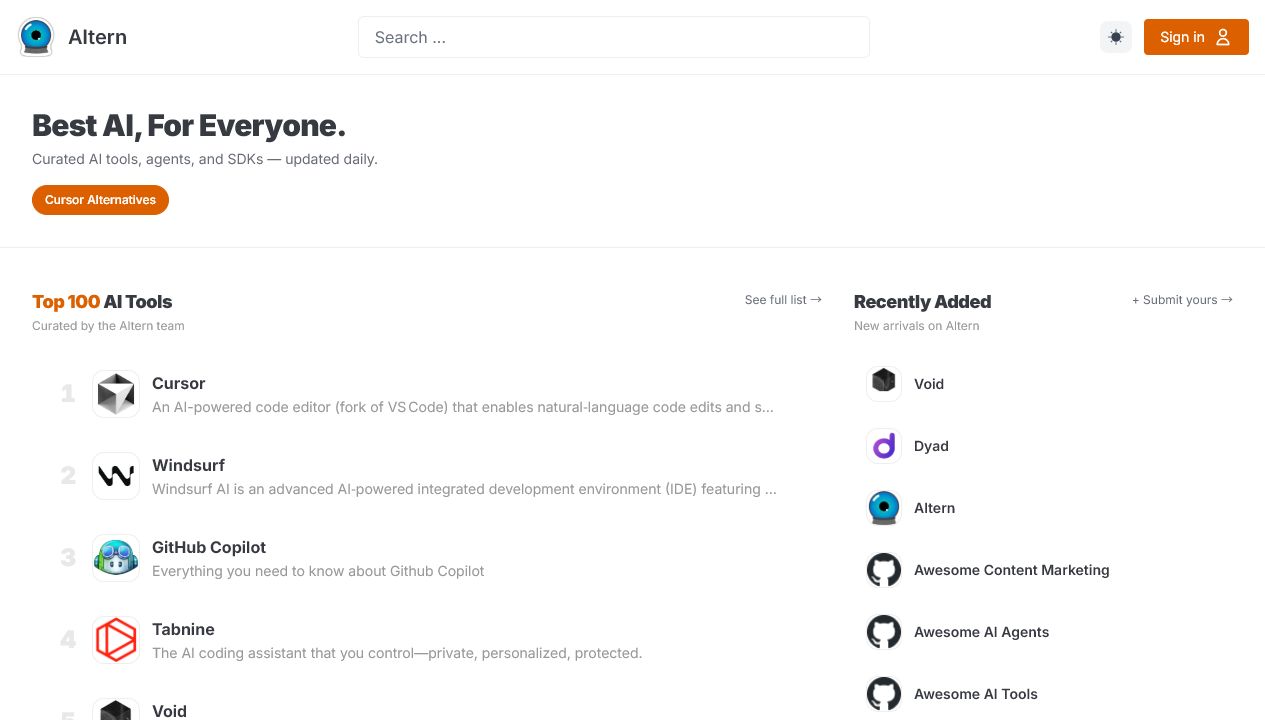
Altern - AI tool discovery and screening platform
Altern’s core parameters and statistics
Altern is essentially an AI tool discovery engine, not a tool execution platform. It covers a wide range of categories from code assistants to AI agents, from application builders to efficiency tools. The core delivery form is "curated list + category index + detail jump".
| Parameters | Details |
|---|---|
| Product Positioning | AI Tool Catalog and Curation Platform |
| Core content structure | Top 100 AI Tools, Recently Added, Curated Lists, All AI Tools |
| Number of tools covered | Hundreds (continuously added, subject to real-time data from the official website) |
| Content scope | Programming assistant AI Agents, App Builder, IDE, search, audio 3D, automation, customer support, data, marketing, etc. 30+ categories |
| Delivery form | Tool discovery and jump, does not directly host tool execution |
| Update frequency | Continuously added, marked "Updated daily" |
| Charging model | Directory access is free, and target tools are billed independently |
| Place of Belonging | Canada (CA) |
| Support Platform | Web |
| Supported languages | English |
| Community contribution | Open tool submission entrance (/submit) |
| Social Channels | X (@altern_ai), LinkedIn, GitHub (alternbits), Medium Blog |
A brief comment: Altern does not help you make decisions, but transforms "finding tools" from scattered fragmented searches into a reusable screening process - its core deliverable is "information pipelines organized by tasks", not the answers themselves.
Applicable Boundary: Altern is suitable for the early stage of selection when the demand direction is known but the specific tools are unknown; it is not suitable for scenarios where the target tool has been clearly defined and only needs to be purchased or deployed directly, nor is it suitable for strict selection processes that require in-depth evaluation data (such as benchmark tests, user ratings, security audit reports).
Altern’s users and market recognition
Altern's positioning in the market is in line with similar catalog offerings such as There's An AI For That, Futurepedia,
GitHub Organization Recognition: Altern's GitHub organization (alternbits) has 128 followers, and its open source projects include Awesome AI Newsletters (367 stars), Awesome CUDA Books (941 stars), Awesome AI Agents (141 stars), Awesome AI Models (144 stars), etc. These Awesome lists form the basis around Altern "Peripheral trust network" - users have already been aware of Altern's brand tone through the open source community before discovering the tool.
Update frequency as a trust anchor: The official website clearly states "Curated AI tools, agents, and SDKs — updated daily". The "daily updated" strategy is a more radical approach among tool catalog products. For technical decision-makers who need to keep track of the latest tool trends, high-frequency updates mean that the catalog is timely available - if a catalog platform is updated monthly or quarterly, its information value will quickly decay. Altern's daily update strategy alleviates this problem to a certain extent.
Ecological expansion: Altern not only operates the core catalog, but also launched Altern Newsletter (subscribe through newsletter.altern.ai), Altern Reviews (reviews.altern.ai, tool evaluation platform) and Productivity Directory (productivity.directory, general efficiency tool directory). The three peripheral products form a small tool discovery ecological network. The Newsletter provides a summary of the latest AI breakthroughs and trends, and Reviews adds a dimension of user reviews that the catalog lacks—a combination that is rare among similar products.
Third Party Reference Value: Altern itself does not publish independent evaluation reports or benchmarks, and the quality of its tool list depends on the selection criteria of the curatorial team and the review granularity of community submissions. Users should note when using: directory inclusion does not mean official recommendation, high ranking does not mean rigorous evaluation, and some tools may be displayed through payment or submission.
Altern’s cost advantage
The "cost" of tool discovery products is not the direct subscription fee, but the opportunity cost of the time users spend on searching, comparing, and verifying. The value of Altern lies in compressing this information gap.
C-side/individual users: Directory access is completely free. There is no need to log in or pay to browse the Top 100, category lists, and tool details pages. This is clearly different from other tool catalog products (such as G2, Capterra and other B2B platforms that require registration to view detailed comparison information) - Altern's zero-threshold access strategy reduces usage friction, but it also means that its commercial sustainability may depend on advertising (currently there is an Advertise page), referral link CPC monetization and possible future value-added services.
Developers/entrepreneurial teams: Reduce the time cost of tool scanning. The following is a time efficiency deduction based on typical workflow and does not constitute an official commitment:
| Selection position | Traditional method time-consuming (estimate) | Time-consuming with Altern (deduction) | Savings scenario description |
|---|---|---|---|
| The technical leader selects an IDE assistant for a new project | 3-5 days (search + recommendation by colleagues + trial) | 1-2 hours (browse the IDE classification list + filter 3-5 candidates) | The classification list directly gives core candidates such as Cursor, Windsurf, GitHub Copilot, Tabnine, etc., without searching from scratch |
| Product manager researches AI Agent implementation | 1-2 weeks (multi-channel collection + compilation and comparison table) | 2-4 hours (Agent classification + Curated Lists + details page jump) | Curated Lists such as "Coding Agents" have aggregated Aider, Qodo, Claude Code and other tools |
| Entrepreneurs evaluate App Builder plans | 1-3 days (search + community comments + check each official website) | 1-3 hours (App Builders category list directly displays Bolt.new, Lovable, v0.dev, etc.) | Category + details page + official website jump to form a link |
| The content team tracks new tool developments | 2-3 hours per week for social media + news | 15-30 minutes per week for browsing Recently Added | Recently Added as a fixed inspection portal |
Enterprise/team level: Implicit cost boundaries need to be noted. Altern itself is free, but the cost of trial and purchase after catalog discovery and transfer to the target tool are actual expenses. If the team uses the directory as an "infinite trial and error pipeline" and lacks systematic evaluation standards, it may increase learning and migration costs due to frequent tool switching. The upper limit of Altern's value depends on whether the team can establish a supporting evaluation process - relying solely on the catalog cannot reduce the verification cost in the second half of the selection.
Cost comparison with similar directory platforms:
| Platform | Service model | C-side fees | Core differences |
|---|---|---|---|
| Altern | AI Tool Directory + Curated Lists | Free | Focus on developer tools, updated daily |
| There's An AI For That | AI Tool Search Engine + Database | Free + Paid Pro | Larger collection, supports search by task |
| Futurepedia | AI Tool Directory + News | Free | Broad coverage with video tutorials |
| G2 | Enterprise software review + comparison | Free + paid | Contains user ratings and in-depth reviews, with stronger B2B attributes |
| Product Hunt | Product launch and discovery community | Free | Favoring new product launches rather than ongoing catalogues |
Cost Advantage Summary: Altern's cost advantage lies not in "saving money" but in "saving time" - for technical teams who need to frequently make tool selections, it can shorten the 3-5 days of zero search to 1-3 hours of short list production stage. However, it cannot replace the subsequent in-depth evaluation, security review and PoC verification. Time and budget for these stages still need to be invested in traditional ways.
Altern’s main functions
Altern's functional modules are designed around the three stages of "Discover -> Filter -> Jump". Its unique value lies in the series effect between functions rather than a single module.
-
Top 100 AI Tools: For users who "don't know where to start". The list covers high-profile tools such as ChatGPT, Claude, Gemini, GitHub Copilot, Cursor, etc. Each tool is equipped with a brief description and classification tags. Acceptance concerns: The update frequency and ranking logic of the list are not disclosed. Users should not equate the Top 100 ranking with an objective quality score - it may be a combination of popularity, curatorial team judgment and commercial factors.
-
Recently Added: For continuous users who "need to track new arrivals". List the tools newly entered into the directory and mark them with the "NEW" tag. Acceptance focus: The speed of new tool collection and review granularity are key - the daily update frequency theoretically ensures the timeliness of new tools, but the review threshold is unknown and there may be quality fluctuations.
-
Curated Lists: oriented to the scenario-based needs of "finding tools according to tasks". For example, the "IDE Assistants" list aggregates candidates such as Cursor, Windsurf, GitHub Copilot, Tabnine, and Void; the "App Builders" list includes Bolt.new, Lovable, Dyad, v0.dev, Aider Chat, etc.; and the "Coding Agents" list aggregates Aider, Qodo, ZZZ Code AI, Kilo Code, Claude Code, etc. Acceptance concerns: The curation criteria of the list are not disclosed - whether it is based on editorial judgment, community voting or data indicators will directly affect its reference value.
-
All AI Tools: For users who "need wide-coverage search". A comprehensive tool catalog arranged in alphabetical order. Each tool card contains a name, a one-sentence description, a category label, and a "Visit tool" jump button. Acceptance concerns: The search and filtering function is relatively basic and does not support filtering by price, rating, functional features and other dimensions, which limits its usability in in-depth selection scenarios.
-
Tool details page and official website jump: Each tool has an independent details page (such as /tool/cursor), including an introduction, category label logo and external links. Acceptance concerns: The information density of the details page is low. In addition to short descriptions and categories, it lacks in-depth fields such as ratings, pricing ranges, and user reviews. This means that users still need to jump to the official website of the target tool for further verification—Altern is essentially a "springboard" rather than a "decision-making platform."
-
Tool Submit (Submit): For tool developers and manufacturers, submit new tools into the directory through the /submit page. Acceptance concerns: The review process and timeline after submission are not public, and submission does not mean immediate inclusion.
Hidden linkage effect:
-
Effect 1: Cross-checking of Curated Lists and Recently Added. The team can set Curated Lists (such as "IDE Assistants") as a baseline and periodically scan Recently Added to see if there are new candidates entering the same track, forming a "baseline + incremental" dual-track monitoring mechanism instead of searching from scratch every time.
-
Effect 2: The Altern directory is related to the evaluation of Altern Reviews. The directory provides a candidate list, and the Reviews platform collects user feedback. The combination of the two can cover the "Discovery -> Word-of-mouth Verification" link. However, the current level of data interoperability between the two platforms is unclear - whether the evaluation data of Reviews and the catalog details page are connected will directly affect the smoothness of this relationship.
-
Effect 3: Three-layer funnel of Top 100, Curated Lists and All AI Tools. Users can gradually narrow down the candidate scope by following the path of "Top 100 (coarse screening) -> Curated Lists (track focus) -> All AI Tools (horizontal comparison)" to form a structured selection funnel. The value of this path does not lie in any one module, but in the information gradient between the three modules - Top 100 gives a global sense, Curated Lists gives task relevance, and All AI Tools gives breadth of coverage.
Altern’s model and version evolution
Altern is not a large model product and does not involve iteration of model versions. Its version context is reflected in the evolution of the platform’s functional stages and content curation system:
| Stage | Approximate time | Functional changes | Curator characteristics |
|---|---|---|---|
| Catalog basic period | ~2024 | Tool collection + basic classification index | Mainly based on directory aggregation of tools, with coarse classification |
| List and topic period | ~2024 end to 2025 | Introducing Top 100 ranking + Curated Lists topic list | Shift from simple catalog to curatorial orientation and start organizing tools by task |
| High-frequency updates and ecological period | ~ End of 2025 to present | Recently Added Enhancement + Submission system + Newsletter / Reviews and other peripherals online | The update frequency is increased to "daily", and the ecosystem is expanded from the tool directory to Newsletter, Reviews and Productivity Directory |
| User lists and social period | ~2026 | Support user-defined Lists (/lists) to enhance community participation | From one-way curation to UGC lists, users can create and share their own collection of tools |
Release Note: Altern does not have a public version numbering system or changelog timeline. The above-mentioned stage division is based on the visible milestones of the official website page structure (home page, category page, list page, submission page) and is not an officially released version node. The specific function launch date is subject to Altern’s official announcement.
Comparison with the curation model of similar products:
| Dimensions | Altern | Product Hunt | There's An AI For That | G2 |
|---|---|---|---|---|
| New methods | Editorial curation + contribution | User publishing + community likes | Automated crawling + editorial review | Vendor claim + user comments |
| Sorting logic | Curation ranking (undisclosed) | Descending order by day/week/month popularity | By search relevance | Comprehensive rating + number of comments |
| Reviews/Ratings | There is an independent Reviews station | In-platform reviews | None | In-depth user reviews |
| Topic Lists | Curated Lists (Editor Curation) | Collections (User Curation) | Sort by Task | Categories + Filters |
| Update frequency | Daily | Daily | Regular updates | Continuous |
Altern’s technical advantages
Altern’s technical advantage does not lie in the underlying algorithm or model capabilities—it is not an AI model product, but an information curation and discovery platform. Its technical value is reflected in three levels: information architecture, workflow embedding and ecological integration.
Information Architecture: Replace unstructured searches with categories and lists. Altern's core technology decision is to "replace search engine-style keyword matching with structured curation." Users do not need to enter "best AI coding assistant 2026" in Google and then click on the 10 search results one by one for evaluation. Instead, users can directly see the aggregated candidate set in Altern's IDE category or "Coding Agents" Curated List. This information architecture reduces the cognitive load of "build search terms from scratch -> filter results -> remove duplicates". Mechanism -> Effect -> Applicable Scenarios: The mechanism is manual curation + classification indexing. The effect is to compress the tool discovery time from hours to minutes. The applicable scenario is the early stage of selection when the requirements are vague and the candidate vision needs to be quickly established - but when the requirements are highly clear (such as "I need a code assistant that supports privatized deployment"), the search engine's precise matching is more efficient.
Workflow embedding: low-friction directory to official website jump link. Each tool card of Altern provides a "Visit tool" direct jump button, and the details page displays screenshots of the tool interface through Open Graph images. The engineering significance of this design is that users do not need to copy and paste the URL or switch multiple tabs to search the official website. There is only one click from "seeing the tool" to "entering the official website for verification". For a selection process that requires batch evaluation of 5-10 tools, the 10-20 seconds of search time saved per click can add up to 1-3 minutes of process compression. Applicable Boundary: The efficiency of this link depends on the accuracy of the information on the Altern details page - if the URL is invalid, the jump is wrong, or the tool description is outdated, additional verification costs will be introduced.
Ecological integration: catalog + news briefs + reviews + multi-site collaboration of classified catalogs. Altern operates four sites: Altern (main directory), Altern Newsletter (email subscription), Altern Reviews (evaluation platform), and Productivity Directory (general tool directory), and expands its external influence through the GitHub Awesome Lists matrix. The technical side of this multi-site architecture means a shared tool database, a unified taxonomy and the ability to cross-reference - after users see a tool in the Newsletter, they can find the details page directly in the main directory. However, the current data integration depth of the four sites is still limited: the evaluation data of the Reviews platform has not yet been synchronized to the tool details page of the main directory, and the tool recommendations of Newsletter are not directly linked to the directory page. These breakpoints weaken the potential value of ecological collaboration.
Current technical limitations: Altern's search filtering function is relatively basic - it does not support filtering by structured fields such as price range, API availability, open source protocol GitHub Stars number, ratings, etc. This means that when the catalog size grows to thousands of tools, the information architecture of pure classification + list may face the problem of decreased discoverability. Additionally, the platform does not provide an API or webhook interface for external teams to programmatically consume Altern’s tool data.
How to use Altern
The usage path of Altern is simple and direct, and the core operations can be completed on the web side without registration or installation.
| Entrance | Access path | Typical uses |
|---|---|---|
| Home | https://altern.ai/ | Browse Top 100 + Recently Added + Curated Lists Overview |
| Categories page | https://altern.ai/categories | Browse tools by 30+ categories (IDE, Coding Agents, App Builders, etc.) |
| Top 100 | https://altern.ai/ (top of homepage) | Quickly understand the current list of the most popular AI tools |
| Recently Added | https://altern.ai/ (middle of homepage) | Tools for tracking new arrivals |
| Curated Lists | https://altern.ai/ (below the homepage) | Get the topic candidate list by task scenario |
| User Lists | https://altern.ai/lists | Browse and create user-defined tool collections |
| Full catalog | https://altern.ai/ Scroll to the bottom | Browse all included tools in alphabetical order |
| Tool details | https://altern.ai/tool/ |
View the tool introduction and jump to the official website |
| Submit a tool | https://altern.ai/submit | Submit a new AI tool to the catalog |
| Latest Deals | https://altern.ai/deals | View tool offers (no active deals currently) |
Typical three-step workflow:
-
Determine the entrance path: Select the entrance based on the clarity of the selection task. When the needs are vague (such as "I want to see what useful AI programming tools are available"), start from the Curated Lists or Top 100; when the needs are clear but you want to add candidates (such as "The existing solution is Copilot, and I want to see other IDE assistant options"), start from the IDE category on the category page.
-
Create a short list: Select 3-8 candidate tools from the category or list, and open the details page one by one to view the introduction and category tags. Note: The details page information is not enough to support purchasing decisions - the introduction is only 1-2 sentences and lacks key fields such as pricing, ratings, privacy policy, etc. After completing the initial screening, please record the candidate list (auxiliary tools or documentation are recommended, Altern does not currently support collection or comparison functions).
-
Jump to official website for verification: Use the "Visit tool" button to jump to the official website of each candidate tool to complete the secondary verification of price, compliance, and functional matching. Suggestion: Be clear about 3-5 key dimensions that need to be verified before jumping (such as whether there is an enterprise version, whether it supports privatized deployment, and the free quota threshold) to avoid being distracted by marketing content when browsing the official website.
Advanced Usage - Weekly Inspection: Set https://altern.ai/ as the fixed inspection entrance every Monday, and spend 15-30 minutes browsing Recently Added (new tool updates) and related classification lists (whether new players have entered the field of concern) to form a continuous tool information update rhythm. This usage is suitable for technical leaders and product managers - in the field of AI tools where the market is changing rapidly, the quarterly tool awareness update rhythm is no longer enough.
Altern’s Product Pricing
As a tool catalog platform, Altern's pricing structure is fundamentally different from traditional SaaS - it does not charge subscription fees to end users, and commercial monetization is achieved through advertising and referral links.
C client/individual users: completely free. Access to all Altern functions (browsing the Top 100, category page Curated Lists, tool details, user lists) is free, and no account registration is required. This is the core difference between it and B2B review platforms such as G2 and Capterra - whose detailed comparison and filtering functions usually require registration to be fully used.
Developers/Tool Manufacturers: Submission is free, promotion requires business confirmation. The tool submission entrance (/submit) is free and open, and any developer or manufacturer can submit a tool. However, whether the exposure ranking and display priority after submission are affected by commercial cooperation, Altern has not disclosed its review and ranking rules. For manufacturers with promotion needs, Altern provides an Advertise page (/advertise) for business contact, and the specific quotation is not disclosed.
Business/Team: Indirect Costs. Altern itself is free, but the costs (subscription fees, implementation fees, consulting fees) incurred by entering the trial and purchase process of the target tool after being discovered by Altern are actual expenses. Taking a 50-person technical team as an example, if Cursor Business is discovered and procured through Altern (about $40/person/month), the annual tool expenditure is about $24,000—this expense has nothing to do with Altern, but is part of the procurement link triggered by Altern. Tip: Altern is about discovery, not procurement—don’t skip the trial and evaluation process and place an order directly just because a tool ranks high in the catalog.
Pricing comparison with similar directory platforms:
| Platform | User-side fees | Vendor-side fees | Monetization model |
|---|---|---|---|
| Altern | Free | Free submission + advertising business | Advertising + CPC referral link |
| There's An AI For That | Free + Pro subscription ($9/month) | Free to contribute + Paid for Featured | Subscription + Advertising + Recommendation |
| Futurepedia | Free | Free submission + paid promotion | Advertising + referral commission |
| G2 | Free (requires registration) | Vendor paid Profile | Vendor subscription + advertising |
| Product Hunt | Free | Free to publish + paid to promote | Advertising + Launch service |
Altern application scenarios
The applicable scenarios of Altern are concentrated in the "information discovery and screening" stage, and it does not cover tool trial, comparative evaluation and purchasing decision-making. The following four types of scenarios have been verified to be suitable for using Altern, and each type has a clear "margin" - the level at which it should be stopped and switched back to the traditional evaluation process.
-
Initial scan for new project selection: When the team enters an unfamiliar AI tool field (such as introducing AI Agent for the first time, evaluating the App Builder solution for the first time), Altern's classified lists and Curated Lists can provide a snapshot of 5-10 candidate tools within 1-2 hours. Key points of verification: Do not rely on the introduction on the Altern details page to make decisions. After the candidate is locked, immediately enter the official website to verify the functional boundaries and pricing. Switching point: When the candidate list is reduced to 3-5, Altern is no longer needed and should move to the PoC trial phase.
-
Technical Team Weekly Tool Inspection: Set Altern's Recently Added and related classification pages as fixed intelligence sources, and spend 15-30 minutes every week scanning newly added tools in the direction of interest (such as "AI Programming Assistant" or "AI Automation"). Key points of verification: The focus is on "new emergence" rather than "recommended". It is recommended to quickly map newly discovered tools every week with existing tool chains. Switching point: When a new tool triggers interest, immediately open its official website for in-depth understanding, and do not stop at Altern to make judgments.
-
Continuous tracking of competitive product ecology: For the tool tracks that the team is using or paying close attention to (such as code assistant AI writing), regularly observe changes in similar tools through Altern's classification portal - whether there are new entrants, whether there are alternatives with similar functional positioning, and whether there are changes in the ranking of tools in the same track in the Curated Lists. Key points for verification: Ranking changes may reflect market popularity, but do not directly reflect product quality. Switching point: If a new competing product is found that deserves attention, add it to the team's official tracking list (such as Notion board), but do not adjust the purchasing plan based on catalog ranking.
-
Tool discovery layer of internal knowledge base: Teams can integrate Altern's classification and list entries into the internal technology selection wiki as a standard starting point for "tool discovery". For example, on the Wiki's "AI Programming Tool Selection Guide" page, team members are guided to first browse Altern's IDE classification and Coding Agents list to establish basic candidate knowledge, and then enter the internal evaluation process. Check Points: The limitations of Altern need to be clearly stated - it can only assist discovery, not replace evaluation. Switching point: When the organization where the team is located has a strict supplier admission process (such as security review, legal review), Altern's role stops at discovery, and subsequent processes must be completed in the internal procurement system.
Unsuitable Scenarios: It is not recommended to use Altern in the following scenarios - scenarios that require strict tool comparison evaluation (such as function matrix comparison API performance benchmark test), have strong compliance audit requirements (such as manufacturers must provide SOC2 reports), and purchase decisions that require multi-party user ratings and in-depth evaluation. In these scenarios, reports from G2, TrustRadius, or industry research organizations are more valuable than tool catalogs.
Applicable people for Altern
Altern's target user groups are mainly technical teams and product teams, and its lightweight model of "Discover -> Jump" is not suitable for procurement roles that require in-depth research.
-
Technical Leader and Architect: Technical pre-research is required for team selection. Altern can quickly provide candidate perspectives to avoid missing mainstream choices. Value Point: Classification and lists reduce the risk of information blind spots of "don't know what's there". Not suitable for the boundary: You cannot rely on Altern to judge the technical maturity or community activity of the tool - these need to be verified by yourself in communities such as GitHub and Stack Overflow. Prerequisite: The team should have clear selection dimensions and evaluation criteria. Altern is only information input and not a basis for decision-making.
-
Product Manager and Growth Team: Need to continuously track changes in the AI tool ecosystem and look for efficiency tools or API services that can be embedded in product processes. Value Point: Recently Added helps PMs discover emerging tools at an early stage and avoid passive acquisition in social media. Unfit boundary: Altern lacks user ratings and real case data, and PM cannot judge the user satisfaction or implementation effect of the tool through the catalog. Prerequisite: Product managers should have the ability to associate cross-border tools - Altern's list is organized by "tool type" rather than "business scenario", and readers are required to map tool capabilities to their own product needs.
-
Entrepreneurs and small teams: Need to quickly understand what AI tools are available on the market at the lowest cost, especially in the stage where budgets are limited and resource efficiency needs to be maximized. Value Points: Free + zero registration + high-frequency updates, suitable for the entrepreneurial rhythm of high-frequency trial and error. Not suitable for boundaries: The time budget of small teams is also limited - excessive immersion in directory browsing may lead to "procrastination in tool selection". It is recommended to set a fixed browsing time window every week and focus on execution during the rest of the time. Prerequisite: The team should have a clearly prioritized list of tool requirements. Altern is used to "fill in the blanks" rather than "shopping".
-
Content creators and AI ecosystem researchers: Need to continuously track new product developments, trend changes, and track distribution in the field of AI tools. Value Point: Altern’s curated list provides a structured snapshot of the tool ecosystem, making it easier to get the overall picture than fragmented search. Unfit boundary: When the research requires quantitative data (such as "the growth rate of a certain type of tool in the past year" or "the change in the proportion of open source vs closed source tools"), Altern's data cannot support it. Prerequisite: Researchers should use Altern as one of the qualitative reference sources, not the only data source.
-
Not suitable for the crowd: The following people are not recommended to use Altern as the main channel for tool discovery - procurement managers who need detailed technical comparison and evaluation data (more suitable for G2), DevOps teams who need automated workflow discovery capabilities (requiring an API callable tool database), and domestic users who prefer Chinese interfaces and Chinese tool descriptions (Altern only supports English, domestic similar products such as or other tool catalogs may be more suitable).
Summary and Outlook of Altern
Altern has found a unique position in the AI tool catalog track - it is not the one with the largest collection (not as good as There's An AI For That), nor the most in-depth reviews (not as good as G2), but it has achieved the most comfortable state of "curation" and "discovery efficiency" for developers and technical teams. Its core value is this: when you say "I need an AI programming assistant," Altern gives you 5-10 options in 30 seconds, instead of asking you to go to Google and write a search term.
Current core advantages: The classification system is clear and focused on the developer group (categories such as IDE, Coding Agents, App Builders, etc. directly correspond to high-frequency scenarios of technology selection); Curated Lists are organized according to tasks rather than tool dimensions, which is closer to actual demand scenarios; the frequency of daily updates remains leading among similar directories; and its ecological matrix composed of Newsletter, Reviews, and Productivity Directory forms a differentiated network effect.
Current main limitations: The information density of the tool details page is low - it lacks structured fields such as ratings, pricing ranges, and user reviews GitHub Stars, which severely limits its value in the second half of the selection process; the search and filtering functions are basic and do not support multi-dimensional combination filtering; compared with larger directory platforms, the independent operating model has a ceiling in the collection scale and update speed; the business monetization model relies on advertising and recommendation CPC, which may affect the neutral perception of ranking; does not support API or data export, whose data cannot be used programmatically by external teams.
Follow-up observation points: Whether to introduce a community rating and user evaluation system (allowing Reviews data to flow back to the main directory); whether to open structured filtering and API interfaces (upgrade from "reading directory" to "queryable database"); whether to introduce a community curation mechanism for Curated Lists (user-defined lists currently exist, but the quality control and incentive mechanism for community curation are not yet mature); whether the commercialization path shifts from pure advertising to value-added subscriptions (such as team collaboration functions, comparison tools, historical change tracking, etc.).
Acquisition and Adoption Risk Assessment: For individuals and technology startup teams, there is no real risk to Altern as a free discovery tool—it is simply an information portal, and users have a low risk of portal bias. For medium and large enterprises, risk points that need to be prudent include: (1) Ranking neutrality - if Altern strengthens CPC/advertising monetization in the future, the ranking may tilt towards paid tools, and the team needs to realize that "Top 100" is not an independent third-party ranking; (2) Information accuracy - the URL, description and classification of the details page may lag (especially for new tools), it is recommended to conduct a secondary verification on the official website for each important candidate tool; (3) Security compliance gaps - Altern It does not provide any tool security certification, privacy policy and data compliance information, and selections involving sensitive industries must complete external compliance reviews. Recommended Adoption Strategy: Position Altern as a "discovery layer" tool in the first stage of the selection process - use it to build candidate horizons, then immediately switch to official channels and internal evaluation processes to complete subsequent validation. Don’t let Altern be the only information node in the selection process. For businesses with established procurement processes, Altern can serve as an "outside intelligence radar" for the team rather than a "procurement decision desk" - there's a fundamental difference between the two, and confusing them takes unnecessary risk on security, compliance and true ROI.
Related tools: perplexity, you-com
Version Info
- Top 100 and Curated Lists update system :The official website shows that Altern continues to maintain the Top 100 AI Tools, Recently Added and Curated Lists, and opens tool submission and thematic classification to enhance discovery efficiency and content update frequency. There is no official precise date yet.
- AI tool catalog basic stage :It has gradually expanded from tool collection to classified navigation, topic lists and community contributions, forming a standardized tool discovery portal. There is no official precise date yet.
User Reviews