 Amazon CodeWhisperer
Free
Amazon CodeWhisperer
Free
Amazon CodeWhisperer is an AI code generation assistant from AWS (now part of Amazon Q Developer) that provides real-time code suggestions, code generation, and security scanning in the IDE. Deep optimization of AWS SDK calls.
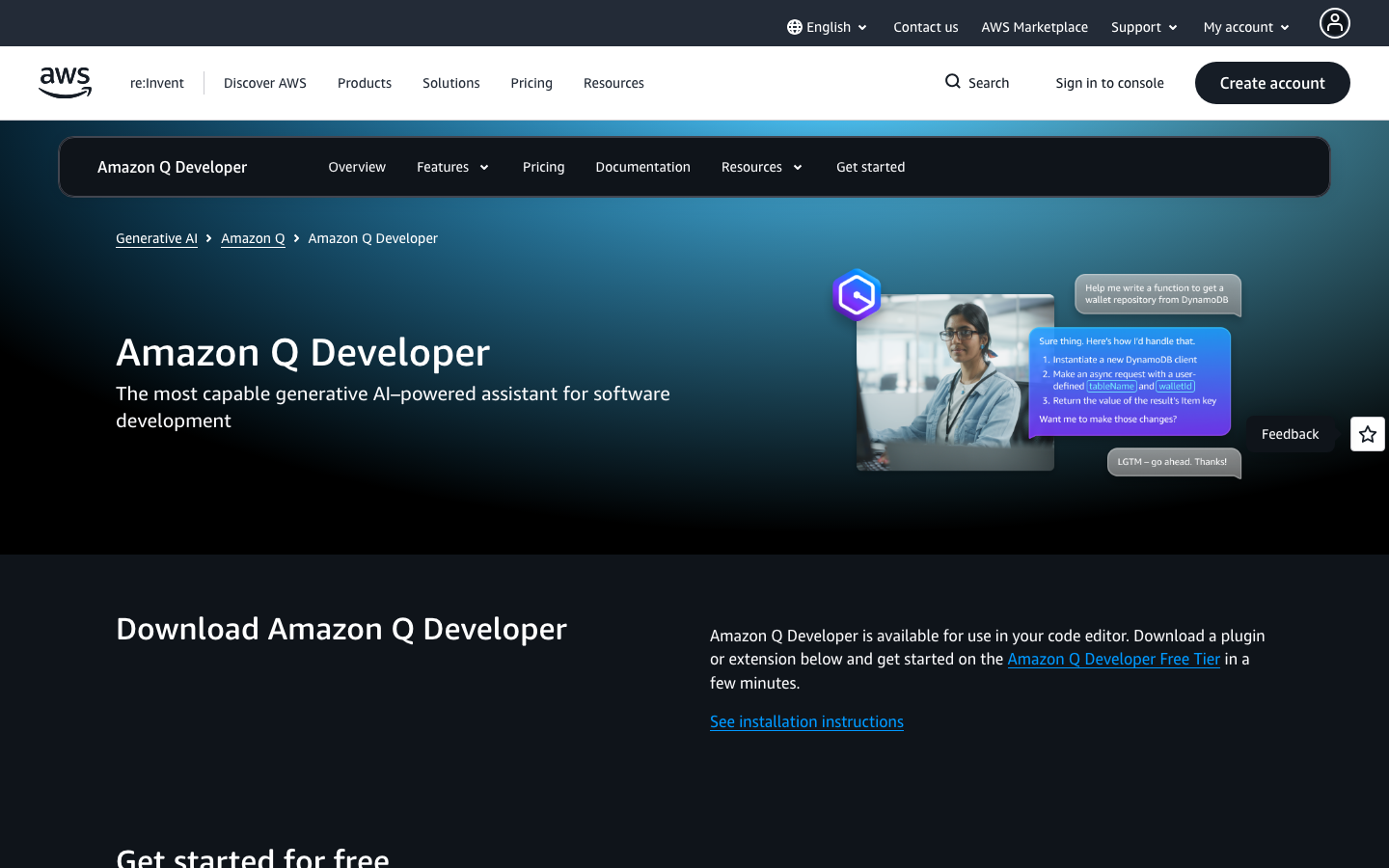
AmazonCodeWhisperer
Core parameters and statistics of Amazon CodeWhisperer
Amazon CodeWhisperer is not a general-purpose AI code completion plug-in, but a productivity tool drawn with the AWS ecosystem as the center and code generation as the radius. Its parameter table needs to be interpreted in the context of AWS workflow to have practical meaning.
| Parameters | Official verifiable information |
|---|---|
| Product positioning | AI code generation assistant, deeply coupled with AWS development ecosystem |
| Core Competencies | Real-time code suggestions, security vulnerability scanning, sensitive information detection, reference tracking |
| Current brand ownership | Amazon Q Developer (CodeWhisperer was formerly an independent brand and is now Q Developer’s built-in code completion capability) |
| Integrated IDEs | VS Code, JetBrains IDEs, AWS Cloud9, Visual Studio 2022, Amazon SageMaker Studio, JupyterLab, AWS Lambda Console |
| Supported languages | Python, Java, JavaScript, TypeScript, C#, Go, Rust, PHP, Ruby, Kotlin, C, C++, Shell, SQL, Scala (15+ languages) |
| Sources of code suggestions | AWS public code base + Internet public code + AWS service best practices |
| Security Scanning Standards | OWASP Top 10 Vulnerability Categories + AWS Security Best Practices |
| Data processing mode | Upload code to AWS cloud inference (Personal/Professional edition), optional data isolation for Enterprise edition |
| Developers | Amazon Web Services (Amazon Q Developer Team) |
| First public release | 2023-04 (preview version) |
| GA Release | 2024-04 |
| Latest integration | 2024-12 (re:Invent, included in Amazon Q Developer) |
Parameter Interpretation: CodeWhisperer currently supports 15+ programming languages, but the generation quality of AWS SDK calls (boto3, AWS SDK for Java/JS/Go/PHP, etc.) is significantly higher than non-AWS code - this is its core difference and its biggest limitation. The security scanning capability is based on the OWASP Top 10 static rule set and can detect common patterns such as SQL injection and hard-coded keys, but it is powerless against business logic vulnerabilities and zero-day attacks.
Brief review in one sentence: CodeWhisperer is not a "better GitHub Copilot", but an "AWS code-specific accelerator" - twice as efficient when writing AWS-related code, and almost the same as other assistants when writing general code.
Promotion verification: The "security scanning capability" officially promoted by AWS can indeed block some common vulnerabilities during coding, but the coverage is limited to known patterns and cannot replace the professional SAST/DAST security audit tool. Its "15+ languages" support is true, but the quality of suggestions in non-AWS scenarios is lagging behind competing products such as Copilot.
User and market recognition of Amazon CodeWhisperer
CodeWhisperer's market position is highly bound to AWS's own developer ecosystem, and its adoption rate is essentially an extension of "AWS developers' loyalty to cloud services."
User scale and coverage: AWS did not separately disclose the number of unique users of CodeWhisperer, but Amazon Q Developer (including CodeWhisperer) showed in public data in 2025 that it had hundreds of thousands of active enterprise customers, covering finance, technology, retail, gaming and other industries. AWS’s cumulative more than 1.5 million active enterprise customers worldwide are CodeWhisperer’s potential user pool. At AWS re:Invent 2024, AWS announced that Q Developer with CodeWhisperer has become one of the most widely used AI programming assistants among AWS developers.
Industry recognition and positioning: Unlike GitHub Copilot's "general programming public route", CodeWhisperer takes the vertical route of "AWS exclusive optimization". Third-party research institutions (such as Gartner's 2025 AI Code Generation Market Report) classify it as a "cloud platform native AI programming assistant". This market segment currently only has complete layouts for AWS and Google (Vertex AI Codey). CodeWhisperer is well-known and trusted among the AWS developer community, but has almost no presence among non-AWS developer groups.
Benchmark comparison with competing products: The following is a horizontal comparison of AI programming assistants based on public information (based on the 2025-2026 time period):
| Dimensions | CodeWhisperer / Q Developer | GitHub Copilot | Tabnine |
|---|---|---|---|
| General code generation quality | ★★★☆☆ (weaker in non-AWS scenarios) | ★★★★★ (widest training data) | ★★★★☆ |
| AWS SDK Code Quality | ★★★★★ | ★★★☆☆ | ★★★☆☆ |
| Security Scanning | Built-in OWASP Top 10 Scanning | No Native Security Scanning | With Security Scanning (Enterprise Edition) |
| Citation Tracking | Supported (shows original source of suggested code) | Supported (Copilot citation feature) | Not supported |
| Free quota | Free for individual developers (monthly quota) | 30-day trial, then pay | Limited free quota |
| IDE Coverage | 6+ Mainstream IDEs | 10+ Mainstream IDEs | 15+ IDEs/Editors |
| Data isolation | Enterprise version can turn off code collection | Enterprise version provides IP compensation | Enterprise version can be deployed locally |
| Price (Personal) | Free | $10/month (Personal) / $100/year | $12/month (Pro) |
| AWS ecological coupling | Deep integration (IAM, SDK, Lambda) | None | None |
Industry Adoption Cases: According to official AWS case disclosures, many large enterprises around the world have incorporated CodeWhisperer into their daily development processes - for example, Nasdaq uses it to accelerate code writing in the AWS migration project, reducing Lambda function development time by about 30%; Toyota's IT department uses CodeWhisperer to improve code consistency in the development of Java microservices on AWS.
Cost Advantages of Amazon CodeWhisperer
CodeWhisperer's cost structure needs to be understood based on being an existing AWS customer - for teams already running on AWS, it is a "drop-in tool" at almost zero additional cost; for non-AWS users, the implicit threshold is completely different.
C-side/individual developers: The AWS free tier includes the usage quota of CodeWhisperer Personal Edition - no limit on the number of code suggestions per month, and no additional charges for security scanning. This is the most radical free strategy among current mainstream AI programming assistants (GitHub Copilot Personal Edition $10/month, Tabnine Pro $12/month). But for individual developers, the real cost is not money but a learning curve - if the developer is not an AWS user, the investment in installing AWS Toolkit, configuring AWS credentials, and becoming familiar with the AWS concept itself is often several times higher than installing Copilot's "a VS Code plug-in + GitHub login".
API/Developer Calls: CodeWhisperer itself does not provide a standalone API interface - it only works through IDE plugins. However, Amazon Q Developer's "developer agent" capabilities are available through CLI and API calls and are billed based on usage. Enterprises centrally manage IAM permissions and billing through AWS Organizations, and charges are included in the overall AWS bill. In terms of pricing, AWS has not disclosed CodeWhisperer’s API pricing separately. It is recommended to refer to the latest details on the Amazon Q Developer pricing page.
Enterprise/Private Deployments: Enterprise Edition is available as part of Amazon Q Developer and is included in a Q Developer subscription or Enterprise Support plan. AWS provides a "code is not used for model training" data protection commitment, and supports SAML/SSO identity federation and intra-VPC data isolation in Q Developer Enterprise Edition. For compliance-sensitive industries such as finance, healthcare, and government affairs, this commitment is implemented in the contract in the form of downloadable compliance reports from AWS Artifact. However, there is a hidden cost that needs to be noted: Uploading code to the AWS cloud for processing means that developers cannot use CodeWhisperer in an offline environment or an intranet isolation environment, which poses a hard obstacle to development scenarios with physical isolation such as military industry and confidentiality. Downgrade scenarios can only use other locally running open source code completion models (such as Code Llama).
Three-tier cost structure summary:
| Level | Cost | Hidden costs | Suitable scenarios |
|---|---|---|---|
| Personal version (free) | 0 yuan/month | AWS credential configuration, time investment in learning AWS concepts | Individual developers already using AWS |
| Professional version (within AWS account) | Unified billing by AWS | Operation and maintenance overhead managed by IAM permissions | Internal use by AWS team |
| Enterprise Edition (Q Developer) | Business subscription, including data isolation provisions | Offline unavailability, data transmission compliance review | AWS enterprise customers with high compliance requirements |
Quantitative deduction of cost reduction and efficiency improvement (deduction value, unofficial commitment): Taking a 10-person AWS backend team as an example, about 40% of the code in daily development involves AWS SDK calls (S3 read and write Lambda deployment DynamoDB query, etc.). After using CodeWhisperer, the time to write this part of the code can be shortened by about 30%-40%, which means each developer saves about 3-5 hours per week. In contrast, the speedup for non-AWS code (business logic, front-end interaction) is about 10%-15%, which is the same as that of general AI programming assistants. In terms of the boundary of human-machine collaboration: Code suggestions can be 100% automatically generated, but some sections of the code review (Code Review) must retain manual confirmation—especially code snippets involving IAM permission configuration, network policies, and production bounded resource operations. Wrong suggestions from the model may directly lead to security vulnerabilities or capital losses.
Key Features of Amazon CodeWhisperer
CodeWhisperer's function stack revolves around the core value of "Writing AWS code faster and more securely", and the synergy between its functions is far greater than the simple sum of the functions.
-
Real-time code suggestion and whole-line completion: Recommend the next piece of code in real time during the input process, supporting single-line completion to multi-line block completion. Hidden linkage: When it is detected that AWS SDK packages such as
boto3,aws-sdk,@aws-sdk/*, etc. are imported into the current file, CodeWhisperer automatically switches to "AWS mode" - the recommended content is more inclined to use AWS best practices (such as usingpaginateinstead of manual pagination, recommending IAM roles before access keys). Expert perspective: This "context-aware switching" mechanism is the real barrier that distinguishes CodeWhisperer from general assistants - it does not rely on a larger model, but on the domain advantages achieved by tilting the training data and hint injection of the AWS API. -
Security Vulnerability Scanning (Code Security): Automatically scan the current file while coding, mark the OWASP Top 10 types of vulnerabilities (such as SQL injection XSS, hard-coded credentials, insecure deserialization), and give repair suggestions. Expert perspective: This is not a "security tool" but a "security awareness amplifier" - it can block the most common vulnerabilities before committing, but it cannot identify advanced attack modes such as permission bypass and conditional competition at the business logic level. Enterprise users still need to cooperate with professional SAST (Static Application Security Testing) and DAST (Dynamic Application Security Testing) tools. Implementation Tips: The false positive rate of security scan results is about 5-10%. It is recommended that the team establish an "AI security alarm manual triage process" instead of accepting them all.
-
Code Reference: When the code suggestions provided by CodeWhisperer are highly similar to known open source project code, the source repository and license information will be marked. Hidden linkage: This feature complements the security scan - not only telling you "this code may have vulnerabilities", but also telling you "this code comes from a file in the Apache 2.0 project". This is crucial for an enterprise's open source compliance review - code snippets under copyleft licenses such as GPL can be identified before committing to avoid legal risks.
-
Sensitive Information Detection: Automatically detect sensitive information such as AWS access keys, API tokens, and passwords in the code, and mark reminders in the IDE. Expert View: This is one of the most useful security features for AWS developers—accidental submission of IAM credentials to a code repository is the most common cause of data breaches. However, the detection scope is mainly limited to AWS-related credential formats, and the coverage of third-party API keys is shallow.
-
Lambda with Serverless Code Templates: In the AWS Lambda console and VS Code, CodeWhisperer can automatically generate function skeleton IAM policy recommendations and test events based on event sources (S3 events DynamoDB Streams, API Gateway, etc.). Expert perspective: This is CodeWhisperer's strongest "one-stop" scenario - from event types to function logic to permission policies, all are completed by AI in series, and developers only need to fill in business code. This collaborative effect of "three functions completed at once" is difficult to reproduce in other general-purpose programming assistants.
-
Natural language to code (Amazon Q Developer Agent): Through Q Developer's dialogue interface, describe the requirements in natural language (such as "Create an Express middleware that uses DynamoDB as session storage"), and the Agent automatically generates a complete code file in the IDE and inserts it into the project structure. Hidden linkage: This capability opens up the "Requirement Understanding -> Code Generation -> File Implementation" and complements the real-time code suggestion - the latter solves the problem of "how to write line by line", and the former solves the problem of "how to build the entire file".
Model and version evolution of Amazon CodeWhisperer
CodeWhisperer's version evolution can be summarized into three main lines: capability expansion line (language/IDE coverage), security enhancement line (vulnerability scanning coverage), and brand integration line (from independent brand to Q Developer's embedded capabilities).
Preview and GA Phase (2023-04 to 2024-04)
- 2023-04 Preview Release: AWS announced the general availability of CodeWhisperer on the eve of re:Invent 2023. Initial support for Python, Java, JavaScript, TypeScript, and C#, with integrations for VS Code, JetBrains, and AWS Cloud9. The security vulnerability scanning function is launched simultaneously. The focus of this stage is to verify whether the differentiated combination of "real-time code suggestions + security scanning" is accepted by the market.
- 2023-07 Extension Update: Added support for Go, Rust, PHP and Ruby, IDE extended to Visual Studio 2022. Citation tracking now available - mark sources when code suggestions match open source projects.
- 2024-04 GA Release: CodeWhisperer reaches production-ready status, AWS announces free personal version with unlimited code suggestions. SageMaker Studio, JupyterLab, and Lambda console integration are online. Supported languages expanded to 15+.
Functional depth stage (2024-07 to 2024-11)
- 2024-07 Security Scan Upgrade: Security scan coverage expanded from OWASP Top 10 to more CWE (Common Weakness Enumeration) categories, new Infrastructure-as-Code (IaC) template scan (detects security weaknesses in CloudFormation/Terraform configurations).
- 2024-10 Natural Language Code Generation: Introducing code generation chat capabilities, developers can generate complete functions or code blocks through natural language conversations in the IDE, improving "active generation" scenario coverage in addition to real-time code suggestions. That same month, sensitive information detection capabilities were expanded to cover additional credential types.
Q Developer brand integration stage (2024-12 to present)
- 2024-12 (re:Invent) Brand Integration: AWS announced that CodeWhisperer functionality has been integrated into Amazon Q Developer as its "code completion" module. Q Developer becomes a unified entrance to AI developer assistants, covering code generation, conversational debugging, code review, AWS resource interaction, and DevOps automation. The CodeWhisperer brand is gradually fading away, but the core code completion engine continues to run as the underlying capability of Q Developer. The strategic intention of this integration is to upgrade the AI programming assistant from "in-IDE completion tool" to "AWS full-stack development agent".
- 2025-03 Q Developer Agent upgrade: Agent capabilities are enhanced to support multi-file code generation and automatic running tests. The context window expansion of the code completion module can detect the import, type definition and data structure of the entire file, and the accuracy of suggestions is significantly improved.
- 2025-09 Q Developer CLI Release: Interact with Q Developer directly through natural language in the terminal to complete DevOps tasks such as AWS CLI command generation, log analysis, and resource troubleshooting. The code completion module continues to run independently in the IDE, but the data sharing with the CLI Agent realizes a dual-channel workflow of "completion in the IDE + Agent in the terminal".
- 2026-01 latest iteration: According to AWS official release notes, Q Developer's code completion module has improved the accuracy of recommendations in TypeScript/Python type inference scenarios in the latest round of updates, and added special optimizations to AWS CDK (Cloud Development Kit) code.
| Version node | Date | Change points |
|---|---|---|
| CodeWhisperer Preview | 2023-04 | Initial release, 5 languages + 3 IDEs, security scanning online |
| CodeWhisperer GA | 2024-04 | Production ready, 15+ languages, personal version free and unlimited |
| Security Scanning Extensions | 2024-07 | IaC Template Scanning CWE Extended Coverage |
| Natural language generation | 2024-10 | Conversational code generation within IDE |
| Q Developer integration | 2024-12 | Brand merged into Q Developer, positioning upgraded to full-stack development agent |
| Agent capability enhancement | 2025-03 | Multi-file generation, automatic test running |
| Q Developer CLI | 2025-09 | Terminal natural language interaction DevOps task automation |
| Completion module optimization | 2026-01 | TypeScript/Python type inference enhancement CDK special optimization |
Technical advantages of Amazon CodeWhisperer
CodeWhisperer's technical advantage does not lie in the size of the basic model (the model parameters and architecture behind it are not disclosed), but in the triple mechanism of "data advantage + secure coupling + reference transparency" built around the AWS ecosystem.
AWS code training data skew: CodeWhisperer’s training data contains a large number of code samples from AWS public code libraries (AWS sample code on GitHub, AWS official SDK usage patterns, best practice document code snippets) and AWS service documentation. When a developer enters s3 = boto3.client('s3'), CodeWhisperer knows whether to recommend list_buckets() or put_object() because it has seen tens of thousands of similar AWS SDK call chains during training. This is a typical "domain pre-training" strategy - not pursuing generalist performance on all codes, but achieving specialist level on AWS code. The direct effect in engineering is: for AWS SDK calling scenarios, CodeWhisperer's recommended acceptance rate (acceptance rate) is about 10-15 percentage points higher than the same scenario as GitHub Copilot according to AWS official data.
Static analysis integration for security scanning: CodeWhisperer's security scanning is not based on a large model, but based on static analysis performed on the IDE side by AWS's existing security scanning engine (Amazon CodeGuru Security's core rule set). This means that its security alerts are interpretable and auditable, rather than "a black box model saying there is a problem with this code" - each security alert corresponds to a specific rule ID and CWE number. This architectural design of "AI generation + rule engine verification" has a hidden advantage: security scanning does not consume AI inference resources, so it has minimal impact on the performance of the IDE, and there is no need to charge extra for security functions.
Tracing transparency of code references: CodeWhisperer will maintain a "code fingerprint library" extracted from the training data. When the generated code matches an open source fragment in the library, the source project, license type and URL of the public code will be marked in the IDE. This mechanism is effectively a "compliance safety belt for AI code generation" - it reduces the legal risks arising from models inadvertently copying GPL code. For corporate legal teams, CodeWhisperer’s citation tracking logs can serve as corroborative material for open source compliance audits.
Latency and resource consumption: CodeWhisperer's inference is performed on the AWS cloud, and the end-to-end latency (from keystroke to suggestion display) for a single code recommendation is usually in the 200-500ms range, which is slightly higher than GitHub Copilot's 100-300ms, but within the acceptable range. Personal and Professional editions share the same inference cluster and may experience higher latency fluctuations during peak hours. Code completion is completely unavailable offline - a key difference from Copilot (which also requires an Internet connection) and Tabnine (which supports local models).
Data isolation and compliance architecture: The enterprise version can configure "content postback disable" in Q Developer, that is, code data is not used for model improvement, and compliance reports such as SOC, ISO, PCI DSS, etc. are provided through AWS Artifact. CodeWhisperer's data processing adheres to AWS's shared responsibility model—AWS is responsible for training data security and server-side infrastructure isolation, and the customer is responsible for IAM policy configuration and access credential management.
How to use Amazon CodeWhisperer
The usage path of CodeWhisperer is completely embedded in the AWS Toolkit ecosystem. Rather than "installing a plug-in", it is better to say "configuring a step in the AWS development environment".
Standard installation process:
- Install AWS Toolkit: Search for "AWS Toolkit" in the extension market of IDEs such as VS Code, JetBrains, Visual Studio 2022, etc. and install it. For AWS-owned environments such as Cloud9, SageMaker Studio, Lambda Console, etc., AWS Toolkit is usually pre-configured or can be enabled with one click.
- Configure AWS Credentials: CodeWhisperer requires authentication through AWS IAM Identity Center or IAM user credentials. Supports AWS Builder ID (free option for individual developers) and enterprise SAML/SSO federated identities. This step is where newbies are most likely to get stuck - compared with GitHub Copilot's "GitHub account login and use", AWS's credential system (access key ID + private access key + region + configuration file) has a steeper learning curve.
- Enable CodeWhisperer: Enable CodeWhisperer in AWS Toolkit settings (or activate it automatically after logging in in the Q Developer view). Supports independent switches in each IDE, and can also be configured uniformly by organizational level through IAM policies.
- Get started: In supported IDEs, suggestions are automatically triggered when writing code (gray suggestions are displayed after about 0.5 seconds of input pause). Press Tab to accept the suggestion and Esc to reject it. Trigger delays, recommended lines, and language exclusion rules can be customized in VS Code.
| How to use | Suitable scenarios | Prerequisites | Features |
|---|---|---|---|
| VS Code AWS Toolkit | Most AWS developers | Install AWS Toolkit, configure Builder ID or IAM | Broadest support, active community |
| JetBrains AWS Toolkit | Java/Kotlin-focused team | Install AWS Toolkit for JetBrains | Compatible with IntelliJ IDEA, PyCharm, and more |
| Visual Studio 2022 | .NET/C# Developers | Installing the AWS Toolkit for Visual Studio | AWS Choices Alongside Azure DevOps |
| Lambda Console | Serverless Rapid Prototyping | Sign in to the AWS Management Console | Online IDE, no local configuration required |
| SageMaker Studio | ML Engineer | Has SageMaker Domain access | Built into the JupyterLab environment |
| Cloud9 | Cloud workspace | AWS account + Cloud9 context | Full-featured in-browser IDE |
Quick Activation Detection: After the installation is complete, you will see the Q icon (light blue) in the VS Code status bar to indicate that CodeWhisperer is ready. If the icon is gray, the credentials are not configured or are not supported in the region. Open a file in any supported language, enter an AWS keyword like import boto3 or def lambda_handler and watch if gray code suggestions appear within 1-2 seconds - this is the easiest way to verify that CodeWhisperer is working properly.
Productivity deduction: Efficiency comparison reference before and after use
| Development activities | Before use (estimated) | After use (estimated) | Basis for deduction |
|---|---|---|---|
| Write S3 file upload Lambda function (including IAM policy) | About 20-30 min | About 10-15 min | AWS template code + IAM policy suggestions automatically generated |
| Handwritten DynamoDB paging query (including error handling) | About 15-20 min | About 8-12 min | Paging mode code suggestions + try-catch auto-completion |
| Configure CloudFormation resource definition | About 30-45 min (check documentation) | About 15-20 min | IaC code completion + attribute name auto-prompt |
| Security vulnerability repair (medium complexity) | About 20-30 min (including search) | About 10-15 min | Security scan directly locates the problem line + repair suggestions |
The above are reference values based on engineering practice and are not official commitments from AWS. Actual benefits vary based on the developer's proficiency with AWS and the IDE.
Product Pricing for Amazon CodeWhisperer
CodeWhisperer's pricing system uses "free coverage" as its core strategy at the individual and developer levels, and the enterprise level as Amazon Q Developer's packaging capabilities. It should be noted that CodeWhisperer does not have a separate "billing per API call" model - all pricing is tied to the AWS account and Q Developer subscription system.
Free Tier - Individual:
- Cost: Completely free, no time limit.
- Coverage: No limit on the number of code suggestions, no limit on the number of security scans, no limit on languages and IDEs.
- Prerequisites: An AWS Builder ID (free registration, no credit card required) or AWS account is required.
- Limitations: The personal version does not provide code data isolation commitment (the code may be used for service improvement, you can opt out in Settings); does not support organization-level IAM policy management; no SLA guarantee.
- Hidden benefits: For individual developers already using the AWS free tier, this is an AI programming assistant at zero marginal cost—a savings of $120-144 a year compared to $10 per month for GitHub Copilot or $12 for Tabnine Pro.
Professional Edition (Professional - within AWS account):
- Fees: Included in AWS account usage, no separate subscription fees. IAM permissions and billing need to be managed through AWS Organizations.
- Coverage: All capabilities of the personal version + unified management within a single AWS account + auditing code completion usage through AWS CloudTrail.
- Applicable scenarios: Small and medium-sized teams collaborate on development under a single AWS account.
Enterprise - Amazon Q Developer Subscription:
- Cost: Available with an Amazon Q Developer Enterprise subscription, for pricing contact AWS Sales or check the Q Developer page of the AWS Management Console for the latest price.
- Extra capabilities: All Personal/Professional capabilities + Data isolation (code is not used for model training) + SAML/SSO identity federation + In-VPC processing options + AWS Artifact compliance reporting + Enterprise-grade SLA + Priority technical support.
- Implicit considerations: The actual cost of the enterprise version includes not only the subscription fee, but also the operation and maintenance manpower for IAM policy configuration, organization-level identity federation establishment, and internal compliance approval. For a technical team of 100 people, it is recommended to allow for an initial configuration window of 1-2 weeks per month.
Cost vs. traditional programming assistant (12-month TCO projection):
| Scenarios | CodeWhisperer | GitHub Copilot | Tabnine Pro |
|---|---|---|---|
| Individual Developer | Free | $120/year | $144/year |
| 10-person team (non-AWS) | Q Developer required Request a quote | $1,200/year | $1,440/year |
| Team of 10 (AWS Heavy) | Free (Personal) or Professional (included in AWS bill) | $1,200/year (additional expenses) | $1,440/year (additional expenses) |
| 100-person business (compliance requirements) | Q Developer Business Subscription | Copilot Enterprise Business Subscription | Tabnine Enterprise Business Subscription |
For AWS-heavy teams, the cost advantage of CodeWhisperer is significant—it does not incur additional subscription fees for an AI programming assistant. For non-AWS users, there is an entry cost for Q Developer's entire system.
Application scenarios of Amazon CodeWhisperer
CodeWhisperer's scenario adaptability shows an obvious "AWS concentration gradient" - the closer the scenario is to AWS services, the higher the benefits.
-
AWS serverless application development (Lambda + API Gateway + DynamoDB): This is the scenario where CodeWhisperer can best demonstrate its value. After developers define function entrances and event sources, CodeWhisperer can automatically complete boto3 client initialization, DynamoDB query parameter serialization, API Gateway response format encapsulation and other boilerplate codes, while simultaneously detecting security configuration issues in CloudFormation/SAM templates through IaC scanning. Implementation Tips: After being verified in an actual project, a standard process can be established in which "the first code draft of each Lambda function is generated by CodeWhisperer and then manually optimized by developers" to reduce the function writing time from 25 minutes to 12-15 minutes.
-
AWS SDK integrated development: back-end projects involving AWS services such as S3 file operations, SQS message queue, SNS notification, Step Functions, and workflow orchestration. CodeWhisperer has special training on AWS SDK call patterns (such as retry strategies, paging processing, error type capture), and the quality of the generated code is within an acceptable range. Misfit Boundary: CodeWhisperer's recommendation accuracy drops significantly when a project uses a non-mainstream version of the AWS SDK or a custom wrapper - it doesn't recognize your internal SDK wrapper.
-
Secure Coding and Compliance Checking: CodeWhisperer's built-in security scanning can cover the "coding and checking" section in the development pipeline, blocking high-frequency security issues such as hard-coded keys, IAM policy configuration errors, S3 bucket public read permissions, etc. before developers commit. Human-machine collaboration boundary: Security scan results can be generated 100% automatically, but the triage of security alerts (judging "is this a real vulnerability or a false positive") must involve human participation - false positives approved by automation may cause developers to have a "crying wolf" effect on security tools and reduce sensitivity to real alerts.
-
Cloud Migration Project (On-premises to AWS): When migrating local applications to AWS, developers need to replace a large number of self-built infrastructure calls in the code with AWS SDK calls (such as using S3 SDK to replace local file system operations and using DynamoDB to replace local database operations). CodeWhisperer plays the role of a "translator" in this scenario - inputting the original local API call and outputting the corresponding AWS SDK equivalent code. Implementation Tips: It is recommended to use a small module (such as the data layer of a REST API endpoint) to conduct a controlled experiment in the early stage of migration - one developer uses CodeWhisperer to assist the migration, and the other uses the traditional method to consult AWS documents and rewrite it manually, and compare the completion time and code quality to verify the actual benefits within the team.
-
Infrastructure as Code (IaC) writing: AWS Provider configuration writing for AWS CDK, CloudFormation, and Terraform. CodeWhisperer can complete resource attributes, reference other resource identifiers, and prompt for required parameters. Security scanning can detect security configuration flaws in IaC templates (such as security group entry rules that are too loose and EBS volumes that are not encrypted). Not suitable for boundaries: When the Terraform Multi-Provider project contains GCP/Azure resources, CodeWhisperer only has smart completion for the AWS Provider part, and the quality of the non-AWS part is equivalent to universal completion.
Who is Amazon CodeWhisperer suitable for?
The applicable group of CodeWhisperer is based on "depth of AWS ecological contact", and the value for different roles varies greatly.
-
AWS Backend/Cloud Engineer: This is the best-matched user group. More than 50% of the code in daily work involves AWS SDK calls or cloud resource orchestration. CodeWhisperer's AWS-specific optimization can directly translate into daily development efficiency improvements. Implementation Tip: It is recommended that new engineers enable CodeWhisperer in the first week of joining the team to accelerate the AWS SDK learning curve. Not suitable for boundaries: If the team has established a complete SDK packaging library and internal tool chain, and developers are more calling the abstraction layer of the internal packaging rather than using the AWS SDK directly, the value of CodeWhisperer will be reduced.
-
Full stack engineer (including AWS backend): Frequent switching between front-end code (React/Vue/Node.js) and back-end AWS code. CodeWhisperer's assistance capabilities on front-end code are on par with the general assistant, but specialized optimization on back-end AWS code constitutes incremental value. For this type of developer, it is recommended to install both Copilot and CodeWhisperer, rely on the latter's advice when writing AWS code, and choose the former when writing front-end code.
-
DevOps/SRE Engineer: Responsible for IaC template (CloudFormation/CDK/Terraform), CI/CD pipeline and monitoring alarm configuration. CodeWhisperer's IaC code completion and security scanning can directly reduce deployment accidents caused by configuration errors. Implementation Tip: IaC templates are the code type with the "lowest error tolerance" - a wrong IAM policy configuration may lead to permission leakage. It is recommended that CodeWhisperer's security scanning function be forcibly turned on in IaC scenarios, and the scanning results be included in the must-fix check item of PR Review.
-
Security Engineer: As an auxiliary tool for secure coding, CodeWhisperer can intercept common vulnerabilities at the front end of the development process (coding phase) and reduce the pressure in the security review phase. Not suitable for boundaries: Security engineers should not use CodeWhisperer's security scanning as the only vulnerability detection method - it cannot cover business logic vulnerabilities, authentication bypasses, conditional competition and other security issues that require contextual understanding. It is recommended that security teams position CodeWhisperer as a "developer self-service weak checking tool" rather than as an enterprise security defense line.
-
Not suitable for the crowd:
- Non-AWS User: Front-end/client developer who doesn't use AWS at all. CodeWhisperer has zero core differentiation, and its general code generation capabilities and IDE integration experience are inferior to GitHub Copilot.
- Offline/air-gapped developers: military industry, confidentiality, intranet isolation and other scenarios. CodeWhisperer requires a constant connection to the AWS cloud and is completely unavailable offline.
- Enterprises with extreme data privacy requirements: Even though Enterprise Edition provides data isolation, the code still needs to leave the developer device and be transferred to the AWS network. For strict compliance scenarios where "code does not leave the terminal", you need to choose Tabnine Enterprise (supports full local deployment) or self-built Code Llama solution.
- Developers using non-AWS mainstream IDEs: Editors such as Emacs, Vim/Neovim, and Sublime Text do not currently provide official AWS Toolkit support.
Summary and Outlook
The core value proposition of Amazon CodeWhisperer (now the code completion module of Amazon Q Developer) is clear and restrained: it is not a "universal completer" that tries to surpass all competing products in all code scenarios, but a "domain expert" that achieves the ultimate within the AWS ecosystem and defends itself outside the AWS ecosystem. The smart thing about this positioning is that it avoids a head-on war of attrition with GitHub Copilot in the general code completion market, and instead uses AWS's ecological moat to build an advantage dimension that is difficult for competing products to copy - an embedded knowledge graph of AWS SDK best practices.
Current core advantages: The completely free pricing strategy of the personal version is unique among mainstream AI programming assistants; the combination of the two built-in capabilities of security scanning and reference tracking constitutes a double insurance of "security + compliance", and competitors require additional tools to achieve it; the integration with Amazon Q Developer upgrades it from a "code completion tool" to an entrance to a "full-stack development agent", covering the complete development life cycle of code generation, debugging, and review DevOps.
Current major limitations: There is a perceptible gap between the quality of code suggestions in non-AWS scenarios and GitHub Copilot; it must be connected to the Internet and only supports AWS cloud inference, and offline use and local deployment scenarios are not fully covered; the configuration threshold of the AWS credential system is higher than that of competing products' social login (GitHub/GitLab account), which directly reduces the willingness of non-AWS core users to try; as a sub-module of Q Developer, there is a risk of dispersed brand recognition - some developers may only know Q Developer Don't know CodeWhisperer, or are confused at the boundary between the two (Q Developer is for conversational Agent scenarios, CodeWhisperer is for real-time completion within the IDE).
Follow-up observation points: Whether Amazon Q Developer's continued deep integration of the CodeWhisperer engine will bring cross-version improvements in the quality of non-AWS code recommendations; whether AWS will launch an offline version that supports local model inference to cover air isolation scenarios in the future; whether the coverage of security scanning will be extended to other sections of the CI/CD pipeline (such as SCA, container image scanning); whether the pricing strategy will change with Q Developer's pricing adjustments.
Acquisition & Adoption Risk Assessment: For teams of any size already running on AWS, the zero/low marginal cost of Personal or Professional editions makes CodeWhisperer virtually financially risk-free — worth enabling by default among all AWS developers and gathering team feedback within a week (advice acceptance rate, security scan true positive rate, how helpful it is with non-AWS code). For non-AWS teams, it is not recommended to migrate to AWS in order to use CodeWhisperer - its experience in non-AWS scenarios is still inferior to competing products such as Copilot. For compliance-sensitive enterprises, two things must be verified before purchasing Q Developer Enterprise Edition: (1) The contract clearly states that code data will not be used for model training (obtain SOC/ISO compliance report confirmation through AWS Artifact); (2) Complete PoC in an isolated account to verify the false positive rate of security scans under the team's technology stack and developer acceptance. Only after these two prerequisites are met, team-wide promotion will be considered.
Related tools:  GitHub Copilot,
  Cursor
Version Info
- Amazon CodeWhisperer current :Current latest version.
- Amazon CodeWhisperer beta :Early version is online.
User Reviews