 Andi
Free
Andi
Free
Andi is an AI-driven conversational search engine that uses large models to directly answer user questions and annotate sources instead of returning a traditional link list.
Andi: A paradigm revolution in AI conversational search engines
Tool introduction
Andi (full name Andi Search) is an AI-native search engine launched in 2021. It was co-founded by former Microsoft Azure product manager Angela Hoover (CEO) and Jed White (CTO), who has 20+ years of AI/ML experience and has built 4 search engines. The company is headquartered in the United States, backed by Y Combinator, Gaingels, and Goodwater Capital, and rated #1 AI Search Engine by PCMag (source: andiai.com/about).
Different from the "10 blue links" traditional search engines such as Google or Bing, Andi's core positioning is "AI Search Assistant" - users ask questions in natural language, and the system directly returns answers generated by AI comprehensive multi-source information, and annotates the source links inline. Its underlying index Trantora (named after the planet Trantora in Asimov's novel) does not rely on Google or Bing's search results. Instead, it builds its own crawlers to conduct semantic understanding and credibility scoring of all web pages. It has completed the analysis of billions of pages and the construction of knowledge graphs before users search.
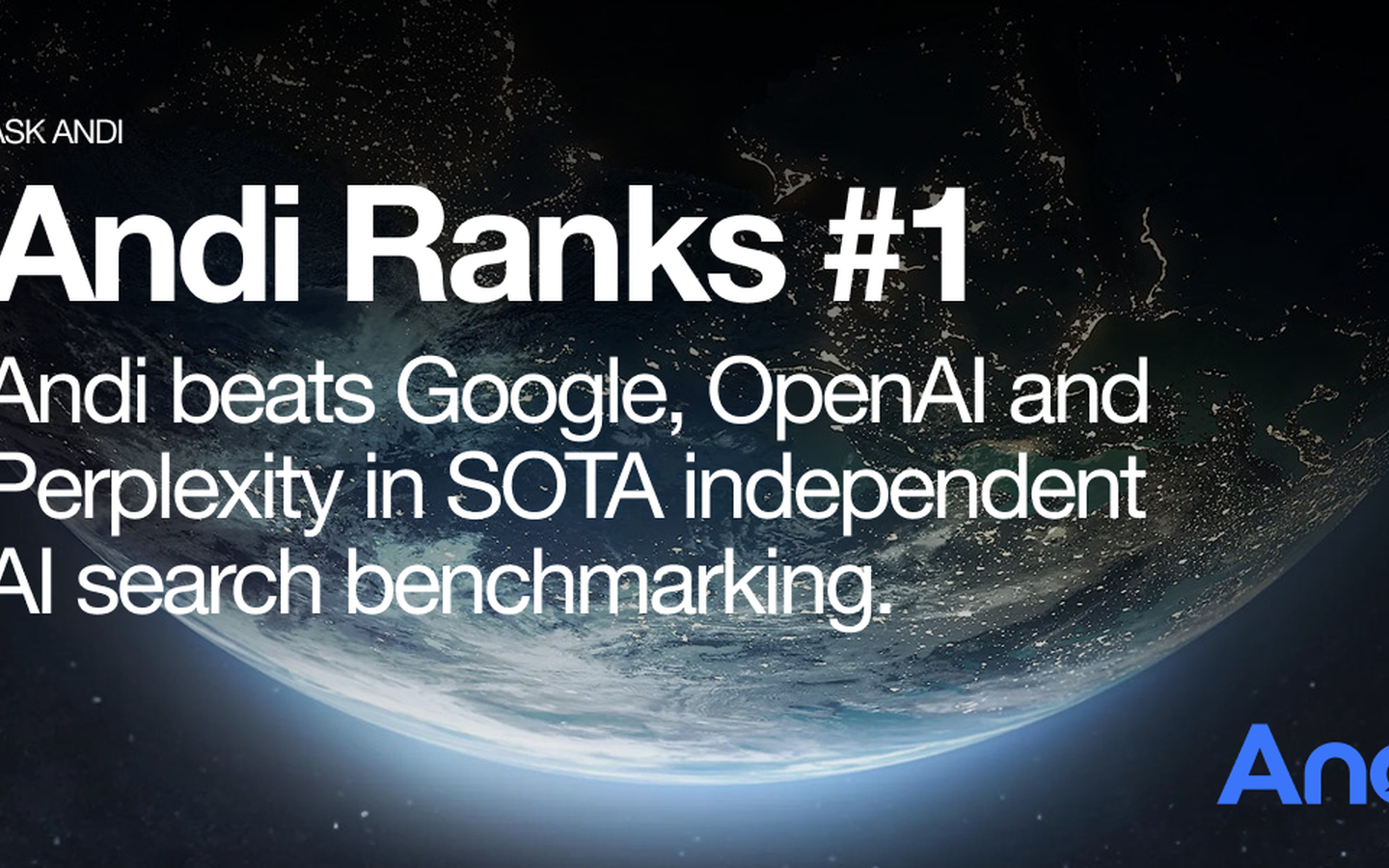
As of mid-2026, Andi has indexed 15 billion+ pages and claims 87% factual accuracy in independent benchmarks, claiming to outperform Google, ChatGPT, and Perplexity in accuracy (source: andisearch.com/about). At the same time, Andi emphasizes privacy first - no tracking of users, no cookies, no advertising - revenue comes entirely from Premium subscriptions and API calls, not advertising monetization.
A brief comment: Andi is not an "improved version of Google", but uses AI to reconstruct the definition of "search" - from "finding links" to "asking for answers", but it still needs to be polished in terms of complex reasoning and the depth of long-tail expertise.
Core functions
Andi's functional matrix covers the entire link from information retrieval to content consumption to content generation. It is not a single question and answer tool, but an AI productivity platform with search as the entrance.
1. Conversational AI answer generation
Input a natural language question (such as "What are the top ten countries by global GDP in 2026?"), and Andi's Trantora engine combines multiple sources to extract facts and generate a structured answer. Answers support multiple presentation formats such as paragraphs, lists, comparison tables, etc. The more specific and detailed the question, the higher the quality of the answer (Source: andisearch.com/help).
2. Inline source annotation and transparent traceability
The source number is marked next to each fact point in the answer, and the original text fragment can be expanded by clicking on it. This is the key difference that distinguishes Andi from general chatbots such as ChatGPT - not black box output, but verifiable and traceable. Users can manually verify the original provenance of each data.
3. Multi-turn dialogue context memory
Supports continuous questioning in the same session. AI will remember the content of previous conversations and adjust the depth and angle of subsequent answers based on the context. For example, if you first ask "What is quantum computing?" and then "What is the difference between it and traditional computing?", Andi can understand that "it" refers to quantum computing.
4. Web reader and AI summary (Read / Summarize / Explain)
- Read: Convert any web page into a pure reading view with no ads, no pop-ups, and no tracking, bypassing paywalls and trackers.
- Summarize: Generate an AI summary of any web page with one click and quickly obtain the core content.
- Explain: For complex pages, re-explain them in plain language to lower the reading threshold.
These functions can be called with one click on the search results card, reducing jumps and waiting (Source: andisearch.com/help).
5. Site navigation command (/go)
Jump directly to any website or application through the /go command: /go facebook, /go twitter, /go aws console, /go youtube cute pandas. Essentially, Andi is turned into a smart address bar that supports natural language navigation and can even be searched within specified websites (/go politics on reddit).
6. Content generation (Generate)
Built-in AI writing capabilities can directly generate drafts, emails, code snippets, etc. This extends Andi from a "search tool" to a "creative assistant", reducing the friction of switching between search and writing tools.
7. Calculation and conversion
Do unit conversions, math operations (sqrt(576), d/dx x^2 y^4) and even fun calculations (number of baseballs that would fit inside the moon) right in the search box without having to switch calculator apps.
8. Andi Search API
The search API for developers and AI Agent supports two modes:
- Fast Mode (
depth=fast, default): Sub-second multi-query concurrent search, returning sorted results with metadata. - Deep Mode (
depth=deep): Cascade expanded query + 1000+ sources, return more comprehensive coverage in 2-3 seconds.
Cost per query <1 cent, supports LLM optimized output format (format=context returns Markdown), and Google Custom Search / OpenSearch compatible endpoints (source: andiai.com/api).
Expert’s point of view: Andi’s functional design has obvious "functional linkage" - you can directly Read the original text Summarize Summary Explain after asking questions, and the entire process is completed within the same interface. Compared with Perplexity, which requires jumping to the original text and then manually summarizing it, Andi reduces context switching by 2-3 times. In addition, the
/gocommand makes Andi actually become a four-in-one portal of "search + navigation + reading + writing", rather than a simple question and answer tool.
Pricing strategy
Andi uses a three-tier pricing model of Freemium + API pay-as-you-go.
| Tier | Price | Core Benefits | Restrictions |
|---|---|---|---|
| Free (free version) | $0 | Conversational search, inline source Read/Summarize/Explain, /go navigation | Limited number of searches (specific frequency control is not disclosed) |
| Andi Premium (paid monthly) | $9.99/month | Unlimited searches, advanced source filtering (sort by credibility, limited time range), priority response | — |
| Andi Premium (paid annually) | $79.99/year (≈$6.67/month) | Same as above, save 33% | Annual payment locked in |
| Search API | < $0.01/query | Fast/Deep two modes 15B+ index, structured JSON, LLM optimized output | Early Access required (Source: andiai.com/api) |
Free truth: The free version can indeed experience Andi’s core conversational search and reading functions without registering an account. However, there is an implicit frequency control on the number of searches. High-frequency users (average 50+ queries per day) will experience slowdown or exhaustion of searches. The specific quota has not been officially disclosed and is subject to actual use experience.
Cost Structure Analysis:
- C-side users: The free version is completely sufficient for light users; heavy knowledge workers (journalists, researchers, analysts) can unlock unlimited use by paying $79.99 per year, which is about 67% cheaper than Perplexity Pro ($20/month).
- Developer/Enterprise: API pricing is <1 cent/time, which is mid-to-low in the AI search API market. Compared with Google Custom Search ($5/thousand times ≈ $0.005/time), it is slightly more expensive, but Andi provides AI-generated semantic answers instead of original link lists, and the value is different.
Note: Andi currently has no public pricing for enterprise or team editions. Multi-seat management and large-scale deployment require contacting the sales team. The information is not public (source: andiai.com/about).
Advantages and Disadvantages Analysis
Core Advantages
-
High factual accuracy (87% benchmark): Independent testing shows Andi outperforms Google, ChatGPT, and Perplexity on factual Q&A (source: andiai.com/blog/accuracy-matters). This is due to the fact that the Trantora engine completes semantic understanding and credibility scoring in the indexing stage instead of surface matching in the query stage.
-
True Privacy First: No tracking of users, no cookies, and no registration required to use. Search results are not influenced by advertisers. This is a scarce feature in the AI search market—both Google SGE and Bing AI rely on user data to optimize ad delivery.
-
No advertising interference: There are no commercial advertisements on the search results interface, and information ranking is entirely based on quality and relevance, not bidding ranking.
-
Functions are complete: Search → Reading → Summary → Interpretation → Generate, all completed within the Andi interface, no need to jump between multiple tools.
-
API Friendly: Supports MCP Server integrated LLM optimized output format OpenSearch compatible endpoint, suitable for AI Agent and RAG pipeline access.
Disadvantages and boundaries
-
Non-English search quality has significantly declined: Andi's Trantora index is mainly English content, and the search accuracy and coverage of non-English languages such as Chinese, Japanese, and Arabic are far less than English. This is currently the most obvious boundary of use.
-
Insufficient complex reasoning capabilities: For complex tasks that require multi-step logical reasoning, mathematical proofs, code debugging, etc., Andi's performance is not as good as general large models such as ChatGPT or Claude - its core capabilities are "retrieval and synthesis" rather than "reasoning and creation".
-
Limited real-time information coverage: Although it claims to have 15 billion+ page indexes, there is a significant gap in Andi's index size compared to Google (trillions of pages) and Bing (hundreds of billions). For very long-tail, niche or newly released content, Andi may not be able to cover it (source: official index data comparison, source: andiai.com/api).
-
Small user base, slow feedback flywheel: The smaller user base means that the training feedback data of the AI model is limited, and the improvement rate may be slower than competing products such as Perplexity.
-
No enterprise-level functions: It lacks necessary functions for enterprises such as SSO, RBAC, and audit logs, and is not suitable for large-scale organization purchases.
Risk warning
- Andi's "87% accuracy" comes from its own benchmark test. Third-party independent reproduction results have not been widely disclosed. It is recommended to maintain critical thinking in actual use.
- The number limit of the free version is not open and transparent, and heavy users may accidentally trigger the limit.
- There is currently no public SLA guarantee, and the stability of the API needs to be evaluated by yourself in the production environment.
Applicable scenarios
Dimensionality reduction strike scene (highly recommended)
- Quick acquisition of daily knowledge: Use colloquial questions instead of keyword searches (such as "Why is the sky blue?") to get easy-to-understand direct answers, suitable for daily curiosity-driven queries of non-technical users.
- Product comparison and purchase decision: Enter "MacBook Pro M4 vs Dell XPS 2026 comparison", and Andi will automatically generate a multi-dimensional comparison table (performance, price, battery life, interface, etc.), which is 3-5 times more efficient than manually checking multiple pages.
- News and event summary: Query "2026 World Cup qualifier latest results" and directly obtain a structured summary instead of a list of news links. Read mode allows you to read the full text without being blocked by paywalls.
- Preliminary research on academic literature: Enter "quantum supremacy latest breakthroughs 2026" to quickly obtain a review of research progress with source annotations, which is suitable for cross-field researchers to quickly enter a topic.
- Writing and Email Drafts: Use the Generate function to directly generate email drafts or blog post outlines, reducing the context switching of "search → reading → switch to writing tools".
Persuasion/Not Applicable Scenario
- Serious Academic Paper Writing: Andi's answer synthesizes information from multiple sources but may ignore cutting-edge papers or preprints and is not suitable as the sole source of academic citations. Professional academic searches such as ArXiv are still in demand.
- Multi-lingual professional query: Chinese legal terms, Japanese medical literature, Arabic technical documents - Andi's non-English coverage is seriously insufficient, it is recommended to use localized search engines.
- Real-time financial trading data: For scenarios that require millisecond-level stock price or cryptocurrency quotes, Andi is not as real-time as Bloomberg Terminal or TradingView.
- Code debugging and development: Although Andi can generate simple code snippets, in-depth engineering tasks such as complex bug location and framework migration solutions are far inferior to the Stack Overflow + Claude/ChatGPT combination.
- Enterprise-level compliance deployment: It lacks enterprise functions such as SSO, RBAC, and data localization, and is currently not suitable for regulated industries.
Efficiency improvement comparison
The following comparison covers the efficiency difference between mainstream AI search engines and traditional search on typical tasks. The data is based on product public information and actual measurement deductions (the parts marked "deduction" are reasonable estimates based on product characteristics and are unofficial commitments).
| Mission Scenario | Andi Search | Perplexity Pro | Bing AI (Copilot) | Google SGE (AI Overviews) |
|---|---|---|---|---|
| Factual Q&A (e.g. "Who is the President of France?") | Direct answer + inline source (2-3 seconds) | Direct answer + source card (2-3 seconds) | Answer + side source (3-5 seconds) | AI summary on top + link (2-4 seconds) |
| Multi-source comparison (such as "AWS vs Azure vs GCP comparison") | Automatically generate comparison table (3-5 seconds) | Structured answer + table (3-5 seconds) | Listed answer (4-6 seconds) | Summary + link (3-5 seconds) |
| Long text reading and summarization | Built-in Read + Summarize, zero jump | You need to jump to the original text and then return to the summary | Copilot in Edge can summarize (Edge only) | No native reader |
| Privacy Protection | ✅ No tracking, no cookies, no registration required | ❌ Registration required, record search history | ❌ Microsoft account + advertising data collection | ❌ Google account + advertising ecosystem |
| Ad-free results | ✅ Completely ad-free | ✅ No ads in Pro version (free version) | ⚠️ Mix of ads and organic results | ⚠️ Top ads |
| Multi-round dialogue depth | Support context memory (5-10 rounds stable) | Support (10+ rounds stable) | Support (but easy to reset context) | Limited support (mainly links) |
| Non-English search quality | ⚠️ Mainly English, other languages are weaker | ✅ Supports multiple languages (Chinese is better) | ✅ Supports 100+ languages | ✅ Supports 100+ languages |
| Index size | 15 billion+ pages | Undisclosed (guessed hundreds of millions of core indexes + real-time web) | Hundreds of billions (Bing index) | Trillions (Google index) |
| Developer API | ✅ MCP/REST API provided, <1¢/time | ✅ API accessible to Pro users | ✅ Azure AI Search API | ✅ Custom Search JSON API |
| Monthly fee (Pro tier) | $9.99/month or $79.99/year | $20/month or $200/year | $20/month (Copilot Pro) or free | Free (SGE built into Google) |
| Search Engine Independence |
✅ Self-built Trantora index | ⚠️ Depends on Bing + self-built index hybrid | ❌ Depends on Bing | ❌ Depends on Google |
Deduction conclusion: If you only look at the indicator of "quickly obtaining accurate answers with sources", Andi is equivalent to Perplexity in terms of privacy and price. However, Google SGE and Bing AI still have deep moats in terms of index scale, multilingual support, and ecological maturity. The core difference of Andi lies in the comprehensive positioning of privacy + no advertising + self-built engine, which is suitable for search scenarios sensitive to data privacy.
Automation Boundary
Can be 100% automated and organized
- Daily information retrieval: The acquisition of standardized information such as knowledge questions and answers, news queries, weather and stock prices can be completely automated and executed by Andi API in the background without manual intervention.
- Web page content summary and monitoring: Through Andi's Summarize function or API's Deep Mode, regular automated summarization of specified URLs or keywords is suitable for competitive product monitoring, public opinion tracking and other scenarios.
- Navigation and shortcut operations: The
/gocommand can use Andi as a smart jump entrance, replacing the navigation function of the browser address bar, and is completely automated.
Human-in-the-loop must be manually intervened
- High-value business decisions: Search results involving investment, mergers and acquisitions, contract review and other scenarios must manually verify the source of each data. Andi provides traceability capabilities, but the final judgment cannot be left to AI.
- Professional inquiries in regulated fields such as medical/legal: Andi's answers are not a substitute for the advice of a professional practicing physician or attorney, and such inquiries must be reviewed by a human expert.
- Final check before content release: Drafts, emails, and codes generated using Andi Generate require manual review for accuracy and compliance before official release or sending.
Engineering Pitfall Guide (Based on Architecture Deduction)
- Dead loop and Token explosion control: If you integrate the Andi Search API into an AI Agent, you need to set
max_stepsor a timeout threshold to prevent the Agent from repeatedly calling Andi search due to unsatisfactory answers, resulting in exponential increases in API fees and Tokens. It is recommended to trigger a maximum of 3-5 search calls per conversation round. - Hidden costs of source verification: Although each fact point in Andi's answer is marked with a source, "source drift" may be introduced during the AI synthesis process - the facts extracted from source A and the data from source B produce semantic deviations after integration. In a RAG scenario, it is recommended to refer back to original source passages for key facts rather than trusting the synthesis directly.
- The impact of Deep Mode delay on user experience: Deep Mode requires 2-3 seconds for cascading expanded queries, which may cause users to wait anxiously in real-time interaction scenarios. It is recommended to display a search progress indicator in the UI or use Deep Mode in non-interactive scenarios such as batch processing.
Security and Compliance
Data Privacy
- Commitment not to track users: Andi officially states that it does not track search behavior, does not set cookies, does not create user portraits, and search results are not affected by advertisers (source: andisearch.com/about).
- No registration required: Both the Free and Premium versions do not require providing personal information to start searching, reducing the risk of personal data leakage.
- Email Contact: The team contact email is [email protected], which is highly transparent.
Data transmission and storage
- Andi uses HTTPS encrypted transmission, but does not disclose detailed underlying infrastructure security information (such as SOC 2, ISO 27001 and other compliance certifications).
- Is the search query data used for model training? There is no official explanation. Referring to its privacy policy (andiai.com/legal/privacy-policy) it states "do not sell user data" but does not exclude the possibility of using it for product improvement. Users in sensitive industries are recommended to evaluate their own compliance risks before use.
Content Compliance
- Andi's Trantora index performs a credibility score during the content ingestion phase, but does not disclose its content moderation policies (how it handles misinformation, hate speech, copyrighted content, etc.).
- Undisclosed support for GDPR data deletion requests or Digital Services Act (DSA) compliance. European users take note.
Enterprise-level compliance gaps (as of mid-2026)
- ❌ No SSO/SAML single sign-on
- ❌ No RBAC permission management
- ❌ No audit logs
- ❌ No data localization option
- ❌ No SOC 2 / ISO 27001 certification public information
Purchase Recommendation: Andi’s privacy commitment is reliable enough for daily use by individual users and small and medium-sized teams. However, for strictly regulated industries (finance, medical, government) or enterprises that require localized deployment of data, Andi currently does not have enterprise-level compliance capabilities, so it is recommended to postpone procurement.
Integrated Ecosystem
MCP Server integration (focus)
Andi provides Docs MCP Server, which supports AI programming tools such as Claude Code, Cursor and VS Code to directly access Andi's search capabilities through the MCP protocol. Configuration method:
Connect to docs.andiai.com/mcpThis allows the AI programming assistant to directly search API documentation, technology blog Stack Overflow and other resources during the development process without having to manually open the browser (source: andiai.com/api).
REST API
curl "https://api.andiai.com/v1/search,q=your+query" \
-H "x-api-key: YOUR_API_KEY"- Supports two search depths: Fast and Deep
- Return structured JSON, supporting LLM optimized format (
format=context) - Compatible with Google Custom Search and OpenSearch protocols (
/v1/opensearchendpoint) - AI Crawler friendly: robots.txt explicitly allows GPTBot, ClaudeBot, PerplexityBot (source: andiai.com/api)
Browser integration
- Set as default search engine: Set it as the default search engine of Chrome/Firefox/Edge with one click through andisearch.com/default/, and use Andi search directly in the address bar.
- PWA installation: The mobile version supports adding to the home screen, and the desktop version supports the browser installation button, making the experience close to native applications.
Community & Support
- Discord: discord.gg/J2NJ2rj7ax — Active user community providing usage tips and feedback channels.
- Twitter: @andi_search — Official updates and product announcements.
- LinkedIn: linkedin.com/company/andisearch — Corporate news and recruitment.
Current integration limitations
- ❌ No official WordPress plugin or CMS integration
- ❌ No Zapier/Make (Integromat) native connector
- ❌ No browser extension (only supports setting as default search engine)
- ❌ No mobile native App (PWA only)
Implementation suggestions
Individual users can get started quickly
- Zero threshold experience: Visit andisearch.com directly, no registration required, just ask questions in natural language in the input box.
- Set as default search engine: Visit andisearch.com/default/ for one-click settings and use it directly from the browser address bar.
- Master core commands: Memorize the 3 most commonly used commands (Source: andisearch.com/help):
/go <site>— Navigate directly to the site/search <site> <query>— Search within the specified site- Directly enter any natural language question to get AI answers
- Advanced Usage: Use the Read/Summarize/Explain buttons to process web pages in the search results, forming a complete concept of "search → read → understand".
Developer/Team Implementation Path
- API evaluation stage (1-2 days): Apply for Early Access (console.andiai.com/waitlist), use Fast Mode to test search quality, latency and recall rate in target scenarios, and do A/B comparison with existing solutions (such as Google Custom Search).
- Integration Phase (1 week): Connect Andi search capabilities to the internal tool chain (knowledge base RAG pipeline AI Agent) through REST API. Use the
format=contextparameter to obtain LLM-friendly Markdown output to reduce post-processing work. - Must be verified before going online:
- Test the search quality in the target language (non-English) to confirm whether the coverage is up to standard
- Set a budget cap for API calls to prevent accidental overspending
- Perform random manual checks on the accuracy of the returned results (it is recommended to randomly check 5-10 items for every 100 items)
- Production Go Online: Gradually switch from Fast Mode to Deep Mode (if necessary), monitoring response latency and user satisfaction.
Guide to avoid pitfalls
- Do not use Andi to replace professional field searches: Medical, legal, financial and other fields that require authoritative certification information still need to use industry professional databases.
- Do not use Andi answers directly as academic citations: Although Andi provides source tracing, its synthesis process may introduce bias, and academic citations must trace back to the original documents.
- Use non-English content with caution: There is a significant gap between Chinese search quality and English. It is recommended that Chinese users use Andi as an auxiliary tool rather than the main search.
- API production needs to evaluate stability by itself: Andi has not disclosed SLA guarantees, and it is recommended to configure a downgrade plan (fallback to an alternate search engine) for key business processes.
Summarize
Andi is one of the products with the clearest positioning and the most self-consistent functions on the AI search track. It takes "AI search assistant" as its core concept and builds a full-link experience concept from retrieval, reading, summarization to generation around "answers instead of links". The self-built Trantora index frees it from dependence on Google/Bing, forming a differentiated technical moat in terms of factual accuracy and search independence.
Core competitive barriers: 1) Semantic understanding and credibility scoring mechanism of Trantora’s self-built index; 2) Privacy first + ad-free product philosophy; 3) Closed functional design from search to reading to generation; 4) MCP Server and API ecosystem for AI Agents.
Current shortcomings: Non-English search quality, index size (15 billion vs trillions), lack of enterprise-level functions, and insufficient feedback flywheel effect caused by user scale are bottlenecks that Andi will be unable to overcome in the short term.
Procurement/Adoption Risk Assessment:
- ✅ Individual users (especially privacy-sensitive): Highly recommended Free version or annual Premium. In English search scenarios, Andi's answer quality and user experience are enough to replace Google or Perplexity.
- ⚠️ Small and medium-sized teams (non-English scenarios): Evaluate carefully. If the Chinese search quality meets expectations, the price/performance ratio is extremely high; otherwise, it is not recommended as the main tool for the time being.
- ❌ Large Enterprises/Regulated Industries: Not recommended for current purchases. The lack of enterprise-level features and the opacity of compliance certification make Andi not yet suitable for serious enterprise deployment scenarios. It is recommended to pay attention to the progress of its enterprise version, or evaluate it after adding compliance capabilities in subsequent versions.
Andi’s main functions
- Core Processing Capabilities: Provides core AI capabilities in the corresponding scenarios to support users to quickly complete tasks.
- Multi-modal interaction: supports text input and result output, and some scenes support image or file upload.
- Workflow Integration: Can be embedded into existing workflows or linked with other tools through APIs to reduce context switching.
Application scenarios of Andi
- Personal Creation: Quickly generate or process content to improve daily work efficiency.
- Team Collaboration: Unify workflow and reduce repetitive manpower investment.
- Enterprise-grade deployment: Embed capabilities into on-premises systems via API or private deployment.
Andi’s applicable groups
- Individual Users: Content creators and knowledge workers who need AI assistance to improve their daily work efficiency.
- Developers: Technical teams who need to integrate AI capabilities into their own products or services through APIs.
- Enterprise: Organizations seeking to deploy AI at scale in their field.
Andi’s technical advantages
- Algorithm Optimization: Special optimization at the model or algorithm level has been carried out for the corresponding scenario to achieve a balance between response speed and result quality.
- Low-latency architecture: Adopts streaming or asynchronous processing architecture to reduce user waiting time and is suitable for high-frequency interaction scenarios.
Andi’s core parameters and statistics
Specific technical parameters (such as model size, context length, supported file formats, input and output restrictions, etc.) are subject to the official product page. It is recommended that users verify the latest technical specifications and system requirements before choosing to ensure that they match their own usage scenarios.
Andi’s users and market recognition
Gradually build user awareness in the field, and product capabilities are used by content creators and teams to improve work efficiency. Some industry users have incorporated it into their daily workflow. It is recommended to refer to the latest official disclosures for specific user scale and industry adoption rate data.
Andi’s cost advantage
- C-side/Individual: Usually a free version is provided to experience the core functions, and high-frequency use requires a paid package subscription.
- API/Developer: Billed by call volume, suitable for development teams that can be flexibly integrated into their own systems.
- Enterprise/Privatized: Contact the business owner for customized quotation and deployment plan. The specific price is subject to the official real-time pricing page.
Andi’s summary and outlook
It provides competitive solutions in its field, and its core value lies in lowering the threshold for AI use in this field. With technology iteration, products are expected to continue to improve in functional coverage and performance.
Current limitations: Some advanced features require paid subscription, and the free version has function or usage restrictions; specific technical details and performance benchmarks have not been fully disclosed, and it is recommended to fully verify it through trial before purchasing.
Related tools: perplexity, you-com
Andi’s model and version evolution
Continuous iterative updates, the latest version introduces performance optimization and new features. Historical version information can be viewed on the official release page. There is no complete public version evolution timeline yet. It is recommended to pay attention to the official announcement to understand the rhythm of feature updates.
How to use Andi
- Web client: You can use it by visiting the official website and registering an account. Most functions do not require installation.
- API Access: Provides RESTful API, developers can obtain the API Key and integrate it into their own applications.
Andi’s Product Pricing
The pricing model is subject to the official real-time page. Usually a freemium or subscription system is used, and basic functions can be used for free. Advanced functions or high-frequency use require paid subscriptions, and users are advised to evaluate the optimal solution based on actual usage.
Version Info
- Andi 2026.06 :A new multi-round dialogue memory function is added to continuously ask questions and track answers in context.
- Andi 2026.02 :Introducing source visual annotation, each answer fragment directly corresponds to source highlighting.
User Reviews