 AnimaX
Free
AnimaX
Free
AnimaX is an efficient 3D animation generation framework launched by Beihang University, Tsinghua University, Hong Kong University, etc. It combines the action prior of the video diffusion model with the bone-based animation structure to support the generation of diverse joint mesh animations of any bone structure.
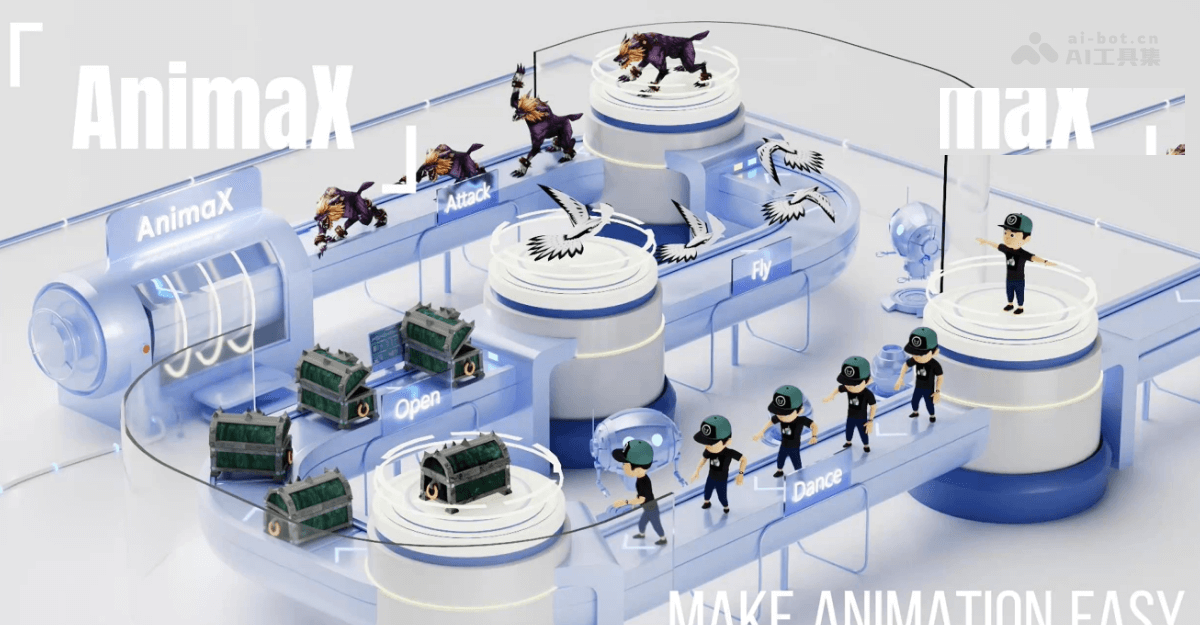
Full review of #AnimaX
Core parameters and statistics
| Project | Specifications |
|---|---|
| Product positioning | 3D animation generation research framework |
| Development institutions | Beihang University, Tsinghua University, University of Hong Kong, etc. |
| Core technology | Video diffusion model + skeletal animation |
| Input method | Text description |
| Output form | 3D skeletal animation sequence |
| Bone support | Arbitrary bone topology (human, animal, object, etc.) |
| Multi-view consistency | Support |
| License Agreement | Open source (the specific license is subject to the GitHub repository) |
| Training data size | 160,000 binding sequences |
| GitHub repository | github.com/anima-x/anima-x |
AnimaX is not a ready-to-use product, but an open source framework for the research community and animation developers. Its core breakthrough is to transfer the "motion knowledge" learned in 2D video diffusion models to the field of 3D skeletal animation - which makes generating 3D animations no longer requires expensive motion capture equipment or manual keyframe drawing.
Publicity verification: The official claim is "text-driven 3D animation generation" - in actual use, the more specific the text description, the better the effect (for example, "a golden retriever trots forward" is better than "making the animal move"), and the output quality is highly dependent on the coverage of the reference video data. The effect is better for common actions (walking, running, jumping), but rare actions (specific dances, martial arts moves) may be unnatural.
User and market recognition
AnimaX was made public in June 2025 through an arXiv paper and GitHub repository and is an open source project driven by academic research. Jointly launched by Beijing University of Aeronautics and Astronautics, Tsinghua University, University of Hong Kong and other universities, it has strong academic credibility.
- Academic Background: The arXiv paper (2506.19851) represents the current frontier in transferring video diffusion model priors to 3D skeletal animation.
- Community Foundation: Open source framework, researchers and developers can freely use and modify the code. Specific community indicators such as GitHub Stars and Forks are subject to real-time data from the warehouse.
- Industry Benchmarking: Technically complementary to the field of diffusion model-driven 3D content generation (such as DreamFusion, Magic3D, AnimateDiff, etc.), but focusing on "skeleton-driven animation" rather than "geometry generation".
Cost advantage
- C client/individual: completely free and open source. Any individual developer or researcher can download the source code and model weights for local operation and secondary development.
- Developer/API: No commercial API is provided, developers need to deploy inference context by themselves. Hardware cost depends on the GPU resources required for model inference (expect a GPU with at least 16GB+ of video memory).
- Corporate/Private: Undisclosed corporate licensing scheme. As an academic open source project, commercial use is subject to specific open source license terms. It is recommended to confirm whether the LICENSE file in the GitHub repository contains commercial restrictions before use.
The Free Truth: The code and models are free, but the real cost is in the hardware and context configuration. One inference takes up about 16-24GB of video memory, and a personal computer (even a top-end Mac Studio) is basically unable to run it. You need to rent a cloud GPU (such as A100 for about $2-3/hour). The total cost of "running" is much higher than the zero cost of the software itself.
Hidden costs: Running inference requires a certain amount of GPU computing power (video diffusion models usually require higher graphics memory), and individual developers may need to rent cloud GPU instances; data preprocessing and bone binding also require certain basic knowledge of 3D animation.
Hidden benefits: For game studios, a set of motion capture equipment costs more than $100,000. AnimaX allows small teams without motion capture budgets to generate character animations of reasonable quality, lowering the entry barrier for 3D animation production by 1-2 orders of magnitude.
Main functions
- Any bone structure support: Not limited to human characters, it also supports 3D models with different bone topologies such as animals and furniture, greatly expanding the scope of application.
- Text-driven animation generation: Users describe actions in natural language (such as "a dog is running"), and the model automatically generates the corresponding 3D skeletal animation sequence without manually setting keyframes.
- Multi-view consistency: The generated animation maintains spatial consistency and motion coherence under multiple camera perspectives, ensuring no distortion when viewed from any angle.
- Efficient feed-forward generation: No need for frame-by-frame optimization or fine-tuning during testing. A complete animation sequence is generated at one time based on the feed-forward network, significantly shortening the production cycle.
Expert View: The synergy of AnimaX lies in the dual constraints of "video prior + bone structure" - the video diffusion model provides rich motion reality (such as the natural swing of the arm when walking), and the bone constraints ensure that the animation can be applied to specific 3D models. This combination not only retains the richness of the actions generated by the diffusion model, but also solves the engineering challenge of pure video model output being unable to directly drive 3D characters.
Model and version evolution
Mainline release
- ~2025-06: AnimaX was made public for the first time, releasing the arXiv paper (2506.19851) and opening the GitHub repository, providing core framework, pre-trained models and sample code.
The project is in the early research stage, and version iterations mainly rely on contributions from the academic community. Possible future directions include: more fine-grained motion control (finger level), multi-person interactive animation, and real-time reasoning optimization.
Technical advantages
Mechanism -> Effect -> Scene
- Joint Video Pose Diffusion Model: Represent 3D actions as multi-view, multi-frame 2D pose maps, and use the powerful action prior of the pre-trained video diffusion model to generate videos and corresponding 2D pose sequences. The effect is a spatiotemporal alignment between the video and the pose - the model "sees" how the character moves in the video and simultaneously derives how the skeleton should change. Suitable for animation scenes that need to retain real action details.
- Shared position encoding + modality-aware embedding: Let the model understand the spatial correspondence between video frame pixels and bone joint points. The effect is that data of different modalities are aligned in the same feature space to avoid posture offset or jitter. This is especially critical for high-fidelity animations that require precise rigging, such as the skeleton of facial expressions.
- 3D motion reconstruction pipeline: Reconstruct 3D joint positions from multi-view 2D poses through triangulation, and then convert them into joint rotation angle drive models through inverse kinematics (IK). This pipeline ensures that the resulting animations are physically sound and deployable in 3D space.
Architecture link
Text description -> Video diffusion model (action prior)
              ->Multi-view 2D pose sequence
                  -> Triangulation -> 3D joint positions
                      -> Inverse Kinematics -> Bone Rotation
                          -> Drive 3D model animation
How to use
- Visit the GitHub repository (https://github.com/anima-x/anima-x) to download the source code
- Configure Python context according to README (it is recommended to use Conda) and install dependencies
- Download pre-trained model weights
- Prepare or select a 3D model with bone binding (supports FBX/DAE and other formats)
- Run the inference script and enter the text description to generate the animation.
- Export animation data for use in game engines (Unity/Unreal), DCC tools (Blender/Maya) or rendering pipelines
Since it is a research framework, the current version does not provide a GUI interface. Users need to have a basic knowledge of Python programming and basic 3D animation concepts.
Product Pricing
| Billing dimensions | Current status |
|---|---|
| Framework usage | Open source and free |
| Pre-trained model | Free download |
| API service | Not provided |
| Enterprise technical support | Undisclosed |
AnimaX is an academic open source project and has no direct commercial pricing. The cost of use is mainly reflected in hardware deployment (GPU for inference) and human investment (boundary configuration, data preprocessing, and animation post-adjustment).
Application scenarios
- Dimensionality reduction strike scene: Character animation production for independent games: A small team lacking motion capture equipment and full-time animators used AnimaX instead of manual key frames to generate basic actions such as walking, running, and standby for NPCs. Traditionally, a set of basic movements for a character takes an animator 2-3 days to complete. AnimaX generates a first draft in 10 minutes and spends another 2-3 hours fine-tuning it.
- Film and VFX Production: Generate virtual character movements, background animations, etc. in animated movies. Action drafts that can be used for quick preview (Previs) stage, reducing waiting time from motion capture or manual adjustments.
- VR/AR Interaction: Generate real-time animations for virtual characters and dynamic context to enhance immersion. Suitable for virtual exhibition halls, educational simulations, social VR and other scenes that require rich character movements.
Unfit Boundary: Not suitable for scenes that require extremely fine finger-level movements or facial micro-expressions (the current version mainly targets full-body skeletal movements); applications with extremely high real-time requirements (such as VR handle tracking) need to wait for inference optimization.
Dissuade scenario: If your project requires high-precision finger animation, facial expression capture (FACS), or a large number of characters requires a batch automation pipeline, the current version of AnimaX cannot meet the requirements. It is recommended to wait for subsequent versions or use a professional motion capture solution.
Applicable people
- AI and computer graphics researcher: Pay attention to the transfer application of the video diffusion model in the 3D field, which can be used as a research baseline or a starting point for further improvement.
- Game animators and technical artists: Technical artists who need to quickly generate a large number of character action previews can greatly shorten the early action prototyping time.
- Independent developers and small studios: Teams that lack motion capture equipment use text-driven animation to lower the production threshold of 3D animation.
Not suitable for people: pure animators with non-technical background (requires coding ability); production teams who need to use mature and stable commercial products (the stability of the research framework and document support are limited).
Summary and Outlook
AnimaX represents a cutting-edge attempt in the technical direction of "video diffusion model -> 3D skeletal animation". It demonstrates that motion knowledge learned in videos can be effectively transferred to the 3D domain while maintaining multi-view consistency and skeletal compatibility. As a research prototype, the current version needs to be polished through engineering in terms of generation quality, inference speed and ease of use.
Current limitations: Documentation and community support are limited, mainly relying on GitHub Issues and academic email communication; the commercial scope of the pre-trained model and the copyright of the training data need to be verified by yourself (the training data comes from online videos and may contain unauthorized action data).
Procurement/Adoption Risk Assessment: As an academic open source project, AnimaX has no commercialization commitments and no long-term maintenance guarantees. It is recommended that research teams use it as a technical reference, and industrial-level applications need to evaluate code quality and extended maintenance costs by themselves. Always confirm the scope of the terms of an open source license before commercial use.
Related tools: runway, pika
Version Info
- AnimaX :There is no official precise date yet.
- AnimaX :There is no official precise date yet.
User Reviews