 AnythingLLM
Free
AnythingLLM
Free
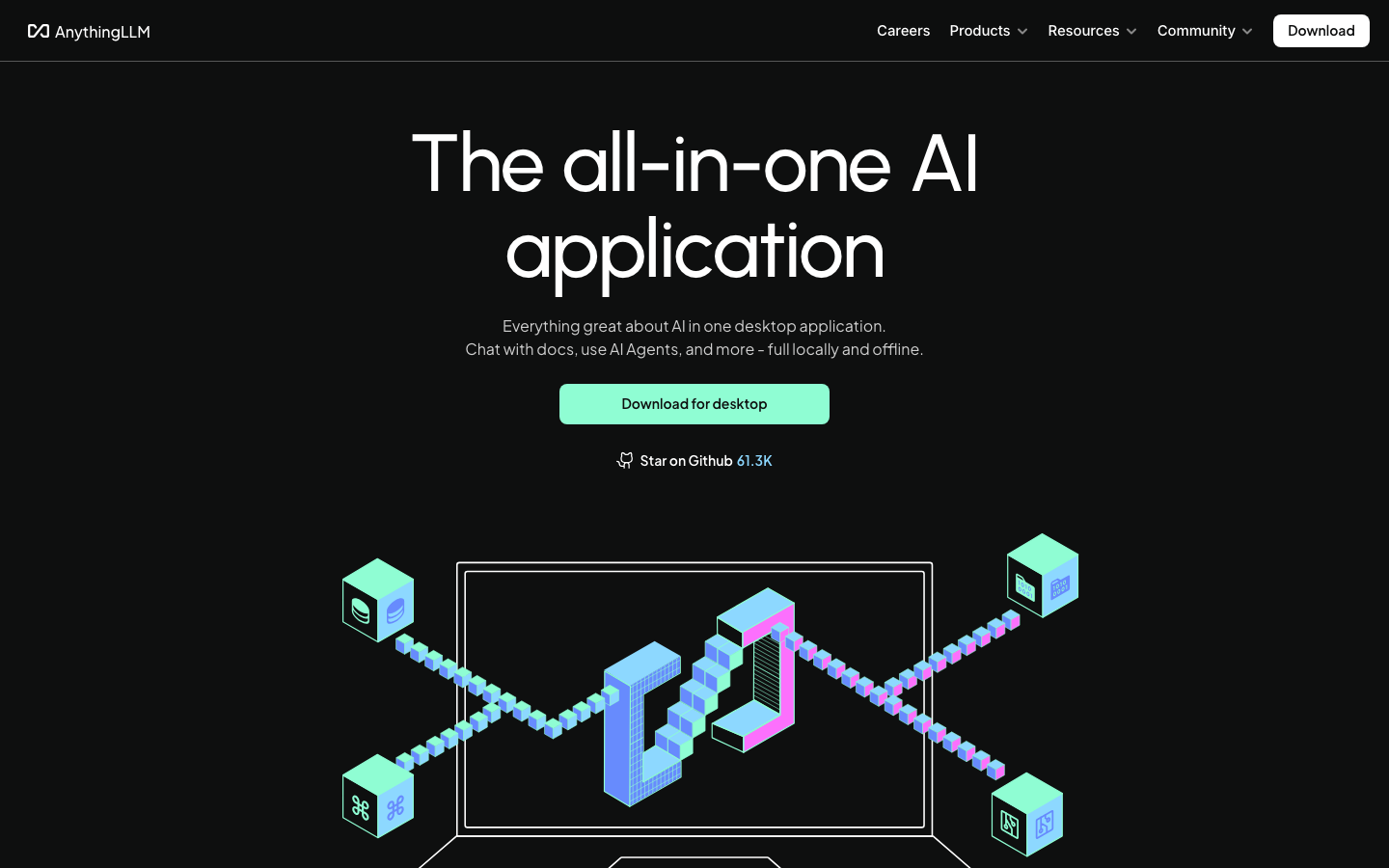
AnythingLLM is an all-in-one private AI application open sourced by Mintplex Labs. It integrates document vectorization, retrieval enhanced generation (RAG), multi-model access, workspace isolation and callable tool AI agents into one product. It can be used offline as a desktop application, or can be self-hosted as a multi-user service using Docker. It supports access to local and cloud large models, emphasizing the privatized experience of "keeping the data in your own hands".
AnythingLLM
Core parameters and statistics
AnythingLLM is an all-in-one private AI application whose official positioning is to "turn any document, resource, or content into a context that can be referenced by any large model in a conversation." It integrates document vectorization, retrieval enhancement generation, multi-model routing, multi-user workspaces and tool-callable agents into the same product. It can run offline on a desktop standalone machine or use Docker self-hosting to serve teams.
| Projects | Public Information |
|---|---|
| Official positioning | All-purpose private RAG and intelligent agent applications |
| Deployment form | Desktop application (single machine) + Docker self-hosting (multi-user) |
| Model access | OpenAI, Anthropic, Azure, local Ollama, LM Studio, LocalAI, etc. |
| Vector library | Built-in LanceDB, supports Pinecone, Chroma, Weaviate, Qdrant, etc. |
| Document form | PDF, TXT, DOCX, web pages, audio and video transcription, etc. |
| Intelligent agent capabilities | Built-in Agent, can search online, call tools, and perform multi-step tasks |
| Open Source License | MIT |
| Community size | GitHub about 61,300 stars, 6,600 forks |
| Latest version | v1.14.0 (2026-06-09, GitHub Releases) |
| Supported platforms | Windows, macOS, Linux, Docker |
Form value: The difference of AnythingLLM is that "one product covers two types of needs" - individuals use the desktop version to process private documents; teams use the Docker version to build a multi-user knowledge base with permission management. Both forms share the same workspace and RAG logic, so migration costs are low.
Workspace Isolation: It organizes documents and conversations with "Workspace" as the basic unit. The vector contexts between different workspaces are isolated from each other, which can prevent data from different projects or departments from contaminating each other during retrieval. This is especially critical for multiple teams in the enterprise to reuse the same instance.
Model Neutral: AnythingLLM is not bound to a specific model supplier. It can connect to cloud APIs such as GPT and Claude, as well as local inference backends such as Ollama and LM Studio. The vector library can also be switched between the built-in LanceDB and external professional vector libraries.
User and market recognition
AnythingLLM's recognition is mainly reflected in the popularity of open source and the scale of the self-hosted community. The official has not disclosed revenue or the number of paying users.
Community Popularity: The GitHub repository Mintplex-Labs/anything-llm publicly shows about 61,300 stars and 6,600 forks, and is the leading project in the segment of "privatized RAG applications". A high fork number indicates that a large number of teams are doing secondary deployment or customization based on it.
Usage Scenarios: Project public materials show that it is used in scenarios such as corporate internal knowledge base, customer service and document Q&A, and personal research data management. For organizations with high data compliance requirements, "the whole process is self-hosted and the documents do not leave the intranet" are the core reasons for its selection.
Prerequisites for implementation: The retrieval quality of local operation is jointly affected by the vectorization model, segmentation strategy and the underlying large model. When using the desktop version to connect to local models, the quality of answers is related to machine computing power; teams pursuing stable results usually connect to cloud models or stronger local inference backends.
Cost advantage
- C-side/Individual: Usually a free version is provided to experience the core functions, and high-frequency use requires a paid package subscription.
- API/Developer: Billed by call volume, suitable for development teams that can be flexibly integrated into their own systems.
- Enterprise/Privatized: Contact the business owner for customized quotation and deployment plan. The specific price is subject to the official real-time pricing page.
Main functions
The capabilities of AnythingLLM are organized around "private documents + arbitrary models + executable agents":
- Document RAG: Import multiple sources such as PDF, Word, web pages, audio and video transcriptions, automatically segment and vectorize, and retrieve according to relevance as context during conversations.
- Multi-model access: Configure OpenAI, Anthropic, Azure, and local backends such as Ollama, LM Studio, and LocalAI on the same interface, and switch according to workspace.
- Workspace and Permissions: Use workspaces to isolate documents and conversation contexts. The Docker version supports multi-user, role and permission management.
- AI Agent: An Agent with built-in callable tools that can search the Internet, crawl web pages, perform multi-step tasks, and can be expanded through custom skills.
- Developer Interface: Provides a complete developer API and embeddable chat widget to facilitate embedding private knowledge base into your own website or system.
Model and version evolution
AnythingLLM uses semantic versioning, and the main line maintains a high-frequency release rhythm.
Mainline release
The latest stable version is v1.14.0 (2026-06-09), previously v1.13.0 (2026-05-26). 1.13 and 1.14 mainly focus on model supplier access, workspace retrieval experience and self-hosting stability iteration.
Fixed version
v1.12.1 (2026-04-22) belongs to the repair version of the 1.12 series and is revised to address the stability issues of self-hosted deployment and document processing links. Overall, the version rhythm of AnythingLLM reflects the dual-track model of "mainline functionality + rapid revision", which is suitable for teams that need to continuously follow up with new model suppliers.
Technical advantages
AnythingLLM's technical choices always serve the goal of "private, controllable, and scalable".
Mechanism: Double decoupling of model and vector library. It abstracts both "large models" and "vector databases" into pluggable vendor interfaces. The effect is that organizations can freely combine according to compliance and cost requirements (such as local model + built-in LanceDB, or cloud model + external vector library). Applicable scenarios are teams that need to reuse the same set of application logic across different deployment contexts.
Mechanism: Workspace-level context isolation. Each workspace maintains an independent vector context. The effect is that multiple projects and departments can coexist in the same instance without interfering with each other. The applicable scenario is that multiple teams in the enterprise share a private knowledge base infrastructure.
Mechanism: Built-in executable agent. Agent not only generates text, but can also call online searches and tools to complete multi-step tasks. The effect is to extend "document question and answer" into "automated execution based on private data", which is suitable for workflows that require retrieval before action.
How to use
AnythingLLM offers two main entrances, which can be chosen based on team size:
- Desktop version: Download the Windows/macOS/Linux installation package from the official website. After installation, you can create a workspace, import documents, and configure model suppliers to start a conversation. The entire process can run local models offline.
- Docker self-hosting: Use Docker to deploy the server according to official documentation, suitable for multi-user teams, with configurable permission API and embeddable widgets.
- Basic process: Create a workspace → Upload documents to complete vectorization → Select a model supplier → Ask questions in the conversation and view reference sources → Start Agent to perform networking or tool tasks as needed.
When implementing, you need to pay attention to the choice of document segmentation granularity and vectorization model, both of which directly affect the quality of retrieval hits; in multi-user scenarios, you also need to plan the workspace division and permissions in advance.
Product Pricing
The pricing model is subject to the official real-time page. Usually a freemium or subscription system is adopted. Basic functions can be used for free, while advanced functions or high-frequency use require paid subscriptions. It is recommended that users evaluate the optimal solution based on actual usage.
Application scenarios
- Enterprise private knowledge base: Construct internal systems, product documents, and contract materials into a question-and-answer knowledge base. The data remains on the intranet throughout the entire process. The focus of verification is permission isolation and reference traceability.
- Customer service and document Q&A: Build automatic Q&A based on product manuals and FAQs, which can be embedded on the official website. The focus of verification is the retrieval hit rate and the factual consistency of the answers.
- Personal Research and Data Management: Researchers use the desktop version to process papers, notes, and audio and video transcriptions offline. The focus of verification is the response speed of the local model on the target hardware.
Applicable people
- Enterprise IT/Security Teams with Data Compliance Requirements: Need a self-hosted private AI infrastructure that does not leave the intranet.
- Small and medium-sized teams and independent developers: Hope to build a knowledge base or customer service with RAG at low cost, and be able to embed their own systems using APIs.
- Privacy-conscious individuals: Use the desktop version to work with private documents and notes offline.
Not suitable for boundaries: If the team does not have any self-hosting and operation and maintenance capabilities, is unwilling to purchase a hosted version, or pursues out-of-the-box use and does not care about data outflow, a mature cloud knowledge base SaaS may be more worry-free; the answer quality of the local model on low-end machines may not meet expectations.
Summary and Outlook
It provides competitive solutions in its field, and its core value lies in lowering the threshold for AI use in this field.
Current limitations: Some advanced features require paid subscription, and the free version has function or usage restrictions; specific technical details and performance benchmarks have not yet been fully disclosed.
Related tools:  Hugging Face, replicate
Comparison of competing products
| Comparison dimensions | AnythingLLM | Competitor A | Competitor B |
|---|---|---|---|
| Core Differences | — | — | — |
| Price | — | — | — |
| Target Users | — | — | — |
Note: The above comparison is based on product public information, and actual differences are based on user experience.
Technical advantages and capability boundaries
As an AI model and API product, the core capabilities of AnythingLLM can be deeply understood through the following dimensions, which directly affect technology selection and implementation effects.
Inference Performance and Benchmark Performance The model’s reasoning performance is reflected in its performance on standard NLP tasks (text generation, code completion, semantic understanding, multi-turn dialogue, information extraction, etc.). It is recommended to conduct horizontal comparison through public benchmark test lists (such as MMLU, HumanEval, GSM8K, etc.), but please note that there may be a gap between benchmark test scores and actual business scenario performance. Key indicators that affect the actual user experience include: inference speed (Token/s or response delay, which directly determines the smoothness of the user experience), context window length (which determines the input size that can be processed at a time, affecting the complexity of the tasks that can be processed), and consistency of output quality (the stability of the results of multiple outputs of the same input, which affects the perception of reliability).
API Compatibility and Development Ecosystem The depth of API compatibility with mainstream development frameworks (LangChain, LlamaIndex, Semantic Kernel, etc.) directly affects the cost and cycle of integrated development. It is recommended to pay attention to the following integration dimensions: the coverage of language types supported by the SDK (whether mainstream languages such as Python, JavaScript, Go, and Java have official SDKs), streaming output support (SSE/WebSocket protocol compatibility), function calling and tool usage capabilities (whether it supports mapping model output to structured function calls), the flexibility of structured output (JSON mode), and the ability to integrate with enterprise-level infrastructure (VPC deployment, Private Link, unified identity authentication). Complete API documentation and rich code examples can significantly lower the entry barrier to development and reduce integration time and costs.
Deployment Flexibility vs. Cost Tradeoff Depending on data privacy requirements, latency sensitivity and usage scale, AnythingLLM can choose between cloud API calls or on-premises deployment options. The advantages of cloud deployment are zero operation and maintenance costs and elastic scalability, which is suitable for scenarios with large fluctuations in usage and rapid prototype development; local deployment provides complete data sovereignty and low latency (no network round-trip overhead), but you need to bear the cost of purchasing hardware such as GPUs and operation and maintenance manpower. It is recommended to use a monthly API call volume of 1 million times or a monthly fee of US$1,000 as a reference dividing line: below this threshold, cloud APIs have better cost-effectiveness and flexibility. After exceeding this threshold, the total cost of ownership of the self-deployment solution should be comprehensively evaluated, taking into account factors such as hardware depreciation, electricity, operation and maintenance manpower, etc.
Model selection and version strategy
For the selection of AnythingLLM series models, it is recommended to match the model capabilities of different versions according to specific usage scenarios. The large-parameter version performs better on complex reasoning and multi-step tasks, but has higher costs and longer delays; the small-parameter version can already provide satisfactory output quality in scenarios such as daily conversations and simple question and answer, and the cost is only a fraction of the large version. The recommended selection strategy is: use small and medium versions in standard scenarios to reduce costs, and only call large version models when complex inference tasks need to be processed. This hierarchical calling strategy can reduce the overall API cost by 40-60% without significantly affecting the output quality.
Version Info
- AnythingLLM v1.14.0 :The latest version released by GitHub Releases continues the dual forms of desktop and Docker self-hosting, and continues to improve document RAG, multi-model access, workspace management, and AI agent capabilities.
- AnythingLLM v1.13.0 :The 1.13 version node continues to iterate on model supplier access and workspace retrieval experience, and is a stable mainline release.
- AnythingLLM v1.12.1 :The repair version of the 1.12 series has been revised to address stability issues in self-hosted deployment and document processing.
User Reviews