 AOP SAI
Free
AOP SAI
Free
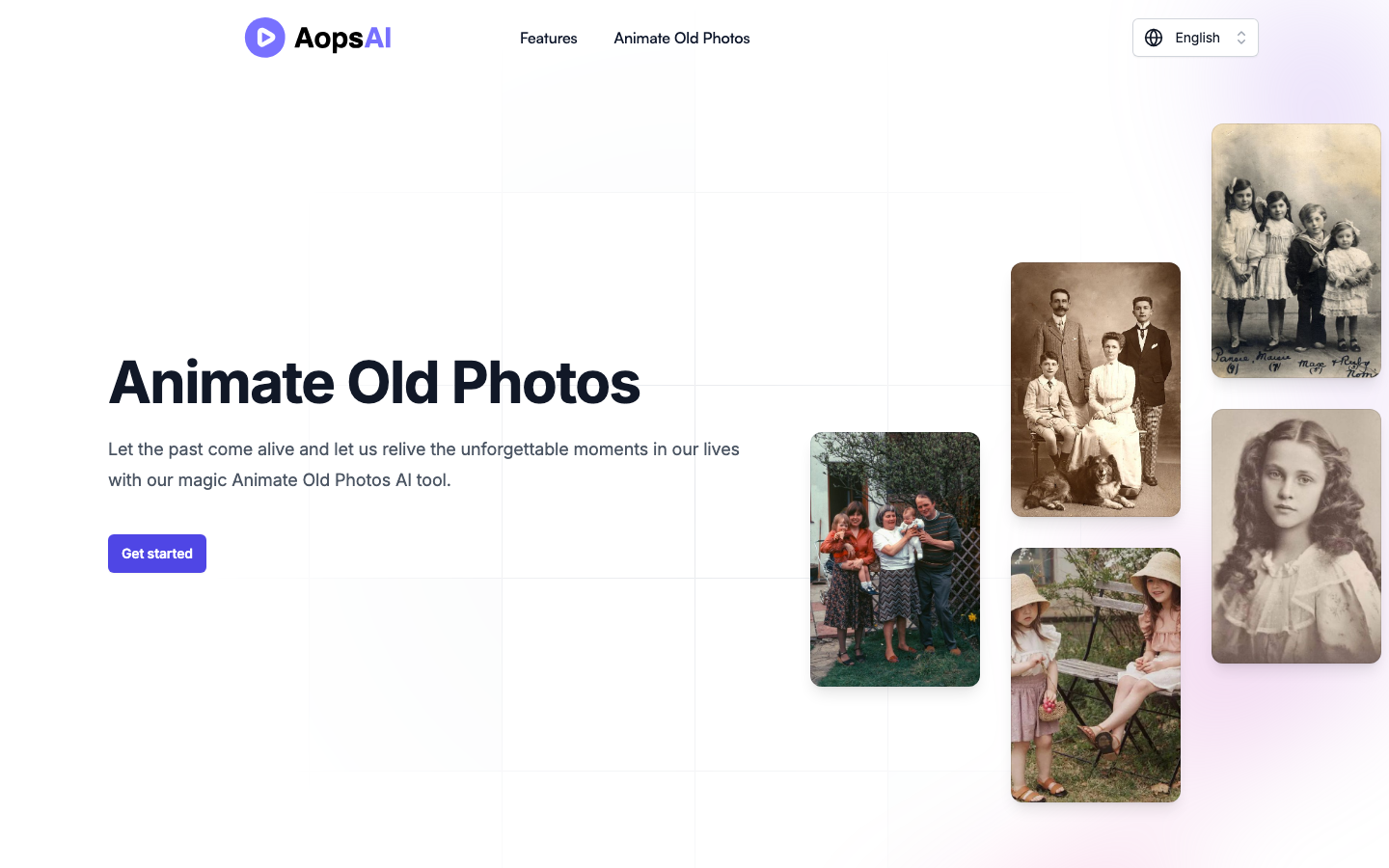
AopsAI is an AI photo processing tool that can convert old static photos into dynamic short videos. Supports facial animation, expression driving and motion transfer.
AOPS AI: AI-driven mathematical problem solving and learning platform
Core parameters and statistics of AOPS AI
AOPS AI is an AI-enhanced mathematics learning platform launched by Art of Problem Solving (AoPS), which aims to deeply integrate the problem-solving capabilities of large language models with the competition-level mathematics curriculum system accumulated by AoPS for more than 20 years. It is not a general AI chatbot, but an AI learning assistant in the vertical field for IMO-level contestants and mathematics educators in grades 5-12. The core value lies in: students input a math question (text or picture), and the AI does not directly give the final answer. Instead, it presents the reasoning process using AoPS's classic "step-by-step guided" teaching method, setting interaction points at key steps to guide users to derive their own conclusions.
| Projects | Public Information |
|---|---|
| Official positioning | AI-powered math problem-solving and learning platform |
| Core Competencies | Intelligent identification of mathematical questions, step-by-step reasoning guidance, comparison of multiple solutions, traceability of knowledge points, attribution analysis of wrong questions |
| Input form | Text description, mathematical formula (LaTeX), handwritten/printed question image (OCR) |
| Output form | Step-by-step problem-solving process (including verbal reasoning, formula derivation, graphic assistance), knowledge point association cards, similar question recommendations |
| Processing form | Web-based, some functions are integrated with the online course system through the AoPS community forum |
| Target schooling period | Grades 5-12, covering AMC 8/10/12, AIME, USAMO, IMO and other competition levels |
| Billing model | Freemium — Basic problem solving is free, advanced analysis (multiple solutions, personalized learning paths) requires AoPS subscription |
| Home | US |
| Supported languages | en-US |
| Latest version | 1.0 (~2026-01, first public version) |
| Product stage | Early public stage, ongoing iteration |
Brief comment in one sentence: AOPS AI is not a "photo-searching" tool, but an AI problem-solving coach embedded with the output of the AoPS teaching method - it does not pursue the speed of giving answers, but cares about the completeness of the reasoning process, the comparison of multiple paths, and the depth of students' understanding of "why this solution works."
Core limitations: Currently, it mainly covers mathematics competition question types (number theory, combinatorial, algebra, geometry), with limited support for advanced mathematics (calculus, linear algebra) and interdisciplinary application questions; the solution process relies on the knowledge graph of the AoPS curriculum system, and may be downgraded to a general LLM reasoning mode for non-standard question types, losing the step-by-step guidance feature of the AoPS style.
Users and market recognition of AOPS AI
User Base: The AoPS community is one of the largest online communities for mathematics competitions in the world, with more than 1 million registered users. AOPS AI will gradually be open to community users for testing from the end of 2025 to the beginning of 2026. Initially, it will be embedded in the discussion forum in the form of a forum "AI Problem Solving Assistant" plug-in. Users can call AI to generate preliminary ideas when posting, and then community members will supplement and improve it. This hybrid model of "AI assistance + community collaboration" lowers the threshold for new users to enter competition mathematics discussions.
Market Recognition: AoPS as a brand is extremely authoritative in the field of mathematics education - all 6 members of the 2024 IMO US team are AoPS alumni. This data has been cited many times by the MIT Admissions Office MAA (Mathematical Association of America). As the brand's extension to the AI era, AOPS AI naturally enjoys brand trust dividends. But it should be noted: this trust is based on the historical reputation of AoPS courses and books. The independent reputation of AI products is still accumulating, and it has not yet seen large-scale independent third-party reviews or academic paper verification.
Competitive positioning: Compared with "photo-based problem-solving" tools such as Photomath and Mathway, the difference of AOPS AI lies not in OCR recognition accuracy or answer speed, but in the "teaching attribute" of the problem-solving process - each step it outputs is associated with specific knowledge points in the AoPS course system, and students can click on any step to go back to the corresponding textbook chapter or video course. This ability to jump from a question to a course is the key design for connecting AI problem-solving tools with online learning systems. Compared with Khan Academy's AI assistant Khanmigo, AOPS AI focuses more on competition-level questions (AMC/AIME and above difficulty) rather than K-12 general mathematics.
Barriers and Risks: The core barrier of AoPS is the competition mathematics content system and community ecology accumulated over more than 20 years, and AOPS AI inherits this barrier. But the risk is: the mathematical reasoning capabilities of general-purpose LLMs (such as GPT-4, Claude, Gemini) are rapidly improving. When general-purpose models can stably solve IMO-level problems, the differentiation space of vertical field AI will be compressed. Whether AOPS AI can continue to provide an experience beyond the general model through "pedagogical differentiation" (not only giving answers, but also guiding thinking in the AoPS style) is the key to long-term competition.
| Comparative Dimensions | AOPS AI | Photomath | Khanmigo | General LLM (GPT-4/Claude) |
|---|---|---|---|---|
| Question difficulty coverage | AMC 8/10/12, AIME, USAMO, IMO | K-12 General Mathematics | K-12 General Studies + AP | Full academic level (but competition level is unstable) |
| Problem-solving process style | AoPS step-by-step guidance + knowledge point series | Step display-based | Interactive question guidance | Large degree of freedom, unstable quality |
| Knowledge point association | Association with AoPS course system (textbooks/videos) | No in-depth association | Association with Khan Academy courses | Manual prompt association required |
| Multiple solution support | Yes (output multiple solutions to the same question and compare) | Limited | Limited | Need to explicitly request |
| Community collaboration | Deep integration with AoPS forum | None | None | None |
| Free availability | Basic features free | Free + paid subscription | Limited free | API/Subscription paid |
| Brand authority | Extremely high (IMO champion cradle) | Medium | High (educational non-profit) | General brand |
Cost Advantages of AOPS AI
The cost structure of AOPS AI needs to be analyzed from two dimensions: C-side learners and educational institutions:
C-side/individual learners: The basic mathematics problem-solving function is free and open. Users can enter questions through the AoPS community or web interface to obtain step-by-step answers. The free version retains the core "step-by-step reasoning" experience, but sets a paywall on advanced features such as multiple solution comparisons, knowledge point traceability maps, and personalized error booklets. The payment model is usually integrated into the AoPS online course subscription system - users who have subscribed to the AoPS Online course can automatically obtain the right to use the full version of AOPS AI. The independent subscription price is subject to the official website announcement. Core Advantages: For families who already subscribe to AoPS courses (the annual fee is about a few hundred dollars), the marginal cost of AOPS AI as an additional feature is zero, and the inference cost is absorbed by the AoPS platform.
API/Developer: No independent API interface is exposed. AOPS AI is currently positioned as an internal component of the AoPS ecosystem and does not open API access to third-party developers. This means that the EdTech SaaS platform of an educational technology company cannot directly use the problem-solving capabilities of AOPS AI to embed it into its own products. Teams with integration needs need to conduct business communication through AoPS partner channels. Currently, there are no public developer documents or Sandbox context.
Enterprise/Educational Institution: Bulk purchasing scenarios such as schools and training institutions require customized solutions through the AoPS sales team. The pricing model is speculated to be a "subscription by student seat" model (based on the pricing of AoPS Academy offline centers), and there is no public standard quotation. For K-12 schools, AOPS AI has clear value in the competitive math top-level development scenario, but faces competition from Khan Academy's free solution in the general mathematics teaching scenario.
Hidden Cost Analysis:
- Learning Curve Cost: The interface and interaction of AOPS AI are designed around competitive mathematics learners, and students who are accustomed to the process of "taking photos to search for questions → directly looking at the answers" need to adapt - it will not give a complete answer at once, but push the reasoning process step by step, and users need to actively click "Next prompt" to gradually expand. This design is an advantage for students with strong self-motivation, but it may cause friction for students who pursue completing homework quickly.
- Content Boundary Cost: When a question exceeds the coverage of the AoPS course knowledge map (such as calculus optimization problems, statistical probability practice, physical and chemical interdisciplinary application problems), the problem-solving output of AOPS AI is downgraded to the general LLM reasoning mode, and the differentiated characteristics of "step-by-step guidance + knowledge point association" are no longer retained. At this time, the usage experience is the same as that of ordinary AI assistants, and the payment value decreases.
- Opportunity Cost: If the user has subscribed to ChatGPT Plus ($20/month) or Claude Pro and can meet their mathematical problem-solving needs, the marginal value of paying for AOPS AI alone depends on the rigid demand for AoPS teaching methods and competition question type coverage.
| Cost Dimension | AOPS AI | Photomath | ChatGPT Plus |
|---|---|---|---|
| Personal monthly fee reference | Included in AoPS subscription ($15-50/month estimate) | $9.99/month | $20/month |
| Free version availability | Basic problem solving free | Basic steps free | Limited free quota |
| API call cost | Undisclosed | Undisclosed | Billed by Token |
| Bulk price for educational institutions | Business communication required | Education discount available | No independent education pricing |
| Knowledge graph value | High (associated with AoPS system) | None | None |
| Competition question coverage | Deep (IMO level) | Light (K-12) | Medium (depends on Prompt) |
Free truth: The free version of "Basic Problem Solving" has implicit limitations on the complexity of the questions - AMC questions of simple to medium difficulty are free and open, but difficult AIME/USAMO questions or requests that require comparison of multiple solutions may lead users to upgrade and pay. Whether the free quota includes image OCR recognition is also subject to the real-time instructions on the official website. Some visual question input may only be supported in the paid version.
Main functions of AOPS AI
AOPS AI combines AI reasoning capabilities with AoPS teaching methods to form a complete set of functional links from "question input" to "ability diagnosis":
-
Intelligent question analysis and step-by-step reasoning (core function): Supports three input methods: text LaTeX formula, handwritten photos, and printed questions. After AI identifies the question, it generates the problem-solving process in AoPS's classic step-by-step approach - instead of outputting the entire answer at once, it pushes the reasoning steps one by one, with each step accompanied by an explanation of "why you do this." Users can click "Expand/Collapse" at any time to control the granularity of details. Applicable tasks: Daily competition mathematics exercises, inspiration for difficult problems, and self-study verification. Acceptance concerns: The logical coherence of the step-by-step process - whether it is really "teaching" rather than "showing answers"; whether the explanation of key steps is consistent with the presentation style of the AoPS textbook.
-
Multiple solution comparison engine: For the same question, AI automatically generates 2-4 different solutions (such as algebraic method, geometric method, number theory construction method) and presents them in a comparison view. Each solution method is marked with "idea key words" and "prerequisite knowledge requirements" to help students understand the applicable scenarios and efficiency differences of different methods. Applicable tasks: Competition strategy training (choosing the optimal solution), knowledge point understanding (understanding the connection between different branches of mathematics). Acceptance focus: The logical independence between multiple solutions - whether it truly provides differentiated solutions rather than variant expressions of the same idea; whether the knowledge point annotations accurately correspond to specific chapters in the AoPS course system.
-
Knowledge point tracing and learning path recommendation: Each step of the problem-solving process is associated with specific knowledge point nodes in the AoPS knowledge graph. Students can click on any step to jump to the corresponding AoPS textbook chapter (Volume 1/2, Intermediate series) or online course segment. The system automatically generates a list of "knowledge points to be strengthened" based on students' performance in multiple questions, and recommends corresponding exercises and video courses. Applicable tasks: Systematic learning from "doing a question" to "reinforcing a knowledge area". Acceptance focus: The relevance of the associated recommendation - whether it is mechanical tag matching or real learning path planning; whether the difficulty gradient of the recommended content is suitable for the current level of the students.
-
Error question attribution and weak point diagnosis: Record metadata such as "number of times the user viewed prompts", "stuck steps", and "whether they completed independently in the end" in each problem-solving interaction to form a personal ability portrait. The system automatically identifies weak question categories (such as "combinatorial counting", "modular arithmetic" and "geometric inequalities") and generates periodic diagnostic reports. Applicable tasks: Directional breakthroughs and staged learning summaries for competition preparation. Acceptance focus: The reliability of the attribution analysis - whether it can distinguish between "lack of knowledge" and "careless mistakes"; whether the diagnostic conclusion is accompanied by actionable learning suggestions rather than just showing statistical charts.
-
AoPS Community Integration and Collaborative Learning: The analysis results of AOPS AI can be shared directly to the AoPS forum. Users can initiate discussions based on the problem-solving framework generated by AI, and community members can supplement, correct or provide better solutions. AI output is not the "definitive answer" but a starting point for community discussion. Applicable tasks: Use community wisdom to deepen understanding and verify the correctness of AI output. Acceptance focus: The naturalness of the connection between AI output and community interaction - whether it is easy for community members to continue iterating based on the AI framework; error correction mechanism - when community feedback points out that the AI answer is wrong, whether the system can be quickly updated.
Functional synergy: These five functional modules form a complete learning chain of "inputting questions → step-by-step teaching → comparison of multiple solutions → tracing the source of knowledge points → ability diagnosis". The fundamental difference from independent problem-solving tools is that each function is aimed at "allowing students to solve similar problems by themselves next time", rather than just solving the current problem. The synergy between the two modules of multi-solution comparison and knowledge point tracing is particularly critical: the former broadens the horizons of problem solving, and the latter turns the broadened horizons into knowledge paths that can be systematically learned. Only by working together can the two achieve the effect of "learning from one question to a whole class of questions."
Model and version evolution of AOPS AI
AOPS AI will enter the internal testing stage at the end of 2025 and will be officially opened to the public in early 2026. The following is a summary of the public version based on AoPS official announcements and community updates:
| Version | Time | Changes |
|---|---|---|
| 0.5 alpha | ~2025-09 | Internal experimental version, closed testing within the AoPS forum. The function is limited to "question text input + single-step step-by-step answer", using basic LLM + retrieval enhancement (RAG) to retrieve relevant knowledge points from the AoPS teaching material library. |
| 0.8 beta | ~2025-11 | Expand testing scope and open to AoPS online course subscribers. Introducing image OCR recognition function and preliminary multi-solution comparison capability. The background model is switched to a version fine-tuned for mathematical reasoning, and the length of the reasoning chain and step controllability are improved. |
| 1.0 | ~2026-01 | First public version. Officially named AOPS AI, independent page online. Added knowledge point traceability map (automatically associated with AoPS textbook chapters), wrong question book and diagnosis functions. Support AoPS community sharing and discussion generation. The platform layer adds usage monitoring and feedback collection systems. |
Version Notes: The above dates are inferred values (~YYYY-MM) based on AoPS official announcements and community posts. There is no official precise release date yet. The product is in a rapid iteration period, and the core LLM inference engine continues to be upgraded (the model version is not disclosed). Front-end experience and knowledge graph coverage are the three main lines of version evolution.
Future Direction Speculation: Based on the public product roadmap signals of AoPS (community discussions, job descriptions, patent applications), subsequent versions may be expanded in the following directions: (1) higher-precision STEM multi-modal input (charts, geometric figures, physical force analysis diagrams); (2) adaptive learning path - dynamically adjust the difficulty of recommended questions and weight of knowledge points based on students' historical performance; (3) teacher dashboard - provide class-level ability analysis and layered practice plans for competition coaches.
Technical advantages of AOPS AI
The technical route of AOPS AI is not to simply use LLM to answer mathematical questions, but to build a reasoning architecture around the core proposition of "how to make the output of AI have teaching significance." Its technical mechanism can be broken down into three levels:
Level 1: Retrieval-Augmented Reasoning. The user's questions are first classified by intent and graded in difficulty, and the system retrieves relevant knowledge points, theorems, and standard solution templates from the AoPS textbook knowledge base (including all AoPS books, online course handouts, and analysis of past competition questions). The retrieval results and user questions together constitute the reasoning context of LLM. The direct benefit of this design is that the AI's answer style and knowledge references are highly consistent with the AoPS textbook, avoiding the common "self-created formula" or "style drift" problems of general LLM. Why it’s more stable: The mathematical solution of general LLM relies on implicit knowledge in pre-trained parameters, while AOPS AI explicitly retrieves the basis from a human-reviewed knowledge base, and every step of reasoning has a traceable source.
Level 2: Controlled Step Generation. AI does not generate a complete answer at once, but outputs it step by step according to the rhythm of "prompt-confirm-next step". The system maintains a "step state machine" internally - before each problem-solving step is completed, the model will verify whether the current reasoning is consistent with the retrieved knowledge and whether it is inconsistent with the conclusion of the previous step. Only steps that pass consistency verification will be pushed to users. If the model's confidence level is lower than the threshold at a certain step, it will actively output "This is a stuck point - it is recommended to consult Chapter XX" instead of forcibly making up inferences. Why it’s more economical: Compared with the general LLM that generates a large number of Tokens at one time and then verifies them as a whole, AOPS AI’s step-by-step generation + instant verification mechanism is more economical in Token consumption and is “explainable” at the step level—users can pinpoint which inference node has a problem.
Level 3: Multi-Solution Orchestrator. When the user requests the output of multiple solutions, the system does not simply sample the same prompt multiple times, but specifies different "strategy prompts" for each solution - for example, one solution takes the algebraic path, one takes the combinatorial construction path, and one takes the number theory transformation path. Each path independently generates a process through the controlled steps of Level 2, and is finally unified into a comparison view. The orchestrator is also responsible for checking the logical consistency between solutions: if different solutions lead to contradictory conclusions (which should not happen normally), the orchestrator flags the conflict and triggers a revalidation. Why it’s more comprehensive: Manually designed multi-path strategy hints have a higher diversity of solutions than random sampling, and can ensure that each path has corresponding learning resource support in the knowledge graph.
Technical limitations and adaptation boundaries:
- AOPS AI's "controlled step generation" relies on the coverage of the AoPS knowledge graph. For questions that exceed the boundaries of the graph (such as college mathematics, non-standard competition variants), the system will be downgraded to pure LLM reasoning mode, and the step quality and knowledge point correlation will be significantly reduced.
- The multi-solution orchestrator may experience "policy hint drift" when processing very long inference chains (>20 steps) - later steps deviate from the initially specified policy path. The current mitigation plan is to set an upper limit on the "step budget" and force it to stop when the upper limit is exceeded.
- OCR recognition accuracy still has bottlenecks in complex handwriting alterations and multi-line formula typesetting scenarios, which may affect the accurate understanding of the questions. The official recommendation is to give priority to LaTeX text input for key topics.
| Technical Dimension | AOPS AI | General LLM (GPT-4) | Photomath |
|---|---|---|---|
| Inference traceability | Strong (each step is associated with the AoPS textbook) | Weak (black box parameter reasoning) | Medium (steps are shown but no knowledge is associated) |
| Step control granularity | State machine control, step-by-step verification | Generate long chains at one time | Fixed template step by step |
| Multiple solution strategies | Explicit multipath orchestration | Random sampling | Not available |
| Knowledge graph association | Deeply integrated AoPS system | None | None |
| Fault tolerance mechanism | Step-level confidence detection + automatic error correction | No built-in fault tolerance | Limited |
How to use AOPS AI
AOPS AI currently mainly provides services through internal channels of the AoPS ecosystem. The entrance and usage methods are as follows:
| How to use | Entrance | Suitable scenarios | Prerequisites |
|---|---|---|---|
| Online use on the Web | aopsai.com (or AoPS online course page) | Personal self-study, competition practice | AoPS account (free registration) |
| Forum AI plug-in | AoPS forum posting/reply interface | Get a starting point for ideas in community discussions | AoPS forum account |
| Course embedded | AoPS Online coursework/exercise module | Course students practice diligently after class | Registered for the corresponding AoPS course |
| API/Developer Access | Unpublished | Not Applicable | Not Applicable |
Typical steps:
- Visit the AOPS AI portal and log in with your AoPS account (if you don’t have an account, you need to register for free first).
- Select the input method: directly type the question (supports LaTeX formula syntax), uploads the question image (cropped to the face area to ensure clear text), or selects the question text in the forum and calls the AI assistant.
- AI automatically identifies the question and presents the initial analysis (difficulty rating of the question, knowledge point area to which it belongs). After the user confirms that they understand the question correctly, they click "Start Reasoning".
- AI pushes the reasoning process step by step: each step includes text description, formula derivation (LaTeX rendering), and a short explanation of "why you got here". Users can click "Show Prompt" to expand additional clues, or click "Next" to advance.
- After the reasoning is completed, the user can choose "View multiple solutions" (AI automatically generates 2-4 other solutions), "Tracing knowledge points" (jumping to the corresponding chapter of the AoPS textbook), or "Recommend similar questions" (recommend 3-5 exercises based on the knowledge points and difficulty of the current question).
- If you have any questions, you can share the AI solution framework to the AoPS forum with one click, and community members can supplement the discussion.
Implementation Tips: For students preparing for the AMC/AIME exam, the recommended AOPS AI usage strategy is not "use AI for every question you don't know", but "think independently for 15 minutes first, use AI to check the next prompt when you get stuck, and then continue to think independently". This "prompt-think" alternating mode is closer to real competition problem-solving training and is also consistent with the step-by-step design philosophy of AOPS AI. If a certain step of AI's reasoning conflicts with its own understanding, give priority to using the "source knowledge point" function to confirm the basis, rather than directly denying the AI output - cognitive conflicts themselves are opportunities for deep learning.
Product Pricing for AOPS AI
The pricing strategy of AOPS AI is deeply bound to the existing subscription system of AoPS and does not provide an independent pricing plan. The following is deduced based on the hierarchical logic of AoPS’s existing product price system and AI functions:
| Tiers | Coverage | Pricing | Description |
|---|---|---|---|
| Free version (community) | Step-by-step reasoning for basic text questions | Free | For all registered AoPS users, the number of daily uses may be limited, and the upper limit of difficulty is about AMC level 12 |
| Course student version | Full functionality (multiple solutions + traceability + image OCR) | Included in the AoPS course subscription fee | The annual AoPS Online course fee is usually $200-600/course, and the marginal cost of the AI function is covered by the subscription |
| Premium subscription version | All functions + unlimited use + priority reasoning channel | Estimated $15-30/month | For users who have not signed up for courses but need to use AI heavily, please refer to the official website announcement |
| Institution/School Edition | Batch Account + Teacher Dashboard + Usage Analysis | Business Communication Required | Bulk Procurement Plan for Competition Training Institutions K-12 Schools, No Public Quotation |
Pricing Transparency: AOPS AI's independent payment plan has not yet been fully finalized, and currently "included in course subscription" is the main delivery path. Standalone pricing may be officially announced after product features stabilize (expected in the second half of 2026). Before purchasing, it is recommended to confirm on the AoPS official website whether access to AI functions is included in the current subscription to avoid repeated payments.
C-side recommendation: For families who have subscribed to AoPS online courses - use it directly without additional payment. For users who only need an AI problem-solving assistant and do not want to sign up for classes yet - try the free version first and confirm whether the problem-solving style and topic coverage of AOPS AI meet your needs before considering the premium subscription. Note that the "difficulty limit" and "daily usage" of the free version may be adjusted at any time before the announcement.
Application scenarios of AOPS AI
The application scenarios of AOPS AI revolve around the two main axes of "mathematics competition training" and "advanced mathematics self-study" and are organized in a cross matrix of question difficulty and usage scenarios:
-
Competition preparation training (core high-frequency scenario): When students prepare for AMC 8/10/12, AIME, USAMO and other competitions, use AOPS AI to practice real questions and diagnose weaknesses. Specific tasks include: solving past real questions one by one, AI step-by-step analysis; for questions that you don't know, check the "next step tips" instead of directly looking at the answers; compare multiple solutions to understand the same question from different perspectives; use the attribution of wrong questions to identify systemic loopholes in the knowledge system. Efficiency Deduction: In traditional preparation, it takes about 3-4 hours for students to take a set of AMC 10 real questions (25 questions), check the answers, analyze the questions one by one, and record the wrong questions. With the assistance of AOPS AI, step-by-step interaction and automatic attribution can compress the review time to 1.5-2 hours, and the attribution report can directly guide the direction of the next stage of research. Boundary of human-machine collaboration: Question brushing and preliminary screening can be fully automated; error correction and in-depth discussions of AI reasoning must be completed manually (through the AoPS community).
-
Advanced self-study and advanced learning (growth scenario): After completing school courses, junior high school students (grades 6-8) who are capable of learning can use AOPS AI to self-study the competition content in the AoPS series of textbooks (Volume 1, Introduction series). The pain point of the traditional self-study model is "stuck and no one asks" - a number theory question may be stuck for a whole day. The role of AOPS AI is to provide directional prompts at every step, neither giving answers directly so that students lose the opportunity to think, nor letting students give up because they don’t know where to start. Efficiency deduction: Students who self-study AoPS Introduction to Number Theory will get stuck on 3-5 exercises on average in each chapter. In the traditional way, if you get stuck, you need to post to the AoPS forum and wait for community response (ranging from 2-24 hours), or turn to the answer prompts at the end of the book (only text, no reasoning process). AOPS AI compresses the "stuck-answer" cycle from hours to minutes, while retaining the learning value of the reasoning process. Human-machine collaboration boundary: AI is responsible for providing "next step prompts" and basic attribution; questioning and in-depth discussions on AI output still require the participation of the community or mentors.
-
Competition coach/teacher preparation (B-side scenario): Competition coaches use AOPS AI to batch generate multi-solution comparison handouts for questions and recommend differentiated practice questions for students of different levels. AOPS AI's "knowledge point tracing" function can help coaches quickly locate the teaching material content corresponding to a certain problem-solving step, reducing the time of reading materials during lesson preparation. Efficiency Deduction: To prepare a 2-hour AMC sprint class, the coach traditionally needs to screen 10-15 example questions, prepare 2-3 solutions for each question, and match the corresponding knowledge point handouts - a total of about 6-8 hours. AOPS AI can systematically automate the screening of example questions and matching of knowledge points. The preparation time can be compressed to 3-4 hours, and the instructor can reallocate the time to classroom interaction design. Human-computer collaboration boundary: The comparison of multiple solutions generated by AI requires manual verification by the coach for correctness and appropriateness of difficulty; the hierarchical practice plan for students recommended by AI is for reference only, and the final grouping decision is made by the coach based on his understanding of the students.
-
Intelligent online education platform (ecological integration scenario): The EdTech platform provides its own users with enhanced mathematical problem-solving capabilities by embedding AOPS AI (if the API is opened in the future). However, this scenario is currently limited by the fact that the API is not open and is only a potential direction.
Quantitative deduction of cost reduction and efficiency improvement (Rule D mandatory):
| Position/Task | Time-consuming by traditional method | Time-consuming by AOPS AI assistance | Efficiency improvement (deduction) |
|---|---|---|---|
| Student preparation for AMC 10 (review of a set of real questions) | 3-4 hours (correct answers + read analysis + manually remember wrong questions) | 1.5-2 hours (step-by-step interaction + automatic attribution) | ~50% time reduction |
| Self-study AoPS textbook (ask for help when stuck) | 2-24 hours (waiting for reply after posting in the forum) | 2-5 minutes (AI real-time prompts) | About 95-99% reduction in waiting time |
| Competition coach preparation (2 hours of class) | 6-8 hours (topic selection + solution preparation + matching knowledge points) | 3-4 hours (AI generated first draft + manual refinement) | ~50% time reduction |
| Sorting and diagnosing students' wrong questions (monthly) | 30-45 minutes (manual classification of each question) | 2-5 minutes (automatic generation of diagnostic reports) | ~85-93% time reduction |
Applicable groups of AOPS AI
-
AMC/AIME/USAMO Preparing Students (Core Population): Grades 5-12, aiming to achieve excellent results in mathematics competitions. The characteristics of this type of users are high difficulty of questions (requiring thinking beyond the school's problem-solving thinking), strong self-motivation (willing to think when stuck rather than looking at the answers directly), and rigid demand for "teaching-level reasoning processes". AOPS AI's step-by-step guidance + multiple solutions + knowledge point traceability combination is highly consistent with the training rhythm of this type of users.
-
Competition coaches and mathematics teachers (B-end core group): teachers responsible for competition training or advanced mathematics courses. The value of AOPS AI lies in the improvement of lesson preparation efficiency (multi-solution handout generation, knowledge point matching) and personalized training of students (recommended exercises based on ability portraits). It should be noted: AOPS AI is not a teaching management system, and the diagnostic data it provides requires manual interpretation and intervention by teachers before it can be transformed into teaching actions.
-
Mathematics enthusiasts with strong self-learning ability (marginal group): Self-learners who do not participate in competitions but have a strong interest in mathematics. AOPS AI can be used as a "never-tiring problem-solving partner", but due to the fact that the curriculum system is biased toward competition questions, purely interest-oriented explorations (such as interesting number theory topics, mathematics history topics) may not be able to obtain an ideal interactive experience.
Not suitable for the crowd (border statement):
| Not suitable for the crowd | Reasons |
|---|---|
| Parents who need math tutoring for lower grades (K-4) | The difficulty of the questions and interaction design are for grades 5-12, and younger children need more intuitive graphical teaching |
| Homework-oriented students who pursue "answers as quickly as possible" | The design philosophy of AOPS AI is delayed gratification - step-by-step guidance rather than direct answers, which conflicts with the goal |
| College students who need in-depth tutoring in calculus/linear algebra/probability and statistics | The knowledge map coverage is mainly competition mathematics, and the content of advanced mathematics is incomplete |
| Schools that require localized deployment or data privacy protection | Pure cloud service, no privatization solution, data processing agreement is not aligned with FERPA/COPPA compliance standards |
| Beginners who are not native English speakers | Currently, only the English interface and solution process are supported, and support for other languages such as Chinese has not been disclosed |
| Students who rely on real-time interactive video teaching | AOPS AI is a text + formula reasoning tool and does not provide video explanations or real-time voice dialogue |
Summary and Outlook
AOPS AI is the core strategic product of the Art of Problem Solving brand as it evolves into the AI era. Its fundamental value does not lie in using AI to solve mathematical problems - this is something that general-purpose LLM can already do - but in embedding AI's reasoning capabilities into AoPS's teaching methodology that has been proven for more than 20 years, making every AI interaction a learning process with teaching significance. From the perspective of product form, AOPS AI has chosen a more "heavy" route than general-purpose LLM (retrieval enhancement + controlled step generation + multi-solution arrangement). This route is superior in controllability of reasoning quality, but the complexity and maintenance cost of the technical architecture are also correspondingly higher.
Current Limitations and Uncertainties:
- Content coverage boundary: The knowledge graph of AOPS AI is centered on competition mathematics (number theory, combinatorial, algebra, geometry), and has limited coverage of advanced mathematics and other STEM subjects. Once users exceed this boundary, the differentiated value of the product will decline significantly.
- Independent pricing has not been determined: Currently, AI functions are mainly delivered through course subscription channels, and independent pricing plans and market strategies have not yet been determined. This may be a normal phenomenon in the early stages of a product, or it may imply that there is no unanimous internal judgment on the independent commercial ownership of AI products.
- Evaluation data missing: As of the writing of this article, key indicators such as AOPS AI’s problem-solving accuracy, user satisfaction, and educational effect improvement rate have not been made public. While the AoPS brand provides a foundation of trust, independent verification at the product level still awaits third-party reviews.
- Evolution of competitive product pressure: The mathematical reasoning capabilities of general LLM are improving on a quarterly basis (GPT-5, Claude 4, Gemini Ultra 2.0, etc.). If the general model can stably solve IMO-level questions and provide high-quality step-by-step reasoning, it is an open question whether the "teaching method differentiation" of AOPS AI can maintain users' willingness to pay.
- Multi-language support is blank: Currently only English is supported, which limits penetration into competition markets in non-English speaking countries. AoPS has a high reputation in the Chinese mathematics competition community, but the lack of language support prevents this potential from being released for the time being.
Procurement and Adoption Risk Assessment:
- Students/Parents: If your child is already on or planning to enter the AMC/AIME preparation track, AOPS AI as a value-added feature of course subscription is extremely cost-effective - even if paid separately, as long as the frequency of use reaches more than 3 times a week, the positive impact on the competition path will most likely cover the cost. It is recommended that you give priority to obtaining access through course subscription before AoPS officially confirms independent pricing.
- Competition Coach/School: Before the API and teacher dashboard functions are perfected, AOPS AI is more suitable as a "lesson preparation aid" and is not recommended as a core dependency of the formal teaching system. You can pay attention to whether its error diagnosis and knowledge point tracing functions can simplify the coach's learning analysis workflow.
- EdTech Platform: No integration possible until API is open. It is recommended to continue to pay attention to the developer plan announcement of AoPS, and use the problem-solving style and technical route of AOPS AI as the product reference benchmark for its own AI teaching functions.
- Risk Hedging Suggestion: For users who rely on AOPS AI for daily teaching, an emergency plan for "AI service unavailability" should be established - the AoPS forum community and teaching materials and books are used as alternatives. The answers output by AI are not guaranteed to be 100% correct, and manual review before important exams cannot be omitted.
Related tools:  Midjourney, stable-diffusion
Version Info
- AopsAI current :The first public version supports dynamization of old photos and facial animation.
- AopsAI beta :Internal beta version, basic photo animation capabilities.
User Reviews