 Arize AI
Free
Arize AI
Free
Arize AI is an engineering platform for AI Agent and LLM applications, providing two product lines: Arize AX (cloud SaaS) and  Arize Phoenix (open source). Covering Agent behavior tracking, LLM evaluation, experiment management prompt optimization, Alyx AI engineering assistant and data weaving integration, helping the team shift from "debugging by feeling" to "systematic improvement based on trace and eval".
Tool text
Core parameters and statistics
Arize AI's product system is divided into two lines: Arize AX (cloud SaaS platform) and Arize Phoenix (open source AI observability platform). The former is aimed at enterprise-level scenarios that require managed services and team collaboration, while the latter is aimed at development teams that require self-hosting, data residency, or local debugging. Both share the same set of OpenInference/OpenTelemetry data standards and evaluation engines.
| Projects | Public Information |
|---|---|
| Product System | Arize AX (Cloud SaaS) + Arize Phoenix (Open Source) |
| Official entrance | arize.com |
| Product Documentation | arize.com/docs |
| GitHub Organization | github.com/Arize-ai — 72 repositories |
| Core repository | Phoenix (10.6k stars), OpenInference (1.1k stars) |
| Open Source License | Elastic License 2.0 (Phoenix), Apache-2.0 (OpenInference, etc.) |
| Platform monthly processing volume | 1 trillion+ spans, 1 billion+ evals, 5 million+ downloads |
| Enterprise Clients | Reddit, DoorDash, Uber, Instacart, Spotify, Booking.com, PagerDuty, Atlassian, Pepsi, Priceline, and more |
| Deployment form | Arize AX SaaS, Phoenix self-hosting (Docker/K8s/local) |
| Team size | 35+ open positions, offices in Berkeley and NYC |
| Financing background | Battery Ventures, Foundation Capital, TCV, Adams Street, Microsoft Venture, OMERS, etc. |
These parameters indicate that Arize is no longer an early startup - its trillion-level span processing capacity and list of leading enterprise customers indicate that it has a first-mover advantage in the LLM observability track. But what really widens the gap is not the numbers themselves, but the three-in-one product logic of "trace + eval + experiment": traditional APM tools can tell you that the system is slow, but they can't tell whether it is a prompt problem, missing retrieval, or model degradation; Arize associates these three types of signals to the same trace, allowing the AI team to debug Agent behavior like debugging code.
User and market recognition
Arize’s market recognition can be observed from three dimensions. Enterprise adoption level, the customer list displayed on the official website includes Reddit, Uber, DoorDash, Spotify, Instacart, Booking.com, Atlassian, PagerDuty, Wayfair, Priceline and other leading companies across social networking, travel, e-commerce, audio and video and SaaS. Most of these customers embed AI Agent or LLM functions into core business processes and have a strong need for observability and evaluation.
Open source ecosystem level, Phoenix received 10.6k stars on GitHub, OpenInference received 1.1k stars, and the number of organization-level warehouses reached 72. The monthly average of 5 million+ downloads and 22 million+ OpenTelemetry instrumentation downloads shows that it is not only being tried out, but also being continuously integrated into actual projects.
Industry Endorsement Arize’s investors include Battery Ventures, Foundation Capital, TCV, Adams Street, Microsoft Venture, OMERS, Sinewave and DataDog. Among them, DataDog’s investment has special meaning-the traditional APM giant indirectly recognizes that AI observability is an independent new category.
It should be noted that open source stars and monthly downloads reflect developer interest and ecological diffusion speed, and are not directly equivalent to the number of paying customers or revenue. During procurement evaluation, enterprises should ask Arize to provide reference case SLA terms and data export policies that match their own trace scale.
Cost advantage
Arize's cost structure needs to be broken down into three tiers because the cost of the open source version and the cloud SaaS version are very different.
Individual/Small Team (C-side): The Arize AX Free tier provides 25k spans/month and 1 GB storage with 15 days of retention, which is suitable for individual developers to verify concepts or learn for trial use. If you just want to run through the tracing process, there is no charge within the quota for the Free tier. Phoenix self-hosting is completely free, but requires commitment of local or server resources.
Developer/API Tier: AX Pro priced at $50/mo, includes 50k spans, 10 GB, 30 day retention. The excess is billed as additional span and storage (the specific unit price is not disclosed, please refer to the official real-time page). Compared with self-hosting, the Pro tier saves operation and maintenance costs and is suitable for small and medium-sized teams without dedicated platform teams. For teams with existing Kubernetes experience and operational capabilities, self-hosted Phoenix may have a lower total cost at larger scale—the software is free and the cost is shifted to infrastructure, storage, and SRE man-hours.
Enterprise/Private Tier: AX Enterprise is a customized quote, and public information shows that it includes dedicated support SLA, SOC2/HIPAA compliance, training, self-hosted add-ons and data residency capabilities. This tier must be confirmed through sales communication, and specific pricing is not listed on the public page. Arize also offers a startup pricing plan for early-stage AI companies.
In terms of hidden costs, there are several points that are easily overlooked: The span granularity of tracing will affect monthly consumption - if each tool call, each retrieval, and each round of agent thinking generates independent spans, the free/entry quota of 25k or 50k may be quickly exhausted in real agent scenarios. In addition, data retention policies directly affect storage costs: long retention periods (such as more than 90 days) require planning of database capacity and backup solutions in enterprise self-hosting scenarios.
Main functions
-
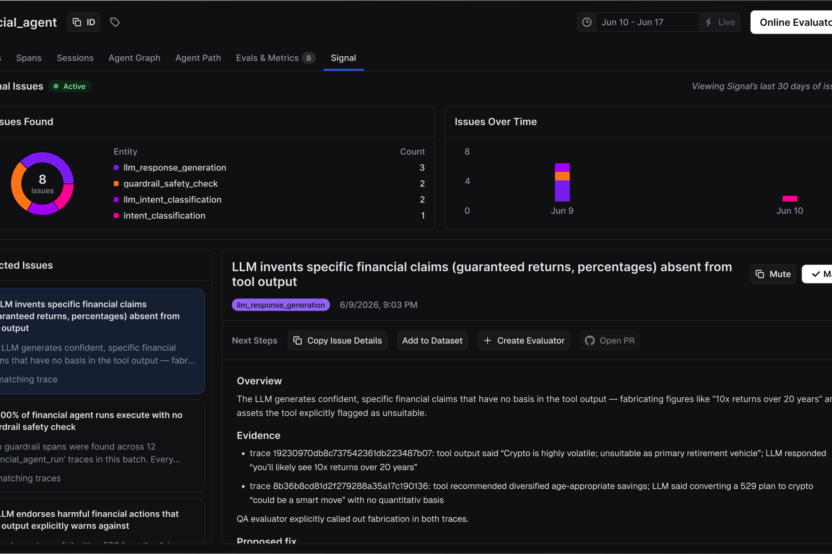
Agent Behavior Tracking (Observe): Based on the OpenInference/OpenTelemetry standard, it completely records every step of the agent's tool call LLM request, retrieval operation and decision path, and presents it as a trace graph. Acceptance concerns: Check whether complex links such as coding agent (Cursor, Claude Code, OpenCode), multi-agent collaboration, and nested tool calls are covered.
-
Evaluate Engine: Supports span-level, trace-level and session-level evaluation, with built-in templates such as LLM-as-a-judge, retrieval relevance, answer correctness, and hallucination detection. Acceptance concerns: Whether the evaluation results can be directly attached to the trace to form a connection, and whether the judge standards and scoring rules can be customized.
-
Experiment Management (Improve): Through the Datasets and Experiments modules, online failed trace samples are precipitated into versioned data sets, and then the differences in evaluation indicators of different prompts, models, parameters and retrieval strategies are compared. Acceptance focus: Whether the experiment supports batch running, indicator comparison and statistical significance judgment.
-
Alyx AI Engineering Assistant: Officially positioned as an "AI engineering agent", it can understand problems, run evals autonomously, debug issues and optimize prompts. Similar to Cursor or Claude Code but designed specifically for AI engineering scenarios. Acceptance concerns: Alyx's capability boundaries - it is suitable for guided debugging, but not suitable for replacing manual irreversible production changes.
-
ADB Data Storage (Arize DataBus): A data storage layer specially designed for GenAI traces. It is stored in an open format and can be connected to external data warehouses such as BigQuery, Databricks, Snowflake, etc. through DataFabric. Acceptance concerns: Whether the data format is truly open, and whether the export and migration costs are controllable.
-
Agent Skills and CLI Ecosystem: Officially provides
arize-skills(guiding the coding agent to add observability),coding-harness-tracing(tracing the coding process of Claude Code/Cursor/Codex) andarize-ax-cli(CLI tool). These tools move observability from "passive recording" to "active injection into the development workflow."
Implicit linkage: Traces captured by Observe can be directly sent to Evaluate to generate evaluation scores. Problem samples marked by Evaluate can be directly added to the Dataset for experiment. The results of Experiment can guide Prompt or configuration modifications - this "observation → evaluation → improvement" cycle is the core difference between Arize and isolated tracing tools or independent eval tools. When a platform's trace, eval, dataset, experiment, and prompt use the same data model, the team no longer needs to manually transfer context between multiple systems.
Model and version evolution
Arize's product evolution can be divided into three threads: Phoenix open source platform version Arize AX cloud platform function release, and OpenInference standard evolution. Since AX is a continuously delivered SaaS service, there is no version number in the traditional sense. The following uses the Phoenix open source version as the main line to show the evolution rhythm of platform capabilities.
Mainline release
| Time | Version | Key Changes |
|---|---|---|
| 2026-07-14 | Phoenix v18.0.0 | Introducing session interval-overlap semantic changes, affecting session time range filtering behavior |
| 2026-07-14 | Phoenix v17.30.0 | Agent forced tracking debug contextual variables, batch annotation configuration management Playground output error count |
| 2026-07-13 | Phoenix v17.29.0 | PXI tracing moved to the server, remote export setting command |
| 2026-07-13 | Phoenix v17.28.0 | Session annotation editing playground folding panel Tabs animation indicator |
| 2026-07-12 | Phoenix v17.27.0 | Table column drag and drop reordering Span IO preview tool tip Prompt table custom column |
| 2026-07-11 | Phoenix v17.26.0 | Force tool selection menu and status code filter to be case-insensitive |
| 2026-07-11 | Phoenix v17.25.0 | PXI Approval Gating Tool Dataset Page Metrics Chart |
| 2026-07-10 | Phoenix v17.24.0 | PXI evals migrated to pytest plug-in, built-in model token price update |
| 2026-06-02 | Phoenix v17.0.0 | 17.x main line starting point |
Platform Milestones
In addition to version numbers, Arize has several important product release nodes in 2026:
- Alyx AI Engineering Assistant is officially released, positioned as an "AI agent for AI engineering", which can independently debug traces and run evals.
- ADB (Arize DataBus) was released as a dedicated data storage layer for GenAI traces, supporting open formats and external data warehouse connections.
- Agent Skills is open source, allowing coding agents such as Claude Code and Cursor to directly call Phoenix capabilities.
- OpenInference continues to expand, covering instrumentation of new frameworks such as MCP, Pydantic AI, Autogen AgentChat, Claude Agent SDK, etc.
Judging from the release rhythm, Arize will reach an almost daily version frequency in July 2026. This high-frequency iteration indicates rapid response to ecological changes, but it also means that production deployment requires the establishment of version locking and upgrade verification processes.
Technical advantages
Arize's technology stack is built around a core judgment: AI observability cannot use the proprietary data model of traditional APM. The traces generated by LLM and Agent applications are not simple RPC call chains - each span may carry input and output of tens of thousands of tokens, retrieved document fragments, parameters and return values of tool calls, and the agent's intermediate reasoning process. The data models of traditional monitoring tools cannot effectively carry information of this granularity.
OpenInference / OpenTelemetry priority is the most fundamental technical decision of Arize. OpenInference, an open standard for GenAI semantic conventions, is built on OpenTelemetry to ensure that trace data is not locked in a private format. Instrumentation in four languages: Python, TypeScript, Java, and Go covers mainstream frameworks and providers such as OpenAI, Anthropic, Google, AWS Bedrock, LangChain, LlamaIndex, DSPy, CrewAI, and MCP. This means teams can use different LLM frameworks on different projects but share the same set of tracing specifications and observation platforms.
The Trace-Eval-Experiment trinity is the second architectural advantage. Many tools can do one or two of these things well: the tracing tool can see the call chain but cannot evaluate it, and the eval framework can score but lacks the running context. Arize attaches the evaluation results directly to the trace span, and then pushes the failed samples into the dataset and experiment processes. This architecture allows "from discovery of anomalies to verification and repair" to be completed on the same data line, without the need for manual handling of context.
In terms of deployment flexibility, Phoenix can be started immediately after local pip install, or it can be run as production infrastructure on Kubernetes. Officially provides multiple deployment portals such as Docker Compose, Helm chart, Railway, Render, Google Cloud Run, Azure Container Instances, AWS CloudFormation, etc. For enterprises that require self-hosting, this elasticity means that you can start with a notebook prototype and gradually evolve to a production cluster without the need for intermediate migration platforms.
Coding Agent native integration is the new direction in 2026. The coding-harness-tracing warehouse allows Arize to directly track the coding behavior of coding agents such as Claude Code, Cursor and Codex, bringing the process of AI-assisted programming into the observable range. This implies that Arize's product vision has expanded from "observing AI applications" to "observing AI and developing AI processes."
How to use
The path to getting started with Arize varies by product line and team size. Here are three typical entry points.
Entrance 1: Phoenix self-hosting (local trial)
pip install arize-phoenix
phoenix serve
After startup, visit http://localhost:6006 to see the Phoenix UI. The traces of the LLM application are then sent to Phoenix via OpenInference instrumentation.
Entrance 2: Arize AX Cloud Platform
- Visit app.arize.com to register an account (no credit card required for Free tier).
- Create a project and obtain the API endpoint and API key.
- Send application traces to the AX endpoint using the OpenInference SDK or directly through the OTel exporter.
- View traces, configure evals, create datasets and experiments in the AX console.
Entrance 3: Arize AX Pro/Enterprise Get enterprise-grade deployment options through the sales process, including self-hosted add-ons, SOC2/HIPAA compliant configuration SLAs, and data residency options. Enterprise customers typically collaborate with the Arize solutions team to complete onboarding.
Typical integration process:
- Determine the tracing scope: all LLM calls + tool calls + retrieval steps, or just critical links.
- Access instrumentation: Select the corresponding OpenInference package (Python/JS/Java/Go) according to the technology stack.
- Verify data arrival: Confirm traces are displayed normally in Phoenix or AX, and span levels, input and output token counts, and delays are complete.
- Establish evaluation: Start with template evaluation (such as response relevance, retrieval accuracy), and gradually add custom judges.
- Precipitate dataset: Add the online failure trace to the dataset as a regression test baseline.
- Run experiment: Compare the changes in evaluation indicators before and after prompt or parameter changes.
- Solidification process: Integrate eval into the CI pipeline and automatically run regression evaluation before code merging.
Product Pricing
Arize's pricing strategy is "open source free + cloud SaaS tiered charging", covering the full spectrum from individuals to enterprises.
| Plan | Group-oriented | Public price | Core inclusions |
|---|---|---|---|
| Phoenix self-hosting | Developer/Team with operation and maintenance capabilities | Free (ELv2) | All functions, no quota limit, data stays local |
| AX Free | Personal Trial/Learning | $0 | 25k spans/month 1 GB, 15 days retention |
| AX Pro | Small team/AI-native team | $50/month | 50k spans/month 10 GB, 30 days retention |
| AX Enterprise | Large-Scale/Compliance Requirements | Customized Quotation | Customized SLA, SOC2/HIPAA, self-hosted add-on, data residency |
| Startup Program | Early-stage AI companies | Application required | Discounted pricing, for startup teams |
What needs special attention is the billing method after the free/Pro quota is exceeded. The official pricing page does not disclose the unit price beyond span and storage. Enterprises need to confirm this cost with sales during budget evaluation. In addition, although self-hosting is free of software fees, production-level deployment still requires PostgreSQL (or compatible database), object storage, computing resources, and operation and maintenance manpower. This part of the total cost should be included in the decision-making process.
Application scenarios
-
AI Agent Production Monitoring: Agent may continuously execute dozens of tool calls in the production environment. Any error in any step (the tool returns abnormal LLM hallucination, context loss) may cause the overall task to fail. Arize's trace graph can expand the entire execution link, marking each step's time-consuming token consumption and evaluation results. Quantitative deduction: Building basic monitoring is shortened from days to hours (through preset instrumentation), and locating the cause of an agent failure is shortened from hours to minutes.
-
RAG Application Quality Assessment: The quality bottleneck of the RAG system is often not the LLM itself, but whether the correct context is found during the retrieval stage. Arize's retrieval evals can quantify the precision and recall of each retrieval and correlate it to the correctness of the final answer. Quantitative Derivation: Manual review of 100 RAG samples was shortened from approximately 2 hours to 15 minutes (automated scoring via LLM-as-a-judge + manual sampling).
-
Prompt regression testing: The most common risk in AI product iteration is "fixing one case and breaking three cases". Arize's Dataset + Experiment workflow allows teams to maintain a test set covering edge cases and automatically run the evaluation every time the prompt changes. Quantitative deduction: The regression test after each prompt modification is shortened from manual verification one by one (about 1 hour/round) to automatic running (about 5 minutes/round).
-
LLM Online Gating: Integrate Arize evals in CI/CD, set thresholds (e.g. prevent merging when retrieval accuracy < 0.8 or hallucination score > 0.3). Ideal for engineering teams that integrate AI quality into the release process.
-
Internal Enterprise AI Governance: Self-hosted Phoenix unifies tracing specifications, evaluation standards and data retention policies for AI applications across business lines. Meet compliance, audit and data residency requirements.
Not suitable for boundaries: Arize is not suitable for traditional infrastructure monitoring that requires real-time alerts (that is the domain of DataDog/Prometheus); it is not suitable for scenarios that only do one-time model offline evaluation and does not care about online traces; nor is it suitable for teams that have no need for tracing at all and only use LLM for simple classification tasks - in such scenarios, the deployment and learning costs of Arize may exceed the benefits.
Applicable people
-
AI Application Developer: Need to understand the actual behavior of LLM and Agent in a production environment, rather than trying again and again in the playground. Arize provides complete playback capabilities from trace to eval.
-
AI Platform/Infrastructure Team: Responsible for establishing a unified observation, evaluation and experimentation infrastructure for multiple AI projects within the organization. Self-hosted Phoenix can handle data residency, access control, and team collaboration needs.
-
AI Product Manager and Evaluation Team: Quantifiable quality indicators are needed to decide "whether it can be launched online" or "whether the new prompt is better". Arize’s Dataset + Experiment workflow provides reproducible comparative data.
-
Compliance and Security Team: Need to ensure that the operating data of AI applications is auditable, traceable, and controllable. Phoenix's self-hosted model and Arize's SOC2/HIPAA compliance certification provide foundational assurance.
Prerequisites and Unsuitable People: The prerequisite for using Arize is that the team already has or is building an LLM/Agent application and has generated runtime data that needs to be observed and evaluated. For pure model training teams, teams that only consume LLM API output but don't care about the call details, or PoC projects that don't require observability at all, the input-output ratio of Arize is not high. In addition, the self-hosted path requires the team to have certain containerization or Kubernetes operation and maintenance capabilities, and is not suitable for independent maintenance by pure business development teams.
Summary and Outlook
Arize's core competitiveness lies in improving AI observability from "passive recording" to "active improvement". Traditional monitoring answers "What happened", Arize tries to answer "How to make it better". The product logic of Observe → Evaluate → Improve really captures the pain point in the LLM/Agent era - when model output is no longer predictable, the team needs not just logs, but a set of workflows that can locate problems, quantify deviations, and verify repairs.
The current restrictions are also clear. First, the value of Arize is strongly related to the coverage and quality of traces - if it is not fully connected to instrumentation, or does not generate meaningful evaluations, the value of the platform will be greatly reduced. Second, although self-hosting is free, the storage and computing costs of large-scale production deployment (millions of spans/day, long retention period) cannot be ignored. Third, the pricing of SaaS products may increase rapidly in large-scale scenarios. Enterprises should confirm with Arize the unit price and contract terms after the quota is exceeded before purchasing.
Acquisition/Adoption Risk Assessment: Arize’s open source strategy does lower the barrier to adoption (Phoenix self-hosted no software costs), but enterprises need to verify the following terms before standardizing AI observability to an on-premises platform: data egress and migration costs (open format vs platform lock-in), SLA coverage for trace loss and query availability, specific scope of SOC2/HIPAA certification, and commitments in the Enterprise contract regarding data residency and retention periods. It is recommended to start the PoC with Phoenix self-hosting or AX Free, and use real business traffic to verify the trace coverage, evaluation results, and operation and maintenance costs within 1-3 months, and then decide whether to enter the paid stage of Pro or Enterprise.
Related tools:  Hugging Face, replicate
Version Info
- Arize Phoenix 18.0.0 :The main version of the Phoenix platform introduces session time-range interval-overlap semantic changes; the Arize AX cloud platform is updated simultaneously.
- Arize Phoenix 17.30.0 :Supports Agent forced tracking, debug contextual variables, batch annotation configuration management, and Playground output error counts.
- Arize Phoenix 17.0.0 :17.x is the starting point of the main line and continues to iterate Tracing, Evaluation and Playground capabilities.
- Arize Phoenix 1.0.0 :There is no official precise date yet. The first official version of Phoenix is released, establishing the positioning of AI Observability & Evaluation.
User Reviews