 Artbreeder
Artbreeder supports character and concept art creation through genetic mixing, parameter editing, and community collaboration. Based on GAN + SDXL dual engines, 14M users have produced 300M images, which is suitable for rapid dissemination of solutions for vision teams.
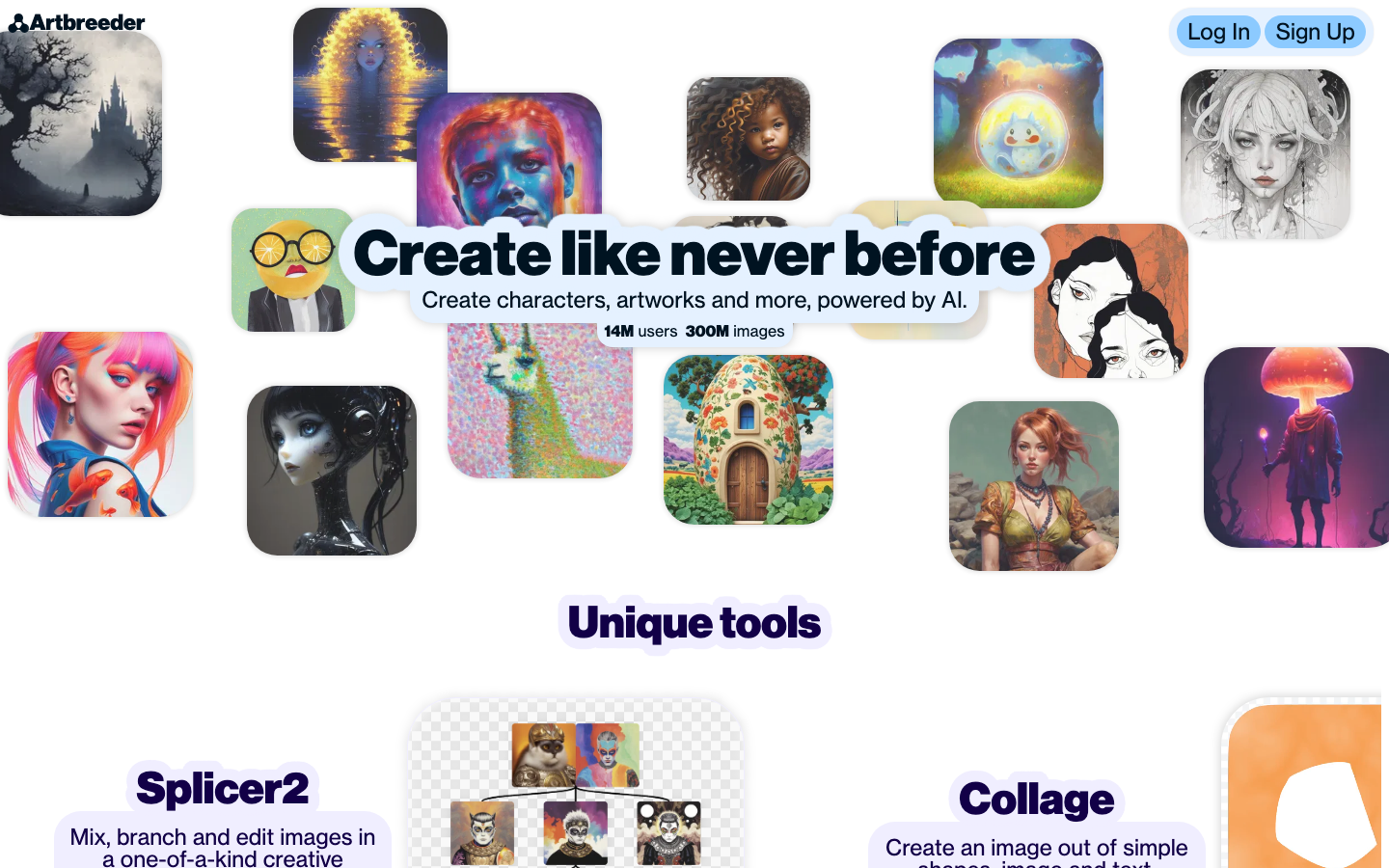
Artbreeder: AI visual creation ecology anchored by genes
Core parameters and statistics
| Projects | Public Information |
|---|---|
| Product positioning | Gene mixing and image creation platform |
| 主要入口 | Web |
| Typical tasks | Character design, concept art exploration, illustration creation |
| Creation method | Gene mixing + parameter adjustment + community secondary creation |
| Underlying technology | BigGAN / StyleGAN + SDXL |
| User scale | 14 million+ |
| Total number of works | 300 million+ |
| Parent Company | Morphogen / Studio Morphogen |
| Founder | Joel Simon |
| Ecological Features | Community Sharing Contests, Remix Parties |
| Version visibility | Unpublished standardized version log |
Parameter meaning: Artbreeder is currently one of the few visual platforms that retains GAN gene mixing and diffusion model generation capabilities. The magnitude of 14 million users and 300 million works shows that its community-driven model has run its course - users not only consume content, but are also "gene providers" of each other's works. Compared with Midjourney's closed community and Leonardo.ai's tool-oriented approach, Artbreeder is unique in its "evolvable creations": each picture can become the starting point for the next person's work. The shortcoming is that the official disclosure of model parameters, inference delays and system architecture is almost zero, and the transparency of technology selection is far lower than similar projects in the open source community.
User and market recognition
Community size is the core barrier: The official homepage clearly states "14M users, 300M images". This data ranks among the top echelons among similar AI vision platforms. Unlike Midjourney's Discord community model, Artbreeder embeds community collaboration into the creative process itself - users can "genetically hybridize" directly based on other people's public works, forming a decentralized co-creation network. Regular operational activities such as Contests and Remix Parties further improve user retention and work reuse rate.
Missing B-side adoption data: Currently, no corporate customer list, industry coverage cases or commercialization revenue data can be found in public information. This means that the commercialization of Artbreeder is still highly dependent on C-side subscriptions and traffic monetization, and it has not yet launched a clear enterprise version or private deployment plan like Leonardo.ai. This information gap is a significant decision-making barrier for corporate buyers who need to evaluate supplier stability.
Complete social communication matrix: The product has official accounts on Twitter, Instagram, Discord, and TikTok, among which the Discord community is the main place for user communication and feedback. However, judging from third-party reviews and community discussions, the tool is far less popular in the professional design circle than Midjourney, and is positioned more as an "inspiration exploration tool" rather than a "production-level drawing tool."
Cost advantage
C client/individual: The free version supports basic creative functions (including advertising) and is suitable for individual creators to experience the core workflow at zero cost. The paid version is divided into three levels - Starter ($7.49/month, 1200 Credits/year), Advanced ($15.99/month, 3300 Credits/year), and Champion ($30.99/month, 8400 Credits/year). The credit system covers SDXL image generation, and the cost per credit is between $0.04-$0.07. After conversion, the Champion level is about $0.04/credit, which is equivalent to about 84,000 SDXL images/year, which is at a medium to low level among tools of the same level.
Core differences between free and paid: Pro subscription removes ads, provides privacy control, Google Drive sync, Composer unlimited generation, and Splicer quick mode. This means that free users will be more restricted in their creative experience - especially the lack of Splicer's fast mode, which will directly affect the iteration efficiency of genetic mixing.
API/Developer: No complete API documentation or commercial licensing terms are available on the public page. Unlike platforms such as Stability AI or Replicate, which offer standardized API services, Artbreeder is currently more of a closed end-to-end application than an open platform. If you need to embed its capabilities into your own workflow, you need to contact the official to confirm the business possibilities.
Enterprise/Private: No pricing or privatized deployment plans for the enterprise version have been disclosed. This creates a clear procurement threshold for organizations with data residency, content moderation and security compliance requirements. It is recommended to proactively contact [email protected] to confirm enterprise terms when evaluating.
Main functions
- Splicer2 (a new generation of genetic mixing tools): Complete image mixing, branching and editing in a unique interactive interface. Compared with the first generation Splicer, Splicer2 provides a more intuitive creative tree structure. Users can see the evolutionary path of each genetic hybridization and return to any node at any time. This is the core function that distinguishes Artbreeder from competing products - it is not just "generation", but "breeding".
- Collage: Create new works by combining simple shapes, images and text. It lowers the threshold for creation, allowing users without painting foundation to quickly produce visual content by combining existing elements.
- Splicer (Classic Gene Mixer): Mix multiple images and edit their "genes". Supports fine adjustment of genetic dimensions such as Age, Gender, and Blue, suitable for the progressive evolution of character appearance.
- Gene Parameter Editing System: Fine-grained control of the generated results through quantifiable parameters such as Age, Gender, and Blue. This set of ideas based on GAN latent space editing has become a differentiated advantage in the era of diffusion models - the text prompt control of the diffusion model is often not as accurate as this numerical slider.
- Community Creation Ecosystem: Users not only consume works, but can also continue to "breed" based on any public works. Normalized mechanisms such as Contests and Remix Parties expand single-point creation into group collaboration, forming a creative model that resembles biological evolution.
Expert’s perspective: Artbreeder’s functional design has a clear main line - "Creations can evolve." Splicer2's creation tree, slider adjustment of genetic parameters, and secondary mixing of community works all reinforce the same concept: images are not the end of one-time generation, but the starting point of continuous variation. This paradigm is extremely efficient in the early stages of concept design and character development—a base face can produce dozens of variants through three to five rounds of genetic mixing, which would require hours of manual tweaking in a traditional workflow. But the price is that the precise control capability is weak: it is difficult for the model to accurately generate a specified composition or posture, which may require additional manual refinement in commercial delivery scenarios.
Model and version evolution
Technology roadmap evolution: from GAN to GAN + SDXL dual engine
Artbreeder was initially launched under the name Ganbreeder. The underlying layer is based on generative adversarial networks such as BigGAN and StyleGAN. Founder Joel Simon explicitly mentions the legacy of Picbreeder and Facebook Graffiti in his about page. The product at this stage is more like a research experiment - allowing users to explore image possibilities through "breeding" in high-dimensional latent space.
Subsequently, the product underwent a brand upgrade to Artbreeder, adding more community features and creative tools. Around 2025-2026, Artbreeder will introduce SDXL support and move from a pure GAN architecture to a GAN + diffusion model dual engine. The implicit message of this shift is that the team recognizes the advantages of the diffusion model in image quality and diversity, while retaining GAN’s unique interactive experience in latent space editing and gene mixing.
Version disclosure status
There is no official standardized version log or changelog provided. The iterative information of the current website version can only be inferred indirectly through product feature changes. Historically, Artbreeder has gone through key nodes such as pure GAN, adding diffusion models, and launching Splicer2 and Collage, but none of them have official version numbers.
Open Source Legacy
Artbreeder maintains an early open source version (based on BigGAN) called ganbreeder on GitHub as a technical legacy and community reference. However, the core code and model weights of the current product are closed source.
Technical advantages
Synergistic value of dual-engine architecture: Artbreeder also retains two technical routes: GAN (StyleGAN/BigGAN) and diffusion model (SDXL). GAN is responsible for gene mixing and latent space operations - users can perform continuous interpolation in the latent space by adjusting "gene sliders" such as Age/Gender. This is an interaction paradigm that the diffusion model currently cannot natively support. SDXL is responsible for making up for the shortcomings of GAN in image quality, diversity and prompt understanding. The two routes coexist in the same product, forming a division of labor pattern in which "GAN does exploration and mutation, and diffusion model does refinement and diversity".
Why is it more economical than the pure diffusion model solution? : In the concept exploration stage, users do not need to run the complete diffusion sampling process every time. Through GAN's latent space interpolation, Artbreeder can quickly generate a large number of candidate variants at very low computational cost - only one forward pass is needed to obtain a new "gene combination". The SDXL engine is called only when the user is satisfied with a certain direction, requires HD output, or drastically changes the content. This "light exploration + on-demand re-rendering" model, the unit image cost in the early creative divergence stage is significantly lower than using Midjourney or DALL-E from beginning to end.
Engineering challenges in gene space: Although the editability of GAN latent space has great advantages in interaction, it also brings inherent pain points in engineering - the selection of latent space dimensions, the smoothness of interpolation paths, and the alignment of gene spaces between different models are all difficult problems that require fine parameter adjustment. Artbreeder’s accumulation in this area is its core moat, but the official has not disclosed specific technical implementation details. For the technical team, if they hope to reproduce similar capabilities, they need to invest a lot of GAN training and latent space analysis work.
How to use
- Registration and Getting Started: Visit the Artbreeder official website and register via email or Google account. Start creating with a free account, no credit card required.
- Select the creation mode: Select the entry from the three tools: Splicer2 (gene mixing tree), Collage (collage), and Splicer (classic mixing). Beginners are recommended to start with Splicer2, whose visual creation tree reduces the learning curve.
- Select materials or start from the community: You can directly upload your own images as "gene seeds", or you can browse the community's public works on the Browse page and choose your favorite works as a starting point. The Remix function of community works is a shortcut to get inspiration quickly.
- Gene Editing and Mixing: Adjust the characteristics of the current image through parameter sliders such as Age, Gender, and Blue. If you select multiple images for blending, you can adjust the proportion of each image's weight in the final result. Splicer2 supports branching operations - try multiple directions from the same picture to form a creative tree.
- Iteration and Export: Repeat the cycle of "Mix → Adjust → Branch" until you get a satisfactory result. Pro users can enjoy Splicer's fast mode (dramatically reducing wait times) and higher resolution exports. The exported results can be used for design proposals, social media content, or as refined drafts.
Process differences from typical AI image tools: Compared with Midjourney's linear process of "prompt → generate → image selection → zoom in", Artbreeder's "selection → hybridization → screening → rehybridization" iterative mode is closer to the designer's manual work habit of diverging plans. The former is suitable for "I want a picture", and the latter is suitable for "I want to see which directions I can go".
Product Pricing
Artbreeder adopts a Credit subscription system and currently publishes three annual packages:
| Tier | Monthly fee | Total annual payment | Credits/year | Approximate SDXL output | Single Credit cost |
|---|---|---|---|---|---|
| Starter | $7.49/month | $89.88 | 1200 | ~12000 tickets | ~$0.07 |
| Advanced | $15.99/month | $191.88 | 3300 | ~33000 tickets | ~$0.06 |
| Champion | $30.99/month | $371.88 | 8400 | ~84000 tickets | ~$0.04 |
Free version: Supports basic creation (including advertising), and has restrictions on Composer usage, export resolution, and Splicer mode. Suitable for light experience and functional evaluation.
Pro Exclusive Features: No ads, privacy control (works can be set to private), Google Drive synchronization with Composer, unlimited generation of Splicer quick mode. Among them, Splicer's fast mode has a direct impact on the creative efficiency of heavy users - the queue waiting time of standard mode may be significantly longer during peak periods.
Pricing competitiveness analysis: Based on the Champion tier of $0.04/credit, the inference cost of a single SDXL image is about $0.04, which is close to Leonardo.ai’s paid tier and lower than Midjourney’s $10-30/month (unlimited but subject to fair usage restrictions). However, it should be noted that Artbreeder's Credit system covers "output" rather than "number of inferences" - the consumption coefficients of different models and resolutions may be different, and the specific deduction rules are not explained in detail on the official website.
Hidden Cost Tip: Splicer Express mode is not available to free users, and standard mode can have wait times of up to several minutes during peak times. For the project divergence stage that requires high-frequency iteration, this delay will significantly slow down the creative pace. If Artbreeder is introduced into a team workflow, it is recommended that active members be assigned at least Advanced or higher.
Application scenarios
- Character Setting and Concept Exploration (Dimensionality Reduction Strike Scene): This is the core battlefield of Artbreeder. In the early stage of a game or film and television project, it is necessary to quickly determine the direction of the character's appearance. The traditional method is for the artist to output 5-10 sketches, which takes 2-3 days. Using Artbreeder's genetic mixing process, designers can start from a basic face shape and produce dozens of variants through multiple rounds of genetic hybridization and parameter adjustment in 30-60 minutes. (Deduction: Based on the divergence of character concepts, the time for a single task can be reduced from 2-3 days to 1-2 hours, and the efficiency is increased by 80%+.) However, the refined finalization of the final selected plan still requires the intervention of human painters - the characters produced by AI are still unstable in terms of fingers, clothing details and perspective structure.
- Quick production of social media content and creative materials: The social media operation team needs high-frequency production images to support content updates. Artbreeder's Collage tool and community material library allow operators to quickly collage available visual materials without a design background. (Deduction: The production time of a social media picture is shortened from 30-60 minutes to 5-10 minutes, which is suitable for fast-paced grass planting, poster and cover scenes.) But please note: Artbreeder's picture gallery tends to be artistic and stylized output, and is not suitable for commercial content that requires real-life photos of products or strict brand visual identity.
- Visual inspiration for design and advertising proposals: When submitting creative solutions to clients, multiple visual directions need to be demonstrated. Artbreeder's creative tree function is naturally suitable for this scenario of "starting from a core concept and deriving multiple visual branches". The proposal team can quickly show the client "what it would look like if we went in this direction," thus accelerating decision-making.
Not suitable for boundaries: ① Commercial production that requires precise composition control (specific angles, specific scenes, product-level detail restoration) - Artbreeder's gene mixing method is far weaker than ControlNet or ComfyUI workflow in terms of controllability; ② Batch standardized production (such as e-commerce main images, ID photos) - Credit system and single interaction mode are not suitable for large-volume consistent output; ③ Visual content generation in strict compliance industries (healthcare, finance, legal) - public information does not indicate that Artbreeder has content compliance review or enterprise-level content governance capabilities.
Applicable people
- Visual Designers and Concept Artists: This is the most matched core group of people. Artbreeder's genetic mixing workflow is highly consistent with the designer's natural habit of "making plans and diverging". Designers can quickly explore "what would happen if the style were changed" and "what would happen if these two characters were mixed", covering more visual possibilities in the early stages, and then narrowing down the scope for refined finalization. It is recommended to position Artbreeder as an "inspiration accelerator" rather than a drawing tool.
- Independent Creators and Self-Media Operations: Individual creators who need high-frequency production of images but do not have the budget to hire a full-time designer. The free version of Artbreeder can meet basic creative needs, and the community material library reduces the difficulty of starting from scratch. Collage tools are especially friendly to users from non-design backgrounds.
- Game and film pre-development team: rapid iteration of character concept design. Artbreeder can help the team quickly align the visual direction of the character during the project establishment stage and reduce rework caused by communication deviations.
Dissuade people: ① Teams that need a stable and controllable industrialized rendering pipeline - Artbreeder, as a closed-source web application, cannot be embedded in automated pipelines, and there is no API interface for programmatic calls; ② Commercial customers with strict requirements on data privacy and IP ownership - works are uploaded to the public cloud platform, privacy control is limited to Pro subscribers, and the official has not disclosed whether the model training data contains user works; ③ Pursue the design task of "accurate drawing" rather than "exploration and divergence" - if you need to generate product display pictures with specified composition and specified perspective, Midjourney + ControlNet or ComfyUI workflow is a more suitable choice.
Summary and Outlook
Artbreeder's core competitiveness lies in its most thorough productization of the concept that "creations are evolvable". In the GAN era, it found the unique interaction paradigm of genetic mixing, and in the diffusion era, it successfully integrated SDXL without losing its own differentiation - 14M users and 300M works are direct proof that this route is effective. Compared with those platforms that compete with Midjourney for homogeneity, Artbreeder maintains a clear positioning in the two dimensions of "visualization of the creative process" and "community-driven content evolution".
But the challenges it faces are equally clear: the maturity of technologies such as ControlNet and IP-Adapter in the field of diffusion models is rapidly reducing the "controllability" advantage of GAN gene mixing; and Artbreeder's closed web application form naturally lags behind open platforms such as Stability AI and Replicate in terms of developer ecosystem and enterprise adoption. If the team does not open the API or launch an enterprise version in the future, its commercialization ceiling will be limited by the size of the C-side subscription market.
Procurement/Adoption Risk Assessment: For the decision to introduce Artbreeder into the team workflow, it is recommended to focus on three points: First, confirm the IP ownership and commercial use rights terms of the work - whether the authorization scope of the free version and Pro version covers commercial use, the official statement is not transparent enough; second, evaluate the match between the Credit consumption model and the actual output volume - the credit consumption rules for different types of creative tasks are not disclosed, and there may be a risk that the actual cost is higher than expected; third, consider the long-term availability of the tool - Artbreeder As a standalone product that relies on Morphogen's continued operations, if the team has a long-term dependence on the tool, it needs to pay attention to its commercialization health and the maturity of alternatives.
Related tools:  Midjourney, stable-diffusion
Version Info
- Artbreeder Web Latest :The official website continues to iterate, introducing new tools such as Splicer2 and Collage. There is currently no official precise version number and release date.
- Artbreeder Web Previous Milestone :There is no official precise date yet, and the historical evolution is subject to the official real-time page.
User Reviews