 Asana
Asana
Asana is a work management platform with Work Graph® as its core, integrating tasks, projects, goals and workflow automation into the same interface. Starting from 2025, the AI capability layer (AI Teammates, AI Studio, Smart series) will be fully embedded, and it has served more than 170,000 paying organizations, covering 85% of the Fortune 100 companies, and is in a leading position in the human-machine collaborative project management track.
Asana
Asana’s core parameters and statistics
Asana is not positioned as a project management tool in the traditional sense, but as a human-machine collaborative operating system with Work Graph® as the data base. It unifies tasks, projects, goals, automation rules, and AI Agents in the same network of relationships, so that all participants—whether humans or AI—operate on the same plan.
| Projects | Public Information |
|---|---|
| Product positioning | Human-machine collaborative work management platform (Agentic Work Management) |
| Core Data Model | Work Graph® — a relational graph of tasks, projects, goals, and dependencies |
| Number of paying customers | More than 170,000 organizations (official data, including total free users) |
| Enterprise Penetration | 85% of the Fortune 100 use Asana |
| Covering team sizes | Small teams of 2 people to multinational organizations of tens of thousands |
| Deployment method | Cloud SaaS, no self-sustaining private deployment |
| Supported platforms | Web, Desktop (Windows/Mac), iOS, Android, API |
| AI capability form | AI Studio, Smart series AI Teammates, MCP/AI Connectors |
| Security Authentication | SOC 2 Type II, 256-bit encryption, multi-factor authentication SAML/SCIM |
| Latest version | 2026-Q2 (AI Teammates + MCP Connectors) |
Positioning difference with competing products: The core difference of Asana is Work Graph® - it is not only a "task list + Kanban board", but maintains the dependency chain between tasks, the alignment between goals and projects, and the real-time mapping of member workloads. This makes the risk prediction and intelligent allocation of the AI layer not based on simple field matching, but on a contextually coherent "working map". In contrast, Monday.com's differentiation lies in the degree of visualization and ease of use. Jira focuses on the agile development process of the engineering team, while Asana covers "company-wide work coordination."
Asana’s users and market recognition
Asana's market position is built on years of accumulation of enterprise-level services, and the trust in its AI capabilities directly inherits the customer base of the platform itself.
- Customer Size: Official disclosure services more than 170,000 organizations, covering technology, finance, manufacturing, medical, education and non-profit industries. 85% of Fortune 100 companies use Asana, demonstrating its penetration into large organizations.
- User Base: There are tens of millions of active users worldwide (including the free version). The free version of the Personal plan provides basic project management for teams of less than 2 people, forming a growth funnel that "penetrates from the bottom up from small teams to large organizations." AI functions are open to all paid plans, and daily interaction data feeds back intelligent models.
- INDUSTRY REcognition: Asana has been named a Leader in the 2025 Gartner Magic Quadrant for Collaborative Work Management for the third consecutive year. With more than 12,000 user reviews in G2's project management and work management categories, AI features lead the way in ratings for "ease of use" and "adoption rate."
- Capital Markets: Asana was listed on the New York Stock Exchange (NYSE: ASAN) in 2020. In 2025, it proposed the strategic transformation of "Agentic Work Management" and promoted AI Agent from additional functions to core product pillars. This directional shift is directly reflected in the launch of the AI Teammates product line in 2026.
Asana’s Cost Advantage
Asana's cost structure needs to be broken down from the three dimensions of "C-side/individual", "team/enterprise subscription" and "AI additional layer". The impact of the three on the total cost of the same organization is significantly different.
C-side/Personal plan: The Personal plan is completely free, supports up to 2 users, provides unlimited tasks and projects, 100+ free integrations for Kanban/Calendar/List views, and a 100MB/file storage limit. For individual freelancers or two-person collaboration scenarios, complete project management capabilities are available at zero cost, but do not include any AI capabilities.
Team/Enterprise Subscription (Main Plan):
| Plan | Price (per seat/month) | Core AI capabilities | Applicable scale |
|---|---|---|---|
| Personal (Free) | $0 | No AI functionality | 1-2 people |
| Starter | $10.99 | AI Studio Basic (50,000 quota/month), Smart Chat, Smart Editor, Smart Fields, Smart Projects, Smart Summaries, Risk Reports | 3-50 people |
| Advanced | $15.99 | All of the above + AI Studio Basic (75,000 quota/month), Smart Status on Portfolios, Smart Goals, Workload | 10-200 people |
| Enterprise | Business Pricing | AI Studio Basic (200,000 quota/month), SAML/SCIM, Universal Workload, Capacity Planning | 100+ people |
| Enterprise+ | Business Pricing | All of the above + Data Residency, HIPAA, EKM, Advanced Audit | Compliance Driven |
AI additional layer (AI Studio Plus/Pro): Starter and above plans have built-in AI Studio Basic (including quota limit). If your team needs the ability to build AI workflows beyond the Basic quota, they can upgrade to AI Studio Plus (monthly/annual subscription) or AI Studio Pro (annual subscription, including advanced billing controls). AI Teammates is available as a standalone add-on subscription by organization, pricing needs to be confirmed by contacting Business.
Hidden Costs and Build-Your-Own Risks: Asana does not offer self-hosted/private deployment options, and all data must be stored on Asana’s AWS infrastructure. For organizations with data residency requirements, the Enterprise+ plan is available as an additional option, but only if the organization is located in a region that is within Asana's supported data residency range. In addition, the accuracy of AI functions is highly dependent on the quality of the team's project data - if task dependencies are not maintained and fields are incompletely filled in, the accuracy of AI recommendations and risk reports will significantly decrease, and increased verification costs may offset efficiency gains.
Asana’s main features
Asana's functional matrix covers the entire link of "planning → execution → monitoring → reporting". The AI layer is related to the core management functions and is not an independent functional module.
-
Project and Task Management: Supports four views: list, Kanban board, calendar, and timeline (Gantt chart). Tasks support multi-level subtasks, dependencies, custom fields, file attachments, and comment collaboration. Usage value: The four views are driven by the same data source, and team members can switch views according to their preferences without worrying about data inconsistency.
-
Goals & Portfolios: Supports hierarchical alignment from company-level OKRs to team-level goals. Goals can be associated with projects and progress is automatically synchronized. Portfolios views allow executives to view the status, health and risk distribution of multiple projects at once. Value in use: Solving the classic problem of "disconnection between daily execution and strategic goals", each project automatically updates its progress in the Portfolio, eliminating the need for manual reporting.
-
Workflow Automation (Rules & Workflow Builder): Built-in visual rule engine, supporting condition triggering of "automatically execute Y when X occurs". Automation rules can be set across task fields, projects and teams, such as "Automatically notify reviewers and update associated task status when a task is marked 'Complete'". Use value: Reduce daily repetitive operations, but when the rule complexity is higher than a simple if-then, you need to pay attention to rule conflicts and loop triggers.
-
AI Studio: Visual AI workflow builder that allows teams to create AI-driven automated processes in a drag-and-drop manner. For example, "Submit from customer form → AI extracts key fields → Automatically assign responsible persons → Generate summary → Create associated subtasks". The Basic version has a quota limit, and the Plus/Pro version provides higher call volumes and advanced features.
-
Smart series (AI native functions): including Smart Chat (natural language query project data), Smart Editor (AI-assisted task description writing), Smart Fields (automatically populate custom fields), Smart Projects (generate project plans from natural language descriptions), Smart Summaries (automatically generate tasks and project summaries), Smart Status (automatically generate progress notes and risk markers), Smart Goals (AI-assisted goal setting). Use value: This set of capabilities forms a package from "language input → structured data → progress output". Users do not need to learn complex filters and formulas to obtain the required information.
-
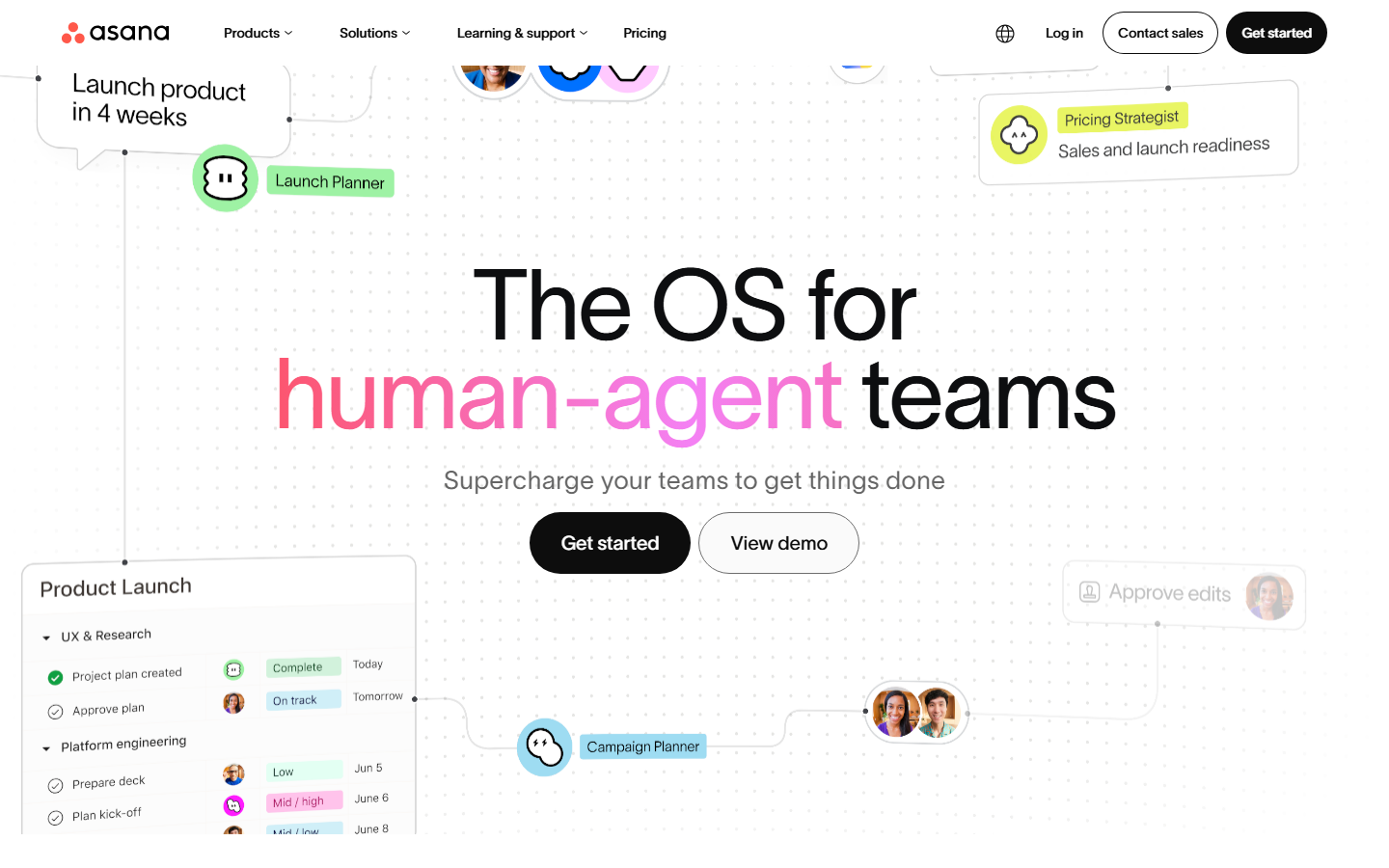
AI Teammates (new in 2026-Q2): Pre-built AI Agent roles, including Launch Planner (generates project schedules), Workflow Optimizer (identifies workflow bottlenecks and recommends optimizations), Compliance Specialist (reviews project compliance), Status Reporter (generates executive reporting summaries), and Data Quality Manager (cleans missing and anomaly data). In addition, it supports "create custom AI Teammate" to encapsulate the team's best practices into reusable Agents. Use Value: AI Teammates are not equivalent to simple chatbots, but "digital colleagues" with read/write access to the Work Graph that can be trained and improved by multiple people. Each Agent has an independent identity, permission scope and audit log.
Asana’s model and version evolution
Asana does not have an independent product version number, and feature updates are released quarterly following the main platform. The following is a summary of its version transformation from traditional project management to "Agentic Work Management" according to key time points.
Milestone node
| Time Window | Update Type | Core Changes |
|---|---|---|
| 2008-2012 | Product foundation | Asana is founded (founded by Facebook co-founder Dustin Moskovitz) and releases the first project management web application |
| 2016-2019 | Scale expansion | Launched enterprise-level functions such as Portfolio, Goals, Timeline, etc., and the number of users exceeded one million |
| 2020 | Capital milestones | Listed on the New York Stock Exchange (NYSE: ASAN), accelerating corporate market investment |
| 2024-Q3 | AI Start | The first introduction of AI workflow suggestions and intelligent field filling, Work Graph® upgrade |
| 2025-Q1 | AI Branding | Launched Asana Intelligence brand, launched Smart Fields, Smart Projects, Risk Prediction |
| 2025-Q4 | Natural language interaction | AI status update generation, intelligent search and "Ask me a question" natural language query |
| 2026-Q2 | Agentic transition | AI Teammates pre-built Agent launched MCP/AI Connectors, AI Studio Plus/Pro layering |
Version Note: Asana's version evolution reflects a clear "accumulation → intelligence" path - accumulating the Work Graph data structure and enterprise customer base in the first ten years, superimposing the AI layer on the existing data after 2024, and upgrading AI from an auxiliary function to an independent Agent role in 2026. This rhythm is different from Monday.com's progressive AI embedding, and from ClickUp's radical expansion of "Everything App". Asana's AI strategy emphasizes "governance first" - each AI Teammate has permission isolation and audit capabilities.
Asana’s technical advantages
Work Graph® is the cornerstone of AI quality: Asana’s AI capabilities are different from stand-alone AI project management tools (such as connecting to OpenAI through API to generate project summaries). Work Graph® maintains not just a task list, but a multi-layered association network of "task → project → goal → responsible person → dependency". When AI makes risk predictions, what it can see is not just "this task is about to expire", but "this task has blocked 3 downstream milestones, and the responsible person is currently overloaded. A similar postponement pattern appeared in the last quarter." This depth of context is unavailable to third-party AI tools through REST APIs.
Rules + AI hybrid architecture: Asana uses an architecture that combines a rules engine and an AI model in intelligent allocation and risk prediction. Simple scenarios (such as allocating tasks by labels) follow the rule path, which is fast and the results are predictable; complex scenarios (such as cross-project load balancing) follow the AI model path and use historical data to make probabilistic predictions. This hybrid design reduces the sense of uncertainty caused by the "AI black box" - users know which decisions are interpretable hard rules and which are probabilistic suggestions from the AI.
AI Agent's governance system: The design of AI Teammates implements the concept of "Agent is an employee" - each Agent has an independent identity, role-based permissions (which items can be read, which operations can be performed), independent audit logs and cost tracking. Administrators manage permissions for human users and AI Agents from the same console, eliminating the need to establish separate security policies for AI. This design is crucial in enterprise compliance scenarios - auditors can trace back "which Agent performed what operation at what time."
Open ecosystem of MCP and AI Connectors: The new MCP (Model Context Protocol) and AI Connectors added in 2026-Q2 allow Asana to conduct two-way data exchange with third-party AI tools (such as ChatGPT, Claude, Gemini). Users can query Asana project data directly in their preferred AI conversational tool, or write AI-generated output directly into Asana tasks. Engineering pitfall tip: MCP connections may introduce additional context token overhead and delay. It is recommended to set reasonable read and write permission boundaries and rate limits before production deployment to prevent excessive queries from AI tools from impacting Asana API quotas.
How to use Asana
Asana's usage path is divided into multiple levels from "free personal use" to "enterprise-level AI Agent deployment", and teams can choose the entrance based on scale and management needs.
| How to use | Applicable people | Features | Cost |
|---|---|---|---|
| Web version | All users | Full-featured access, no installation required | Personal free / paid plan per seat |
| Desktop client | Windows/Mac users | Offline cache, system notifications | Same as above (same account permissions) |
| iOS/Android App | Mobile office | Scan QR code, take photos to create tasks, voice input | Same as above |
| API and Integration | Developer | REST API + 200+ Native Integration + Webhooks | API calls in the same solution (with frequency control) |
Typical startup path: Create an Asana account (free Personal plan) → Create the first project through a template (such as "Campaign Schedule" or "Product Release Plan") → Add team members and assign tasks → Set task dependencies and deadlines → Switch to Timeline view to view the project critical path → Enable automation rules (such as "Automatically notify superiors when tasks are completed") → Upgrade to Starter/Advanced to use AI functions.
AI function enabled: AI function is available by default in Starter and above plans. Administrators can enable/disable specific AI capabilities (e.g. Smart Chat, AI Studio) in the Admin Console. AI Studio Basic can be used without additional configuration, and Plus/Pro needs to contact the business upgrade. AI Teammates is an independent add-on product and needs to be activated by contacting sales.
AI Studio Quick Start: Enter the Asana project → Select AI Studio → Click "Create New Workflow" → Select a trigger (such as "When the form is submitted") → Add an AI node (such as "Extract key information") → Add an action node (such as "Create task and assign") → Test and publish. Each AI Studio workflow consumes a certain amount of credit, and the Basic plan has a monthly credit of 50,000-200,000 (depending on the subscription level).
Asana’s Product Pricing
The pricing model is subject to the official real-time page. Usually a freemium or subscription system is adopted, basic functions can be used for free, and advanced functions or high-frequency use require payment.
Asana application scenarios
Asana's applicable scenarios span the two dimensions of "project execution coordination" within the enterprise and external "customer delivery management". The following three types of scenarios have relatively mature implementation cases.
Cross-department project coordination (cost reduction and efficiency improvement deduction): When multiple departments such as marketing, product, engineering, and design collaborate, the cost of information synchronization is the largest hidden expense. Asana's Portfolio view is generated with AI status updates, which can transform project managers from "asking each team one by one about their progress" to "directly viewing AI-generated cross-project summaries." After deducing, the manual status summary that originally took 3-4 hours per week can be compressed into a verification within 30 minutes. The premise is that the team has developed a habit of updating task status in Asana - if team members rely on offline communication or email to update progress, the accuracy of AI reporting will be greatly reduced.
IT and HR Service Management (Asana Service Management): The Service Management module launched in 2026 applies Asana’s Work Graph and AI capabilities to IT work order HR requests, facilities management and legal review processes. Compared with traditional ITSM tools (such as ServiceNow, Jira Service Management), Asana's differentiation is that "there is no need to independently learn a new system" - employees can submit service requests and view processing progress in the same Asana interface. Not Fitting the Boundary: For highly disciplined IT organizations that require ITIL-certified CMDB integration or complex change management processes, the depth of capabilities of Asana Service Management may not be sufficient to replace existing ITSM investments.
Customer project delivery (Asana Client Management): The Client Management module for agencies (advertising, consulting, design), integrating the entire process of customer projects from pre-sales proposal to delivery acceptance into Asana. The function of AI is reflected in automatically generating weekly customer progress reports, identifying delivery risks, and predicting delivery cycles based on historical project data. Quantified cost reduction and efficiency improvement: Agency project managers usually spend 20-30% of their time on "internal coordination + customer reporting". After using automatic state generation and risk warning, this part of the deduction time can be compressed to 10-15%. However, Asana does not come with contract management, invoicing and CRM functions, and the complete customer life cycle still requires professional tools.
Applicable groups of Asana
Asana's applicable coverage ranges from a small team of 2 people to a multinational organization with tens of thousands of people, but the benefit methods and value release conditions of different roles are obviously different.
-
Project Manager and Project Portfolio Manager: This is the role with the most direct benefits. Status summaries and risk reports automatically generated by AI can be used directly in weekly reports and reports, eliminating the time of collecting information from various teams. Prerequisite: The team needs to have relatively standardized task creation and update habits.
-
Executive and operational decision-making levels: Portfolio and Goals views provide layer-by-layer drill-down capabilities "from company goals to specific tasks." AI status updates allow executives to get a real-time overview of progress without disturbing executive levels. Not suitable for boundaries: If the organization's goal system is unclear or changes frequently, the maintenance cost of the Goals module may exceed the benefits.
-
Cross-department collaborators (marketing, product, design, engineering): Asana’s 200+ native integrations (Slack, Microsoft Teams, Jira, Salesforce, Figma, and more) reduce information fragmentation across tools. AI search allows "finding a certain decision record in history" to change from browsing chat records to natural language questions. Human-machine collaboration boundary: The accuracy of AI search is highly dependent on the structure and completeness of the project data - if the team mainly communicates with attachments and comments instead of structured fields, the recall rate of AI may not be ideal.
-
IT and Compliance Managers: The SAML/SCIM and audit log SIEM integration in the Enterprise solution meet the security compliance needs of medium and large enterprises. AI Teammates’ permission isolation and auditing capabilities are key differences from consumer-grade AI tools. Dissuade the Crowd: Asana’s SaaS-only model is not suitable for organizations that have strict data sovereignty requirements and require completely private deployment. Such organizations should evaluate competing offerings from self-hosted options (such as OpenProject, Plane) or private deployments.
Summary and Outlook of Asana
Asana will complete the positioning transition from "traditional project management tool" to "human-machine collaborative operating system" from 2024 to 2026. As a data base, Work Graph® provides a depth of context that is difficult to replicate by competing products, while AI Teammates and AI Studio upgrade AI from "additional functions" to "core interaction dimensions." For organizations already using Asana, the marginal cost of AI capabilities is close to zero and the upgrade path is smooth.
Not suitable for boundaries: Asana does not provide private deployment and does not support offline mode. Organizations with high data sovereignty requirements need to evaluate carefully. For organizations with low team project management maturity (missing task descriptions, unmaintained dependencies, unclear responsible persons), the actual value of AI functions is limited, and may even increase the verification burden due to inaccurate recommendations. Additionally, Asana’s Service Management module still needs to be used with specialized tools for organizations that require deep ITSM integration (ITIL certified CMDB) or complex PPM (Project Portfolio Management + Financial Control).
Acquisition/Adoption Risk Assessment: Asana’s subscription model reduces acquisition risk – start with free Personal and upgrade to Starter/Advanced on demand, each step is completed within the same platform, with no data migration. However, the following risk points need to be confirmed before signing: (1) Whether the AI Studio Basic quota is sufficient to cover the actual call volume of the team - after the quota is exhausted, the AI workflow will stop running instead of downgrading to the free mode; (2) Whether the pricing model of AI Teammates is billed by organization or by Agent instance - this can only be confirmed through business consultation at present; (3) The terms of use of data storage region and model training data - Enterprise+ The plan provides data residency options, but you need to confirm whether the organization's region is within the support scope; (4) Seat incremental rules of the contract - when a medium or large team expands from 30 people to more than 100 people, the incremental procurement ladder may push up the actual per-person cost.
Related tools:  Notion AI, google-workspace
How to use Asana
- Web client: You can use it by visiting the official website and registering an account. Most functions do not require installation.
- API access: Provides RESTful API, developers can obtain the API Key and integrate it into their own applications.
Version Info
- Asana 2026 Q2 version :AI Teammates (pre-built AI Agents) are fully launched, and role-based Agents such as Launch Planner, Workflow Optimizer, and Compliance Specialist are added; MCP & AI Connectors are introduced to realize two-way data exchange with third-party AI tools; AI Studio is upgraded to Plus/Pro tiered subscription.
- Asana 2025 Q4 version :Launched the automatic generation of AI status updates, intelligent search and natural language query functions, and launched the "Ask me a question" capability.
- Asana 2025 Q1 version :Launched the Asana Intelligence brand and launched smart allocation recommendations, risk prediction Smart Fields and Smart Projects.
- Asana 2024 Q3 version :Introducing AI workflow suggestions and smart field filling for the first time, Work Graph® upgrades.
User Reviews