 AssemblyAI API
AI Audio Infrastructure platform that provides pre-recorded and real-time speech transcription (STT), speech understanding (speaker separation, entity extraction, sentiment analysis, translation, summarization), Guardrails (PII desensitization, content moderation), Voice Agent API (end-to-end voice agent) and LLM Gateway (large model routing in voice workflow). Covering medical, financial, media, customer service center and other scenarios, it is API driven and supports HIPAA/PCI-DSS/SOC2 compliance.
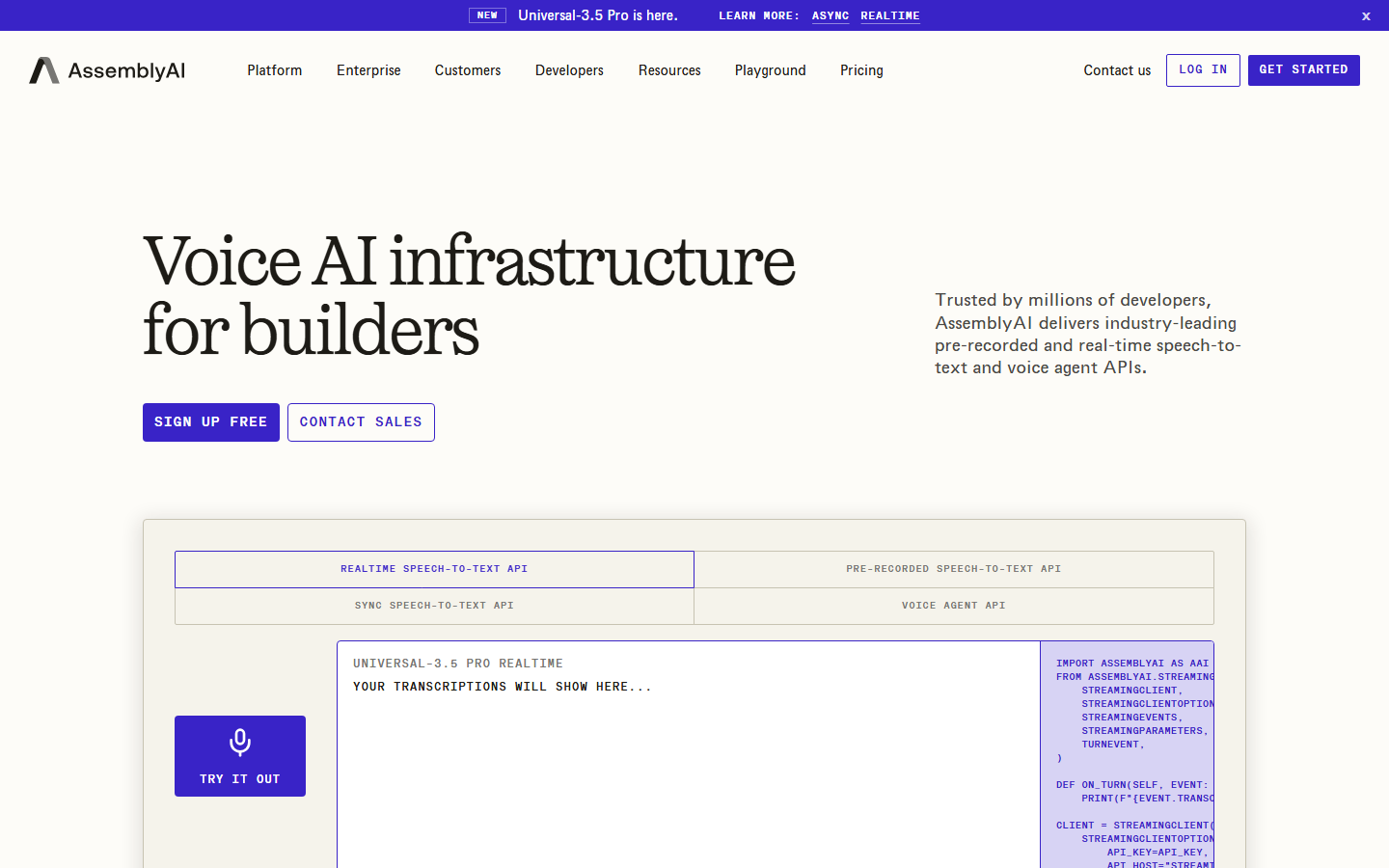
AssemblyAI API
Core parameters and statistics of AssemblyAI API
AssemblyAI is not a single chat product or end-to-end application, but a set of REST + WebSocket API collections for the full link of voice processing. Its core deliverable is an engineering balance between transcription accuracy and processing latency, not feature count. The following table summarizes its main product lines and specifications:
| Product Line | API Form | Core Model | Billing Unit | Typical Latency |
|---|---|---|---|---|
| Pre-recorded speech-to-text (Pre-recorded STT) | REST API (asynchronous) | Universal-3.5 Pro, Universal-2 | Hourly audio | File duration × ~0.3-0.5 (real-time factor) |
| Real-time speech-to-text (Real-time STT) | WebSocket (streaming) | Universal-3.5 Pro Realtime, Universal-Streaming | WebSocket session duration | 300-800ms First word |
| Voice Agent API | Single WebSocket (full duplex) | U3.5 Pro Realtime + LLM + TTS (cascade) | Sessions per minute | ~500-1500ms End-to-end response |
| Speech Understanding | REST (overlaid on top of transcription) | Independent analysis model based on post-transcription | Hourly audio (additional features are billed per piece) | Returns with transcription |
| Guardrails | REST/WebSocket | Independent moderation model | Hourly audio (additional features are billed per piece) | Return with transcription |
| LLM Gateway | REST/WebSocket | 25+ models (OpenAI/Anthropic/Google/Qwen/Kimi) | tokens per million (input/output separate) | Depends on selected model |
Boundaries of product positioning: AssemblyAI does not provide an end-to-end customer service system, does not provide recording hardware, and does not provide an NLP training platform. Its value anchor is in the transformation layer "Audio Input → Structured Text/Intent/Metadata". If your need is "convert podcasts into text and label them", it is suitable; if you need a complete customer service platform for scheduling agents, it is just one of the modules.
Community and Industry Status: According to public information, AssemblyAI has processed more than 10 million hours of audio data, serving customers ranging from independent developers to Fortune 500 companies. The company will complete Series C financing in 2022, with cumulative financing exceeding US$115 million. Investors include Insight Partners, Accel, etc. GitHub open source projects (such as Python SDK, Go SDK, sample code) have accumulated thousands of stars, but their core model weights are not open source.
User and market recognition of AssemblyAI API
AssemblyAI's position in the speech API market is between "purely academic open source models (such as Whisper)" and "full-stack cloud speech platforms (such as Azure Speech, Google Cloud Speech-to-Text)". What it competes against is not the number of models, but the combination of "out-of-box accuracy + developer experience + compliance readiness".
C-side/independent developer level: $50 free credit and no credit card registration process significantly lower the experience threshold. It is commonly used by independent developers for podcast transcription, video subtitle generation, and personal voice assistant prototypes. Discussions about AssemblyAI on Reddit and Hacker News focus on "API documentation clarity" and "Chinese/multilingual long audio accuracy" - in Chinese complex audio scenarios, users reported that its accuracy still lags behind local solutions such as Alibaba Cloud or Tencent Cloud, but it is industry-leading in English scenarios.
B-side/Enterprise level: Medical transcription is AssemblyAI’s most competitive vertical scenario. Medical Mode (+$0.15/hr) is specially optimized for medical terminology and combined with HIPAA BAA (no additional fees and no need for sales communication to sign), allowing it to be stably adopted in scenarios such as telemedicine and electronic medical record voice entry. The customer service center (Contact Center) is the second largest adoption scenario. The combination of real-time transcription + sentiment analysis + content review covers the three typical needs of agent assistance, call quality inspection and compliance monitoring. Publicly disclosed corporate customers include a number of leading medical technology companies and outsourced customer service center operators.
Positioning difference with competing products: Azure Speech and Google Cloud STT have advantages in language coverage and cloud-native integration, but AssemblyAI is more compact in link integration of "single API to complete transcription + understanding + review". Whisper (OpenAI) has freedom in offline scenarios and custom fine-tuning, but lacks real-time streaming, speaker separation and compliant binding. AssemblyAI's entry point is right in between the two - more voice-focused than cloud vendors and more production-ready than open source solutions.
Cost Advantages of AssemblyAI API
AssemblyAI's cost structure needs to be evaluated in terms of "total cost of ownership (TCO)" rather than "price per line." Its unit price is not the lowest, but the packaging effect of "transcription + understanding + review + compliance + operation and maintenance" can significantly reduce engineering integration costs in certain scenarios.
Price Competitive Stratification: AssemblyAI's pricing does not rely on the logic of the big model era of "a few cents per million tokens", but is billed on an "hourly audio basis". Different model grades have a price difference of 3-10 times, and additional functions are superimposed on billing, forming a pricing system that can finely control fees.
| Billing Items | US/EU Prices (Same) | Billing Instructions |
|---|---|---|
| Pre-recorded - Universal-3.5 Pro | $0.21/hr | Flagship model, recommended for complex audio, medical, critical transcription |
| Pre-recorded - Universal-2 | $0.15/hr | Universal model, 27+ languages, suitable for batch transcription of clear recordings |
| Streaming - U3.5 Pro Realtime | $0.45/hr | The flagship real-time transcription, billed by WebSocket session length |
| Streaming - Universal-Streaming | $0.15/hr | Low-cost real-time solution, only available in English or multi-language |
| Voice Agent API | $4.50/hr ($0.075/min) | End-to-end voice agent (STT+LLM+TTS+orchestration), all-inclusive price |
| Medical Mode (Additional) | +$0.15/hr | Medical terminology optimization, overlaid on top of the transcription model |
| Content Moderation (Guardrails) | +$0.01~$0.15/hr | PII text desensitization PII audio muting, pornographic/violent content moderation |
| LLM Gateway | Billing by token | 25+ models ranging from $0.05~$5.00/M input token |
Customer/Indie Developer: The $50 free credit is enough for a medium-sized podcast transcription project (~50-100 hours). But you need to pay attention to the pitfalls of streaming billing - WebSocket idle time is also billed, and a connection that is forgotten to be closed may consume all the free quota within a few hours. No credit card is required for initial registration, and API calls will stop after the free quota is used up, so there will be no unexpected bills.
Developer/API Integrator: The core cost control tool is model selection. The accuracy of Universal-2 is sufficient in clear recording scenarios. Switching to Universal-3.5 Pro costs 40% more but the accuracy improvement is usually within 5-10% - the key is whether your scene falls into that 5-10%. For scenarios that are noisy, dense with medical terminology, and have multiple people speaking overlappingly, the additional cost of the flagship model has a positive ROI. Keyterms Prompting (+$0.05/hr) can improve the recognition rate of specific terms without upgrading the model, and is a priority optimization method in cost-sensitive scenarios.
Enterprise/Compliance Scenario: HIPAA BAA and SOC 2 certifications are included in the standard price at no additional cost, meaning the healthcare and financial industries do not need to pay a "compliance premium." PCI-DSS certification is limited to Voice Agent API products. Multi-channel audio is billed at double the number of channels - the actual cost of a stereo file (2 channels) is the list price × 2, which needs to be evaluated in advance when dealing with phone recordings (usually two-channel: one track for the agent + one track for the customer).
Hidden costs: The biggest hidden cost is not the API call fee, but "rework caused by wrong model selection". The official documentation clearly states that the default models (the speech_models parameter is not explicitly set) may differ between free and paid accounts, and relying on the defaults may lead to mutations in transcription behavior after upgrades. Another hidden cost is over-billing caused by forgetting to close the connection in streaming mode - this is different from the inertia of big-model API billing by token, and the team needs to adapt the financial audit process when switching.
Main functions of AssemblyAI API
The function of AssemblyAI is not to win based on "number of functions", but to build barriers based on "completeness of the link from audio input to structured output". The following breaks down the core capabilities and their applicable scenarios by product line.
-
Pre-recorded speech to text (Pre-recorded STT): Supports uploading audio/video files and returns transcription results asynchronously. Core parameters include
audio_url(pointing to audio files),speech_models(selecting models),language_code(specifying language or automatically detecting). Applicable scenarios: podcast transcription, conference recording to text, video subtitle generation, medical dictation recording. Acceptance concerns: The speaker separation accuracy and term recognition rate of Chinese long audio (>60 minutes) need to be independently verified on the test set. -
Real-time STT: Stream audio via WebSocket, returning text fragments (utterances) in real time. Supports 3 real-time models and real-time speaker labeling (U3.5 Pro Realtime supports in-line real-time speaker separation from March 2026). Applicable scenarios: live subtitles, real-time transcription of phone calls, input layer of voice agent, real-time recording of meetings. Acceptance concerns: The first word delay (TTFF) may increase to more than 2 seconds in a weak network environment. The impact of network jitter needs to be evaluated in mobile scenarios.
-
Voice Agent API: Officially released in April 2026, completes voice input → voice output (STT → LLM → TTS) through a single WebSocket. Built-in turn detection, interruption handling, and tool calling. Pricing is all-inclusive at $4.50/hr, eliminating the need to manage billing and integration of three providers of STT/LLM/TTS separately. Applicable scenarios: customer service voice robot, telephone consultation pre-screening, sales outbound call qualification verification. Core limitation: The selection of LLM is limited by the model pool available in AssemblyAI's LLM Gateway. If the team needs to access its own fine-tuned model, it needs to build a self-built link.
-
Speech Understanding: Overlay an analysis layer on top of the transcription results, including Speaker Identification, Entity Detection (50+ entity types), Sentiment Analysis (paragraph level), Auto Chapters (deprecated, recommended to be migrated to LLM Gateway), Key Phrases, Topic Detection (IAB), Translation (100+) Target language), Summarization (Summarization, deprecated, recommended to migrate to LLM Gateway). Applicable scenarios: customer service call analysis (extracting customer emotional fluctuation points, identifying high-frequency issues), sales meeting summary (automatically generating meeting minutes and action items), secondary utilization of media content (extracting quotable fragments and topic classification from podcasts).
-
Guardrails (Content Security Guardrail): Perform security audits at the transcription layer at the same time - PII text desensitization (automatic replacement of credit card numbers, social security numbers, phone numbers, etc.), PII audio silencing (beep coverage of the original recording), sensitive words/illegal content filtering (Profanity Filtering), pornography/violence/hate speech and other prohibited content audits (Content Moderation). Applicable scenarios: voice applications for minors, financial customer service recording compliance review, public podcast content filtering. Expert view: Guardrails and transcription are completed in the same API call, without the need for additional sections - which means it has more advantages in latency and integration costs than the "transcribe first and then review separately" link.
-
LLM Gateway: A new product launched in April 2026. It is essentially a resale layer - using AssemblyAI's API Key to uniformly call 25+ models from 5 suppliers including OpenAI, Anthropic, Google, Qwen, and Kimi. Featured features include automatic failover (automatically switches to an alternative model when one model is unavailable, without adding latency), hint caching (Anthropic/OpenAI/Google model support), structured JSON output (Claude 4.5+). Applicable scenarios: LLM inference steps in voice agents, automatic summary generation after calls, and tool call chains based on audio content. Key limitations: LLM Gateway does not provide model fine-tuning services, nor does it support the access of custom models.
Model and version evolution of AssemblyAI API
AssemblyAI's product evolution follows the parallel rhythm of "model iteration + API expansion". In terms of models, from Conformer-1 to Universal-3.5 Pro, the core changes focus on the encoder architecture, training data scale and language coverage; in terms of APIs, it has expanded from single transcription to speech understanding Guardrails, Voice Agent and LLM Gateway, forming a layer-by-layer product matrix.
Main line of models: from Conformer to Universal series
- Conformer-1 (~2021): Early model, based on the Conformer encoder architecture, with limited coverage of non-English scenes such as Chinese. Retired and not recommended for new integrations.
- Conformer-2 (2023-11): Improved encoder structure, significantly improved English transcription accuracy, and supported understanding functions such as speaker separation and sentiment analysis for the first time. Currently available but not recommended models.
- Universal-2 (2024-06): Language coverage expanded to 27+, including Chinese, Japanese, Spanish, German, French and other major languages. Introducing the Keyterms Prompting mechanism, allowing users to use a keyword list to guide the model to identify specific terms. It is positioned as the main model for general transcription, and has a price gradient with the flagship model.
- Universal-3.5 Pro (2025-03): The flagship pre-recorded model, the accuracy is significantly ahead of Universal-2 in difficult audio scenes such as noisy situations, multi-person conversations, fast speaking, and accents. The streaming version (Universal-3.5 Pro Realtime) was simultaneously launched and became the preferred input model for voice agents. It is recommended that new integrations use this model by default.
API Product Line Expansion Milestones
- 2024 and before: With Pre-recorded STT and Streaming STT as the core, Speech Understanding as an additional capability. The business model is pure API pay-as-you-go.
- 2025: The Guardrails product line will be launched independently, integrating PII desensitization, content review, and sensitive word filtering. Medical Mode is officially supported, covering medical transcription scenarios. The pricing system is refined in the direction of "basic model + additional functions billed on a piece-by-piece basis".
- April 2026: Voice Agent API is officially released (renamed and upgraded from the original Speech-to-Speech API), and LLM Gateway is launched simultaneously. The two new products expand AssemblyAI's positioning from "speech-to-text" to "voice-to-speech + LLM routing for speech workflows."
Noteworthy deprecation and migration paths
- The
bestandnanomodel aliases are deprecated and map to Universal-3.5 Pro and Universal-2 respectively. - The
speech_model(singular) parameter has been deprecated, usespeech_models(plural) instead. - The
auto_chaptersandsummarizationfunctions will silently return 500 errors on Universal-3.5 Pro, and it is officially recommended to migrate to LLM Gateway (generating chapter summaries and summaries through Claude Sonnet or GPT-5 series). u3-prostreaming model alias has been mapped tou3-rt-pro, new integrations should use the standard name.
Technical advantages of AssemblyAI API
AssemblyAI's technical roadmap revolves around the goal of "achieving the highest transcription accuracy on standard GPU hardware", rather than simply pursuing the number of model parameters or breadth of language coverage.
Practical orientation of encoder architecture: Unlike open source models such as Whisper that use pure Encoder-Decoder Transformer, AssemblyAI's Conformer series combines convolution modules (CNN) and self-attention (Self-Attention) in the encoder. The advantage of this hybrid architecture is that the convolution module can efficiently capture local timing patterns in audio (such as phoneme transitions), while self-attention is good at modeling global dependencies. This architecture is more robust to noise, accents, and inflections in real-world scenarios than pure Transformer encoders, resulting in 10-20% lower word error rate (WER) in noisy contexts.
Design philosophy of cascading control flow: The actual architecture of the Voice Agent API is STT (Universal-3.5 Pro Realtime) → LLM (Gateway routing) → TTS (self-hosted LiveKit), but it is exposed to the outside as a single WebSocket endpoint. The difference between this cascade solution and the end-to-end speech model (such as GPT-4o's native speech mode) is that the intermediate products of each layer (text transcription LLM response text) can be audited and debugged. This auditable cascade architecture is irreplaceable for compliance scenarios such as finance and healthcare that require "explainable AI intermediate results."
Low-latency engineering for real-time transcription: The core technical challenge of real-time STT is "how to produce readable output before the full context arrives." AssemblyAI's approach is to start decoding as soon as the first 100-200ms audio arrives, use a local alignment algorithm to generate temporary utterance, and continuously correct and refine when subsequent audio arrives. This means that the first word delay can be controlled at 300-800ms, but the first output word may be corrected after the context is improved. For real-time subtitle scenarios, this "first out and then change" strategy is more usable than "wait until everything is processed and then out".
Technical solution selection for speaker separation: AssemblyAI provides two levels of speaker separation - the standard version (+$0.02/hr, based on audio feature clustering) and the experimental version (+$0.065/hr, using a more refined embedding model). The standard version is sufficient for clear conversations between 2-3 people, but the experimental version will show significant improvements when there are more than 4 speakers or when the audio has a lot of overlapping. Real-time speaker separation will support inline annotation of U3.5 Pro Realtime after March 2026, which is a rigid requirement for voice agent scenarios - without real-time speaker labels, the agent cannot distinguish between "customer said" and "agent said".
How to use AssemblyAI API
AssemblyAI has no GUI desktop app or mobile app, all functionality is exposed through REST API and WebSocket API. The usage path is divided into three stages: "Product page experience → API integration → Production deployment".
Product experience portal: The official website provides a Playground page, where you can upload audio files to test the transcription effect, switch models, and adjust parameters without writing code. This is the most direct way to evaluate accuracy. It is recommended to test 10-20 audio samples of your own scene before purchasing.
API integration steps:
- Register an AssemblyAI account and obtain an API Key. Sign up and automatically get $50 in free credit, no credit card required.
- Select a product line: Prerecorded Transcription uses REST POST to submit the audio URL, Live Transcription opens a WebSocket connection, and Voice Agent uses the Agent WebSocket endpoint.
- Key request parameters:
audio_url(pre-recorded) / WebSocket URL (real-time),speech_models(explicitly specify the model, do not rely on the default value),language_code(specify the language or leave it blank for automatic detection), additional function parameters (such asspeaker_labels: trueto enable speaker separation). - Receiving results: Pre-recording mode obtains results through callback (webhook) or polling; real-time mode continuously receives utterance events on WebSocket; Voice Agent sends and receives voice data on the same WebSocket.
API call example (Python SDK):
import assemblyai as aai

aai.settings.api_key = "<YOUR_API_KEY>"

# Pre-recorded transcription
transcriber = aai.Transcribe()
config = aai.TranscriptionConfig(
    speech_model=aai.SpeechModel.best, # Automatically map to Universal-3.5 Pro
    speaker_labels=True,
    language_code="zh"
)
transcript = transcriber.transscribe("https://example.com/audio.mp3")
print(transcript.text)

# Real-time transcription (WebSocket)
transcriber = aai.RealtimeTranscribe(
    sample_rate=16000,
    on_data=lambda utterance: print(utterance.text),
    on_error=lambda error: print(error)
)
transcriber.connect()
Integration Notes:
- Streaming billing is based on WebSocket connection duration rather than audio duration. Be sure to close the connection immediately after the audio stream ends.
- Multi-channel audio is billed by channel × duration. Please confirm whether all channels need to be retained before uploading.
- Default model selection may differ between free and paid accounts, always set the
speech_modelsparameter explicitly.
Product Pricing for AssemblyAI API
AssemblyAI adopts a pricing model of "free quota starting + pay-as-you-go + additional function overlay". There are no public offers for subscription packages or annual discounts, enterprise-level volume discounts require contacting sales.
Free quota: Register and get $50 free processing time, no credit card required. The free tier has a concurrency limit of 5 new streaming connections per minute, which increases to 100 per minute when upgrading to pay-as-you-go (PAYG).
Pay-as-you-go billing structure:
- Pre-recorded transcription: billed according to the duration (hour) of audio submission, multi-channel according to the number of channels × duration. Additional features (speaker separation, entity detection, sentiment analysis, etc.) stack up to $0.01-$0.15/hr each.
- Real-time transcription: Billed by the duration of the WebSocket session (from connection to disconnection), not the duration of the audio send. Additional features also stack up.
- Voice Agent API: Billed by session minute, $0.075/min ($4.50/hr), all components (STT+LLM+TTS+orchestration) included.
- LLM Gateway: Billed by model input/output token, each model is priced independently, ranging from $0.05/M input token (GPT-5 Nano) to $5.00/M input token (GPT-5.5 / Claude 4.8 Opus).
Common billing traps:
- WebSocket Idle Connection Continuous Billing - Forgetting to close a connection is the biggest source of unexpected expenses.
- Using the deprecated
auto_chaptersorsummarizationfeatures on Universal-3.5 Pro will not only not work, but will incur error handling and debugging time costs. - The model price of LLM Gateway is divided into global routing (global) and regional routing (in-region). The regional routing price is 10% higher - if data sovereignty restrictions are not required, explicitly specifying
"model_region": "global"can save 10% of the LLM call cost.
Application scenarios of AssemblyAI API
AssemblyAI's capabilities cover two dimensions: "offline batch processing" and "online real-time interaction". The following three types of scenarios are the most representative.
-
Medical Transcription and Medical Record Voice Entry: Medical Mode (+$0.15/hr) is specifically optimized for medical terminology (drug names, anatomical vocabulary, diagnostic criteria), combined with HIPAA BAA compliance (no fee required to sign), allowing clinics and hospitals to build voice-driven electronic medical record entry systems. Typical link: doctor dictation → real-time transcription → Medical Mode optimization → structured medical record field extraction. Deduction benefits: Freeing doctors from manual entry, it is estimated that each doctor will save 45-90 minutes of clerical time per day. Prerequisites for implementation: Chinese medical scenarios need to use samples to test the accuracy of Medical Mode first - the accuracy of English medical transcription has reached a production-usable level, and there is less public data for Chinese medical transcription, which requires more adequate acceptance testing.
-
Customer service center call analysis and agent assistance: The combination of real-time transcription + sentiment analysis + content review covers three sub-scenarios at the same time: during the call (the agent screen displays customer mood swings and keyword prompts in real time), after the call (automatically generates call summaries, identifies high-frequency issues, and extracts to-do items), and compliance audit (checks whether the agent has used sensitive words and whether the customer has authorized necessary information). Deduction benefits: Increase the call sampling rate of the quality inspection team from 5-10% (manual limit) to 100% (AI automatic review), while shortening the agent training cycle by 20-30%. Prerequisites: The cost doubling effect of two-channel call recording needs to be included in the TCO. The accuracy of keyword prompts depends on the configuration quality of Keyterms Prompting.
-
Voice Agent/Voice Robot: Voice Agent API provides the fastest path "from scratch to conversational voice agent". Typical applications include: automatic reminder visits for takeout/logistics, bank and credit card repayment reminders, and outpatient appointment confirmation and rescheduling. Deduction benefits: Compared with manual outbound calls, the cost of a single call has dropped from about 5-10 yuan (labor) to about 0.45 yuan (Voice Agent API's $4.50/hr is about $0.1125 ≈ 0.8 yuan for a 1.5-minute call, which is still lower than the labor cost after adding the operator's line charges). Prerequisites for implementation: Voice Agent is currently mature in simple question and answer and information confirmation tasks, but when it involves multiple rounds of complex intent reasoning (such as customer complaint escalation, complex after-sales service that requires manual intervention), artificial agents still need to be set up.
Applicable groups of AssemblyAI API
-
Independent developers and start-up technology teams: $50 free credit + clear API documentation + multi-language SDK (Python, JavaScript, Go, Ruby, .NET), making it one of the first choices for voice prototyping. Not suitable for the boundary: If the project requires offline transcription (no Internet context) or requires deeply customized models (fine-tuning/distillation), AssemblyAI's pure API mode cannot meet the requirements, and open source solutions such as Whisper should be considered.
-
Voice application back-end engineer: A back-end team that needs to process audio and video file transcription and build real-time voice pipelines. The advantage of AssemblyAI is that a single API Key can connect the entire link of transcription → understanding → review, reducing the engineering overhead of multi-vendor integration. Prerequisites: The team needs to have WebSocket programming experience. The billing logic of real-time mode (connection duration instead of audio duration) is different from REST API thinking, so attention needs to be paid in design and pre-production.
-
Compliance Technology Team for Healthcare and Financial Industries: Standard coverage of HIPAA BAA and SOC 2 certification, plus PCI-DSS certification for the Voice Agent API, minimizes the engineering overhead of the compliance path. Not suitable for borders: If regulatory requirements require that data must be stored on domestic (China) servers, AssemblyAI currently only provides services in the US and EU regions, and has no deployment in China. The compliance feasibility of cross-border data transmission needs to be evaluated.
-
Media and Content Production Team: Podcast transcription, video subtitle generation, meeting recording archiving. The Universal-2's accuracy in clear recordings is adequate enough that you don't need to pay the premium of a flagship model for simple scenes. Prerequisites: A certain degree of scripting or integration work is required (such as automatically submitting audio files to AssemblyAI through Zapier or self-built scripts and getting back the transcription results), and non-technical people may need to rely on third-party tool packaging.
Summary and Outlook of AssemblyAI API
AssemblyAI's core competitiveness lies in the "API level of the entire speech processing link" - it is not the solution with the highest speech accuracy (in specific languages and scenarios, local cloud vendors or fine-tuned models for specific corpus may be better), but it provides a production-level commercialization option based on the triangular balance of "out-of-the-box accuracy + compliance readiness + engineering integration efficiency".
Major Current Limitations:
- There is no service node in China. For businesses within China, cross-border transmission of audio data faces compliance uncertainty. This is not a technical issue, but an access issue that requires legal assessment.
- The accuracy of non-English languages such as Chinese still lags behind English. Although it continues to improve, the processing capabilities of Chinese complex audio (dialects, homonym ambiguities, professional terms) have not yet reached English levels, and pre-purchase PoC for Chinese scenarios is a must.
- The LLM selection of Voice Agent (Voice Agent API) is limited by the model pool of Gateway. If you need to use your own fine-tuned model or a specific uncollected model, you can currently only use the self-built STT+LLM+TTS link, which will lose the convenience of single WebSocket all-inclusive price and PCI certification.
Procurement and Adoption Risk Assessment: For teams with English speech processing needs, AssemblyAI is a low-risk option to "validate first and expand later" - the $50 free credit is enough to complete the proof of concept, and no annual contract or upfront payment is required. The recommended evaluation path is: first use $50 free credit to test 20-50 representative audios on the Playground → Confirm that the accuracy meets the standard → Contact sales to negotiate a discount when the usage exceeds $500/month → In the Voice Agent scenario, first use the all-inclusive price of $4.50/hr to verify product market fit, and then decide whether to migrate to a self-built link to control costs. For business in China, before AssemblyAI officially enters China or cooperates with local cloud service providers, it is recommended to keep an eye on it but not make it the main solution for the time being.
Related tools:  ElevenLabs, udio
Version Info
- AssemblyAI API (version 2026-07) :Universal-3.5 Pro is the latest flagship transcription model, Voice Agent API has reached the officially available stage, and LLM Gateway has added 25+ models and automatic failover. The specific version iteration is subject to the official changelog.
- AssemblyAI API (version 2026-04) :Voice Agent API is officially released (formerly Speech-to-Speech API), and LLM Gateway is online, supporting 25+ models from 5 providers. There is no official precise date yet.
- AssemblyAI API (version 2025-12) :Universal-Streaming Multilingual is released, supporting multi-lingual real-time streaming transcription; Universal-3.5 Pro launches streaming version. There is no official precise date yet.
- AssemblyAI API (version 2025-03) :The Universal-3.5 Pro model is released, significantly improving the transcription accuracy of complex audio (noisy, multi-person conversations). There is no official precise date yet.
- AssemblyAI API (version 2024-06) :The Universal-2 model is released, replacing the previous Conformer-2, covering 27+ languages, and serves as the main model for universal transcription. There is no official precise date yet.
- AssemblyAI API (version 2023-11) :The Conformer-2 model was released, introducing an improved encoder architecture and becoming the flagship transcription model at the time. There is no official precise date yet.
User Reviews