 Audio Flamingo Next
Free
Audio Flamingo Next
Free
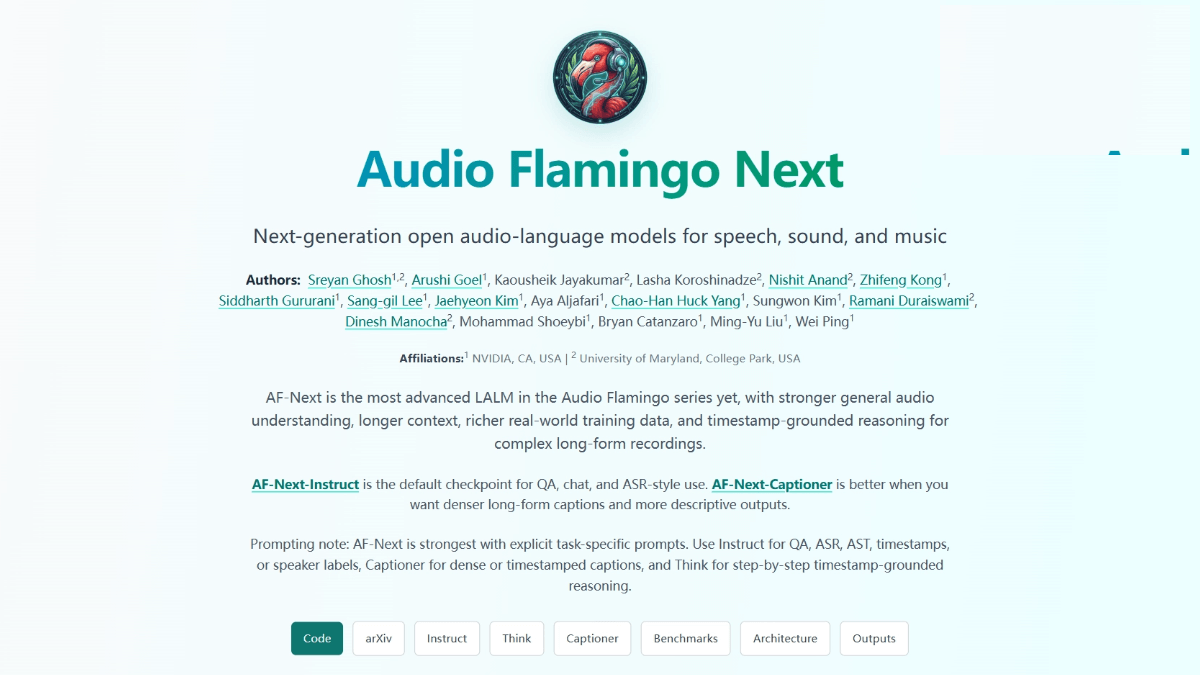
Audio Flamingo Next is an open source audio language model jointly launched by NVIDIA and the University of Maryland. It emphasizes 30-minute long audio understanding, time-anchored reasoning, multi-speaker analysis and unified speech, music, and ambient sound modeling capabilities.
Audio Flamingo Next
Core parameters and statistics
The main delivery form of Audio Flamingo Next is closer to [Basic Large Model/API Infrastructure]. It is not a music app for direct consumption by ordinary users, but a unified audio understanding base for researchers, developers and audio AI teams.
| Projects | Public Information |
|---|---|
| Development Team | NVIDIA and University of Maryland |
| Model form | Audio Language Model |
| Core Competencies | Unified understanding of speech, music, and ambient sounds |
| Maximum input | Maximum 30 minutes of audio |
| Base scale | Based on Qwen-2.5-7B |
| Training data | Over 1 million hours of audio |
| License | Mainly for research purposes, subject to project description |
| Key Technologies | Temporal Audio Chain-of-Thought, RoTE |
A brief comment: It is not a "chat model that listens to audio", but a research-grade base that combines long audio evidence location, cross-modal audio understanding and temporal reasoning into the same model.
Publicity verification: The project emphasizes that it can surpass open source models of the same scale in more than 20 audio understanding benchmarks, and compete with closed source solutions in long audio tasks. This selling point is credible based on the public benchmark description, but the actual implementation effect still strongly depends on the specific task definition, audio cleanliness and inference resources.
User and market recognition
Audio Flamingo Next's recognition method is different from that of consumer products. It looks at papers, project citations, open source weight reproducibility and benchmark results, rather than app downloads.
Expert view: The real value of this type of model is to break down the tasks that used to be divided into multiple pipelines such as ASR, music tag classification, soundscape recognition, and long audio retrieval, and converge them into a unified reasoning interface. For research teams and vertical scenario platforms, this is a change in the way R&D is organized, not just a stronger model.
Hidden benefits: If a team originally maintained multiple sets of audio models, the most direct benefit after unifying the models is not the accuracy score, but the simplification of the evaluation system, service interface and data annotation process.
Current Limitations: The official commercial customer scale is not disclosed, and there is no standardized SaaS delivery caliber, so it is more suitable as a technical base rather than a ready-to-use product.
Cost advantage
Free Truth: Model weights, code, and project information are public, but this does not equal zero cost. A research use permit itself means that commercial use boundaries need to be independently verified.
C-side/Individual: Ordinary users have almost no direct consumption path. This is not a web product for the public.
Developer/API: Open source is the biggest obvious advantage, and the team can reproduce it in Hugging Face or a local environment; however, the costs of GPU memory, long context reasoning, audio preprocessing and batch evaluation are not low.
Enterprise/Private: If the enterprise already has a GPU cluster, the marginal cost of adopting it may be lower than the long-term purchase of a closed-source API; if there is no infrastructure, computing power and operation and maintenance will quickly offset the superficial advantages of "open source and free".
Hidden Cost: The most common pitfall of long audio inference is not that the model is inaccurate, but that the pre-processing link is too heavy. Segmented slicing, unified sampling rate, speaker separation, noise cleaning and return evidence location will all affect the overall cost.
Main functions
- Long-term Audio Understanding: Supports up to 30 minutes of input, suitable for podcasts, meetings, interviews, and long video audio track analysis.
- Time-anchored reasoning: Explicitly tie the intermediate reasoning to the timestamp to solve the problem of "I have the answer, but I don't know what minute the evidence is."
- Unified Audio Modeling: Speech, music, and ambient sounds are processed in one set of models to reduce task switching.
- Multi-speaker tracking: suitable for analysis of meeting minutes, podcast editing, and customer service recordings.
- Multi-variant adaptation: Instruct, Think, and Captioner correspond to tasks of different complexity.
Expert View: Hidden linkage is in the combination of "long audio + time anchoring + multiple speakers". Each capability is not surprising when viewed individually, but the three together are sufficient to support auditable meeting analysis, long audio Q&A, and film and television audio annotation.
Model and version evolution
The public version of Audio Flamingo Next is not complicated. The focus is not on the continuous commercial version, but on the differentiation of capabilities around the unified audio understanding task.
Mainline release
- Audio Flamingo Next: The main version released in April 2026, for long audio and unified audio understanding.
Mission Variations
- Think: More suitable for complex reasoning and evidence integration.
- Instruct/Captioner: Favor general Q&A and detailed audio description respectively.
Publicity verification: This type of "more variants than versions" structure shows that it is more like a research and engineering base than a continuous release rhythm of consumer products.
Technical advantages
As [basic large model/API infrastructure], its key evaluation points should fall on the boundaries of performance, throughput, and adaptation.
Performance and Throughput: Public data emphasizes 30-minute long audio 128K token-level context and leading multiple benchmarks, but does not uniformly disclose TTFT, RPM, TPM and online service-level SLA. Therefore, any real-time business access must be stress tested by itself, and the paper results cannot be directly equated with production throughput.
Adaptation Boundary: It is best at long audio evidence location, cross-speech and ambient sound understanding, and multi-speaker analysis; it is least good at zero-sample plug-and-play commercial deployment, because compliance, licensing and inference resources still need to be built in-house.
API Example: The official main path favors Hugging Face weights and local deployment, rather than unified hosting of the API. To access, it is recommended to refer to the official warehouse README and Hugging Face examples.
from transformers import AutoProcessor, AutoModelForCausalLM

model_name = "nvidia/audio-flamingo-next-hf"
processor = AutoProcessor.from_pretrained(model_name)
model = AutoModelForCausalLM.from_pretrained(model_name)

# The specific audio loading and inference parameters are subject to the official warehouse examples.
How to use
| Usage | Suitable for the crowd | Description |
|---|---|---|
| Hugging Face weights | Researchers, developers | Directly pull model weights for inference |
| GitHub repository | Engineering team | Reproduce the project and connect to local services |
| Colab / Gradio | Experience user | Quick test run, not suitable for production |
Steps to use: Determine the task goal first, and then select a variant; for long audio such as podcasts and conferences, plan a slicing and evidence review strategy first, instead of directly sending the 30 minutes of original audio in one go.
Dissuade scenario: If the team just wants to do basic transcription or simple summary, this model is often too heavy. Traditional ASR plus post-processing may be more stable and cheaper.
Product Pricing
Audio Flamingo Next does not have a standard subscription price for the public, and public information is mainly obtained from open source.
- Individual: Can be experienced through public projects, and the explicit subscription cost is zero.
- Developers: The main costs are GPU, storage, and tuning labor.
- Enterprise: Licensing and commercialization boundaries need to be confirmed separately, especially the restrictions on research use licenses.
The truth about free: No invoicing, no hosting, no guarantee of SLA, "free", only truly free for teams with engineering capabilities.
Application scenarios
- Conference and Podcast Analysis: automatic summarization, time-anchored Q&A, multi-speaker tracking.
- Long video audio annotation: Add structured tags for film, television, education, and media materials.
- Music Education and Content Understanding: Identify musical instruments, analyze fragment structure, and assist teaching retrieval.
- Customer Service and Quality Inspection: Location and attribution of key events in long call recording.
Dimensionality reduction strike scenario: The advantages of this type of model are most obvious when the task must answer "at which seconds did the evidence appear, who said it, and what happened in the background."
Applicable people
- Audio AI Research Team: It is most suitable to use it as a unified audio understanding base.
- Media Analysis Platform: suitable for building long audio retrieval, content moderation and multi-speaker analysis capabilities.
- Enterprise R&D Team: If GPU and MLOps already exist, privatization potential is greater.
Dissuaded/Not Applicable: It is not recommended for individual content creators, teams that only need light transcription, and organizations without computing power and model maintenance experience to directly start using this type of base model.
Summary and Outlook
The value of Audio Flamingo Next lies not in "replacing an app", but in unifying long audio, multi-modal audio and temporal reasoning into a capability layer that is more like a platform base. It is suitable for R&D teams and vertical industries that require privatized audio understanding capabilities.
Current limitations: The license is for research purposes, the production throughput is not uniformly disclosed, and the real deployment cost is not low. These three points determine that it is more like a strong base than a low-barrier finished product.
Procurement/Adoption Risk Assessment: If the team is ready to adopt, the first step is not to purchase, but to do a PoC first to verify three things: whether the performance is stable after long audio slicing, whether the time-anchored results are interpretable enough, and whether the throughput under the conditions of its own GPU can support the business. Only when all three are passed will it be worthwhile to continue investing in platform development.
Related tools:  ElevenLabs, udio
Version Info
- Audio Flamingo Next :The latest major version shown in papers and project materials supports audio input for up to 30 minutes and introduces Temporal Audio Chain-of-Thought.
- Audio Flamingo Next Think :A variant for complex reasoning tasks that emphasizes time-anchored evidence aggregation and stronger audio question-and-answer capabilities.
User Reviews