 AutoGPT
Free
AutoGPT
Free
AutoGPT is a platform product for AI agents. The official website emphasizes that AI agents can be built, deployed and run without writing code for digital workflow automation such as research, outreach, content, support and operations.
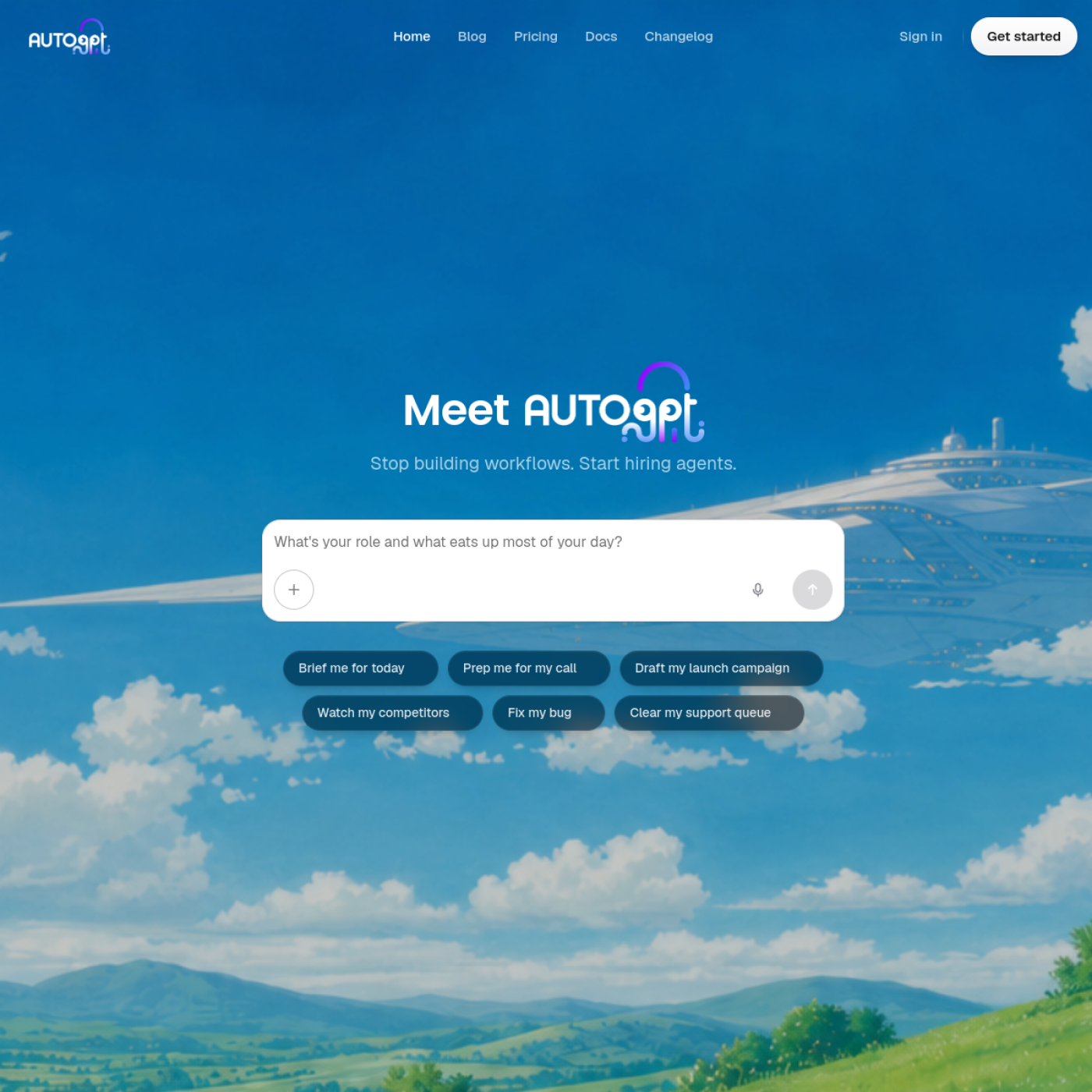
AutoGPT
Core parameters and statistics
AutoGPT is a platform-based AI Agent product. The official website advocates "Stop building workflows. Start hiring agents." It emphasizes building, deploying and running AI agents without writing code for digital workflow automation such as research, outreach, content, support and operations.
| Projects | Public Information |
|---|---|
| Official positioning | Stop building workflows. Start hiring agents. |
| Usage | Build, deploy, and run AI agents without writing code |
| Open source license | GitHub public repository (Significant-Gravitas/AutoGPT) |
| Community size | About 184,808 stars, 46,188 forks |
| Latest version | Platform Beta v0.6.62 (2026-05-28) |
| Scope of application | research, outreach, content, support, operations |
| Support Platform | Web, API |
Product positioning: AutoGPT treats Agent as an execution unit that can be "hired". The focus is not on single-node automation, but on letting Agent handle an entire business link.
Community Impact: GitHub has approximately 184,808 stars and 46,188 forks. It is one of the most widely spread Agent projects in the open source ecosystem, but community popularity does not equal production availability.
Release status: The current main line is clearly marked with Platform Beta, which is suitable for rapid piloting, but production procurement needs to include Beta risks into acceptance conditions.
User and market recognition
From a community perspective, AutoGPT is still one of the most well-known Agent projects, but its commercial revenue and enterprise customer list have not been officially disclosed.
Community scale: GitHub API shows approximately 184,808 stars and 46,188 forks at the current point in time, which is enough to illustrate its spread and discussion in the open source ecosystem.
Recognition Boundary: High star cannot be equated to production availability. Whether the platform Beta main line matches its own launch rhythm and whether the team accepts the uncertainty of Agent in multi-step tasks are more critical judgments.
Measurement method: The evaluation should be based on business task completion rate and manual review ratio, rather than using star number instead of usability conclusion.
Cost advantage
AutoGPT's cost advantage mainly comes from the influence of the open source community and platform-based delivery ideas, rather than static pricing on public pages.
Platformization Consolidation: The official website emphasizes that agents can be built, deployed, and run without writing code, which means that it can consolidate the originally scattered costs of scripts, manpower, and orchestration tools into one platform.
Mainline open source: The core warehouse is open source and available. You can first use the community version to verify the suitability of the task link and Agent.
True cost structure: The total cost of a platform-based Agent is usually composed of three parts - model calling costs, running costs, and manual cover costs for failed tasks. The latter two are often more critical than licenses. It is recommended to pay attention to the total cost of a single task, the proportion of manual review and the failure recovery time.
Main functions
The core of AutoGPT's public capabilities is the construction, deployment and operation of Agents, emphasizing a common platform across task types rather than vertical assistants:
- Agent Build: Define tasks and execution logic in a codeless way.
- Agent deployment and operation: Put the Agent into actual business processes for continuous execution.
- Multi-scenario coverage: Officially lists typical directions such as research, outreach, content, support, operations, etc.
- Task Orchestration: Split complex tasks into repeatable units.
The key to functional evaluation is: whether the task can be broken down into repeatable execution units, whether sufficient execution observability is provided, and whether the business team can maintain task logic without over-reliance on R&D.
Model and version evolution
Continuous iterative updates, the latest version introduces performance optimization and new features. Historical version information can be viewed on the official release page. There is no complete public version evolution timeline yet. It is recommended to pay attention to the official announcement to understand the rhythm of feature updates.
Technical advantages
The technical advantage of AutoGPT lies in platform expression, which can be broken down into two points:
Completely closed: Compared with projects that only provide a single Agent demonstration, it emphasizes the three complete steps of "build, deploy, and run", and the product idea is closer to the Agent platform rather than the model demo.
Unified Governance: The team can manage Agents of different task types in a unified way, and integrate research, content, support and other processes into the same set of platform governance.
Its limitations are also clear: the more complete the platform, the higher the requirements for governance, monitoring and execution stability, so it is not suitable for teams that only want to do one-time script experiments.
How to use
AutoGPT takes the open source platform as its main entrance, and its implementation path is as follows:
| How to use | Suitable for the crowd | Features | Cost |
|---|---|---|---|
| Open source community version | Platform and R&D team | Self-deploy and verify Agent fitness | Free, including model and running costs |
| Platform Beta | Teams who want to verify platform capabilities | Weekly iterations, functions continue to evolve | Accounting models and contextual costs |
| Enterprise solutions | Scaling and hosting requirements | Hosting methods and support scope are not disclosed | Business confirmation is required |
The key to implementation is not to expand the scale first, but to define the success criteria first. The most common failure of platforms such as AutoGPT is not that the technology cannot be connected, but that the task objectives are too vague, causing the Agent output to fail to be accepted; therefore, the acceptance criteria should be passed on a business link first.
Product Pricing
The pricing model is subject to the official real-time page. Usually a freemium or subscription system is used, and basic functions can be used for free. Advanced functions or high-frequency use require paid subscriptions, and users are advised to evaluate the optimal solution based on actual usage.
Application scenarios
AutoGPT scenarios focus on digital processes that can be broken down into stable steps:
- Research and Information Integration: Continuous research tasks for the market, products or operations.
- External contact and content production: Outreach and content draft generation.
- Internal Operations and Support: work order classification, task distribution, and operational action orchestration.
What these scenarios have in common is that they can be broken down into relatively stable execution steps; if the task relies heavily on offline judgment or strong artificial context, it will be difficult for the platform to take advantage of it.
Applicable people
AutoGPT is suitable for three types of roles:
- Product and Platform Team: Hope to build an Agent platform rather than a single robot function.
- Operations Team: Has a large number of digital tasks that can be standardized.
- Technical Team: Willing to accept the open source ecosystem and Beta version rhythm.
It is not suitable for situations where the business only needs a lightweight chat assistant, the organization does not have clear task acceptance criteria, or the production environment cannot accept the frequency of changes to the Beta mainline. In these scenarios, the stronger the platform capabilities, the greater the landing resistance.
Summary and Outlook
The core value of AutoGPT is to advance Agent from concept demonstration to the product path of "platform construction, deployment and operation", which is more attractive to teams with existing digital task foundations. Its advantages come from platform integrity and community influence, rather than a single low price; its nearly 180,000 stars also reflects its long-term ecological precipitation.
If you want to implement it, it is recommended to fix a Beta evaluation version first, define clear acceptance criteria on a link such as content generation or work order diversion, and run through it, and then decide whether to expand; before entering deeper procurement, you still need to confirm the hosting mode, whether the model call is collected on behalf of the company, the scope of enterprise support, and the stability boundary of the Beta version in the production environment.
Related tools:  CrewAI,
  LangChain
Version evolution of AutoGPT
The current verifiable public version of AutoGPT is mainly concentrated in Platform Beta, with a weekly iteration rhythm.
Platform Beta Mainline
- v0.6.62 (2026-05-28): The latest public beta platform version.
- v0.6.61 (2026-05-20): Indicates that the platform continues to iterate at a weekly pace.
- v0.6.60 (2026-05-13): The previous month's baseline, suitable for regression control.
Since the main line is clearly labeled as Beta, production-bound acceptance should be more stringent than that of mature SaaS: a more prudent approach is to fix an internal evaluation version, run a complete task sample first, and then decide whether to follow weekly updates.
Version Info
- AutoGPT Platform Beta v0.6.62 :The latest platform beta version released by GitHub Releases continues the main line of platform-based AI Agent construction and operation.
- AutoGPT Platform Beta v0.6.61 :The previous release in the latest beta sequence to observe the continuous delivery cadence of platform-level capabilities.
- AutoGPT Platform Beta v0.6.60 :Earlier versions of the same Beta main line are suitable for looking back at the speed of the last three platform iterations.
User Reviews