 Avatar AI
Free
Avatar AI
Free
Avatar AI is an AI avatar generation tool that allows users to generate personalized avatars and avatars in various styles after uploading photos. It supports various styles such as realistic, cartoon, and art, and is suitable for social media and brand image scenarios.
AvatarAI
Core parameters and statistics of Avatar AI
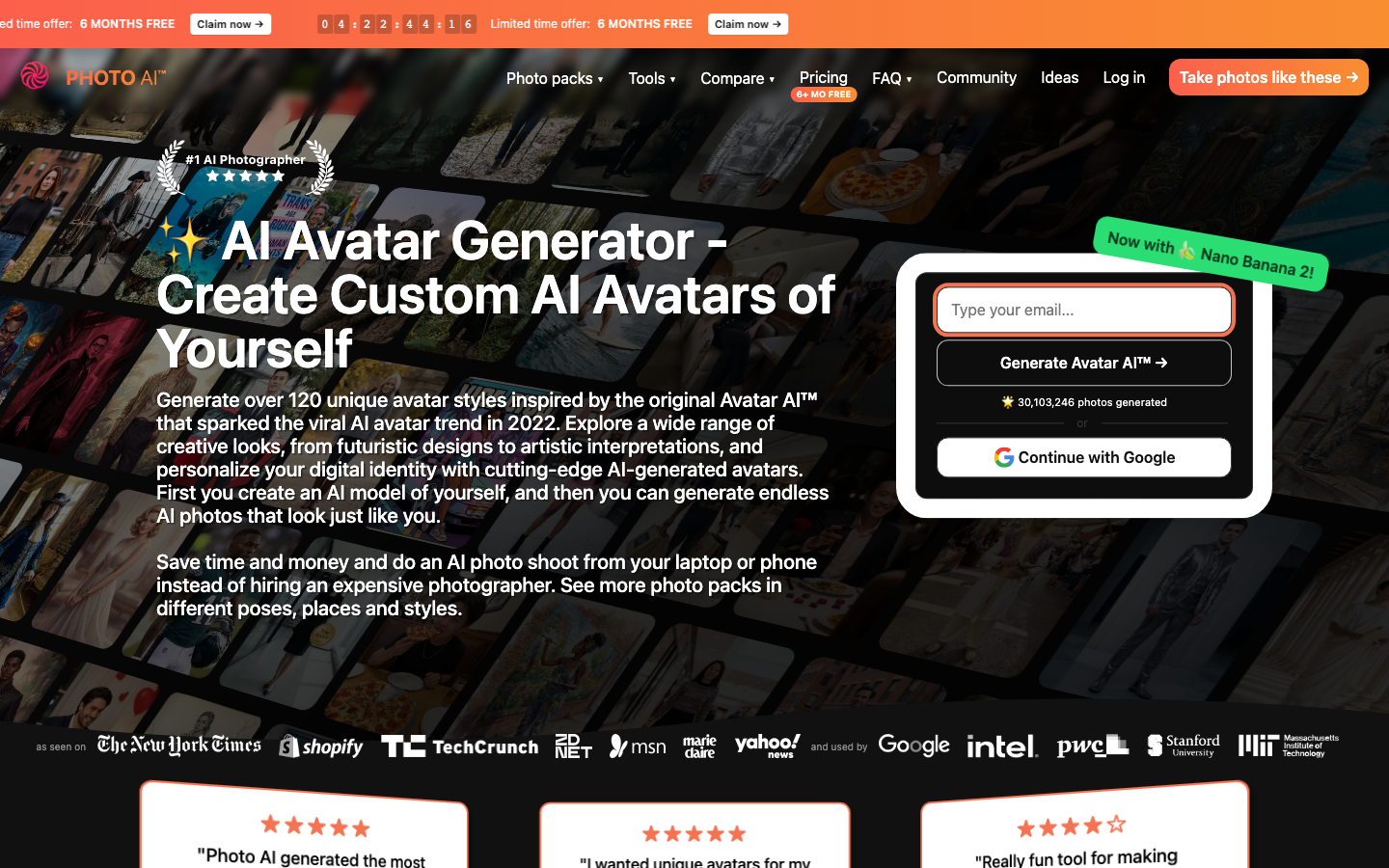
Avatar AI is a groundbreaking product that started the AI avatar generation craze in 2022. It was created by independent developer Pieter Levels (@levelsio). It was initially launched as avatarai.me and later evolved into a complete AI photography platform Photo AI (photoai.com). It is not a general AI image tool, but an end-to-end avatar production line from "uploading selfies → training AI models → unlimited generation". The product positioning has expanded from a single "avatar generation" to a comprehensive AI photography platform covering realistic portraits, AI video 3D models and virtual try-ons.
| Projects | Public Information |
|---|---|
| Product positioning | AI avatar generation / AI photography platform |
| Core Competencies | AI model training + photo/video generation + 3D model + virtual try-on |
| Underlying technology | DreamBooth + Flux → Self-developed Hyper Realism, now supports Google Nano Banana Pro |
| Number of styles | 120+ preset avatar styles + custom prompt generation |
| Platform | Web |
| Target users | Individual users, social media creators, e-commerce sellers, brand operations |
| Developer/Company | Photo AI (Pieter Levels, independent developer) |
| Community scale | The official website shows that more than 30.25 million photos have been generated |
| Media Mentions | New York Times, TechCrunch, ZDNet, MSN, Marie Claire, Yahoo News |
| Enterprise customers | Google, Intel, PwC, Stanford, MIT, etc. |
| Latest version | Photo AI platform continues to iterate, Avatar AI exists as a built-in photo pack |
Brief review in one sentence: Avatar AI is not an independent "avatar filter", but a complete AI personal photo production line - first train a dedicated AI model, and then infinitely generate photos of you in any scene and in any clothing, solving the two core pain points of "cannot afford a professional photographer" and "not able to pose".
Platform Evolution: As a historical starting point, Avatar AI’s core capabilities have been integrated into the Photo AI platform. Avatar AI-style preset packages are currently available to users via photoai.com, while enjoying expanded features such as video-generated 3D modeling and virtual try-on. This means that early Avatar AI users are not being deprecated, but are instead getting more complete product capabilities.
Users and market recognition of Avatar AI
The market’s recognition of Avatar AI does not come from the scale of financing or revenue figures (not officially disclosed), but from two signals: media coverage density and industry influence of the product model.
Pioneering Status: Avatar AI is one of the first products in 2022 to bring DreamBooth stylized portrait generation to the mass market. Its emergence directly promoted the explosion of the "AI avatar" category, and many mainstream media (New York Times, TechCrunch, ZDNet, Marie Claire, Yahoo News) listed it as a representative case when reporting on the AI avatar trend.
Enterprise-level trust: The official website shows use cases from Google, Intel, PwC, Stanford, MIT and other institutions. Although the specific usage depth and payment scale of these "enterprise customers" have not been disclosed, the fact that they can appear on the brand pages of well-known institutions at least shows that the products have passed basic security and compliance audits.
Independent Developer Mode Verification: Avatar AI / Photo AI is operated by independent developer Pieter Levels alone, with no external financing. The product page declares it to be a "100% independent business, not dependent on venture capital." This means that product iteration is not driven by growth indicators, but it also means that investment in large-scale customer service SLA guarantees and high-concurrency architecture depends entirely on single-point benefits.
Industry Impact: Avatar AI's model (upload selfie → train model → stylized output) has been imitated by a large number of subsequent AI avatar tools (such as Remini, Aragon, Headshot Pro, etc.), but its product logic of "training personal models first and then generating infinitely" is still a differentiated path among similar products.
Cost Advantages of Avatar AI
The cost structure of Avatar AI/Photo AI is not a binary division of "free vs. paid", but a combination model of subscription grading + point consumption, allowing users with different frequency of use and quality requirements to find their own cost-effective balance point.
C client/individual user: There is no permanent free plan, but the annual payment pricing significantly lowers the average monthly cost. The annual payment plan saves approximately 6 months compared to the monthly payment. The lowest-end Starter plan has an annual payment discount of about 9 yuan/month ($9/year), including 50 points per month and 48 free photos per model. For individual users who only need to generate a set of LinkedIn avatars, the Starter plan is enough to cover a single need.
Pro plan ($29/year): 1,000 points per month, can create 3 AI models, supports commercial use authorization. Suitable for self-media creators who need to continuously produce social media content. The new points can be used for custom prompt writing, photo remix and other functions.
Max plan ($49/year): 3,000 points per month, 10 models, supports advanced functions such as video generation, Zoom Out, image expansion, Relight, relighting, and trying on clothes. For e-commerce sellers and content studios, this is the highest functional level.
Ultra plan ($99/year): 10,000 points per month, 50 models, supports ultra-high quality photos, priority processing, and model export. Suitable for commercial users who need mass production.
| Plan | Annual price | Monthly price (calculated) | Monthly points | Number of models | Commercial license | Video/3D/Try-on | Photo quality |
|---|---|---|---|---|---|---|---|
| Starter | $9 | $2 | 50 | 1/month | ❌ | ❌ | Low |
| Pro | $29 | $5 | 1,000 | 3/month | ✅ | ❌ | Medium |
| Max | $49 | $9 | 3,000 | 10/month | ✅ | ✅ | High |
| Ultra | $99 | $16 | 10,000 | 50/month | ✅ | ✅ | Ultra |
Point consumption reference (Max/Ultra plan): Normal photo generation consumes 1 point, HD mode (Nano Banana Pro) consumes 5 points, video generation consumes 30 points, speaking video is charged by character (3 points/100 characters), 3D model generation consumes 20 points, and Upscale consumes 5 points. For high-frequency users, whether the points are enough depends on the selection of the generation mode - if you mainly use the Nano Banana Pro HD mode, the consumption speed is 5 times that of the normal mode.
API/Developer: No public API access is provided. The product is a pure web-side tool and does not support batch external calls. This is a hard limitation for teams that need to incorporate avatar generation into automated workflows.
Enterprise/Private: Undisclosed enterprise and private deployment options. As an independent developer product, enterprise-level data-resident SSO integration and SLA guarantee are subject to confirmation by contacting the official website.
Quantification of cost reduction and efficiency increase (deduction): Taking e-commerce sellers as an example, the cost for a traditional photographer to shoot a set of product scene portraits is about $200-$2,000 (including models, locations, and post-production). The annual fee for using the Photo AI Max plan is only $49. With the virtual try-on function, more than 50 sets of model pictures in different scenes can be produced in one season. In terms of time, traditional photography takes about 3-7 days from appointment to delivery. Photo AI’s generation cycle is 15-30 seconds per picture, and it takes about 5-10 minutes to generate 100 pictures in batches. From $500/time + 3 days to $49/year + 10 minutes, this is the magnitude of cost reduction achieved by Avatar AI in specific scenarios.
Main features of Avatar AI
The functional system of Avatar AI/Photo AI revolves around the core logic of "once training, unlimited generation", but its capabilities have far exceeded the original "avatar generation" category:
-
AI model training: Upload 5-15 diversified selfies (different angles, lighting, expressions), and train an exclusive AI model in about 1 minute. Premium/Ultra training takes approximately 90 seconds and is of higher quality. Hidden linkage: A model trained once can be reused for all subsequent functions - photo generation, video, and trying on 3D models. There is no need to upload photos repeatedly. This means that model training is a one-time investment, and all subsequent outputs are completed on this basis.
-
120+ preset avatar styles (Photo Packs): Covering LinkedIn professional photos, Tinder/Hinge dating photos, Luxury Lifestyle, Old Money, Cosplay, Film Noir, Santorini Summer and other scene-based style packs. Expert opinion: The real value of Photo Packs is not "various styles", but "scenario-based lighting/composition/outfit presets" - non-professional users do not need to understand photography lighting and composition, they only need to choose a theme pack to obtain output under professional lighting conditions.
-
Custom Prompt Generation: Supports free description of scenes, such as "model standing on a rooftop at sunset, wearing a black suit, cinematic lighting". Unlike Midjourney, the model here is your personal image rather than a randomly generated face.
-
AI Video Generation (Max/Ultra): Convert still photos into 5-10 second dynamic videos, supporting the description of moving scenes (such as "camera slowly zooms out while wind blows from outside"). The bottom layer calls Kling, Minimax, Pixverse, Google Veo and other video models, and the system automatically selects the best available model.
-
Virtual Try-On: Upload a picture of the clothing, and AI will put the clothing on your model. Supports batch processing, especially useful for e-commerce Shopify sellers. Hidden linkage: The combination of try-on + video generation can produce display videos of models wearing specific clothing, completing the entire link from product selection to material production.
-
Relight: Change the background and lighting of your photo without changing the subject itself - switch from an interior studio to a Bali beach or a Parisian café. Applicable Boundary: Relight may slightly affect facial similarity, which can be restored through the Remix function.
-
Magic Edit: Use text commands to modify elements in your photo, such as "Change red wine to lemon sparkling water" or "Change background to sunset beach." It does not rely on AI models, and the character similarity can be restored through Remix after modification.
-
Zoom Out: AI expands the boundaries of the photo to generate scene content beyond the original cropping range. Can be operated repeatedly, from close-up to panorama.
-
3D Model Generation: Convert photos into rotatable 3D models (.GLB format), supporting AR viewing. The current quality is limited, and the official self-assessment is "people quality not great yet".
-
AI Influencer (Virtual Internet Celebrity): Design a completely non-existent virtual character from scratch (set gender, age, hair color, etc.), and then generate photos, videos and talking videos for it. The official provides real virtual influencers such as Lil Miquela (annual income $10M), Noonoouri, Aitana Lopez, etc. as case references.
Avatar AI model and version evolution
The product evolution of Avatar AI is not a software product taking the "multi-version" route, but a main line of functions from a single function to platform capabilities. The following are verifiable milestones:
Creation period: Avatar AI independent product (2022)
- 2022 (exact month undisclosed): Avatar AI goes live on avatarai.me, offering dozens of AI stylized avatar generation. By uploading 1-3 photos, you can generate different styles of avatars, which quickly became popular on Instagram and Twitter and became the tipping point of the "AI avatar" category. The product capabilities at this stage are relatively simple, only supporting stylized avatars and not custom scenes and videos.
Evolutionary period: Photo AI platform (2023-2024)
-
~2023: Product migrated from avatarai.me to photoai.com and renamed Photo AI. Introducing an AI model training mechanism - upgrading from "uploading photos to generate directly" to "training a personal model first, and then continuously generating based on the model". This marks the transformation of product logic from "disposable filter" to "personal photo engine".
-
~2024: Introduce Hyper Realism self-developed pipeline, use DreamBooth + Flux to replace the early Stable Diffusion basic model, significantly improving photo realism and face consistency. At the same time, functions such as video generation and virtual try-on began to be added.
Maturity period: multi-model + multi-modality (2025-2026)
-
2025: Released functions such as Relight, Magic Edit, Zoom Out, and 3D model generation. Introducing batch generation (Batch Img2Img) to support processing multiple photos at one time.
-
2026: Integration of Google Nano Banana Pro models as an HD generation option. The platform has generated more than 30.25 million photos. Avatar AI remains in Photo AI as a "photo pack", so new users can still experience the original stylized avatar.
**Product status: current avatarai.me domain name has been redirected to photoai.com/ai-avatars. Avatar AI is no longer operating as an independent product, but its core functions and style library have been fully integrated into the Photo AI platform. Users can still obtain the same output effects as back then by selecting the "Avatar AI" style package.
Avatar AI’s technical advantages
The technical route of Avatar AI/Photo AI is not to "one model conquers the world", but to build a multi-model pipeline from training to generation to post-processing:
DreamBooth Fine-tuning + Flux/Hyper Realism: The core process of the product is based on the DreamBooth technology proposed by Google researchers - using 5-20 personal photos to fine-tune the pre-trained image generation model and implanting the person's identity into the model parameters. Photo AI trained its Hyper Realism pipeline on Flux, the next generation derivative of Stable Diffusion. Mechanism→Effect: The fine-tuning process allows the model to learn "what does this person's face look like" instead of temporarily adding conditions during generation. This means that every time a photo is generated, the model is reasoning "based on an internal understanding of the person's identity," rather than a map-based face replacement. This is also the fundamental reason why the same model can maintain identity consistency in different styles and scenarios.
Self-developed RLHF pipeline: Officially disclosed the use of reinforcement learning to continuously improve the generation pipeline from human feedback (RLHF). Specifically, the user's implicit feedback on the generated results (save, download, regenerate) is used to fine-tune model priorities. Engineering cost: The maintenance of the RLHF pipeline requires continuous annotation and model updating. For independent projects operated by a single person, the iteration depth is limited by computing power and time budget.
Multi-model automatic routing: The system automatically selects the optimal generation model based on the mode selected by the user (Hyper Realism vs Nano Banana Pro) and the content security review results. Automatically fallback to Hyper Realism when Nano Banana Pro rejects a build due to content moderation. Meaning for users: There is no need to understand the differences in the underlying models. The system makes downgrade decisions in the background, lowering the selection threshold.
Economic logic of point consumption: The platform's point system is not only a billing method, but also an implicit resource scheduling strategy. The low-price plan (Starter/Pro) has low training rounds and fewer inference steps, which means that "low-price plan users have lower model quality, but the system can serve more users." The "Ultra High Photo Quality/Ultra High Similarity" of the Ultra scheme essentially allocates more computational steps to each inference.
Human-machine collaboration boundary (Rule D mandatory): The automatable sections of Avatar AI include - photo upload, model training, stylized generation, batch processing, and video generation. These sections can be 100% automated and users only need to provide an initial photo and select a style. Something that requires manual intervention:
- Photo Filtering: The quality of uploaded photos (clarity, light, diversity) directly determines the quality of the model, which is something that current AI cannot automatically judge - users need to choose "good photos" rather than "many photos".
- Scenario description optimization: The quality of custom prompts directly affects the generation effect, similar to the principle of "good prompt = good output", which requires users to iterate descriptions.
- Commercial use compliance judgment: For content involving model copyright, brand authorization, and face and portrait rights, the platform cannot automatically determine the compliance boundary, and the responsibility lies with the user.
- Refund Review: The platform has set strict manual refund conditions (no model created, less than 20 photos generated, no recommended links used), which require manual confirmation.
Technical differences with competing products: Compared with Midjourney, the core difference between Avatar AI/Photo AI is not image quality (MJ is still ahead in art style), but "maintaining the consistency of character identity". MJ generates "people who fit the description", while Photo AI generates "specific people". Compared with Remini, which enhances existing photos, Photo AI creates new photos that don’t exist. Compared with Headshot Pro, which only takes professional photos and does not support custom scenes, Photo AI’s scene freedom is several orders of magnitude higher.
Avatar AI usage path
The use of Avatar AI/Photo AI is divided into four stages, from one-time model training to unlimited content output:
| Stage | Operation | Time consuming | Description |
|---|---|---|---|
| 1. Registration | Visit photoai.com and register using Google or email | 1 minute | Supports annual/monthly subscription |
| 2. Create an AI model | Upload 5-15 diverse selfies, and the system will train a dedicated model | ~1-5 minutes | High-end solutions train faster and with higher quality |
| 3. Generate content | Choose Photo Pack, write custom prompt, or use Try-On/Video, etc. | 15-30 seconds/picture | Supports parallel generation (up to 16 pictures at the same time) |
| 4. Post-processing | Upscale Magic Edit to modify details Download | Instant | Support 2x/4x super resolution |
Key Success Factors for the Training Phase: Photo variety (angles, lighting, clothing, expressions) is more important than number of photos. Officials recommend 5-15 photos, but emphasize "avoid sunglasses, hats, group photos and filters" because these will interfere with facial feature extraction. A common misunderstanding is uploading a lot of selfies from the same angle - this can cause the model to perform poorly at certain viewing angles.
Word writing tips: Use "model" to refer to your AI model (e.g. "model on a rooftop at sunset wearing a black jacket"). The more specific the prompt word, the more controllable the outcome. Official recommendations include four dimensions: scene, clothing, light, and angle.
Points Management: Each generated action consumes a certain amount of points. Ordinary photos are worth 1 point/piece, Nano Banana Pro high-definition photos are worth 5 points/piece, and videos are worth 30 points/time. Points for annual paying users are reset every month (not given all at once). After exceeding the points, you can purchase additional points packages, and unused points are valid within the subscription period.
Batch production operation: Supports batch generation of multiple prompts separated by |||. For example: "model in Paris cafe|||model on beach sunset|||model in office meeting". The system will execute each prompt in turn, and each prompt can be set to generate 1-32 photos. Max/Ultra plans support this feature.
Product Pricing for Avatar AI
Avatar AI/Photo AI adopts a two-tier billing model of subscription + points consumption. For all prices, the following is a verifiable public pricing structure:
| Plan | Annual Payment | Core Benefits | Commercial Authorization | Applicable Scenarios |
|---|---|---|---|---|
| Starter | $9/year | 50 points/month, 1 model/month, low quality, 1 picture/time | ❌ | One-time trial |
| Pro | $29/year | 1,000 points/month, 3 models/month, medium quality, 4 pictures concurrently | ✅ | Self-media/content creator |
| Max | $49/year | 3,000 points/month, 10 models/month, high quality, 8 pictures in parallel | ✅ | E-commerce/Content Studio |
| Ultra | $99/year | 10,000 points/month, 50 models/month, ultra-high, 16 pictures in parallel | ✅ | Volume production for commercial users |
The truth about the free quota: Although the Starter plan has the lowest payment, it essentially serves as a "quasi-free" experience entrance - with an annual payment of only $9, users can create their first model and get 48 free photos (8 profile photos + 8 professional photos + 8 date photos + 8 outfits + 8 social media content). These 48 photos are enough to verify the model quality and product experience. If you are sure, consider upgrading.
Hidden Costs:
- Generation quality is bound to the scheme: The photo quality (resolution, similarity, details) of the low scheme is significantly lower than that of the high scheme. This is not a simple "number limit" but "the difference in computing power distribution for each photo".
- Video and 3D functions are locked in the high plan: Video, try-on and 3D functions can only be used at the Max starting level, which means that if the core requirement is video generation, the low plan is almost unavailable.
- Strict refund restrictions: Refunds are only allowed for users who "have not created models and generated less than 20 photos", and referral link registrations are non-refundable. This means that once you have paid to train the model, you cannot get a refund even if you are not satisfied.
Avatar AI application scenarios
The implementation scenarios of Avatar AI/Photo AI focus on the cross-section of "personal digital image", covering multiple dimensions from social profiles to e-commerce product materials:
-
Social Media Avatar and Personal Brand: Generate LinkedIn professional photos, Tinder/Hinge dating photos, Instagram life photos, and YouTube thumbnails. Quantified benefits (deduction): The traditional method requires making an appointment with a photographer ($200-$500/time), waiting 3-7 days to pick up the photos, and usually only 10-20 finished photos can be obtained. With Photo AI, it takes about 30 minutes from registration to getting a finished photo, and costs less than $1. For job seekers or Internet celebrities who need to update information on multiple platforms at the same time, the time saving is reduced from "days" to "minutes".
-
E-commerce product pictures and virtual try-on: Shopify sellers use the "Try On Clothes" function to generate scene pictures of selected models wearing store products. Quantitative income (deduction): Traditional e-commerce costs about $50-$200 to shoot a SKU model picture (including model fee + venue + post-production), and 50 new styles in a quarter is $2,500-$10,000. With the Photo AI Max plan ($49/year), you can complete 50 clothing try-on shots in one afternoon. However, please note: the physical pictures generated by AI are not as accurate as real photos in terms of detail accuracy (labels, stitching, fabric texture). They are recommended for A+ page presentation and social media promotion, and are not suitable for product details pages that require accurate display of material details.
-
Personal branding and content creation: Freelancers, coaches, consultants and other practitioners who need a unified visual image use Photo AI to generate a series of life photos, work photos and speech photos with a consistent style for personal websites, press releases and speech materials.
-
Dating App Photo Upgrade: Photo AI specially provides Tinder, Hinge, and Bumble photo packages, and designed preset styles based on the user psychology of dating apps (travel background, positive emotions, diverse scenes). Engineering Tips: The aesthetics of dating photos are highly subjective. Although the photos generated by AI are of excellent photography quality, they may be recognized by the other party as "non-real photos" and reduce trust. It is recommended to mix and match real photos.
-
Virtual influencer and content IP: Create a completely virtual character through the AI Influencer function, generate photos, videos and speaking videos for it, and operate brand cooperation on social media. The commercialization path of this scenario has been verified in cases such as Lil Miquela (annual income $10M), but the acceptance of the domestic market remains to be seen.
Applicable groups of Avatar AI
The multi-layer solution of Avatar AI/Photo AI allows different groups of people to find suitable entrances, but the adaptation boundaries and preconditions for each group of people are obviously different:
-
Individual users and social media active users: Basic needs can be met through the Starter or Pro plan. Suitable for individuals who need to quickly update LinkedIn profile pictures Tinder photos Instagram content. Not suitable for borders: If you just want a "stylized filter selfie", Remini or Meitu Xiu Xiu is faster and cheaper. Photo AI's "train the model first and then generate" model is more process-oriented for users with one-time needs.
-
E-commerce sellers and independent website operations: Max plan is the core choice. The functional combination of virtual try-on + batch generation + video generation can replace most e-commerce shooting needs. Prerequisite: It is necessary to have stable product pictures (clothing tiles or real shots of models wearing them) as try-on input, and have a tolerance for detailed errors in the AI-generated results. Not suitable for boundaries: For brands that have strict restoration requirements for clothing materials, labels, and stitching details (such as luxury goods and high-end customization), Photo AI is currently unable to achieve real-life shooting accuracy.
-
Content creators and self-media KOLs: Both Pro and Max plans are available. The core value lies in "one person can complete the workload of a content studio" - a blogger can use Photo AI to produce three sets of content including Instagram life photos, YouTube thumbnails and TikTok short videos on the same day. Quantitative comparison (deduction): The traditional method requires separately making appointments with photographers → photo studios → video editors, 3 external roles + a 3-5 day cycle. Using Photo AI, it was all done by one person in 2 hours, but at the expense of "the creative and aesthetic contribution of a truly professional photographer" - AI is good at executing known styles and not good at creating new visual languages.
-
Designers and Creative Workers: Photo AI can be used as a proof-of-concept and client proposal tool - quickly generating visual references (such as "this model will look like in a Paris cafe"), shortening the communication feedback cycle with clients. Not Fitting Boundaries: Not a substitute for final execution of professional photography or 3D rendering - AI-generated images fall short of professional work in terms of resolution, copyright clarity, and modification flexibility.
-
Enterprise/Team (need to evaluate carefully): Undisclosed enterprise solution, no SSO, no private deployment, no API. For companies that need to uniformly manage employee avatars (HR scenario), Aragon or Headshot Pro may be more suitable. For data-sensitive industries, photos need to be uploaded to the cloud for processing, and the privacy policy is subject to the real-time information on the official website.
Summary and Outlook
The success of Avatar AI does not lie in its leading technical indicators, but in its packaging of an AI task that requires GPU, Python and DreamBooth scripts into a web product that ordinary people can get started in 5 minutes. From a single avatar generation in 2022 to a multi-modal AI photography platform in 2026, its product evolution path demonstrates the commercial feasibility of "independent developers + AI capability encapsulation".
Current core advantages: Pioneer brand premium ("The original that started the trend"), extreme annual payment threshold (starting at $9), functional completeness leading in the field of personal AI photography (combination of photos + videos + 3D + try-on), pricing flexibility brought by independent operations (no oppressive growth from investors).
Current major limitations: Scale bottleneck of single-person operation (customer service response SLA guarantee, concurrent architecture disaster tolerance depends on single point of revenue), no enterprise-level functions (SSO/API/privatized deployment), strict and opaque refund policy, core functions (video/3D/try-on) that can only be unlocked by high-level plans, which means that users with low-level plans cannot have access to complete product capabilities. AI-generated products cannot replace professional photography in terms of e-commerce product details and brand consistency.
Follow-up observation points: Whether the product introduces long-form video capabilities and more refined motion control of AI videos; whether it opens APIs to access external workflows (e-commerce platforms, social management tools, etc.); the iteration rhythm and image quality differences between the Hyper Realism pipeline and Nano Banana Pro; long-term product stability and data security strategies in independent developer mode.
Acquisition and Adoption Risk Assessment: For individual users, the annual Starter payment of $9 imposes virtually no decision-making burden—the 48 free photos are worth the price. For e-commerce sellers, the functional completeness and cost-effectiveness of the Max plan ($49/year) are significantly higher than the traditional shooting method. However, it is recommended to use the Pro plan to run 1-2 SKUs to verify whether the generated quality meets the store requirements, and then upgrade to Max to start mass production after confirmation. For enterprises that require compliance and stability, under the current conditions of no API, no SSO, and no privatized deployment, it is not recommended to incorporate it into the core business process - its optimal positioning is "an auxiliary creative tool for the marketing team" rather than a formal material production pipeline. Monitor the official pricing page regularly for changes, as prices for independent products adjust more frequently and unpredictably than for larger companies.
Related tools:  Midjourney, stable-diffusion
Version Info
- current :Current version.
- launch :Product goes online.
User Reviews