 Awesome Prompts
Free
Awesome Prompts
Free
Awesome Prompts collects selected AI prompt words, covering models such as ChatGPT, Midjourney, and DALL·E, to help users quickly obtain high-quality prompts.
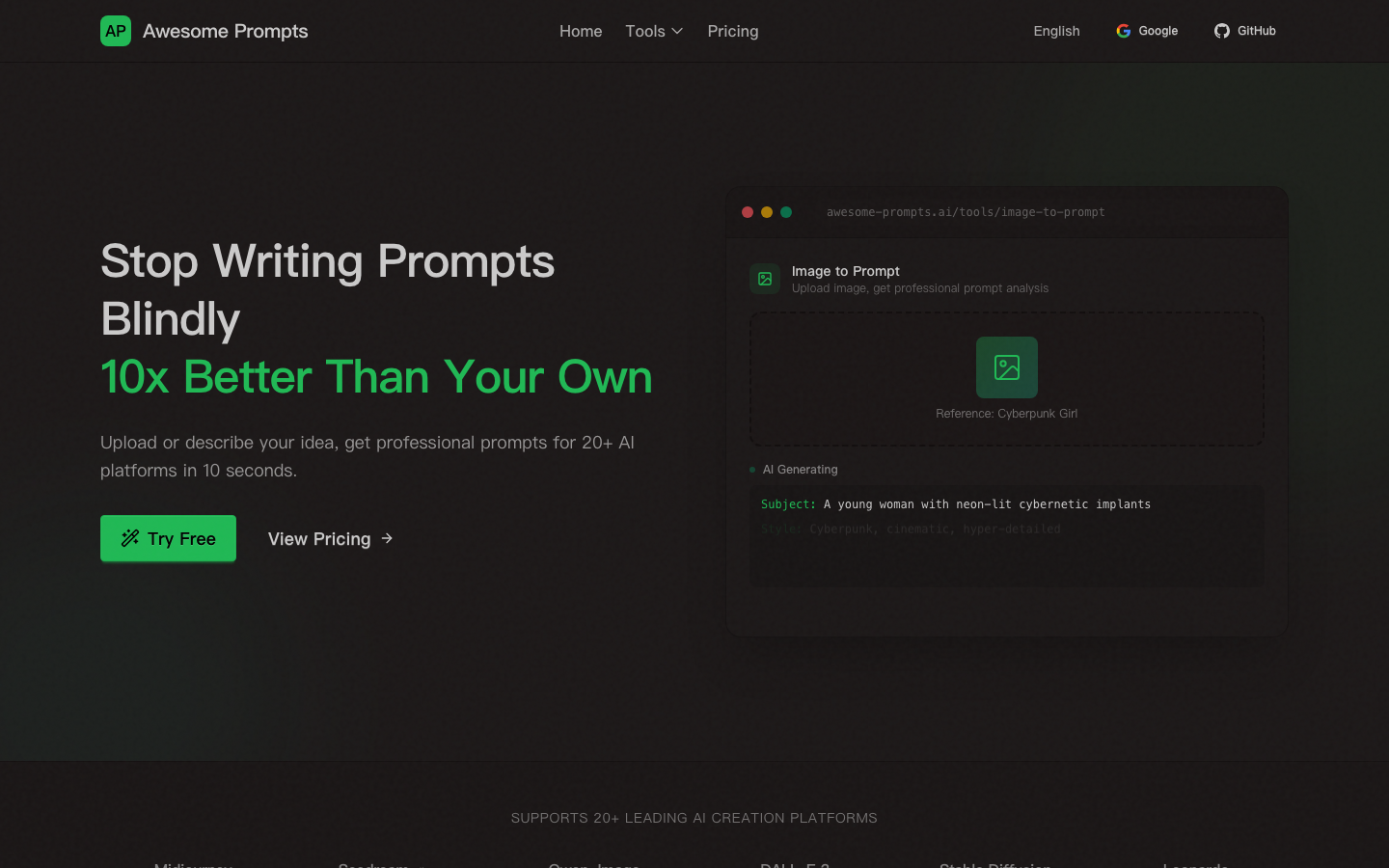
AwesomePrompts
Core parameters and statistics
Awesome Prompts is a collection of AI prompts organized as "learning paths + selected recipes". The official GitHub repository is positioned as "A curated collection of AI prompts organized as learning paths". Its core selling point is not the number of items included, but the way each Prompt is organized into "Recipes" based on skill progression, allowing users to gradually master the use of specific AI tools from basic to advanced.
| Projects | Public Information |
|---|---|
| Official positioning | A collection of selected AI Prompts organized by learning paths |
| Coverage Tools | Claude, Cursor, ChatGPT, Midjourney, DALL·E, Stable Diffusion |
| Content organization | Learning Paths + Progressive Recipe |
| Open Source License | MIT License |
| GitHub Community | 1 star, 0 forks, 0 watching (as of collection date) |
| Latest commits | ~2025, Initial commit (by johnwheeler) |
| Platform form | Web client |
| Paid model | Totally free |
Difference in organizational methods: Most Prompt collection sites are flatly classified according to models or scenes, while Awesome Prompts emphasizes "progressive progression between Recipes" - the output of the previous Recipe may become the input material of the next Recipe. This arrangement is more suitable for systematic learning rather than temporary retrieval.
Project Maturity: GitHub only has 1 star, no Release, and no Packages. The project is still in a very early stage, and the site content iteration frequency may be unstable.
User and market recognition
Gradually build user awareness in the field, and product capabilities are used by content creators and teams to improve work efficiency. Some industry users have incorporated it into their daily workflow. It is recommended to refer to the latest official disclosures for specific user scale and industry adoption rate data.
Cost advantage
Awesome Prompts’ cost structure is extremely simple – all content is available for free without any paywalls or subscription tiers:
- C-side/Individual: Unlimited access to all featured Prompts, no need to register to browse and copy. The hidden cost is zero.
- Developer/API scenario: The batch export or API access solution is not disclosed and cannot be used in business scenarios of automated prompt distribution.
- Enterprise/Private: No enterprise deployments or customization options are disclosed, and no managed instances are available for purchase. The project is under the MIT open source license. In theory, it can be forked and deployed by itself, but it needs to be maintained by itself.
The real limitations behind the free model: Free means no after-sales service, no commitment to content updates, and no guarantee of availability. The continued operation of the site depends entirely on the author's personal wishes. If the author stops maintaining it, the content will stagnate.
Hidden Cost: After users invest time to learn a certain Recipe, if the corresponding model (such as Claude, Cursor) updates the interface or behavior, the old Prompt may need to be manually adapted, and Awesome Prompts does not provide version compatibility tracking.
Main functions
The functions of Awesome Prompts are designed around "selected + progressive learning", and the core capabilities can be summarized into the following four categories:
- Learning Path Prompt Arrangement: Each Recipe is built on the basis of the previous one, forming a progressive link from basics to advanced. For example, from "Understanding Claude's System Prompt writing method" to "Using multiple rounds of dialogue to decompose complex tasks." The implementation effect of this arrangement depends on the quality of the connection between Recipes. It is recommended to verify whether there are skipped steps or missing premises during actual use.
- Multi-tool coverage: Covers mainstream AI tools such as Claude, Cursor, ChatGPT, Midjourney, etc. Each type of tool designs its own Prompt series according to its own characteristics, instead of general templates being reused across tools.
- Recipe comes with effect description: Each Recipe is equipped with an expected output description to help users determine whether the Prompt meets the current needs before running.
- MIT open source and self-hosted: The source code is open on GitHub under the MIT license, and users can fork or download it locally to modify and expand it themselves.
Synergy between functions: When the learning path is combined with multi-tool coverage, users can complete the complete link of "learning the copywriting framework from ChatGPT → using Midjourney to generate images → using Cursor to create landing pages" under the same orchestration system, avoiding the need to repeatedly adapt to different Prompt styles when switching between different tools.
Model and version evolution
Continuous iterative updates, the latest version introduces performance optimization and new features. Historical version information can be viewed on the official release page. There is no complete public version evolution timeline yet. It is recommended to pay attention to the official announcement to understand the rhythm of feature updates.
Technical advantages
The technical advantage of Awesome Prompts is not in engineering performance or reasoning efficiency, but in "the impact of content organization on learning efficiency":
Progressive Recipe Structure: The traditional Prompt directory station uses a flat list. After finding a Prompt, users need to judge the prerequisite knowledge and subsequent steps by themselves. The Recipe chain of Awesome Prompts reduces the decision-making cost in the learning path through the dependency relationship of "the previous output is the next input" - the user only needs to execute in order.
Open source and auditable: The MIT protocol means that content creators can fork the warehouse, audit the original writing of each prompt, and submit improvements. For educational scenarios (such as AI training courses), customized lesson plans can be built directly based on this warehouse without having to start from scratch.
Tool-specific optimization: Classification by tool instead of task allows each Prompt to make full use of the unique capabilities of the corresponding model (such as Claude's long context advantage and Cursor's code editing feature), rather than using the same set of Prompt templates to adapt to all models.
Technical limitations: The project does not have automated testing or prompt effect regression mechanism, and there is no guarantee that Recipe can still output the expected results after the model is updated. Users need to verify the current validity of each Prompt by themselves during actual use.
How to use
The usage path of Awesome Prompts is very straightforward and suitable for getting started quickly:
| How to use | Entrance | Operation steps |
|---|---|---|
| Web browsing | https://awesomeprompts.com/ | Open the site → Browse by learning path → Select Recipe → Copy Prompt → Paste into the corresponding AI tool for execution |
| GitHub source code | https://github.com/awesome-prompts/awesome-prompts | Clone the repository → Browse the Markdown source code locally → Modify or expand as needed |
| Self-hosted deployment | Fork the warehouse and build it yourself | Need to handle web hosting and bounded configuration by yourself, no official deployment documents |
Typical usage process:
- Open the Awesome Prompts site and select a target tool (such as Claude).
- Select a starting recipe from the tool's learning path.
- Copy the Prompt in the Recipe to the corresponding AI tool for execution.
- Determine whether to enter the next progressive recipe according to the output result.
For developers who want to obtain Prompts in batches, it is recommended to view the Markdown source files of the GitHub repository directly. Only part of the content may be displayed on the Web.
Product Pricing
Awesome Prompts adopts a fully free pricing strategy without any paid tiers:
- C-side/Personal: Unlimited access to all featured Prompts, no registration or login required. There are no limits on usage, copying or viewing time.
- Developer/API scenario: No API or batch export interface is provided, and cannot be directly integrated into automated workflows. If you need to obtain it in batches, it is recommended to pull the source code directly from the GitHub warehouse.
- Enterprise/Team: No enterprise or team collaboration features. The MIT open source license allows enterprises to fork and use it internally, but officially does not provide any enterprise-level support.
Sustainability of the free model: The site has no advertising, no sponsor logos, and no paid product diversion. The operating costs (domain name, hosting) are currently borne by the author personally. There is uncertainty about long-term sustainability. If a site goes offline, GitHub repositories can continue to serve as a content distribution channel.
Application scenarios
The core applicable scenarios of Awesome Prompts focus on "systematic learning" rather than "emergency retrieval":
- Introduction to learning AI tools: For novice users of tools such as Claude, Cursor, Midjourney, etc., master basic to advanced usage in 3-5 exercises through progressive recipes. Learning efficiency depends on whether all recipes are completed in order. Skipping previous steps may lead to gaps in understanding.
- AI Training Course Lesson Plan Arrangement: Trainers or educational institutions can quickly build a course outline based on the Recipe chain of Awesome Prompts. Each Recipe corresponds to a teaching unit, and students complete practical operations according to a progressive path. The open source protocol allows modification and distribution, making it suitable for customized teaching scenarios.
- Cross-tool workflow prototype verification: In scenarios where multiple AI tools need to be connected in series to complete an end-to-end task (such as "copywriting → illustration → landing page"), you can use the multi-tool coverage feature to quickly run through the prototype under the same prompt style.
Not suitable for scenarios: It is not suitable for users who require random retrieval of massive prompts (the coverage is much smaller than that of the community-driven platform), nor is it suitable for scenarios that require extremely high prompt timeliness (such as real-time prompts that follow the latest changes in the model's capabilities).
Applicable people
- AI Beginners: People who want to master the use of AI tools through systematic practice rather than scattered searches. Progressive recipes reduce the decision-making burden of "not knowing what to learn next". It should be noted that beginners still need to have a basic AI tool account and operational knowledge, and the Recipe will not cover the registration and bounded configuration steps.
- AI Trainers and Educators: Instructors who need lesson plan materials and exercise sequences. Recipes from Awesome Prompts can be directly quoted or modified as teaching materials. The prerequisite is that you are willing to invest time in screening and adapting Recipe to your own course system.
- Self-hosting and content customization requirements: Teams or individuals who want to deploy customized Prompt collections under their own domain names. The MIT protocol allows for free forking and modification, but you must bear the hosting and maintenance costs yourself.
Not suitable for people: Advanced users who frequently use Prompt (coverage is not enough to meet long-tail needs), production-bound users who rely on time-sensitive Prompt (no version tracking and update guarantee), developers who need API integration (no export interface).
Summary and Outlook
The core difference of Awesome Prompts is to "organize prompts with learning paths" instead of making another flat prompt directory. For users who systematically learn AI tools, this arrangement method can indeed reduce the learning curve; but for users who pursue Prompt coverage and retrieval efficiency, its value is limited.
Current Limitations:
- The project is in a very early stage (GitHub 1 star, no Release), and the sustainability of content iteration is uncertain.
- There is no Prompt validity verification mechanism, and Recipe failure may occur after the model is updated.
- Coverage models are limited, and support for less popular or emerging tools may lag.
- No API or batch export interface to embed automated workflows.
Procurement/Adoption Risk Assessment: Awesome Prompts is completely free and open source, making it a risk-free reference resource for Prompt learning. It is recommended to use it as an auxiliary learning material rather than the only source of Prompt, and to be used in conjunction with community-driven platforms such as PromptLayer and FlowGPT. If you need to rely on specific prompts in the production environment, it is recommended to fork the warehouse locally and set up your own validity regression test to avoid interruption of work due to upstream suspension.
Version Info
- Awesome Prompts 2026 :There is no official precise date yet. Expanded featured Prompt library and updated model adaptation content.
- Awesome Prompts 2025 :There is no official precise date yet. Initial launch, including selected ChatGPT and Midjourney Prompt.
User Reviews